A report from Senate Democrats accuses big banks of failing to report suspicious money transfers made by Jeffrey Epstein until after his arrest in 2019.
A report from Senate Democrats accuses big banks of failing to report suspicious money transfers made by Jeffrey Epstein until after his arrest in 2019.
Five state primaries are being held today, and Michigan is a key focus for Democrats who want to see how progressives fare in races. And, a man has been arrested in connection with a Spokane fire.
Five state primaries are being held today, and Michigan is a key focus for Democrats who want to see how progressives fare in races. And, a man has been arrested in connection with a Spokane fire.
U.S. troops killed or wounded since July 7 are now counted separately from casualties during the first months of the Iran war. The post The Pentagon Found a New Way to Undercount U.S. Casualties in Iran appeared first on The Intercept.
The Pentagon is using a new method of tallying the number of U.S. soldiers killed and wounded in the Iran war that a U.S. government official said was “designed to obscure the count.”
Since the start of the conflict, the Department of War has posted the official count of casualties on the website of the Defense Casualty Analysis System, or DCAS, which tracks “deceased, wounded, ill or injured” service members for Congress and the president. This official total of dead and wounded personnel, as documented over months of reporting by The Intercept, has been a gross undercount, stemming from what that same official previously called a “casualty cover-up.”
But after a series of Iranian strikes on U.S. facilities in the Middle East in July, the Pentagon last week rolled out a new approach. Casualties since July 7 are now counted separately on a new webpage with a generic designation: “Overseas Operations.”
Two hundred and seventy-three U.S. troops were killed or wounded since July 7, according to the Monday total on the new Overseas Operations page.
When combined with the existing DCAS page for the Iran war, the official count stands at 704, an 83 percent increase in casualties since April 8, the day the first ceasefire deal was struck between the Trump administration and Iran. When counting known casualties overlooked by the DCAS page, the total exceeds 900 personnel.
For months, the Pentagon has failed to comment on DCAS anomalies reported by The Intercept nor the reason for the change in the way it now counts casualties, which was first reported by the New York Times. Last week, the Pentagon told the newspaper that “since Operation Epic Fury has concluded, the department classifies casualties as overseas operations in the CENTCOM area of responsibility.” Central Command oversees U.S. military operations in the Middle East.
“This is certainly designed to conceal the count of the wounded,” the official said, while noting that “incompetence” has also caused confusion in the casualty count.
The change comes after a July 20 rant by Pentagon spokesperson Sean Parnell who claimed reports of a Pentagon effort to withhold news of dozens of U.S. casualties were “baseless and malicious” and a U.S. official’s disclosure to The Intercept that same day that recent attacks on U.S. bases by Iran had wounded “far more” personnel than the Pentagon had acknowledged.
The casualty spike resulted from Iranian attacks on at least nine U.S. outposts across the Middle East since July 9, according to a second U.S. official who spoke to The Intercept on the condition of anonymity because they were not authorized to speak with the press.
Iran’s military managed to overwhelm U.S. air defense systems using a mix of attack drones and advanced ballistic missiles, despite months of claims by President Donald Trump and self-styled War Secretary Pete Hegseth that Iran’s military was annihilated.
Last month, the tally of wounded personnel fluctuated by the day in the wake of increased Iranian attacks. On July 21, the casualty count on DCAS for Operation Epic Fury, the military’s official designation for the Iran war, stood at 500. Now, it has shrunk to 431.
For months, The Intercept found anomalies with the counts offered on the DCAS website. On April 21, for example, the number of wounded-in-action troops declined by 15 without public acknowledgment by the War Department. Despite repeated questions for months, the Pentagon has not commented on the disparities in its casualty count.
Prior reporting by The Intercept also found DCAS is missing hundreds of dead and wounded personnel from Epic Fury. The Pentagon list of the names of the dead is still missing Maj. Sorffly Davius, a signals and communication officer with the New York Army National Guard who was assigned to the headquarters of the 42nd Infantry Division and reportedly died of sudden illness while on duty in Camp Buehring, Kuwait, on March 6. Davius’s death was widely acknowledged even as it was excluded from the the official count: Rep. Mike Lawler, R-N.Y., spoke about him during a memorial service that month, and Gen. Dan Caine, the chair of the Joint Chiefs of Staff, recognized Davius while “honoring our fallen.”
While DCAS provides a running tally of “non-hostile” deaths — meaning those who died from accidents or by illness — it doesn’t include “non-hostile” injuries. The DCAS figures for Epic Fury show that 65 Navy personnel were wounded in action. Missing, however, are the more than 200 sailors treated for smoke inhalation or lacerations due to a March 12 fire that raged aboard the USS Gerald R. Ford. The aircraft carrier had been conducting round-the-clock flight operations to, Caine said, “project combat power” in the Middle East.
Recent reporting by the War Horse, using Pentagon records obtained via the Freedom of Information Act, found more than 400 casualties were recorded between February 28 and April 8. Seventy occurred on March 18 alone, but this huge single-day toll was never reported by the Pentagon.
The records provide more granular detail than DCAS, revealing that at least 17 troops sustained life-threatening injuries. They show that U.S. troops suffered shrapnel wounds, broken bones, smoke inhalation, and other injuries. The most common injury recorded, however, was head trauma — which affected at least 170 troops, according to the data.
President Donald Trump has long dismissed brain injuries as “headaches” and “not serious.”
Rand Paul is trying to put Anthony Fauci in prison for not confirming a conspiracy theory, but the key to blunting the next pandemic is universal healthcare. The post Fauci’s Diary Isn’t the Key to Why Covid Ravaged the U.S. — Our Broken Healthcare System Is appeared first on...
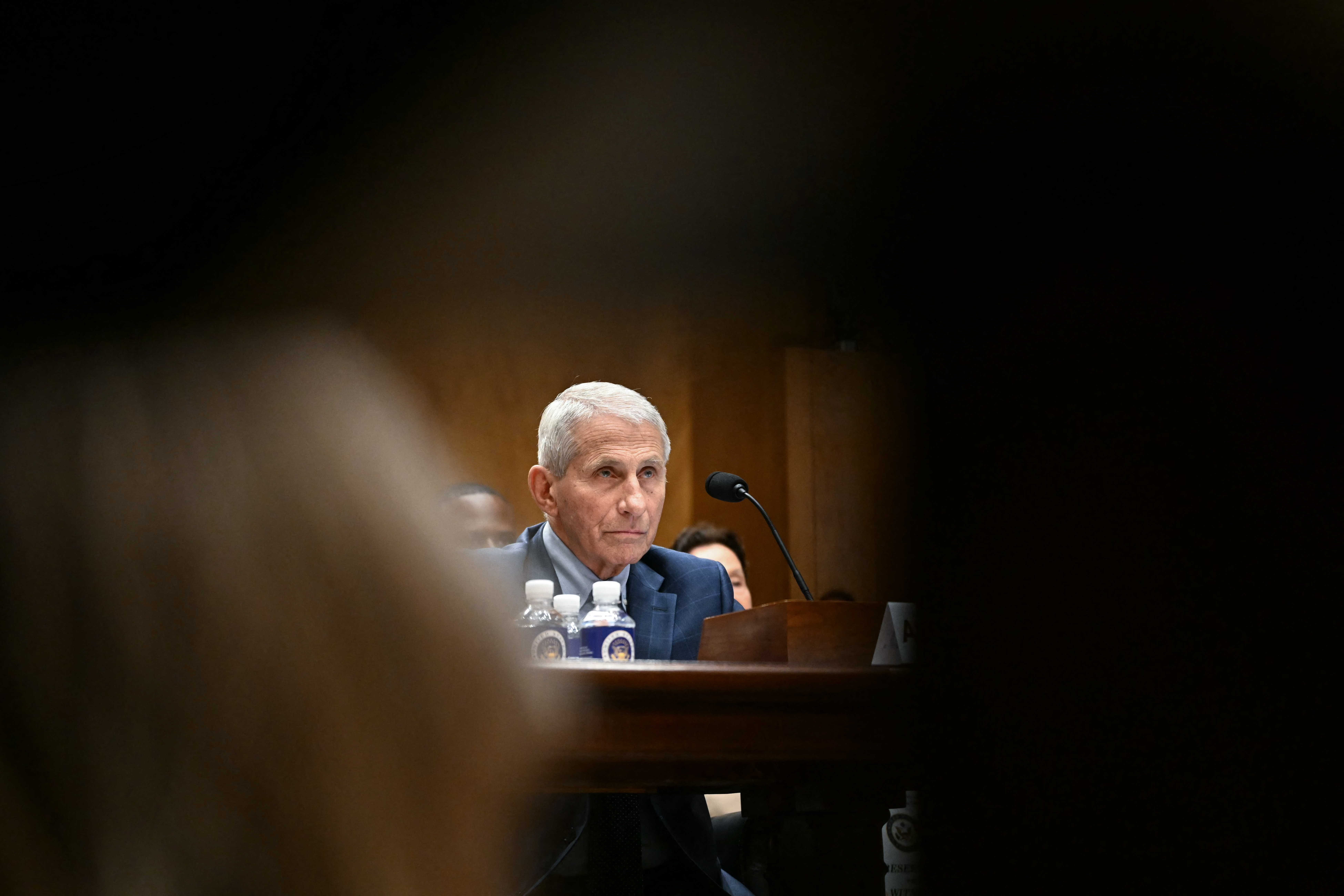
Dr. Anthony Fauci testifies during a Senate Homeland Security and Governmental Affairs committee hearing on Capitol Hill in Washington on July 29, 2026. Photo: Alex Wroblewski/AFP via Getty Images
Sen. Rand Paul, R-Ky., has made it his mission to put Dr. Anthony Fauci in prison.
Last month, the chair of the Senate Homeland Security and Governmental Affairs Committee subpoenaed Fauci, the former director of the National Institute of Allergy and Infectious Diseases who led the nation’s response to the Covid pandemic, to answer still more questions related to the origins of the disease.
Paul insists the novel coronavirus was the result of the National Institutes of Health having funded gain-of-function research at China’s Wuhan Institute of Virology — essentially that the virus was created in a lab in China and unleashed on an unsuspecting public.
Fauci has maintained that while the mostly likely source of the Covid-19 virus was animal-to-human transmission but that we cannot know for certain. Paul thinks he deliberately misled the public about the coronavirus’s origins and called him to testify before the Homeland Security Committee based on supposed new evidence that comes from Fauci’s diaries.
Over 7 million people worldwide have died from Covid, with about 1.2 million of those deaths occurring in the U.S.
While the quick work to produce a vaccine undoubtedly saved many millions of lives, that level of loss is difficult to account for and has certainly taken an emotional and psychic toll on the world since. We, the public, deserve answers about what went wrong during that time and how our governments are preparing for similar outbreaks in the future such that they can prevent the loss of so much life.
That is not what Paul and his Fauci subpoena are focused on. Instead, Paul sunk his libertarian teeth into a xenophobic conspiracy theory that reinforces his ideological priors: too many government agencies that spend too many public dollars.
It’s the same reason Paul avoids the real, persistent public health crisis underlying huge spike in deaths in the U.S. from Covid — and a host of other diseases: the lack of universal healthcare.
Did the virus come from a lab in Wuhan? I certainly don’t trust Paul’s ideologically infused takes, but I’ll leave it for others to decide.
To focus on it at the exclusion of all other public health policy, though, is clearly a mistake. It’s learning the wrong lesson from the Covid pandemic.
The United States remains the only “developed” country without universal healthcare coverage.
The insurance companies and for-profit medical system insist that this is the best system to provide people with the best healthcare, but during early days of the Covid pandemic, its limitations came into stark relief. The pandemic put so much stress on our system that resulted in shortages in staff, and a decreased quality of care for those infected with virus, and all others who needed care.
Underlying medical issues exasperated Covid deaths. These are exactly the types of chronic illnesses that people suffer from because of a lack of preventative care or a failure to get treatment because of prohibitive costs — respiratory diseases, heart conditions, blood pressure issues.
It’s notable that some of the greatest successes of Covid policy arose not from private health insurers acting on their mandates for profit, but rather by mandates and funding from local, state, and federal government. Acts of Congress forced healthcare insurers and providers into covering certain services. When testing became a feasible method of helping to prevent the spread of Covid, federal funding made it far more widely available — even for the uninsured, with the government providing reimbursement for healthcare providers who tested those without coverage.
This is to say nothing of a federal program to speed along a Covid vaccine and rush its distribution — the key to creating enough immunity to weaken the virus and lower death rates. For those who got Covid, antiviral medication, which could drastically reduce symptoms and prevent hospitalizations and even death, was available for free thanks to federal funding. In the first two years of the pandemic, around 6 million people took the drug without paying a thing.
In 2020, the American Public Health Association released a policy statement that began: “The COVID pandemic adds a new sense of urgency to establish a universal health care system in the United States. Our current system is inequitable, does not adequately cover vulnerable groups, is cost prohibitive, and lacks the flexibility to respond to periods of economic and health downturns.”
This remains true, as the Trump administration and the Republican-led Congress continue their assault of existing forms of federal healthcare spending.
While Paul is focused on trying to place Fauci in prison for not confirming a conspiracy theory, more people are being crushed by the weight of medical debt due to our inadequate system, more people aren’t getting the care they need because of the costs, and more people are dying.
The fight for universal healthcare coverage remains a vital one, as the uncertainty of when we could face another pandemic looms over us all. The longer the delay, the more unprepared we become for what’s next.
Whatever Fauci said from his perch at the National Institutes of Health about the virus’s origins, the fact of the matter remains that the government’s interventions during the Covid pandemic were overwhelmingly lifesaving. Its biggest failure — then as now — was the inability to provide healthcare coverage for all Americans.
There should be accountability for whatever role the government played in the Covid pandemic, but let’s be clear that deaths spiked in large part because of the failures of our healthcare system to cover all Americans, not because of what Fauci said in his diaries.
By selling off early access to his posts at a premium, the president is merging a public good with his own profit motives. The post Trump’s Truth Social API Is a Blatantly Corrupt Favor to Wall Street appeared first on The Intercept.
Donald Trump holds up an image taken from his Truth Social account at an event about coal on June 4, 2026, in the White House in Washington, D.C.Photo: Julia Demaree/AP Photo
For the low, low price of $100,000 a month, the ever-oxymoronic Truth Social is now selling direct access to its most important posts — or, in the firm’s preferred parlance, “truths” — to Wall Street. That’s an expedited lane to access statements and data from the president of the United States and other government officials, which have significant potential to move financial markets, ahead of us suckers in the general public.
This sort of product, called an Application Processing Interface, or API, is not a particularly unusual offering for a social media company in the abstract. But Truth API, which launched today, is uniquely positioned to fuel blatant presidential graft.
The move has been rightly called “brazen corruption,” “the president’s most desperate grift yet,” and a “clear and unacceptable pathway for corruption.” In a letter to the Securities and Exchange Commission, Sens. Adam Schiff and Elizabeth Warren called the offering “an outrageous abuse of the President’s office for his personal benefit that undermines everyday investors and the integrity of our markets, while enriching Wall Street and other wealthy insiders.” All of that is true, but Truth API doesn’t stop at creating a new pathway to funnel de facto bribes to Trump; it also seeks to functionally merge the provision of a public good with a for-profit company.
It has become de facto administration policy for high-ranking government officials to make official announcements on Truth Social without going through traditional press offices. Trump has also set a new standard for blurring the lines between his communications as a public official and a private citizen.
For nearly half a century, communications from the president have been recognized as the property of the United States, not the president himself. Under the Presidential Records Act, any documents (with some carve-outs for national security and personal records like journals and diaries) that are “created or received by the President … in the course of conducting activities which relate to or have an effect upon the carrying out of the constitutional, statutory, or other official or ceremonial duties of the President” are subject to the United States’ “complete ownership, possession, and control.”
Selling expedited access to Trump’s statements is effectively privatizing a public asset.
In other words, selling expedited access to such statements is effectively privatizing a public asset. That might be part of the reason why, this spring, Trump’s Department of Justice Office of Legal Counsel issued an opinion that argues the heretofore uncontroversial Presidential Records Act is unconstitutional.
Trump owns a 41 percent stake in Truth Social’s parent company, Trump Media & Technology Group. In December 2024, all of his shares were transferred into Trump’s revocable trust, which is overseen by Donald Trump Jr. At the time, it was a 52 percent stake, worth about $4 billion against the company’s total valuation of $7.5 billion. Those TMTG shares (which are of course traded under the narcissistic ticker DJT) represent a major part of the president’s total wealth. While his stake in the company is now valued at (only!) $1.2 billion, it still represents 18 percent of Trump’s overall wealth, which Forbes estimated to be $6.5 billion.
And while Truth Social has become a pillar of the Trump business empire, it is also a pillar of sand. Truth Social hemorrhages money: In 2024, it only brought in $3.6 million and had a net loss of more than $400 million. Last year was even worse: Revenue ticked up slightly to $3.68 million, but its net loss soared to more than $700 million. The company’s value is now less than one-fourth of what it was in its spring 2024 heyday. That’s a lot of money on board a sinking ship.
TMTG tried to find income streams from branching out into prediction markets, cryptocurrency issuing, bitcoin investment, and nuclear energy production (perhaps a nod to Trump’s physicist Uncle John). But none of these maneuvers have stopped the bleeding.
This latest plan to sell the API might finally be the path to profitability that TMTG so desperately needs. At its core, what an API does is provide a data feed directly into a particular software program, in this case financial trading terminals. So even though the company insisted to the Wall Street Journal that “Truth API is designed to deliver posts the instant they are made public to everyone, not before,” it still represents priority access to government officials’ statements because anyone not paying for the service will be unable to process the information at the same pace as subscribers, letting professional traders and hedge funds outpace the market and reap the benefits.
In modern financial markets, an advantage of even fractions of a second can be decisive — and can provide the opportunity to reap huge profits. This is the sitting president directly selling financial powerhouses a significant edge from the very heart of the federal government for a cool $100,000 a month (or a paltry $60,000 if you opt for a multi-year subscription!).
This entire sordid arrangement already reeks of corruption, but the stench grows stronger when juxtaposed with this administration’s propensity to mistakenly, illegally, and/or prematurely release information when they aren’t supposed to, and not infrequently on Truth Social. Trump’s presidency has always been defined by the degradation of our sense of shared reality and by rampant corruption. There’s no better metaphor than sticking a price tag on the “truths” coming out of the administration.