• maiweb v0.1.0
  • ★
  • Feedback

The Intercept

active · last success 2026-06-18 23:25

Visit site ↗ · Feed ↗

  • The Intercept theintercept.com investigative journalism news politics 2026-06-16 16:51
    ↗

    The official count of U.S. personnel hurt or killed in the war on Iran inched up, but it still omits hundreds of known casualties. The post U.S. Casualties in Iran Are Still Rising appeared first on The Intercept.

    America’s Iran War casualties crept higher even as the U.S. was in the final stages of declaring a second ceasefire with Iran this weekend. 

    The U.S. and Iran have agreed to a second ceasefire and the eventual reopening the Strait of Hormuz under a preliminary deal scheduled to take effect on Friday. “Iran has taken a major step toward final victory,” Mohammad Bagher Ghalibaf, the speaker of the Iranian Parliament, said on Monday, one of several Iranian leaders taking a victory lap after outlasting the Trump administration.

    Trump’s war has already killed thousands of Iranian civilians — including more than 150, most of them children –  in a strike on an elementary school. The official number of dead and wounded U.S. personnel stands at 426, an almost 11 percent increase since the first ceasefire between the U.S. and Iran was struck on April 8. This tally, however, is missing hundreds of casualties, including two soldiers wounded in action earlier this month.

    Related

    Trump Celebrates Achieving Absolutely Nothing in Iran

    For months, The Intercept has reported that the Pentagon’s official tally of dead and wounded military personnel from the Iran War is a gross undercount, stemming from what another U.S. government official called a “casualty cover-up.” The Defense Casualty Analysis System, or DCAS, which tracks “deceased, wounded, ill or injured” service members for Congress and the president, is missing hundreds of known casualties. The true number exceeds 625.

    When the first ceasefire was struck between the Trump administration and Iran, the tally of U.S. casualties was 385. Despite a pause in hostilities, the number slowly rose to 428, according to Pentagon statistics.

    On April 21, however, the number of wounded-in-action troops declined by 15 without public comment from the War Department, dropping the casualty total to 413. Despite repeated questions over almost two months, the Pentagon has not explained the disparity in its casualty count. A defense official told The Intercept that it was impossible to tell whether Pentagon casualty analysts were “grossly incompetent” or had been ordered to manipulate the figures.    

    Since the 15 wounded vanished in April, the DCAS casualty count has steadily crept upward to top out at 413, where it stood on Tuesday morning. This includes one sailor wounded in action this month. Central Command did not reply to a request for further information about the injury.

    The official figures appear to be missing two soldiers who were recently wounded in action. CENTCOM spokesperson Capt. Tim Hawkins told NBC News last week that two crew members from a U.S. Army AH-64 Apache helicopter downed by an Iranian drone on June 8 were receiving medical care. And a CENTCOM social media post said they were in “stable condition.” But DCAS lists no Army personnel wounded in action this month.

    The official tally of war dead also appears to be an undercount. For weeks, DCAS listed 13 hostile and non-hostile U.S. deaths during the war. DCAS briefly raised the total to 14 last month before dropping it back to 13, without any explanation on the fluctuation.

    The Pentagon list of the names of the dead is still missing Maj. Sorffly Davius, a signals and communication officer with the New York Army National Guard who was assigned to the headquarters of the 42nd Infantry Division and reportedly died of sudden illness while on duty in Camp Buehring, Kuwait, on March 6. Davius’s death was widely acknowledged even as it was excluded from the official count: Rep. Mike Lawler, R-N.Y., spoke about him during a memorial service that month, and Gen. Dan Caine, chair of the Joint Chiefs of Staff, recognized Davius while “honoring our fallen.”

    While DCAS provides a running tally of “non-hostile” deaths — meaning those who died from accidents or by illness — it doesn’t include “non-hostile” injuries. The DCAS figures show that 65 Navy personnel have been wounded in action. Missing, however, are the more than 200 sailors treated for smoke inhalation or lacerations due to a March 12 fire that raged aboard the USS Gerald R. Ford. The aircraft carrier had been conducting round-the-clock flight operations to, in Caine’s words, “project combat power” in the Middle East. The ship returned to its home port in Norfolk, Virginia, last month after 326 days at sea, the longest deployment of any U.S. aircraft carrier since the Vietnam War.

    The casualty numbers also don’t include a sailor who suffered a non-combat-related injury aboard the USS Abraham Lincoln as it was involved in “strike missions in support of Operation Epic Fury” on March 25.

    On April 21, two Pentagon spokespersons said they were unable to field questions about why more than a dozen casualties had been disappeared by the War Department, claiming only the “duty officer” could answer the question but that person was not at their desk. “As soon as the duty officer comes back to their desk, I can get this to them,” said one of them. After almost two months, The Intercept has yet to receive a response from the duty officer.

    The Pentagon did not reply to a request for clarification on Monday about whether the duty officer ever returned to their desk.

    The post U.S. Casualties in Iran Are Still Rising appeared first on The Intercept.

    • U.S. lifts blockade on Iranian ports as 60-day clock for a final deal starts ticking NPR - Top Stories
    • Read the full text of Trump's preliminary U.S.-Iran agreement to end the war NPR - Top Stories
    • U.S. lifts blockade on Iranian ports as 60-day clock for a final deal starts ticking NPR - Politics
    • Read the full text of Trump's preliminary U.S.-Iran agreement to end the war NPR - Politics
    • How much of an economic boom is the 2026 FIFA World Cup for the U.S. hosting cities? NPR - Business
    • Kenyan court blocks U.S. plan to open Ebola quarantine center to treat Americans PBS NewsHour - Health (Podcast)
    • Alleged Kimwolf Botmaster ‘Dort’ Arrested, Charged in U.S. and Canada Krebs on Security
    • Mitchell's seesaw round makes U.S. Open history ESPN
    • Pulisic still training solo a day before U.S. game... ESPN
    • “Digital Colonialism”: U.S. Demands to Access Africans’ Data Raise Privacy, Sovereignty Concerns ProPublica
    • Almost half of U.S. singles feel negatively about AI in dating, Match says TechCrunch
  • The Intercept theintercept.com investigative journalism news politics 2026-06-18 02:36
    ↗

    Before Trump paused Jay Clayton’s nomination, Democrats thought they were on a “glide path” to renewing FISA. Now the president wants to tie domestic surveillance to voter suppression. The post Senate Democrats Aren’t Happy About Trump’s Spy Law Ultimatum appeared first on...

    Before President Donald Trump threw his latest hand grenade into congressional negotiations over a key domestic spying law, two factions of Senate Democrats seemed to believe they were on the verge of a breakthrough.

    Privacy advocates thought they had their best chance in years of passing reforms, including a warrant requirement for searching American communications collected abroad.

    Related

    Are Jeffries and Schumer Getting Ready to Greenlight Domestic Spy Power for Trump?

    Centrists allied with U.S. intelligence agencies, meanwhile, thought they were close to renewing Section 702 of the Foreign Intelligence Surveillance Act with only minor tweaks.

    Then Trump, who had once already thrown the renewal process into chaos, announced on Wednesday that he wouldn’t sign it unless Congress passed an unrelated voter suppression bill.

    Claiming that Democrats were poised to walk away from a spy law compromise, Trump said that “to add a slight bit of intrigue but, for the Good of the Nation, and the People of our Country, I will not approve FISA without THE SAVE AMERICA ACT going along with it.”

    Trump’s surprise outburst on Truth Social on Wednesday scrapped the confirmation hearing set later in the day for Jay Clayton, a federal prosecutor in New York, to serve as the permanent director of national intelligence. Senate Majority Leader John Thune, R-S.D., had said that he hoped to quickly confirm Clayton.

    Clayton’s impending confirmation had appeared to solve a problem — at least for some Democrats — that Trump created by tapping lapdog housing chief, Bill Pulte, as the Cabinet-level intelligence chief. It might also have opened a route for Congress to renew Section 702, the surveillance law that allows federal agents to conduct “backdoor,” warrantless searches of Americans’ communications collected abroad.

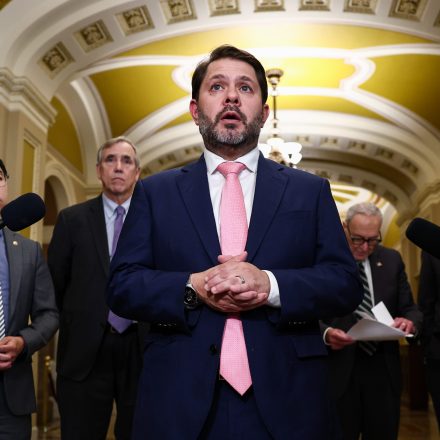
    In a joint press conference on Wednesday, top Senate Democrats revealed the cracks in their coalition over next steps on FISA.

    A key reformer, Sen. Ron Wyden, D-Ore., said he still hopes to pursue adding a warrant requirement to Section 702, while a centrist aligned with the intelligence agencies, Sen. Mark Warner, D-Va., expressed disappointment that the easiest route to renewal without major changes had been foreclosed.

    “We had a path forward, as of yesterday, and today we don’t, and that’s because of this president.”

    “This has become a complete debacle, and now it’s up to the White House to figure out a path forward here,” said Sen. Mark Kelly, D-Ariz., a member of the intelligence committee. “We had a path forward, as of yesterday, and today we don’t, and that’s because of this president and his advisers.”

    Senate Minority Leader Chuck Schumer, D-N.Y., remained cagey about what version of the law he would like to see ultimately passed. But in comments at the joint press conference, he sought to portray Democrats as the more responsible party when it came to Section 702.

    “It’s on our Republican colleagues to work with us to find A) a capable director, not someone who is a menace, and second, then to work with us on renewing FISA. It is up to them,” Schumer said at the press conference. He said he was deeply concerned about Trump’s appointment of Pulte, who appears likely to step into the office on Friday.

    Republicans “have got to have the courage to buck the president, who clearly doesn’t want a DNI director and doesn’t want FISA renewed,” Schumer said. “All he wants is Pulte.”

    Warner, the top Democrat on the Senate Intelligence Committee, claimed Sunday that Section 702 renewal was on a “glide path” before Pulte’s nomination. He also praised Clayton’s selection, while reserving the right to ask about Clayton’s views on election integrity.

    Reformers said Thursday, however, that Section 702’s renewal was never as assured as Warner and Senate Intelligence Committee Chair Tom Cotton, R-Ark., have suggested in public comments.

    Majorities of both Republicans and Democrats voted in recent weeks against advancing the law’s renewal in versions of the bill that do not include a warrant requirement.

    “They don’t want to have to deal with people who want things like warrants.”

    “They want that to be the narrative, because they don’t want to have to deal with people who want things like warrants,” said Kia Hamadanchy, a senior policy counsel at the American Civil Liberties Union. “At no point have they actually demonstrated that they have a deal that one, has 60 votes in the Senate, and two, has any chance of going anywhere in the House.”

    Wyden expressed alarm about Trump’s actions at the joint Senate Democrat press conference. Wyden said that he always wanted to reform the law — not allow it to expire.

    Related

    Top Senator Warns Sweeping New Surveillance Powers Will “Inevitably Be Misused” by Trump

    “It is now even clearer than before that the only path to 60 votes in the United States Senate on intelligence is real reform, actual black-letter law, that addresses these issues,” Wyden said.

    Privacy advocates argue that the way out of the congressional logjam is to allow members of Congress to vote on whether to add a warrant requirement, something that Thune and House Speaker Mike Johnson have not been willing to allow so far. Even then, however, Trump could veto whatever version of the law emerges from that process.

    The post Senate Democrats Aren’t Happy About Trump’s Spy Law Ultimatum appeared first on The Intercept.

    • Poll: Most Americans have the summer blues about Trump and the economy NPR - Politics
    • Poll: Most Americans have the summer blues about Trump and the economy NPR - Business
    • Anthropic incident leaves confusion about Trump administration's AI regulation NPR - Technology
  • End of feed
Maibook — your private personalized AI community
  • rcanand.com
  • mlaillc.com
  • @rcanand (X)
  • LinkedIn
  • Feedback
  • Credits