A complaint by Newark police didn’t mention that ICE led the ambush on a protester and made the initial arrest. The post Undercover Cops Infiltrated Delaney Hall ICE Protest to Spy and Make Arrest appeared first on The Intercept.
Detectives with the Newark Police Division of the city’s Department of Public Safety went undercover to infiltrate protests outside U.S. Immigration and Customs Enforcement’s Delaney Hall detention facility earlier this month, according to court records obtained by The Intercept.
At the June 3 protests outside the detention center sparked by a hunger strike inside, detectives in plainclothes worked alongside uniformed officers to arrest Samuel Becker, a protester alleged to have thrown items into a fire days earlier, according to a criminal complaint.
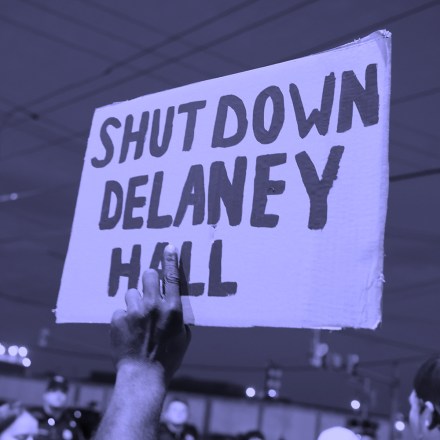
The protests had taken place for nearly a month outside Delaney Hall, a privately run ICE facility located on an industrial corridor in Newark, New Jersey, where detainees and their families have complained of poor conditions and retaliation by staff.
“The use of plainclothes officers presents the concern of people constantly being surveilled when they are engaging in First Amendment-protected activity.”
The operation was strictly aimed at arresting Becker, 30, who is accused of dragging a tarp into a fire during a raucous protest several days earlier, according to the complaint filed in Newark Municipal Court by police officer Elddy Torres.
“A PLAN WAS DEVISED TO DEPLOY TWO UNDERCOVER NEWARK POLICE DETECTIVES TO MONITOR AND REPORT REAL TIME INFORMATION TO SURVEILLANCE UNITS,” Torres wrote, describing what happened after Becker was identified. “AS THE UNDERCOVER DETECTIVES REMAINED WITHIN THE CROWD, BECKER WAS OBSERVED COORDINATING PROTESTERS PAST THE BARRICADED PROTEST ZONE.”
Law enforcement presence at protests can have a chilling effect, said Amol Sinha, the executive director of the New Jersey chapter of the American Civil Liberties Union, who declined to discuss the specifics of the arrest, with which he was not familiar. The psychological effect of undercover officers — and the fear of undercovers — stands out as especially problematic.
“The use of plainclothes officers presents the concern of people constantly being surveilled when they are engaging in First Amendment-protected activity,” Sinha told The Intercept. “These are moments that should be celebrated as part of democracy and not viewed through the lens of suspicion.”
While the use of undercover officers at protests is not unusual, advocates said the tactic could raise questions about suppression of speech if the aim goes beyond keeping the peace, according to Aedan Neary, a defense attorney in Kearny, who is not involved in the case.
“The concern arises out of the question of, at what point do the actions of these undercover agents become a pressure tactic as opposed to a law enforcement tactic?” Neary told The Intercept. “Is this being used to ensure that things remain peaceful? Or is this more about gathering intelligence?”
ICE Role Unmentioned
The arrest and police report also raise thorny questions about cooperation between ICE and local authorities, which is prohibited for immigration matters by a New Jersey state law passed in March.
According to Becker and two eyewitnesses to the arrest, ICE agents led the ambush that led to Becker’s detention and initially took him into custody.
“An ICE agent chased and grabbed me and quickly handed me over to an NPD officer,” Becker told The Intercept in a written statement. “The NPD officer brought me back over to the other side of the street and sat me down on the side of the ICE minivan that led the ambush.”
“An ICE agent chased and grabbed me and quickly handed me over to an NPD officer.”
While Newark police and Becker’s accounts align on basic details — such as the time and location of the arrest behind Delaney Hall, where protesters had gone to monitor vehicle traffic in and out of the facility — the complaint by Torres, the officer, says the arrest was the work of Newark police with the support of Essex County Police, omitting ICE’s role.
“ONE OF THE NPD UNDERCOVER DETECTIVES ADVISED US THAT THE GROUP WAS PLANNING TO LIGHT THE DUMPSTER ON FIRE AND PUSH IT IN THE REAR FENCE EXIT. A PLAN WAS DEVISED TO INTERRUPT THE GROUPS CONDUCT AND DISPERSE THEM BEFORE THEY COULD HURT ANYONE OR CAUSE ANY DAMAGE,” said Torres’s complaint. “NUMEROUS NPD DETECTIVES AND ESSEX COUNTY SHERIFF’S OFFICE SWAT PERSONNEL RESPONDED TO THE AREA TO MOVE THE GROUP ALONG.”
At least one of the vehicles that arrived in the convoy to make the arrest, Becker told The Intercept, was driven by ICE agents, converging on the group at the rear of Delaney Hall.
According to Becker, his interaction with that initial ICE agent making the arrest indicated some degree of intelligence sharing between federal authorities and local police.
“As I was surrounded by ICE agents and the arresting officer, one of the ICE agents accused me of [setting a] fire a different night,” Becker told The Intercept in a statement. “The ICE agent’s words matched the language NPD used when it put out a statement about my arrest the next day.”
In a statement made in a Facebook post announcing Becker’s arrest, Newark Public Safety Director Emanuel Miranda said, “He was identified by Newark Police as the individual responsible for setting a dumpster fire during the weekend protest at Delaney Hall and also attempting to start a second fire there on Wednesday night.”
The two eyewitnesses, who asked for anonymity for fear of retribution, confirmed Becker’s account of the arrest in interviews with The Intercept.
No Sanctuary
While no law in New Jersey prohibits local police from cooperating with ICE on non-immigration matters, such collaboration has become a hot button for Newark Mayor Ras Baraka, who oversaw a zealous crackdown on protests outside the facility despite publicly opposing President Donald Trump’s deportation blitz.
The recent sanctuary law prohibits New Jersey police from assisting immigration agents in enforcement of federal immigration law, but leaves room for exceptions, including the enforcement of state criminal law.
The ACLU’s Sinha said that his organization had pushed for a broader version of the law that would have prohibited any collaboration between police and ICE.
“This is why we were advocating for an end to collaboration, period,” said Sinha. “We wanted to make sure that there was no instance of collaboration between immigration enforcement and law enforcement, and the fuller version of the law that did not ultimately make its way through the legislature would have prevented that sort of collaboration.”
Catherine Adams, a spokesperson for Miranda, the public safety director, told The Intercept, “To ensure that public safety is provided to peaceful protesters in accordance with their First Amendment rights, and for the safety of other members of the public, as well as the Officers at Delaney Hall, we deploy plainclothes officers, cameras, drones, etc., to identify those at the protest site who unlawfully damage property, start fires, or commit other crimes.”
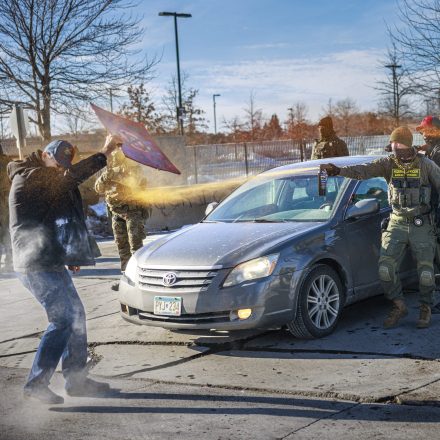
Over the course of several weeks, ICE agents repeatedly charged protesters in an effort to clear them from the entrance to allow vehicles to move in and out of the facility, often deploying batons, pepper spray, and pepper balls against demonstrators, as well as taking some into custody.
Becker suffered an injury during a charge by ICE agents, when one agent swung a baton so hard that it fractured Becker’s shoulder, according to his account. On the night of his arrest, Becker’s arm was in a sling.
After initially keeping a wide berth from the clashes, state and local police operating under orders from Baraka and New Jersey Gov. Mikie Sherrill — both of whom are Democrats who have spoken out against ICE crackdowns — involved themselves in policing the protesters in late May. The scene immediately became even more volatile, with police firing tear-gas canisters, charging protesters on horseback, and kettling dozens of protesters for mass arrest.
On May 31, Baraka instituted a curfew in the vicinity of Delaney Hall, and Newark police set up barricades to keep protesters more than half a mile away from the facility for several days. In the weeks since the curfew ended, protests have continued sporadically, but with less intensity or energy as in the initial weeks.
Baraka has repeatedly sought to minimize the city’s role in policing the protests, claiming he was trying to “bring down the temperature,” not bring an end to protests. That posture eventually shifted.
“It is not the responsibility of the Newark Police Division to secure a private facility,” Baraka said in a June 4 statement. “Our intention was never to protect Delaney Hall or HSI” — ICE’s Homeland Security Investigations division — “but to bring calm. It is a clear contradiction to the city’s position with GEO group to remain there.”
For Becker and many other protesters, the presence of police from various agencies in New Jersey were a godsend to ICE and GEO Group — not to public safety.
“State and local police ramped up their repression of the protestors because ICE agents were having an increasingly difficult time carrying out their daily operations at Delaney Hall by themselves,” Becker said. “Without the ramped-up support of the state and local police, ICE and GEO would have continued to encounter growing difficulty suppressing the strike and operating the concentration camp.”
Sheriff’s deputies in Michigan fired 27 shots at John Jenuwine. “He was not the guy that they were supposed to be chasing,” said the victim’s father. The post Police Chased the Wrong Man, Then Shot Him and Watched as He Bled Out appeared first on The Intercept.
In the early hours of January 6, 2026, two 911 callers near Ypsilanti, Michigan, reported a white van driving erratically.
Within an hour, police had found a white van, crashed into it twice on purpose, and fired 27 shots at the driver while the vehicle lay on its side, burning. At least eightcops watched as 34-year old Navy veteran John Andrew Jenuwine bled out and died inside.
Of several inconsistencies in the police response, one stood out: The only physical description provided to the dispatcher was that “two Black guys” were driving the van, and a caller said they’d brandished a handgun at his wife. Jenuwine was white, driving alone, and unarmed.
That’s not what police told Jenuwine’s parents when they contacted them the following evening, 17 hours after killing their son.
“We were told that there was an exchange of gunfire, and that John was killed,” John’s father, Larry Jenuwine, told The Intercept. “Call it naïveté or whatever you want to call it, but our first thoughts were, ‘Oh my God, what did he do, why did he cause this?’”
On the phone with Larry and Kelly, John’s mother, a deputy with the Washtenaw County Sheriff’s Office claimed their recently deceased son had a gun. But Jenuwine, an industrial field engineer traveling to repair million-dollar lasers, just had his work equipment; no gun was ever found in his van. And the officers who caused two intentional collisions appear to have violated their own policies, which the department updated after the police killing of George Floyd — testing the limits of post-2020 police reforms.
“We were told that there was an exchange of gunfire, and that John was killed. Come to find out, he didn’t do anything to cause any of this.”
The Jenuwine family is now suing Washtenaw County and eight sheriff’s deputies who responded to the case for wrongful death; for violating John’s constitutional rights to protection under the law, and against unreasonable searches and seizures; and for gross negligence and willful misconduct, including improper use of deadly force. The suit seeks to hold the county responsible for what it calls the sheriff’s failures to train officers and enforce its policies.
“Come to find out, he didn’t do anything to cause any of this,” Larry said. “He was not the guy that they were supposed to be chasing.”
Less than 15 minutes elapsed between the time Washtenaw County Sheriff’s deputies incorrectly identified Jenuwine’s van and when they started shooting. Officers fired their first shots seconds after causing Jenuwine’s vehicle to flip on its side and catch fire.
Only seven out of the 27 shots fired hit Jenuwine. None of them alone was responsible for killing him, according to an independent autopsy obtained by Jenuwine’s family and described by their attorneys in a press conference last week, which found he bled out and died over time. While Jenuwine struggled and died, dashcam footage shared with The Intercept recorded officers outside discussing whether any of the shots had hit him.
After several minutes had passed, one officer said over the radio, “He’s kicking around inside the vehicle right now.” None of them called for emergency services.
According to the footage, an edited version of which was viewed by The Intercept, Jenuwine lay dying in the van for at least five minutes.
“The cruelty of it, I suppose, is what strikes me the most,” said Maura Battersby, one of the attorneys representing the family. “If aid had been rendered, he may have survived this.”
Of the four deputies attorneys said fired shots, two names have been publicly released: Jacob Gombos and Jonathan Early. Both received awards in 2024 for distinguished service; Gombos got the department’s Life Saving Award.
“If aid had been rendered, he may have survived this.”
The sheriff’s office placed Gombos, Earley, and the other deputies involved on paid administrative leave pending an investigation by Michigan State Police, which was completed last month and is now pending review by the Michigan attorney general. The state AG will decide whether to bring criminal charges against any of the officers in the case.
A spokesperson for the Michigan State Police confirmed that their investigation is closed and referred questions to the attorney general’s office, which did not respond to a request for comment. Spokespeople for the Washtenaw County Sheriff’s Office and the Ypsilanti Police Department did not respond to requests for comment.
One of the officers who shot at Jenuwine had received the department’s Life Saving Award.
The case has brought renewed scrutiny to the Washtenaw County Sheriff’s Office, which is currently facing dual lawsuits from whistleblowers who claimed the department hired unqualified officers and fired them in retaliation for reporting it. Both plaintiffs are former office staff who said they were fired after raising concerns that Sheriff Alyshia Dyer and other staff pushed them to hire candidates who had lied about their qualifications and in one case had an “extensive” criminal history. Another sheriff’s deputy resigned in March while under investigation for allegedly having a sexual relationship with a subordinate officer. Dyer herself was also independently investigated last year after a partially burned cannabis cigarette was found in her county-issued vehicle. (She denied it was hers, and an independent report could not determine whether the joint belonged to Dyer.)
“It seems like every day we hear something about the Washtenaw Sheriff’s department,” Kelly Jenuwine told The Intercept. “They are in the news constantly, and it’s not for a good reason.”
Jenuwine’s killing raises a new round of questions about the efficacy of police reform. In 2024, Michigan implemented new statewide guidelines restricting vehicle pursuits to “protect the lives of innocent bystanders.” Following the police killing of George Floyd in 2020, the Washtenaw County Sheriff’s office released a memo outlining how its policies aligned with a series of proposed reforms pushed by activists against police violence that grew out of 2014 protests in Ferguson, Missouri. And the sheriff’s office adopted a new use of force policy in 2022, which classifies intentional vehicle collisions — known as a “PIT” maneuver, a precision immobilization technique — as deadly force.
“That’s something you’re trained not to do,” said Todd Flood, the lead attorney on the Jenuwines’ case.
The new policy also guides officers to “seek voluntary compliance and operate with minimal reliance on the use of force,” using techniques in crisis intervention and “rapport-building communication,” and try to de-escalate, even after using force. It requires a mandatory medical evaluation when deadly force is applied, if an officer observes an injury, or if they believe one has occurred; and it ties the degree of appropriate force to how certain they are that the subject committed a crime. The policy states: “Sheriff’s Office employees shall never employ excessive force.”
Officers did not verbally engage with Jenuwine a single time, Battersby told The Intercept.
“I would have expected them to be calling out over the loudspeaker,” Battersby said. “There were many instances in which they were in close proximity to him, and it doesn’t appear that they did that.”
At a press conference after the shooting, the Washtenaw County Sheriff’s Office played a dashcam video that showed Jenuwine reversing his van and driving on the wrong side of the road. Before the sheriffs hit Jenuwine’s van in the first PIT maneuver, the dashcam video cuts ahead, with the video timestamp jumping forward 30 seconds.
The Jenuwines said what they describe as John’s “execution” changed the way they look at law enforcement after having considered themselves generally supportive of police. “I want the people that executed my son to never have the opportunity to work in law enforcement again,” said Kelly.
“They ran around with those guns like they were playing video games, guns held sideways,” Larry said, referring to the dashcam footage. “I’m still struggling with this and I anticipate that’s going to be a continuing struggle.”
Despite believing the vast majority of police were “good, honest, hard-working people,” he said, “I don’t believe these guys that were involved in this shooting were. And that’s the kind of people we need to get out of that system.”
“We want to make sure that the people involved in this, in John’s death, are held accountable,” Larry said. “We’re hoping that there will be criminal charges as well, but we can’t count on that.”
Jenuwine liked to spend his time outdoors fishing and hunting with his family, his parents told The Intercept. He was on his high school football team, spent six years in the Navy, and was a member of a Detroit motorcycle club. When he was growing up, he and Larry worked on cars and tractors together.
On what would have been Jenuwine’s 35th birthday last month, his parents said they spent the evening crying over a birthday cake.
“Those officers get to go home to their families every night,” Kelly said. “What Larry and I get, we get a box of ashes and a lock of my son’s hair.”
Company records reviewed by The Intercept show Israel urged Facebook and Instagram to take down posts supportive of Iran. The post Israel Asked Facebook to Censor Iran War Content, Internal Documents Show appeared first on The Intercept.
Israel’s government asked Meta to censor social media content about its ongoing war against Iran, according to internal documents viewed by The Intercept.
Company records show that Israel petitioned Meta to take down Facebook and Instagram posts expressing support for Iran, opposition to Israel, and even depictions of Iranian missile impacts.
The government flagged a variety of materials related to the war, including posts mourning the death of Ayatollah Khamenei following his assassination by the U.S. and Israel on the opening day of the conflict, content supportive of Iran’s retaliatory attacks, and Iranian accounts that shared military analysis and propaganda sympathetic to the Iranian regime’s perspective.
“Governments wanting to suppress speech that is critical of their war efforts is as old as time.”
In some cases, Meta complied with the censorship requests, the records show, though it is unclear on what grounds. Meta maintains that it only removes content as required by law or materials that violate its speech policies.
When asked how many Iran-related takedown requests had been granted to date since the war began, the company did not answer. The Israeli Ministry of Justice, which submits takedown requests to social media platforms, did not respond to a request for comment.
Israel’s social media lobbying is not new; for years the nation has leaned on its close relationship with Meta to push for targeted enforcement of the company’s content moderation rulebook.
Israel’s Office of the State Attorney routinely lodges complaints to social media platforms on behalf of state security agencies about content deemed illegal or said to promote “terrorism,” according to its website. In the documents reviewed by The Intercept, the office in some cases made no claim that the social media content violated Israeli law. Instead, the office asked that posts or accounts should be removed because they were in violation of Meta’s content moderation rulebook.
Meta, for instance, designates Iran’s Islamic Revolutionary Guard Corps a “Dangerous Organization,” and prohibits users from engaging in many forms of positive speech about its actions. This means posts supportive of retaliatory missile launches by the IRGC, for instance, could run afoul of the company’s rules. No such prohibition exists for users who post favorably about the U.S. or Israeli militaries.
Meta did not respond to questions about the Iran war requests, but spokesperson Daniel Roberts provided a statement to The Intercept. “Anyone is able to report content they think violates our rules. Regardless of who or how a piece of content is flagged, we assess it based on our policies, which govern what is and isn’t allowed on our platform. It is wrong and irresponsible to imply that these requests are in any way unusual or improper.”
A company headquartered in California can determine what is or is not permissible speech for billions of users across the world, only a fraction of whom are American.
Meta has faced scrutiny, specifically in the Middle East, for removing content that doesn’t violate the company’s rules. A 2022 audit commissioned by the company itself found discrepancies in its content moderation practices between Arabic and Hebrew content. “Arabic content had greater over-enforcement (e.g., erroneously removing Palestinian voice) on a per user basis.” the company found. A 2023 report by the company’s inhouse Oversight Board described the “over-enforcement” of the company’s Dangerous Organizations and Individuals blacklist, disproportionately composed of Muslim and Middle Eastern entities.
Meta has long claimed that as an American company, it is legally required to sometimes remove content pertaining to certain entities sanctioned by the U.S., such as the Islamic Revolutionary Guard Corps. But legal scholars say that has little to no precedent or basis in existing sanctions law, which focus on matters of material support rather than political speech. It’s a policy that has created an immense ideological slant: A company headquartered in California can determine what is or is not permissible speech for billions of users across the world, only a fraction of whom are American.
Further adding to the imbalance when it comes to Middle East crises is the fact that Meta has granted Israel privileged access to its content moderation policy teams. In 2024, The Intercept reported how Meta employee Jordana Cutler, a former aide to Benjamin Netanyahu, served as a dedicated liaison to the Israeli government, advocating for the country’s interests and helping facilitate the removal of unwanted speech. Few other countries in the world have a dedicated representative within Meta — in 2020, a similar policy head for India market resigned after revelations she had lobbied for rule enforcement that favored India’s ruling Hindu nationalist party. Asked if Cutler has had a role in facilitating Israeli takedown requests of content relating to the war, Meta did not respond.
“Meta’s close relationship with the Israeli government for takedown requests has been a long-standing issue,” Evelyn Douek, a Stanford Law School professor and scholar of digital speech policies, told The Intercept. “Meta’s acquiescence in lots of takedown requests has been a long-standing practice.”
These asymmetries of censorship power are particularly sensitive during times of war, said Douek.
“Governments wanting to suppress speech that is critical of their war efforts is as old as time,” she said. “Allowing governments to claim national security reasons to suppress speech willy-nilly would obliterate the value of speech protections.”
According to a source familiar with the matter, Israel lobbied Meta to implement a blanket rule restricting imagery of war damage within its territory, mirroring an Israeli news media censorship policy that bars journalists from documenting weapon impacts without military approval. Meta has so far declined to implement such a policy for its billions of global users, the source said. Meta did not respond to questions about the status of this request.
The U.S. and Iran signed on Friday a ceasefire agreement, though Israel has suggested it would not abide by the terms of a deal. While many of the censorship requests directly addressed the war, others were tangential to the conflict itself. The records show Israel has pushed to remove content expressing outrage over last month’s storming of Al-Aqsa Mosque by far-right government minister Itamar Ben-Gvir. It also sought to stifle posts critical of rhetoric by Israel that linked Israel’s recent closure of Al-Aqsa with the ongoing war.
In general, Meta grants the vast majority of Israeli governmental takedown requests.
In general, Meta grants the vast majority of Israeli governmental takedown requests. The State Attorney’s Office boasted a 92 percent compliance rate in 2023, and a 2025 report by Drop Site News said the overall rate has climbed to 94 percent since the October 7 attack by Hamas.
Records reviewed by The Intercept show Israel asked for Iran war takedowns using the exact same language evoking Hamas’s October 7 attack that it submitted when requesting the censorship of pro-Palestinian and anti-Israeli speech across the globe during Israel’s war on Gaza.
“It suggests that they don’t expect their requests are being reviewed very carefully,” Douek said.
Douek argued that the wartime censorship requests underscore the danger of policing speech entirely out of public view through “opaque processes” like governmental backchannels.
“These companies … have been responsive to their own geopolitical and commercial interests, and have always been more responsive to powerful governments.”
“These platforms have always maintained that they are neutral, or that they are just a platform for people to express their views, but it has long been true that these companies have always presented a particular view of the world and have been responsive to their own geopolitical and commercial interests, and have always been more responsive to powerful governments,” Douek said.
This creates a deeply lopsided dynamic when it comes to the Iran war: The two arguably best-represented governments in the world within Meta — the U.S. and Israel — are allied belligerents in a conflict against a state deeply sanctioned by the company’s speech rules. “You’re going to end up with a skewed debate,” Douek said.
ICE’s crackdown in Minneapolis left deep scars on the besieged city, says a new Human Rights Watch report. The post ICE’s Unseen Toll in Minneapolis: Suicide Helpline Calls More Than Doubled During Surge appeared first on The Intercept.
More than six months after federal agents descended on Minnesota, the toll of the immigration crackdown on the Twin Cities continues to mount.
The latest revelations about the far-reaching and deeply felt impacts of the campaign known as Operation Metro Surge come in a Human Rights Watch report published Thursday.
Based on more than 130 interviews, video analysis, and government arrest data, the report documents a dizzying array of abuses over the multi-month siege of Minneapolis and St. Paul — from lethal violence to free speech violations, unlawful detentions, and more.
While many of the abuses are well-known — including the killings of Minnesota residents Renee Good and Alex Pretti by federal agents — others occurred in the shadows of the infamous campaign.
Among the most troubling accounts are those provided by healthcare and mental health professionals.
According to the report, the National Alliance on Mental Illness in Minnesota saw a 120 percent increase in calls and a “significant increase” in the number of people struggling with suicidal thoughts or actions during Metro Surge. One medical provider knew of at least three teenagers who attempted to take their own life after their parents were detained in the crackdown, with one of the adolescents doing so on a “frequent” basis.
“One goal of the report is to bring light back to the full scope of the harm, and not only the harm that we saw in terms of violence in the streets, in terms of abusive detentions,” Reagan Williams, the author of the new report, told The Intercept, “but also the effects that that had for aspects of daily life for everybody here — the impact it had on people’s ability to leave their homes, to go to doctor, to go to school, to go to work.”
Human Rights Watch found the combination of violence and racial profiling that defined the crackdown caused many Minnesotans to forgo medical care.
The day after Good was killed, nearly a third of one healthcare provider’s patients — mostly Somali or Spanish-speaking immigrants — did not show up for pre-scheduled appointments. Another provider said the number of in-person visits at their office dropped by as much as 50 percent.
When Williams arrived in the Twin Cities, her focus was the kind of violent interactions documented in viral videos proliferating from Minnesota. She soon learned those weren’t the only issues community members were desperate to discuss.
“People that we talked with expressed emotions of exhaustion, fear, frustration, immense stress,” she said. “They expressed particular concerns for children, medical providers in particular, the impact of missing school, of knowing violence is happening in their communities — for immigrant children and children of color, the fear of having a parent taken, of themselves being taken.”
“Children are particularly vulnerable to long-term impacts of this kind of acute violence and stress,” Williams added. “Those are impacts that will continue on.”
“Near-Total Impunity”
Described by Trump administration officials as the largest immigration enforcement operation in history, the crackdown in the Twin Cities began in December and stretched into February. Thousands of officials from Immigration and Customs Enforcement and the U.S. Border Patrol conducted roving arrest operations throughout the area.
More than 4,000 immigrants were arrested during Metro Surge. At roughly 100 arrests per day, it was the highest per capita arrest rate in the country; 64 percent of immigrants arrested in the campaign had no criminal record.
“In Minnesota, US citizens and immigrants alike were racially profiled in the ordinary course of their day — approached by federal agents while driving, while at work, or while shoveling snow,” the report said. “Minnesota residents of Somali and Latin American descent were notably targeted, despite the fact that the overwhelming majority of these communities are US citizens or have green cards.”
A hotline run by the National Lawyers Guild recorded 524 cases of the U.S. citizens detained during the surge, though the figure is believed to be a significant undercount. A survey by the U.S. Immigration Policy Center at the University of California, San Diego earlier this year found that nearly a third of Minneapolis residents experienced an interaction with federal agents; of those interactions, nearly half occurred “at or near a school, healthcare facility, childcare facility, courthouse, or place of worship.”
The new report follows a fresh tally from Minneapolis officials, announced last week, estimating that Metro Surge cost the city nearly $700 million. A nonprofit serving tenants in Minnesota described the economic fallout as a “crisis,” the Human Rights Watch report said, with an 85 percent increase in people seeking rent payment assistance.
“If I told you every time ICE was near a school, you’d stop reading my messages.”
In one Minnesota school district, attendance dropped by nearly a third during the government operation. At least 14 incidents of immigration enforcement reported at or near campuses, including the arrest of a preschool teacher, a special education staff member, and a parent at a school bus stop.
“If I told you every time ICE was near a school,” the district’s superintendent told Human Rights Watch, “you’d stop reading my messages.”
Considering the sweeping impacts of the crackdown, Human Rights Watch is calling for an overhaul of the Department of Homeland Security, which oversees ICE and Border Patrol; congressional investigations into the actions of officials involved in the operation; legislation to prohibit immigration arrests at sensitive locations such as schools and hospitals; and a host of other reforms.
To date, the report said, “The many abuses committed by federal agencies during Operation Metro Surge have so far been met with near-total impunity.”
Before Trump paused Jay Clayton’s nomination, Democrats thought they were on a “glide path” to renewing FISA. Now the president wants to tie domestic surveillance to voter suppression. The post Senate Democrats Aren’t Happy About Trump’s Spy Law Ultimatum appeared first on...
Before President Donald Trump threw his latest hand grenade into congressional negotiations over a key domestic spying law, two factions of Senate Democrats seemed to believe they were on the verge of a breakthrough.
Privacy advocates thought they had their best chance in years of passing reforms, including a warrant requirement for searching American communications collected abroad.
Centrists allied with U.S. intelligence agencies, meanwhile, thought they were close to renewing Section 702 of the Foreign Intelligence Surveillance Act with only minor tweaks.
Then Trump, who had once already thrown the renewal process into chaos, announced on Wednesday that he wouldn’t sign it unless Congress passed an unrelated voter suppression bill.
Claiming that Democrats were poised to walk away from a spy law compromise, Trump said that “to add a slight bit of intrigue but, for the Good of the Nation, and the People of our Country, I will not approve FISA without THE SAVE AMERICA ACT going along with it.”
Trump’s surprise outburst on Truth Social on Wednesday scrapped the confirmation hearing set later in the day for Jay Clayton, a federal prosecutor in New York, to serve as the permanent director of national intelligence. Senate Majority Leader John Thune, R-S.D., had said that he hoped to quickly confirm Clayton.
Clayton’s impending confirmation had appeared to solve a problem — at least for some Democrats — that Trump created by tapping lapdog housing chief, Bill Pulte, as the Cabinet-level intelligence chief. It might also have opened a route for Congress to renew Section 702, the surveillance law that allows federal agents to conduct “backdoor,” warrantless searches of Americans’ communications collected abroad.
In a joint press conference on Wednesday, top Senate Democrats revealed the cracks in their coalition over next steps on FISA.
A key reformer, Sen. Ron Wyden, D-Ore., said he still hopes to pursue adding a warrant requirement to Section 702, while a centrist aligned with the intelligence agencies, Sen. Mark Warner, D-Va., expressed disappointment that the easiest route to renewal without major changes had been foreclosed.
“We had a path forward, as of yesterday, and today we don’t, and that’s because of this president.”
“This has become a complete debacle, and now it’s up to the White House to figure out a path forward here,” said Sen. Mark Kelly, D-Ariz., a member of the intelligence committee. “We had a path forward, as of yesterday, and today we don’t, and that’s because of this president and his advisers.”
Senate Minority Leader Chuck Schumer, D-N.Y., remained cagey about what version of the law he would like to see ultimately passed. But in comments at the joint press conference, he sought to portray Democrats as the more responsible party when it came to Section 702.
“It’s on our Republican colleagues to work with us to find A) a capable director, not someone who is a menace, and second, then to work with us on renewing FISA. It is up to them,” Schumer said at the press conference. He said he was deeply concerned about Trump’s appointment of Pulte, who appears likely to step into the office on Friday.
Republicans “have got to have the courage to buck the president, who clearly doesn’t want a DNI director and doesn’t want FISA renewed,” Schumer said. “All he wants is Pulte.”
Warner, the top Democrat on the Senate Intelligence Committee, claimed Sunday that Section 702 renewal was on a “glide path” before Pulte’s nomination. He also praised Clayton’s selection, while reserving the right to ask about Clayton’s views on election integrity.
Reformers said Thursday, however, that Section 702’s renewal was never as assured as Warner and Senate Intelligence Committee Chair Tom Cotton, R-Ark., have suggested in public comments.
Majorities of both Republicans and Democrats voted in recent weeks against advancing the law’s renewal in versions of the bill that do not include a warrant requirement.
“They don’t want to have to deal with people who want things like warrants.”
“They want that to be the narrative, because they don’t want to have to deal with people who want things like warrants,” said Kia Hamadanchy, a senior policy counsel at the American Civil Liberties Union. “At no point have they actually demonstrated that they have a deal that one, has 60 votes in the Senate, and two, has any chance of going anywhere in the House.”
Wyden expressed alarm about Trump’s actions at the joint Senate Democrat press conference. Wyden said that he always wanted to reform the law — not allow it to expire.
“It is now even clearer than before that the only path to 60 votes in the United States Senate on intelligence is real reform, actual black-letter law, that addresses these issues,” Wyden said.
Privacy advocates argue that the way out of the congressional logjam is to allow members of Congress to vote on whether to add a warrant requirement, something that Thune and House Speaker Mike Johnson have not been willing to allow so far. Even then, however, Trump could veto whatever version of the law emerges from that process.
Trump’s indictment of 15 Minneapolis protesters is a well-worn strategy to criminalize political resistance as a “conspiracy.” The post Trump’s Spaghetti-Against-the-Wall Indictment Against ICE Protesters — and How to Fight It appeared first on The Intercept.
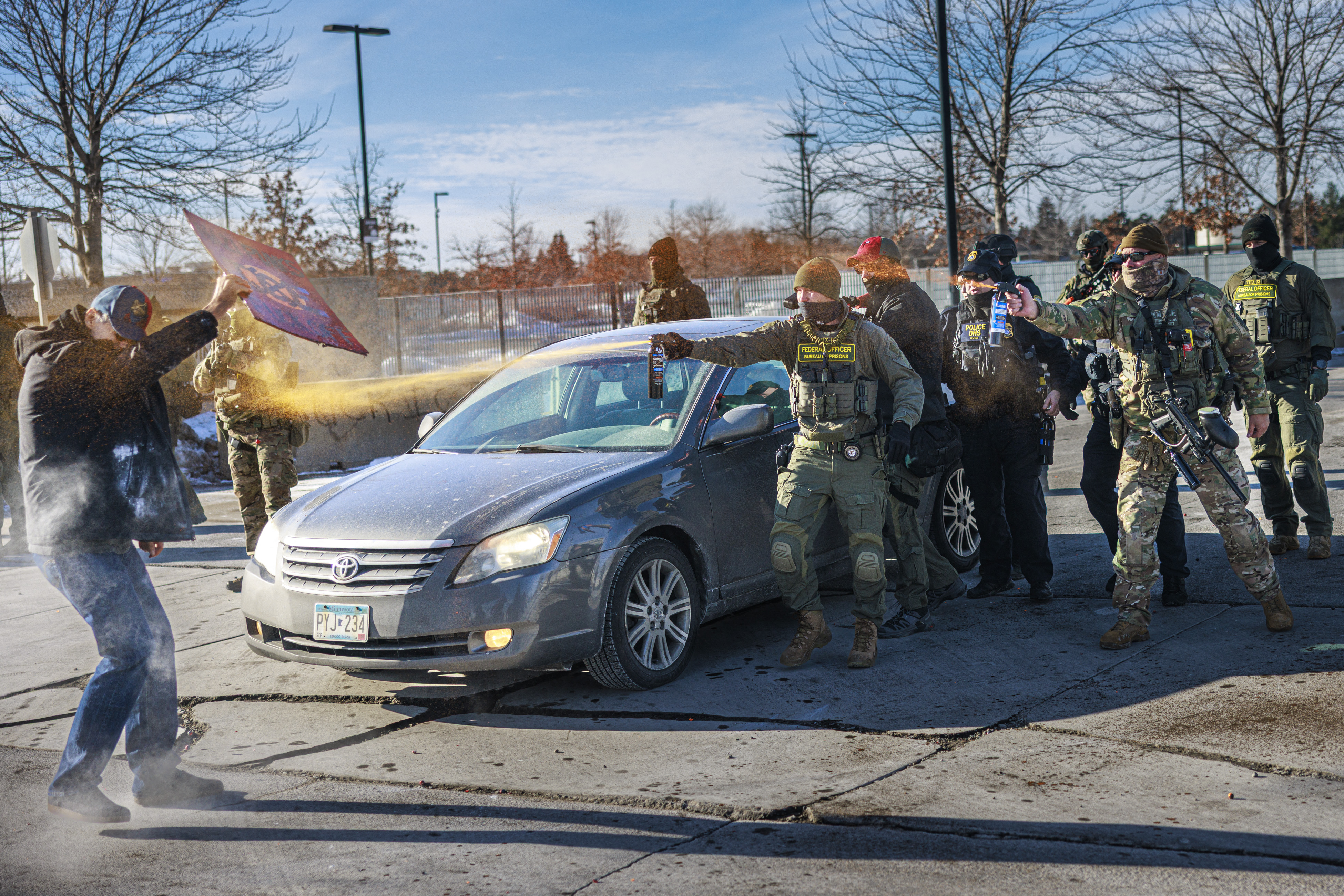
Federal agents pepper-spray a protester holding a sign during an enforcement operation outside the Whipple Building ICE facility in Minneapolis on Jan. 11, 2026.Photo: Kerem Yucel/AFP via Getty Images
Donald Trump’s Department of Justice unsealed a federal indictment on Tuesday announcing hefty charges against 15 antifascist protesters for alleged actions taken in response to the brutal U.S. Immigration Customs and Enforcement surge in Minneapolis earlier this year.
The federal prosecutor in the case, Minnesota U.S. Attorney Daniel Rosen, warned that more arrests and charges could follow.
Once again, prosecutors are throwing extreme and overreaching charges at activists in a scrambling effort to criminalize organized, collective opposition to Trump’s most violent policies.
The Minneapolis indictment exemplifies the Trump regime’s escalating strategy: Criminalize whole political movements with claims of collective liability and “conspiracy,” and treat typical acts of protest, constitutionally protected speech, association, and political identification as criminal acts.
The indictment, Rosen said, is a part of Trump’s National Security Presidential Memorandum-7, or NSPM-7, initiative to target and prosecute leftists and antifascists as terrorists.
Minneapolis is not an incidental target for Trump’s Department of Justice. The city unleashed an oftentimes-inspiring response to the ICE crackdown: mutual aid organizing, confrontational protest, blockades, and strikes in response to brutality set a national example for how to fight back when federal agents descend on a city to kidnap our immigrant neighbors.
“Conspiracy” to What?
The “conspiracy” in Minneapolis according to the government, involves purported antifa activists acting with the aim of impeding ICE operations and injuring officers. The indictment names no federal officer injuries, and only minor incidents of property damage — like a protester leaving a dent in an ICE vehicle from kicking it.
Among other pieces of evidence cited for the alleged criminal conspiracy are the most basic protest strategies, including self defense, nonviolent tactics, and First Amendment-protected activity.
The government points out that organizers employed phrases like “become ungovernable” — a liberatory slogan so common it has spread to cute animal memes.
Demonstrators are accused of building and advocating for the use of shields at protests outside an ICE detention facility — the sort of protests in which, in Minneapolis and nationwide, federal agents have beaten people and fired rubber bullets and tear-gas canisters directly at heads and bodies.
The indictment even claims that people tracking ICE vehicles and alerting others to their presence, as agents prowled neighborhoods looking for immigrants to kidnap, is evidence of criminal conspiracy.
That certain protest activities may have indeed impeded ICE in its efforts to ruin lives and whiten the country do not make those activities illegal. Minor violations and property damage may involve unlawful acts, but do not constitute a mass criminal conspiracy.
Certainly, none of it calls for unleashing the vast resources of the federal government against protesters. The Trump administration, however, has made its own strategy clear: Make the stakes of association with political movements dangerously high.
The Minneapolis charges do not stand alone. Recent weeks have seen an array of federal arrests, prosecutions and raids aimed at Trump’s favored targets: antifascists, Palestine solidarity activists, and voting rights advocates.
Protesters who participated in the Atlanta-based Stop Cop City movement were hit last week with new federal charges under the NSPM-7 initiative — despite the fact that state cases against the movement for the very same incidents have consistently collapsed.
This month, the FBI also raided the homes of numerous Palestine-solidarity activists connected to the University of Michigan, with eight activists indicted on federal charges for allegedly aiming to “intimidate” university officials in protests aimed at ending the school’s investment in Israel’s genocide. FBI agents also raided the offices of an Ohio voter-registration organization, seizing employees’ phones and computers.
Such repression is not the sole preserve of Trump’s regime or Republican administrations, but we are witnessing an escalation in authoritarian efforts to criminalize political resistance.
The assault on the left has been, perversely, carried out in tandem with brazen attempts to lavish Trump’s violent far-right supporters with impunity, government jobs, and even financial rewards.
When the Spaghetti Sticks
Sometimes the spaghetti does stick. In March, a Texas jury found eight defendants guilty of terrorism charges for simply being present and wearing black at a protest in which a shooting took place outside ICE’s Prairieland Detention Facility in Northern Texas.
The ruling was a major victory for the Justice Department — a case in a Trump-friendly jurisdiction, presided over by a Trump-appointee judge, the government’s flimsy effort won through.
In Spokane, Washington, three anti-ICE demonstrators were convicted in May on conspiracy charges for impeding federal officers in a case with similarities to the Minneapolis indictment. The original federal prosecutor in the Spokane case resigned instead of signing indictments against protesters; he did not believe they were warranted, he said. As is a pattern with Trump’s Department of Justice, however, the prosecutor’s successor moved forward with charges. Six people took plea deals, but three refused, wanting to defend their First Amendment rights in court. For typical protest activity, they were convicted of federal conspiracy charges. They face up to six years in prison.
Trump has ample reason to relentlessly push politically motivated cases, even those thrown out in lower courts.
Just consider the extraordinary, ongoing efforts to deport Palestinian activists like Mohsen Madawi and Mahmoud Khalil, or a Salvadorian immigrant with legal status, Kilmar Abrego Garcia.
With an ideologically aligned far-right Supreme Court, Trump has ample reason to relentlessly push politically motivated cases, even those thrown out in lower courts.
Antidote to Collective Guilt
Cases like Prairieland threaten to set frightening precedents, but the lesson they offer is not that federal prosecutors have somehow now cracked the mass-prosecution code after other collective liability efforts had failed. Rather, the lesson is an older one, about solidarity.
Prosecutors in the Prairieland case relied heavily on the testimony of cooperating defendants, who testified against co-defendants as a part of plea deals. Without that testimony, the case would likely not have played out the same way.
“If people hadn’t cooperated in Prairieland, the case would’ve been extraordinarily different,” said Xavier T. de Janon, an attorney with the People’s Law Collective, which is representing Stop Cop City protesters in state-level cases. “Their entire prosecution was made possible by cooperators, and their investigation was successful because people cooperated very quickly.”
De Janon nonetheless stressed that, while the federal government was successful in the Prairieland trial, the Justice Department has accrued “hundreds of failures.”
“If people hadn’t cooperated in Prairieland, the case would’ve been extraordinarily different.”
In Stop Cop City cases so far, as was the case in the mass federal prosecution against the so-called J20 protesters at Trump’s first inauguration, no defendants aided prosecutors as cooperating witnesses. Efforts to isolate and criminalize “bad protesters” failed, and collective prosecutions, based on the flimsiest of claims, collapsed.
The response to ICE in Minneapolis and St. Paul was powerful precisely because residents blended tactics of mutual aid, community support, mass mobilization, and militancy. The worst possible response to the Justice Department’s sweeping indictment would be for certain elements of the movement to follow the government’s lead and demonize antifa associations and confrontational protest.
The government is escalating a well-worn strategy to disarticulate and defang movements.
“This is a fascist society, not just the government, but the fabric of society,” said de Janon. “People thinking, ‘If I go to a rally, I might be charged with a federal felony and spend 25 years in prison’ — it is outrageous.”
There is no denying that the Department of Justice is attempting to make the stakes devastatingly high for even minimal association with today’s liberatory movements, from antifascist immigrant defense to Palestine solidarity.
The price for failing to stand together against this fascist overreach is, however, far higher still.
ICE investigators leaned on Signal communications to build their case against protesters. Take these steps to keep your chats safe. The post How Did the Feds Get Into Anti-ICE Activists’ Signal Messages? appeared first on The Intercept.
When anti-ICE activists rallied against the Trump administration’s deportation campaign in Minneapolis, many relied on the encrypted messaging app Signal for secure communications. In activist chats and quickly established ICE-tracking groups, locals used Signal to keep tabs on federal agents patrolling their communities.
When the Department of Homeland Security announced this week the arrest of 15 alleged “anti-ICE rioters” in Minnesota, it pointed directly at their Signal chats.
The indictment is in large part built upon on conversations from more than a dozen Signal groups, citing more than 100 specific messages. The case is a stark reminder that using an encrypted messaging platform like Signal is not in and of itself a magic bullet to safeguard communications. It also raises the question: How did Immigration and Customs Enforcement’s Homeland Security Investigations unit gain access to all of these communications in the first place?
The indictment doesn’t provide a clear answer. But sprinkled throughout the document are clues that suggest that law enforcement may have gained access to the physical devices of some of those indicted.
The indictment singles out its targets for their alleged participation in local ICE rapid response networks, where volunteers monitor and report the presence of federal agents in their communities by flagging details such as the license plate numbers of vehicles used by immigration authorities. ICE watchers in Minnesota have been met with intimidation from immigration authorities amid the national outcry following the killings of Alex Pretti and Renee Good as they observed the actions of immigration authorities.
The 15 people named in the latest indictment are all charged with “conspiracy to impede or injure an officer,” with some facing additional charges like “solicitation to commit a crime of violence” and “destruction of government property.” Though some of the accused had court appearances on Tuesday, their defense attorneys have not as of yet been named.
The indictment comes months after FBI Director Kash Patel said in a podcast interview that federal law enforcement had started an investigation into Minnesota ICE watchers using Signal groups to share information about immigration agents.
The bulk of the indictment consists of transcripts of group messages; at various points it also makes mention of voicemails, text messages, Signal direct messages, and Signal calls. For instance, the indictment in one spot mentions that two of the indictees “exchanged approximately 20 connected Signal calls.” This hints that authorities were able to access not just group chat messages, but likely had wholesale access to the devices of at least some of those indicted.
The Signal app provides end-to-end encryption, protecting communications in transit, so that anyone monitoring your internet or cellular data connection cannot see the contents of your messages. Signal also minimizes the amount of metadata collected, so if the organization behind the app, the Signal Foundation, was served with a compulsory legal process to reveal user information, it wouldn’t even know with whom you spoke or chatted.
But all that falls apart if your device gets into the wrong hands. In order to safeguard your Signal data from someone who obtains access to your device, it’s necessary to manually harden Signal by modifying some of its default settings.
Perhaps Signal’s most well-touted security and privacy feature is its ability to set disappearing messages. Messages can be set to expire in periods ranging from seconds to weeks. A default expiration time for all messages can be selected, and specific groups and conversations can be set to custom retention times. To minimize risk, set retention times to the shortest amount feasible — minutes or hours, instead of days or weeks.
Signal’s disappearing messages don’t remove evidence that communications between parties occurred in the first place.
Keep in mind that Signal’s disappearing messages delete the contents of a message, but they don’t remove evidence that communications between parties occurred in the first place. This means that even if a group has enabled disappearing messages, someone who gains access to a member’s device could later determine with whom they were chatting. Therefore it’s safest to regularly delete entire groups and chats, not just the messages themselves.
Just like its chat function, Signal also keeps similar records of voice and video calls. It’s as important to delete records of the calls as it is to delete records of text messages, both within the Signal app and in your phone’s standard call history.
On iPhones, Signal can integrate its call history into the iPhone’s regular call history. This privacy-eroding feature can be disabled on Signal on iOS by tapping your profile circle on the top-left corner of the app, clicking on Settings, then Privacy, then disabling “Show Calls in Recents.”
Additionally for Signal on iPhones, you’ll also likely want to disable settings like “Share Contacts with iOS” and “Use Phone Contact Photos” (for Android users, the equivalent is “Use address book photos”), which can be found under Settings, then Chats.
Such precautions may sound extreme, but in a recent case, authorities were able to recover deleted incoming Signal messages based on old push notifications that were archived on iPhones (the latest iPhone update fixes this issue, highlighting the importance of keeping your devices up to date). On that note, remember to either turn off Signal notifications entirely or have them display only the names of people sending messages — which should be pseudonyms, not real names.
Democrats balked at handing Bill Pulte spy powers. Will they stay strong against Trump’s new pick for intel chief? The post Are Jeffries and Schumer Getting Ready to Greenlight Domestic Spy Power for Trump? appeared first on The Intercept.
When Congressional Democrats rallied against President Donald Trump’s appointment of Bill Pulte to serve as temporary director of national intelligence last week, they said he was an unqualified pick who would be too eager to use the job to undermine elections.
Now some high-ranking Democrats are lining up to support another permanent appointee with a dubious claim to the legal job requirements — Jay Clayton — who has also openly questioned the integrity of U.S. elections.
Some to Democrats are lining up to support Jay Clayton, who has questioned the integrity of elections.
Clayton’s nomination will be heard by the Senate Select Committee on Intelligence on Wednesday. Senate Majority Leader John Thune, R-S.D., hopes to have him confirmed as soon as Thursday — a lightning-fast process for a top intelligence post.
What’s at stake, however, isn’t just the outcome of Clayton’s nomination process. Trump’s pick is intertwined with the fate of a key domestic surveillance law, Section 702 of the Foreign Intelligence Surveillance Act, that expired Friday.
Privacy advocates are worried that Clayton’s nomination will give some Democrats the excuse they have been looking for to vote for renewing Section 702. The advocates are raising concerns about Clayton and calling on Congress to add a warrant requirement to the surveillance law, no matter who ultimately takes over as intel chief.
The top Democrats on the House and Senate intelligence committees, Rep. Jim Himes of Connecticut and Sen. Mark Warner of Virginia, who have both supported renewing Section 702 without major changes, have issued positive statements about Clayton’s nomination.
Neither House Minority Leader Hakeem Jeffries, D-N.Y., nor Senate Minority Leader Chuck Schumer, D-N.Y., has tipped their hand as to whether Clayton’s nomination will lead them to support a so-called “clean” renewal of Section 702.
Jeffries said last week that he supports making significant reforms to the law, although he did not specifically commit to a warrant requirement.
Sean Vitka, executive director of the left-leaning advocacy group Demand Progress, urged Democratic leaders to stand firm on reform.
“There is no universe where the momentary person who happens to satisfy Himes and Warner’s vibe check,” Vitka said, “should mitigate everybody’s concerns that are decades old with warrantless surveillance.”
Election Conspiracies
The reauthorization of Section 702 once appeared to be on a “glide path,” according to Warner. The law sets the parameters for when intelligence agencies can warrantlessly search American communications collected abroad.
Congress was within days of passing a new version of the law with minor tweaks when Trump nominated Pulte, the director of the Federal Housing Finance Agency and chair of mortgage giants Fannie Mae and Freddie Mac, to serve as temporary director of national intelligence.
When he tapped Pulte, Trump said he wanted to him to use the post to investigate “rigged” elections. That alarmed Democrats who noted that Pulte is already accused of misusing sensitive mortgage databases to help launch investigations against Trump’s political enemies.
The intelligence chief post has no formal role in election administration, but that did not stop outgoing Director of National Intelligence Tulsi Gabbard from appearing at an FBI raid of a Fulton County, Georgia, ballot warehouse.
Pulte’s lapdog reputation was not the only thing that worried Democrats. They also noted that he did not meet the job requirement for the intelligence chief post in statute, which states that the nominee “shall have extensive national security expertise.”
Centrist Democrats who were willing to renew Section 702 despite Gabbard’s overt politicization of the intelligence chief job finally had enough when it came to Pulte’s nomination. Even Warner and Himes voted against the law’s reauthorization.
Trump’s nomination of Clayton was an attempt to undo the backlash. Clayton currently serves as the federal prosecutor for the Southern District of New York and was previously the Securities and Exchange Commission chair — the kind of resume that reassures Washington insiders.
“I’ve known and respected Jay Clayton for decades,” Himes said on X. “His intelligence, temperament and deep commitment to public service will make him a terrific DNI. Had this nomination been made a week ago, lots of pain might have been avoided.”
Advocates were more dubious. They noted that only days before his selection, Clayton had been asked on CNBC about the delays in returning California’s election results that had fueled right-wing conspiracy theories.
“On the integrity side, we’re doing an absolutely terrible job,” Clayton said, without offering evidence. “And the American people are right to question it.”
Clayton’s willingness to engage with one of Trump’s favorite tropes alarmed advocates, who say that Gabbard’s role in the Georgia warehouse raid shows how the intelligence chief post could be misused to sow election doubt.
Clayton’s willingness to engage with one of Trump’s favorite tropes alarmed advocates.
Even centrist Democrats concede that, like Pulte, Clayton doesn’t have “extensive” national security experience. In his defense, supporters point to the role of federal prosecutors in launching national security cases.
Sen. Jack Reed, D-R.I., the ranking member of the armed services committee, sounded a note of skepticism on “Fox News Sunday.”
“We have to look very clearly at Jay Clayton,” Reed said. “He is a very accomplished lawyer, but the statute requires someone taking this job to have significant national security experience, and that has to be measured. I don’t think he does.”
Senators of both parties will have an opportunity to probe Clayton’s qualifications at Wednesday’s confirmation hearing. Warner has said that Clayton will have to answer questions about his views on elections.
Whatever happens with his nomination, privacy advocates say the entire saga of replacing Gabbard further proves the need for major reforms to Section 702.
“It doesn’t matter who’s in charge,” longtime privacy booster Sen. Ron Wyden, D-Ore., said on June 11. “FISA 702 can’t be renewed without real reforms.”
“Case in point: Trump’s latest nominee for director of national intelligence was peddling election conspiracies just a few days ago.”
With endorsements and a new pledge for lawmakers, TrackAIPAC is flexing its growing influence on the Capitol. The post Once a Target of TrackAIPAC, Ro Khanna Gains Its Endorsement appeared first on The Intercept.
After a resounding primary victory and ahead of a potential presidential run in 2028, progressive California lawmaker Ro Khanna has received the endorsement of the influential advocacy and watchdog group TrackAIPAC, known for posting red cards of lawmakers and candidates who receive money from the pro-Israel lobby.
Khanna, a Democrat representing parts of San Francisco’s Bay Area, is the first member of Congress to go from a target of TrackAIPAC’s online fury to the winner of its endorsement. Though Khanna never took money from the pro-Israel lobby giant, the American Israel Public Affairs Committee, he received a red anti-endorsement card from TrackAIPAC in 2024 largely due to his legislative record. Khanna has taken money from the liberal Zionist group, J Street, which opposed Gaza ceasefire attempts in 2023 but has since pushed for conditions on military aid to Israel.
“Rejecting AIPAC money isn’t enough — every member of Congress must be clear on these issues.”
Khanna’s TrackAIPAC endorsement, first reported by The Intercept, came after the lawmaker on June 10 became the initial signatory of a new pledge from TrackAIPAC called PEACE to enforce American law, counter foreign influence, and end war crimes. Among other commitments, candidates who sign the pledge swear off money from AIPAC and aligned groups, acknowledge Israel’s genocide in Gaza, oppose military aid to any country that commits human rights violations, and agree to stand against efforts in Congress to enmesh the U.S. and Israeli militaries.
“I’m proud to be the first member of Congress to sign the PEACE Pledge to reject campaign contributions and political support from AIPAC, DMFI, and other groups that promote unconditional support for Israel,” Khanna told The Intercept in a statement. “The pledge also affirms my opposition to the genocide in Gaza and my commitment to voting against future military assistance to any country whose security forces are committing human rights violations. Rejecting AIPAC money isn’t enough — every member of Congress must be clear on these issues.”
With the endorsement and the new pledge, TrackAIPAC is flexing its growing influence on the Capitol. Its viral social media posts have played a large role in making AIPAC into a politically toxic entity, helping drive underground much of its campaign giving in the midterms. Those posts have also compelled lawmakers, including Khanna, to seek meetings with the group in hopes of removing their red cards. With its political arm, Citizens Against AIPAC Corruption, TrackAIPAC has also been endorsing and funding candidates.
TrackAIPAC’s founders said they want to offer a good-faith offramp for members of Congress looking to evolve on Israel and Palestine. Beyond tracking the pro-Israel lobby’s political spending, the group also serves as an advocacy organization pushing for Palestinian rights in the Capitol. It has claimed major midterm primary victories in races it has endorsed a candidate, such as in New Jersey with the victory Adam Hamawy, a former Army surgeon who volunteered in Gaza during the war; Chris Rabb in Pennsylvania; and Mai Vang in California.
“We’ve been really effective at building a megaphone and bringing accountability to folks who are on the wrong side,” TrackAIPAC co-founder Casey Kennedy, told The Intercept. “But with that success we’ve had, now we have a responsibility to offer a bridge to folks to chart a new path forward.”
The group has attracted controversy over its methodology, which examines campaign financing as well as lawmakers’ legislative record on policies relating to Israel and Palestine. TrackAIPAC has at times assigned its red card to lawmakers and congressional candidates who do not take AIPAC money, which critics have called unnecessarily confusing or misleading.
Last June, Khanna became the first lawmaker to meet with TrackAIPAC, according to the group, and asked why TrackAIPAC had initially assigned him a red card. By the time they met, the group had removed the red card but did not grant him its green seal of approval. Instead, it appended a label that remains on his page today, stating: “We encourage this representative to continue improving their legislative record on Israel-Palestine issues.”
In contrast, Squad member Rep. Alexandria Ocasio-Cortez, D-N.Y., has a green card and a positive label stating: “This candidate rejects Israel lobby contributions. This representative has a strong legislative record on Israel-Palestine issues.”
Khanna had previously appealed to TrackAIPAC on social media, doubling down on his rejection of AIPAC support. The posts drew the ire of AIPAC, which relentlessly attacked him on social media, at times using TrackAIPAC’s own red card graphic.
Khanna’s stances on Israel and Palestine have shifted in recent years. In the immediate weeks after October 7, 2023, Khanna voted in favor of a string of pro-Israel House resolutions, including reaffirming Israel’s “right to self-defense” on October 25. A week later, he signed a resolution that condemned antisemitism and “the support of Hamas, Hezbollah, and other terrorist organizations” in colleges and universities. Khanna was also notably absent on early resolutions calling for a ceasefire.
Khanna has since become a loud critic of Israel and has voted against a bill that sought to codify the International Holocaust Remembrance Alliance definition of antisemitism, which has been used to silence criticism of Israel. In the summer of 2025, he co-sponsored the Block the Bombs bill and signed on to a pair of resolutions by Rep. Rashida Tlaib, D-Mich., acknowledging Israel’s offensive in Gaza as a genocide and recognizing the Nakba. Earlier this month, Khanna attempted to strike a portion of the National Defense Authorization Act that would codify Israel’s joint development of weapons with the U.S.
It was also this month when Khanna’s office reached out again to TrackAIPAC to revisit the possibility of gaining the group’s endorsement, the group said. His office had been receiving inquiries about his “continue improving” label on TrackAIPAC’s presidential candidate list. At the time, TrackAIPAC had already been developing its pledge and offered it to Khanna’s office.
“Groups like AIPAC are pouring money into our elections and are influencing policies that undermine human rights,” Khanna told The Intercept in a statement. “When Track AIPAC offered, I was proud to sign the pledge.”
While Khanna has not formally announced a run for president, he is positioning himself to the left of the Democratic establishment on Israel. In April, he announced he supports the halt of both offensive and so-called defensive weapons to the country due to its human rights abuses.
Adam Carlson, a political consultant and pollster behind Zenith Research, who has been critical of TrackAIPAC’s methodology in the past, has said he expects other congressional and presidential candidates courting the left to sign on to the new TrackAIPAC pledge. But he doesn’t expect a shift from the kinds of establishment Democrats often in the crosshairs of TrackAIPAC over their support for Israel.
“It’s a flex — the more people they get to sign this pledge, the stronger they are,” Carlson said of TrackAIPAC. “But it won’t change the dynamic broadly.”
He cautioned of potential pitfalls, such as how the group will hold legislators who sign the pledge accountable and warned of the risk of purity tests on the left that could hurt certain candidates’ election chances in swing districts.
TrackAIPAC said anyone who abandons the pledge would again receive a red graphic and be targeted in the group’s intense social media campaigns. Cory Archibald, a TrackAIPAC co-founder, also resisted the premise of a purity test. “If you’re gonna have a litmus test,” Archibald said, “I think genocide is certainly a good one.”
The official count of U.S. personnel hurt or killed in the war on Iran inched up, but it still omits hundreds of known casualties. The post U.S. Casualties in Iran Are Still Rising appeared first on The Intercept.
America’s Iran War casualties crept higher even as the U.S. was in the final stages of declaring a second ceasefire with Iran this weekend.
The U.S. and Iran have agreed to a second ceasefire and the eventual reopening the Strait of Hormuz under a preliminary deal scheduled to take effect on Friday. “Iran has taken a major step toward final victory,” Mohammad Bagher Ghalibaf, the speaker of the Iranian Parliament, said on Monday, one of several Iranian leaders taking a victory lap after outlasting the Trump administration.
Trump’s war has already killed thousands of Iranian civilians — including more than 150, most of them children – in a strike on an elementary school. The official number of dead and wounded U.S. personnel stands at 426, an almost 11 percent increase since the first ceasefire between the U.S. and Iran was struck on April 8. This tally, however, is missing hundreds of casualties, including two soldiers wounded in action earlier this month.
For months, The Intercept has reported that the Pentagon’s official tally of dead and wounded military personnel from the Iran War is a gross undercount, stemming from what another U.S. government official called a “casualty cover-up.” The Defense Casualty Analysis System, or DCAS, which tracks “deceased, wounded, ill or injured” service members for Congress and the president, is missing hundreds of known casualties. The true number exceeds 625.
When the first ceasefire was struck between the Trump administration and Iran, the tally of U.S. casualties was 385. Despite a pause in hostilities, the number slowly rose to 428, according to Pentagon statistics.
On April 21, however, the number of wounded-in-action troops declined by 15 without public comment from the War Department, dropping the casualty total to 413. Despite repeated questions over almost two months, the Pentagon has not explained the disparity in its casualty count. A defense official told The Intercept that it was impossible to tell whether Pentagon casualty analysts were “grossly incompetent” or had been ordered to manipulate the figures.
Since the 15 wounded vanished in April, the DCAS casualty count has steadily crept upward to top out at 413, where it stood on Tuesday morning. This includes one sailor wounded in action this month. Central Command did not reply to a request for further information about the injury.
The official figures appear to be missing two soldiers who were recently wounded in action. CENTCOM spokesperson Capt. Tim Hawkins told NBC News last week that two crew members from a U.S. Army AH-64 Apache helicopter downed by an Iranian drone on June 8 were receiving medical care. And a CENTCOM social media post said they were in “stable condition.” But DCAS lists no Army personnel wounded in action this month.
The official tally of war dead also appears to be an undercount. For weeks, DCAS listed 13 hostile and non-hostile U.S. deaths during the war. DCAS briefly raised the total to 14 last month before dropping it back to 13, without any explanation on the fluctuation.
The Pentagon list of the names of the dead is still missing Maj. Sorffly Davius, a signals and communication officer with the New York Army National Guard who was assigned to the headquarters of the 42nd Infantry Division and reportedly died of sudden illness while on duty in Camp Buehring, Kuwait, on March 6. Davius’s death was widely acknowledged even as it was excluded from the official count: Rep. Mike Lawler, R-N.Y., spoke about him during a memorial service that month, and Gen. Dan Caine, chair of the Joint Chiefs of Staff, recognized Davius while “honoring our fallen.”
While DCAS provides a running tally of “non-hostile” deaths — meaning those who died from accidents or by illness — it doesn’t include “non-hostile” injuries. The DCAS figures show that 65 Navy personnel have been wounded in action. Missing, however, are the more than 200 sailors treated for smoke inhalation or lacerations due to a March 12 fire that raged aboard the USS Gerald R. Ford. The aircraft carrier had been conducting round-the-clock flight operations to, in Caine’s words, “project combat power” in the Middle East. The ship returned to its home port in Norfolk, Virginia, last month after 326 days at sea, the longest deployment of any U.S. aircraft carrier since the Vietnam War.
The casualty numbers also don’t include a sailor who suffered a non-combat-related injury aboard the USS Abraham Lincoln as it was involved in “strike missions in support of Operation Epic Fury” on March 25.
On April 21, two Pentagon spokespersons said they were unable to field questions about why more than a dozen casualties had been disappeared by the War Department, claiming only the “duty officer” could answer the question but that person was not at their desk. “As soon as the duty officer comes back to their desk, I can get this to them,” said one of them. After almost two months, The Intercept has yet to receive a response from the duty officer.
The Pentagon did not reply to a request for clarification on Monday about whether the duty officer ever returned to their desk.
The EEOC is moving to rescind a rule that has stood in the way of its politicized attacks alleging discrimination against white men. The post Trump Admin Wants to Make It Easier for White Men to Sue for Discrimination appeared first on The Intercept.
The chair of the Equal Employment Opportunity Commission, the federal agency created by the Civil Rights Act of 1964 to protect American workers from discrimination, moved to delete the agency’s affirmative action rule that was implemented almost 50 years ago.
Chair Andrea Lucas, who was appointed by President Donald Trump, proposed to rescind the “Affirmative Action Appropriate Under Title VII of the Civil Rights Act of 1964” rule on May 27. The rule has proved a barrier to her efforts to bring lawsuits on behalf of white men who say they were discriminated against at work — a barrier the rescission would get rid of.
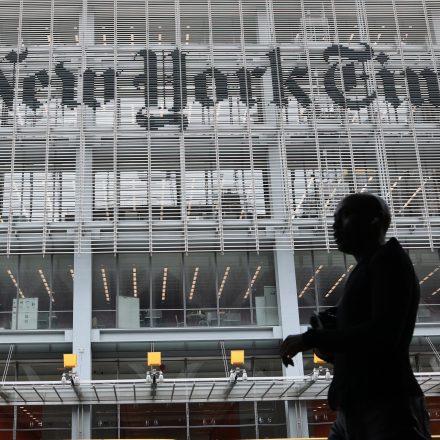
The move, which was previously unreported, comes amid Lucas’s quest to characterize all employer efforts at diversity, equity, and inclusion as illegal race discrimination. The agency has filed lawsuits under her watch on behalf of white men at the New York Times and Coca-Cola, as well as investigations into Nike and Northwestern Mutual.
“This proposed rescission is part of this administration’s continued assault on equality for people of color and for women,” said former EEOC commissioner Jocelyn Samuels, who added that the change reflects Trump’s “solicitude for the fortunes of white men.”
The EEOC did not respond to a request for comment.
Rule to Fight Discrimination
The rule Lucas wants to do away with was crafted shortly after the EEOC was granted litigation authority in 1972.
Racial discrimination had been rampant throughout American workplaces, and some employers wanted to act to correct those long-standing discriminatory practices and racial disparities in an affirmative way.
Responding to the call, the EEOC crafted the rule to allow for very narrow circumstances in which it would be permissible for employers to take race into account in such efforts.
To take advantage of the rule, employers have to do an analysis showing they had shut out women or people of color for a long time — in other words, that there were “prior discriminatory practices.” Only then can a hiring process favor, say, Black candidates for a job position.
The rule also gives employers some cover. Under the Civil Rights Act, employers can’t be held liable for taking action done in good faith to follow an EEOC regulation that was voted on by the commissioners, such as the affirmative action rule.
At least one large employer in the Trump EEOC’s sights has cited the rule. In its motion to dismiss the EEOC’s lawsuit, Coca-Cola referred to the agency’s affirmative action rule as proof that the agency has encouraged the very behavior it is now penalizing.
Samuels, the former EEOC commissioner, said Lucas’s move to get rid of the rule “could be part of an effort to remove a potential defense.”
Upheld at Supreme Court
The Supreme Court has found narrow approaches to affirmative action to be constitutional.
In the 1987 case Johnson v. Transportation Agency and the 1979 case United Steelworkers of America v. Weber, the court allowed employers, in the case of what it called a “manifest imbalance,” to temporarily take sex and race into account as part of plans to increase representation in particular jobs until women or people of color are commensurate with their share of the population.
Those decisions still stand.
“The law is set by the statute and the Supreme Court’s interpretation,” said Charlotte Burrows, a senior affiliated research scholar at New York University’s School of Law and a former EEOC chair. “The EEOC can’t change that.”
That’s true despite the Supreme Court’s decision in Students for Fair Admissions, Inc. v. President and Fellows of Harvard College that struck down affirmative action in college admissions; that decision doesn’t apply to Title VII, which governs employment discrimination.
“The law is set by the statute and the Supreme Court’s interpretation. The EEOC can’t change that.”
That doesn’t mean the administration isn’t trying to change the law.
After Lucas asked the Office of Legal Counsel at the Department of Justice to weigh in, the department released an opinion that says, among other things, that the agency’s affirmative action guidelines “run further into unconstitutional territory.”
Lucas may be trying to blur the lines between affirmative action and DEI policies, but “they are two very distinct things,” Burrows said.
Employers can engage in a variety of perfectly legal approaches to diversity, such as having DEI programs that don’t give women or people of color more advantages but simply open the doors to more people.
“It is a messaging exercise that is part of this administration’s campaign to brand any form of proactive conduct on the part of employers to anticipate, preempt, and address barriers to equal employment opportunity as unlawful, race-based decision-making that disadvantages white men,” Samuels said. “This administration’s pronouncements have had really damaging effects on proactive programs that were designed to identify and address potential barriers before they ripened into discrimination.”
Assault on DEI
Lucas recently scrapped the EEOC’s previous Strategic Enforcement Plan that included as a priority that the agency “support employer efforts to implement lawful and appropriate diversity, equity, inclusion, and accessibility (DEIA) practices.” It was crafted through a lengthy public process and was slated to remain in place through 2028.
Instead, Lucas replaced the plan with a National Enforcement Plan that prioritizes going after DEI policies.
That move came after she had already directed agency officials to compile a list of cases in line with her own personal priorities, including “rooting out unlawful DEI-motivated race and sex discrimination,” and recorded a direct-to-camera video soliciting complaints from white men who feel they’ve been discriminated against at work.
Such cases have been accelerated through the agency’s processes, according to the New York Times, although staff have struggled to find complaints with merit.
Pearson challenged the last Tennessee Democrat in the House. Now he’s up against the threat of total GOP control. The post Bernie Sanders Backs Justin J. Pearson, House Candidate at the Heart of Tennessee Voting Rights Fight appeared first on The Intercept.
An outspoken progressive running for Congress in the Tennessee district at the center of Republicans’ efforts to sabotage voting rights and maintain control of the House earned the endorsement of Sen. Bernie Sanders on Tuesday.
Tennessee state Rep. Justin J. Pearson found himself the unexpected front-runner in the Democratic primary when two-decade incumbent Rep. Steve Cohen dropped out last month, after new gerrymandered maps throttled his chances of winning reelection. The redrawn 9th Congressional District and sudden shakeup mean that rather than running against the last Democrat representing Tennessee in the House, Pearson is facing a Republican machine bent on delivering an all-GOP delegation for President Donald Trump.
The new map hurts the chances for Pearson — or any Democrat — to win in November, but the candidate said he’s running on a platform focused on wealth, income inequality, and corporate overreach that aims to appeal across party lines. “You’ve got a number of disaffected Republican voters, you’ve got a number of distraught MAGA voters, and you’ve got fired-up Democrats, which is a perfect recipe for success for us,” Pearson told The Intercept. “Because our tent is big enough for everybody who is feeling that this status quo was rigged and broken against working-class folk, and want to see a future that is more just.”
It’s a message similar to the one that buoyed Sanders’s 2016 and 2020 presidential campaigns.
“As billionaires and Big Tech take more and more control over our lives and our government, we need leaders like Justin J. Pearson who have the experience and track record of standing up to the rich and power-hungry elites,” Sanders said in a statement.
Tennessee is one of several Republican-led states where officials rushed to protect Trump and the GOP’s chances of keeping power in what is expected to be a particularly difficult midterm cycle for Republicans mired in an unpopular war on Iran and an ever-increasing cost of living. After the U.S. Supreme Court ruled in April to gut a key provision of the Voting Rights Act, Trump said he spoke with Tennessee Republican Gov. Bill Lee, who called the next day for a special session to redraw the maps.
Using a practice known as “cracking,” the new map breaks the majority-Black district concentrated in and around Memphis across three red districts, diluting the power of Black voters in the area. Pearson said he believed the antidemocratic move, while detrimental to his chances, was unpopular with voters.
“A lot of people were really upset about the gerrymandered maps,” Pearson said. “I had about half a dozen Republicans who said they’re going to be voting in our campaign and I’d be the first Democrat they’d be voting for in their lifetimes.”
Pearson, who launched his campaign against Cohen in October with the backing of the progressive outfit Justice Democrats, received Sanders’s endorsement the day after getting one from the Working Families Party, and four days after he returned from a listening tour in rural and Republican counties in the newly drawn district. His campaign said more than 750 people attended the gatherings.
Attendees expressed frustration with being unable to afford housing, healthcare, and the things they need to live their daily lives, Pearson said. He said voters couldn’t afford “more of the same” when running against Cohen, and has now directed that message at his likely Republican opponent, state Sen. Brent Taylor.
“Both of them were millionaires, both of them benefited from a status quo that’s broken,” Pearson told The Intercept. “Both of them don’t like me.”
Also running in the August 6 Democratic primary are state Sen. London Lamar, who launched her campaign with Cohen’s endorsement after he dropped out, and Jim Torino, a former executive at a healthcare company focusing on people with disabilities and founder of a social welfare nonprofit. Perennial candidate M. LaTroy Alexandria-Williams filed to run but has not filed any reports with the Federal Election Commission.
Pearson is the top fundraiser in the Democratic primary race so far, with just under $2 million, according to the campaign. Most of that has come from contributions under $200, according to the FEC data; the campaign said its average donation is $31. Torino has raised $117,000, and Lamar has not yet had to file any reports with the FEC.
In addition to Sanders, Justice Democrats, and the Working Families Party, Pearson has backing from groups including MoveOn; Sunrise Movement; Indivisible; IMEU Policy Project and its Peace, Accountability, and Leadership PAC; as well as Reps. Summer Lee, D-Pa.; Ayanna Pressley, D-Mass.; Rashida Tlaib, D-Mich.; Delia Ramirez, D-Ill.; and Ro Khanna, D-Calif.
Pearson said he believes federal legislation is needed to force states to support working people and improve public safety.
“We need to put this ban on AI data centers, we need to increase the minimum wage nationally, because the states won’t do it,” Pearson said. “I’m in a state House, they refuse to do it. We need to have national gun safety laws passed, because states refuse to do it.”
In May, Pearson drew the ire of his Republican colleagues when he marched with protesters before the special session to redraw the state’s maps. Three years earlier, Republicans voted to expel him and another Black Democratic lawmaker after they and one other Democratic colleague led a protest against the legislature’s inaction on gun control after a deadly elementary school shooting in Nashville. Local officials reappointed Pearson and his colleague, state Rep. Justin Johnson, to the state House shortly after the vote.
Pearson, Cohen, two other Democratic congressional candidates, four registered voters, and the Tennessee Democratic Party filed a federal lawsuit challenging Tennessee’s maps last month, but they dropped it last week, citing a political environment hostile to their cause. Pearson said other cases before the federal courts had “a higher probability of success,” pointing to voting rights suits from the American Civil Liberties Union and the National Association for the Advancement of Colored People.
Still, he expressed hope for his long-shot campaign in Tennessee. He pointed to a stop on his listening tour in the city where the Ku Klux Klan was founded in 1865, and where Pearson, who is Black, welcomed 150 people at a rally — his largest crowd throughout the tour.
There is a “renewed vigor and enthusiasm because of what the Republicans have done — to show up in spite of them, in spite of what they’ve tried to do,” Pearson said. “I think that’s not something they probably calculated for when they did this racist redistricting.”
To end his war on Iran, Trump was forced to return to the status quo with the Strait of Hormuz open and no nuclear deal in place. The post Trump Celebrates Achieving Absolutely Nothing in Iran appeared first on The Intercept.
The Trump administration is boasting about pending plans to conclude its war with Iran, having achieved none of the original objectives laid out by President Donald Trump.
With a commitment to a ceasefire and the scheduled signing of a “framework” later this week, Iran is expected to agree to reopen the Strait of Hormuz within 30 days. Negotiations over an agreement regarding Iran’s nuclear program are expected to take place in the 60 days following Friday’s signing ceremony.
If the deal is signed on this week, it will mark a return to the status quo antebellum when the Strait of Hormuz was open and no nuclear deal with Iran was in place. Aside from killing top regime leaders, thousands of civilians — including more than 150, most of them children, on a strike on an elementary school — and damaging almost 149,000 civilian infrastructures, the United States has functionally achieved nothing. The same regime is in power and it maintains missile capabilities, still has a navy, and still supports regional proxies.
Trump also teased the prospect of a U.S. protection racket under which Middle Eastern nations would be forced to pay monetary tribute to America if the U.S. and Iran do not finalize a nuclear accord.
On Monday, Iran’s government declared victory and appeared to vow revenge on the U.S. for the war.
“The Deal with the Islamic Republic of Iran is now complete,” Trump wrote on Truth Social on Sunday, his 80th birthday. “I hereby fully authorize the toll free opening of the Strait of Hormuz.” An hour later, Trump offered a caveat, stating the strait would only be opened “upon the signing of the Deal on Friday.”
“This victory was achieved through absolute national cohesion, under the wise guidance of the Supreme National Security Council and all state pillars,” Iran’s Foreign Ministry spokesperson Esmail Baghaei announced on Monday, claiming that the conflict “cost the aggressors heavily.”
“Moving toward diplomacy does not mean we will ever forgive or forget the crimes against the Iranian nation; the pursuit of justice for our martyrs is permanent,” said Baghaei.
The White House did not reply to a request by The Intercept for comment on Iran’s declaration of victory and apparent vow of revenge for its dead.
The new “deal” is a complete capitulation for Trump who claimed, on March 6: “There will be no deal with Iran except UNCONDITIONAL SURRENDER!” No such surrender occurred.
Nor is it the first ceasefire Trump has claimed would result in a reopening of the Strait of Hormuz.
“Iran has now agreed to a ceasefire and reopening the Strait of Hormuz,” the White House announced on April 8, essentially the same agreement publicized on Sunday. That original ceasefire collapsed months ago, but the fiction was observed by the administration and mainstream news media outlets alike, until the new agreement was rolled out.
Pakistan says it will oversee a formal signing of a memorandum of understanding on Friday in Geneva, Switzerland. Prime Minister Shehbaz Sharif told the National Assembly session in Islamabad “the immediate and permanent cessation of military operations has been announced across all fronts, including Iran, America, and Lebanon.”
Self-styled War Secretary Pete Hegseth claimed on Sunday that the agreement guarantees “Iran will never have a nuclear weapon, won’t seek one, won’t buy one, won’t have one.” Iran previously agreed to those terms when it first ratified the Nuclear Nonproliferation Treaty in 1970, and reaffirmed that agreement on the first page of the 2015 Joint Comprehensive Plan of Action, or JCPOA, negotiated by former President Barack Obama’s administration. Trump unilaterally withdrew from that pact during his first term.
Trump indicated Hegseth was lying or uniformed in an interview with the New York Times on Sunday. The president said the U.S. was still negotiating whether Iran would suspend its enrichment for 20 years but hinted that he might settle for a 15-year suspension.
Trump has consistently criticized the JCPOA. “Barack Hussein Obama gave them 1.7 Billion Dollars in ‘Green” Cash,’” he wrote during a social media rant in April. Iran’s Mehr news agency reported that the U.S. would release $12 billion in frozen assets to Iran before the start of nuclear negotiations. “The accord secures the unfreezing of all Iranian assets and addresses compensation for wartime damages,” said Baghaei.
Trump said that if the U.S. does not sign a final nuclear agreement with Iran, the United States might assume the role of “the guardian of the Middle East” in return for 20 percent of the region’s revenues. The proposed extortion scheme appears akin to the 19th-century Barbary States, which practiced state-supported piracy to exact tribute from other nations. The United States fought two separate wars against two of these North African states: Tripoli from 1801 to 1805, and Algiers from 1815 to 1816.
A recent Intercept analysis of Trump’s claims about the Iran war, his stated objectives, and supposed American achievements found the U.S. has fallen short or flamed out on all counts. The public record shows an administration that has consistently scaled back its goals and downgraded its claimed successes, without nearing anything resembling the victory Trump has touted.
On the first day of the conflict, Trump laid out his most ambitious objectives. “The heavy and pinpoint bombing … will continue, uninterrupted … as long as necessary to achieve our objective of PEACE THROUGHOUT THE MIDDLE EAST AND, INDEED, THE WORLD!” Trump wrote on Truth Social on February 28.
Since April, the White House has not replied to requests for further information about Trump’s inability to achieve world peace. Trump has also failed to accomplish even his more modest goal, as the region remains mired in conflict. Israel continued its war on Lebanon on Sunday and said it was not involved in the new pact. “Trump’s agreement does not bind us. … We are not party to this agreement,” Israeli National Security Minister Itamar Ben-Gvir wrote on Telegram on Sunday.
“He’s a very difficult guy,” Trump said of Israeli Prime Minister Benjamin Netanyahu on Sunday. “He should be very thankful to us for doing this,” he said of the war, lapsing into typical hyperbole. “Because if Iran had a nuclear weapon, Israel wouldn’t be around for two hours.”
The Army told a mother that video of her son being abused didn’t exist, then produced it months later. It’s part of a pattern of obfuscation in abuse cases at military daycare centers. The post An Army Whistleblower Believed in Pete Hegseth — Until the Military Covered Up Her...
Amanda Feindt sat in the fourth row during the Senate confirmation hearing of Defense Secretary Pete Hegseth. A U.S. Army major and former whistleblower who had submitted a letter supporting his nomination, Feindt listened as Hegseth spoke about troop readiness, military lethality, and protecting military families. Service members and veteran advocates around her wore shirts and hats bearing his name.
While Feindt sat in the Senate chamber, her 4-year-old son was in the military’s care, spending the day at the North Post Child Development Center at Fort Belvoir, in nearby Virginia. There, according to records reviewed by The Intercept, he was subjected to treatment that would leave lasting psychological effects.
It took a year for Feindt and her husband to figure out what it was.
In a series of interviews with The Intercept, Feindt described a grueling pattern of obfuscation in which military officials refused to answer questions about her child’s treatment, directed her to file public records requests, and claimed not to have the attendant evidence — then produced it months later. Military experts characterized these delays as part of a pattern in which the institution seeks to slow-walk and minimize findings of child abuse or mistreatment to decrease reputational damage. Over a year of persistent requests, Feindt and her husband finally pieced together a picture of their child’s treatment during at least two instances that January: The day of the hearing, when staff mocked and harassed the 4-year-old, and a few days earlier, when surveillance video showed them stepping on his feet and pinning his legs under a table. Local authorities later classified the treatment as child abuse.
“My son barely has the words to describe what happened to him,” Feindt told The Intercept. “You can see it in the video — they’re screaming while the abuse is taking place.”
Three other military families whose children suffered maltreatment in U.S. Army facilities described similar roadblocks. Parents who sought surveillance footage in other abuse investigations described receiving heavily redacted videos, incomplete clips, or footage with audio removed.
“This is a standard tactic in administrative cases,” said Ryan Sweazey, a retired Air Force officer and former inspector general. “They tell you the investigation is done, and if you want to challenge it, you have to file a FOIA request. The report then comes back heavily redacted months or years later.”
That’s what happened to the Feindt family: Army officials allowed them to review only a limited portion of the footage and would not provide copies of the video. While they watched, Feindt and her husband recorded audio and later described the scenes in a memorandum to Defense Department officials, both of which they shared with The Intercept. When the family sought additional footage and records, Feindt said officials directed them to file a Freedom of Information Act request before saying the remaining footage had been deleted after review.
According to Feindt’s memorandum, three staff members watched the teacher pin the 4-year-old’s legs and mock him without intervening. The footage then shows the teacher yanking the child upward by his clothing, grabbing him by the wrists, and pushing him out of camera view, Feindt and her husband write. In the audio the family shared with The Intercept, a child Feindt identified as her son can be heard screaming for the teacher to stop.
Pete Hegseth arrives for his confirmation hearing before the Senate Armed Services Committee in Washington, D.C., on Jan. 14, 2025.Photo: Kent Nishimura/Bloomberg via Getty Images
Accusations of child abuse in the Army are handled through a quasi-judicial body known as the Incident Determination Committee, or IDC, which operates without many of the safeguards found in civilian courts. These panels can include social workers involved in the underlying case, members of the chain of command, or personnel with limited subject-matter expertise. The committee applies a “preponderance of information” standard that experts say can produce conclusions at odds with civilian investigators reviewing the same evidence.
Once the committee reaches a determination, parents are typically not allowed to review how the decision was made. Proceedings occur behind closed doors, with no transcript, evidentiary record, or opportunity for cross-examination available to families or attorneys.
“It’s one entity acting as judge, jury and executioner. There is no real due process, and there are almost no checks and balances,” said Sweazey.
The Feindt family was left unsure why their IDC did not substantiate abuse claims despite medical concerns and video evidence reviewed by investigators. Feindt tried to attend the committee’s hearing, but her request was denied. Afterward, she sought additional CCTV footage from the daycare, but Fort Belvoir officials told her the case was closed and she would have to file a FOIA request.
The system overseeing military child care centers is so fragmented that even grieving parents struggle to determine who is responsible when something goes wrong, said Jason Degenhard, a retired Army master sergeant who served in special operations. In 2012, Degenhard’s 4-month-old son was in the care of the child development center on Pope Air Force Base (which today is part of Army base Fort Bragg) when a caregiver placed him on his stomach for tummy time, propped him against a rolled blanket, and left the room, as reported by WRAL News in Raleigh, North Carolina.
The infant’s muscles were not developed enough to support his weight, and he suffocated, causing catastrophic brain damage. The baby, named Sonny, was removed from life support days later.
“If you are a new parent trying to figure out how these centers are doing, you really do not have anything to go off of,” Degenhard said. In his telling, his chain of command supported the family immediately after Sonny’s death, but he remained troubled by what he described as limited institutional accountability afterward. Although the center was located on Pope Air Force Base, it operated under Army garrison authority, and Degenhard said the overlapping bureaucracies often left the family unsure who had the authority to provide answers or accept responsibility.
After federal prosecutors declined to pursue criminal charges, the Degenhards settled a wrongful death lawsuit against the federal government. Their emotional distress claims were dismissed.
“The heartbreak goes beyond the personal,” said Degenhard, who is still suffering from grief 14 years later. “The professional heartbreak is the lack of accountability, the lack of communication, and the lack of supervision.”
Feindt’s son became fearful and mistrustful of adults, regressed in potty training, and developed nightmares after Hegseth’s January 2025 confirmation, she told The Intercept. The family transferred him to another daycare, where Feindt said he struggled to adjust and accumulated roughly 20 behavioral incident reports in his first month, prompting administrators to bring in trauma specialists for support. His doctors said his symptoms resembled post-traumatic stress.
Army internal documents and communications acknowledged that supervisors watched her son being mistreated but did not intervene; no mandatory reporters documented the incident; and the parents were never notified. The conduct aligns with the Defense Department’s criteria for emotional maltreatment of a minor, but the Army IDC refused to classify the child’s treatment as abuse.
“For 15 months, the military told us this didn’t meet criteria,” Feindt said. “They made our lives a living hell.”
More than a year after the incident, in March 2026, Fairfax County Child Protective Services substantiated the case as child abuse and neglect, according to information provided to the family and confirmed by The Intercept. The finding will remain on the caregiver’s record for seven years.
On May 1, Fort Belvoir Child and Youth Services sent a letter to parents acknowledging a “founded disposition of a child abuse allegation,” stating that one caregiver had been removed from the facility and another was in the process of being terminated.
Records reviewed by The Intercept indicate the conduct at the childcare center extended beyond a single confrontation involving Feindt’s son.
Investigative materials obtained through FOIA describe repeated incidents in which caregivers allegedly mocked, threatened, and harassed children inside the classroom. Investigator notes reviewed by The Intercept describe a caregiver tugging a child’s hair, lifting a child by the back of their shirt, roughly repositioning children during classroom activities, and swinging a broom at a child.
In November 2021, when Pete Hegseth was a co-host on “Fox & Friends Weekend” and Amanda Feindt was an Army major, a storage tank maintained by the U.S. military began leaking jet fuel into the drinking water supply at Joint Base Pearl Harbor–Hickam in Oahu, Hawaii. In what became known as the Red Hill incident, for the name of the fuel storage facility, about 20,000 gallons of JP-5 jet fuel contaminated drinking water for roughly 93,000 people, including members of the military and civilians. The Associated Press reported that about 6,000 people were poisoned.
Feindt and her family were among the military households exposed to contaminated drinking water during the Red Hill fuel leak. After developing severe gastrointestinal symptoms, the entire family sought emergency medical care. Her infant son suffered chemical burns after bathing; her husband underwent multiple medical procedures for ongoing complications; and her daughter later developed neurological issues that the family believes stemmed from the exposure. The Feindts were evacuated from their home, shuffled between seven hotels, and relocated across the country twice. Feindt, a former cancer patient, developed enlarged and suspicious cervical lymph nodes.
Air transportation specialists at Travis Air Force Base, Calif., load bottled water to be shipped to Joint Base Pearl Harbor-Hickam, Hawaii, amid the Red Hill water crisis on Dec. 10, 2021.Photo: Grant Okubo/U.S. Air Force via DVIDS
Feindt became a substantiated whistleblower and lead plaintiff in a lawsuit over the fuel leak, arguing that the contamination had upended her family’s health, finances, military career, and daily life. Hegseth was of the first national reporters to contact her about Red Hill.
“There was a lot of back-and-forth by email,” Feindt said, recalling that Hegseth knew her attorney and would write from his personal Gmail as he followed the case. “He would check in about Red Hill, and we would give updates to him and Fox. He always seemed like he would advocate for us as a reporter.”
“He always seemed like he would advocate for us as a reporter.”
In the four years since Feindt’s exposure at Red Hill, the family has managed more than 700 medical appointments, multiple surgeries, and long hospitalizations. The Army moved the family to Fort Belvoir so Feindt could enter the Soldier Recovery Unit, a program intended to support service members with complex medical issues.
When her son experienced abuse at the Fort Belvoir childcare center, Red Hill came back to haunt her.
Staff members for Secretary of the Army Dan Driscoll told Feindt they would not meet with her because of her association with the Red Hill litigation, which she believed had already concluded. (A federal court found the U.S. government liable for poisoning military families through the Red Hill fuel spill, but awarded substantially lower damages than plaintiffs sought.) She escalated the matter beyond Army leadership, going up to Stephen Simmons, deputy assistant secretary of defense for military community and family policy, who acknowledged Feindt’s concerns and indicated he was aware of the situation as it unfolded in messages reviewed by The Intercept.
Simmons referred The Intercept’s request for comment to the Pentagon’s public affairs team, which did not answer detailed questions.
Sweazey, who also runs a nonprofit that supports whistleblowers, said he believes Feindt faced retaliation after pressing the Army for accountability.
“Unfortunately, it appears to be retaliation, and it’s not rare,” Sweazey said. “The moment someone questions the institution, they can become a target.”
Experts say abuse allegations inside military childcare centers often move slowly, with limited transparency and strong institutional pressure to minimize failures.
“Burying cases like these is a matter of control and institutional survival,” said Maj. Gen. Dennis Laich, a retired Army officer and director of the Eisenhower Media Network. “Incidents viewed as leadership failures can damage careers.”
When a toddler named Evie Glick came home injured from the Ford Island childcare center in Honolulu in 2022, staff told her mother that Evie had tripped, fallen, and hit her head. Jennifer Glick, a special agent with the Army Criminal Investigation Division, accepted that explanation at the time.
The following year, Navy Family Advocacy officials informed the family that Evie may have been physically abused at the daycare after another military family, the Kuykendalls, raised concerns uncovered while investigating the abuse of their own daughter, Bella. The Kuykendalls later launched Operation Mei Mei, an advocacy effort pushing for greater transparency and accountability in military childcare centers.
When the Glicks sought details, records, and footage, they said they received few answers.
It wasn’t until nearly three years after Evie’s injury that Glick saw surveillance footage through Operation Mei Mei. She said the videos contradicted the explanation she had originally been given.
“We were lied to. The [daycare] never told us our daughter was abused,” Glick said. “My first question, being in law enforcement myself, was: Where is the investigation?”
“The moment someone questions the institution, they can become a target.”
Glick said the footage showed a caregiver grabbing Evie by the arm, pulling her to the ground, and making her head strike the floor — causing the injury that, years earlier, the family had been told happened when Evie fell. In another clip, Glick said, a provider removed Evie’s shoes and socks and threw them away while the 18-month-old cried and wandered the classroom for 16 minutes.
Glick later filed a FOIA request seeking additional footage. She said the material she eventually received was heavily edited, redacted, and stripped of audio.
“They told me I could only view it with a JAG officer present,” Glick told The Intercept, referring to a judge advocate general, or a military lawyer. “There were three clips, each less than 20 minutes long. It wasn’t the full footage I asked for.”
As Feindt was fighting for recognition of her son’s abuse, and unbeknownst to her, the North Post Child Development Center at Fort Belvoir lost its accreditation.
In July 2025, the facility failed to complete required renewal requirements, including annual reporting and coordination of a site visit, as The Intercept confirmed with the National Association for the Education of Young Children.
The Intercept asked Fort Belvoir this April whether the center had experienced any recent changes to its licensing or accreditation status, including suspension, probation, or revocation. Fort Belvoir Public Affairs responded that the facility’s “current licensing status has not been changed” but did not directly answer questions regarding accreditation or respond to related follow-ups.
“My number one problem is that [Army childcare centers] are not responsible or reportable to the state.”
Unlike civilian daycares, Defense Department child development centers are not licensed by the state where they’re located. Instead, they operate under DoD oversight, but DoD policy requires centers to maintain national accreditation standards.
“My number one problem is that [Army childcare centers] are not responsible or reportable to the state,” said Degenhard, the father whose infant died in Army care. “They follow their own compliance and standards.”
According to a summary circulated among parents following a May 14 Fort Belvoir Parent Advisory Board meeting reviewed by The Intercept, installation officials later acknowledged the center had lost accreditation and recently reapplied. Families had not been informed the facility had operated without accreditation for almost a year.
Families had not been informed the facility had operated without accreditation for almost a year.
Feindt said she first learned of the lapse from a former daycare employee and independently contacted the accrediting organization to verify the information before raising it with installation leadership. The issue was later discussed at the parent meeting, where officials acknowledged the loss of accreditation.
Feindt said she was relieved that the caregiver who abused her child had been fired. “But this is not just about our family,” she said. “It’s a serious indictment of a system that failed to protect military children.”
Hegseth posted a photo of himself fist-bumping a child, captioned “This is our why.” “Well, if that’s the case,” Feindt said, “why aren’t we taking care of our military kids?”Screenshot: @secwar via Instagram
“Leaders at all levels will be held accountable,” Hegseth announced at the confirmation proceeding Feindt attended in January 2025. “And warfighting and lethality and the readiness of the troops and their families will be our only focus.”
Since taking office, Hegseth has made the military’s killing capability and the restoration of what he calls a “warrior ethos” the defining themes of his tenure. He has ordered the elimination of diversity, equity, and inclusion programs across the Defense Department; repeatedly criticized what he describes as “woke” influences in the military; and personally intervened in a series of culture-war controversies involving military installations and schools. Critics argue those battles have consumed attention that could otherwise be directed toward long-standing quality-of-life issues affecting service members and their families.
Lawmakers like Rep. Jill Tokuda, D-Hawaii, are pushing for greater transparency through measures like the Military Child and Youth Program Abuse and Neglect Notification Act, which would require timely notification to parents and establish more consistent reporting standards across services when allegations of abuse arise. But experts say the military continues to struggle with accountability when abuse allegations emerge inside its own child care system.
“How can anyone be mission ready or focused on lethal force if the military, in my family’s case, literally poisoned my child and now I can’t take them to daycare because they were abused?” Feindt said.
For Glick, her child’s abuse fundamentally changed how she views military service and childcare inside the Defense Department.
“That affects readiness because people will walk away if they don’t feel their children are safe,” she said.
The Pentagon has shown it can respond quickly when controversies involving children attract national political attention. After parents complained and a flurry of right-wing press coverage erupted over a transgender teacher who wore an animal tail and collar at a Fort Bragg elementary school, Hegseth proudly announced the teacher’s firing within weeks.
Feindt said the speed of that response contrasted sharply with her family’s experience.
“It shows they can act quickly when something becomes politically important,” she said. “But when military children are actually being harmed, families are left fighting the system alone.”
More than a year after the incident involving her son, Feindt said she believes meaningful change will only come if military families and senior leaders speak publicly about what they have experienced.
She pointed to a photo Hegseth posted online showing him fist-bumping a child alongside the caption: “This is our why.”
“Well, if that’s the case,” Feindt said, “why aren’t we taking care of our military kids? Why do we have a system that protects itself instead of protecting our children?”
With whole towns leveled by Israel, a quarter million Lebanese people may have lost the proof of who they are and what they own. The post Civil Records for Hundreds of Thousands of Lebanese Could Be Wiped Out By Israel’s Total War appeared first on The Intercept.
Israel’s campaign to raze huge swaths of southern Lebanon may destroy not only people’s homes, but also their ability to even show they owned the properties, according to locals and officials from the Lebanese government — potentially leaving as many as a quarter million Lebanese unable to prove that they have property or homes at all.
Aerial imagery from Bint Jbeil, the seat of a municipality by the same name, shows what residents describe as burn marks at sites where official records were kept: civil registration files, land deeds, the paper infrastructure of a city’s legal existence.
With the notary gone, civil administration buildings bulldozed, and widespread destruction of homes that contained important personal documents, residents of the 36 villages of the Bint Jbeil district fear Israel’s total war has meant the destruction of all their records could permanently untether them from the homes they left behind when they fled under Israel’s evacuation orders.
That could make reconstruction after the war a nightmare. Bint Jbeil is Lebanon’s most southwestern district and the site of an Israeli campaign to evacuate entire populations before flattening their villages.
“The Ministry of Interior has not yet been able to obtain the civil registry records for Bint Jbeil district.”
Some Lebanese even see it as an intentional tactic, part of Israel’s plan to empty out southern Lebanon and establish a buffer zone south of the Litani River Israeli leaders hope will put northern Israel out of the reach of Hezbollah’s rockets.
A mukhtar, or local official, confirmed to The Intercept that civil registry records had been digitized up to 2020 only, which offers limited reassurance. Much, however, remains unaccounted for. There are the last six years of records along with countless others that were not officially registered thanks to Lebanon’s notoriously chaotic bureaucracies and lax enforcement of registration rules, which are at times flouted to avoid paying taxes.
At the center of the crisis is Bint Jbeil’s Grand Serail, the old administrative building that houses land deeds for thousands of families across more than 20 villages in the district. Since Israeli forces moved in, Lebanese authorities have not been able to reach it, despite making efforts through the International Committee of the Red Cross with requests to the so-called Mechanism Committee that administers the Israeli-Lebanese ceasefire agreement.
“The Ministry of Interior has not yet been able to obtain the civil registry records for Bint Jbeil district, because the ICRC (International Committee of the Red Cross) has not received approval from the Mechanism Committee, which includes Israel, to enter the area, despite submitting a request to do so, in order to retrieve the records and transfer them to the Interior Ministry in Beirut,” a ministry spokesperson told The Intercept.
In a statement to an Intercept journalist in New York, a spokesperson for the Israel Defense Forces declined to comment on the ICRC request and said the Lebanese group Hezbollah installs military assets in civilian areas.
“IDF directives permit the execution of clearing operations of structures used for military purposes, or when there is an essential operational necessity that justifies the full or partial demolition of a structure, in accordance with international law,” the statement said.
Destruction of civilian infrastructure in war is permissible by the laws of armed conflict only under narrow conditions, including that there be a military purpose and that the destruction be incidental to that military purpose.
Israel has flattened entire border towns in Lebanon. Experts have said the actions could constitute war crimes. Israel’s defense minister has previously said, “All houses in villages near the Lebanese border will be destroyed.”
The Grand Serail
Lebanese Finance Minister Yassine Jaber has been monitoring the Grand Serail by satellite.
“The walls are still standing mostly,” he told The Intercept, “but satellites don’t have keys to doors. We don’t know what happened inside. Were the records destroyed? Were they confiscated? The truth is still behind the front lines.”
For four weeks, Jaber ran what amounted to a crisis operations room: calls to Lebanese army command, coordination with military intelligence, repeated attempts to reach the Mechanism Committee — the multilateral body, including Israel, that monitors the its mid-April ceasefire agreement with Hezbollah — and appeals to UNIFIL, a United Nations force in Lebanon.
Their goal was to establish a corridor for a single journey to Bint Jbeil to recover the records.
“We tried everything,” Jaber said. “But Bint Jbeil today is a forbidden zone.”
“We tried everything. But Bint Jbeil today is a forbidden zone.”
Even the International Committee of the Red Cross has been unable to reach the records.
“The ICRC supported the Ministry of Interior in the evacuation of some civil registries in southern Lebanon at the beginning of the escalation,” said Sally Aoun, a spokesperson for ICRC Lebanon. “It was not possible to support the evacuation in Bint Jbeil because of ongoing hostilities.”
Jaber has had some successes in other areas where recovering records proved a challenge. When fighting reached Marjayoun, in Lebanon’s south, a team of civil servants went in under bombardment to get the civil records. The same thing happened in the Hasbaya distrcit.
Records from the southern city of Tyre are now held further up the coast in Sidon. The ministry also managed to evacuate files from Meiss El Jabal, Tibnine, Jbaa, Jouaya, and Nabatieh to Beirut. The Ministry of Interior in Beirut designated one day each week for each of the district registries to process civil documentation requests from displaced southerners.
Bint Jbeil remains the missing piece.
An Israeli military vehicle drives past destroyed houses in southern Lebanon along the Israeli-Lebanese border, as seen from northern Israel on May 30, 2026.Photo: Gil Cohen-Magen/dpa Picture-Alliance via AP Images
A Legal Trap
Lebanon does have a partial digital backup. The Finance Ministry holds electronic records for most registered properties in the south — a safety net for deeds that were formally logged. Thousands of transactions, however, were never registered.
Take the case of Ali Khreizat, known by the honorific Abu Hassan, who was displaced from his home in the village of Aitaroun in Bint Jbeil district. When the village faced Israeli bombardment, Abu Hassan left — but he left behind, in a drawer in the corner, a worn leather bag holding the bill of sale for the land he had lived on for five years.
Abu Hassan has made peace with the destruction of his house, but his far more profound worry is that he will never be able to prove he ever owned the property.
“Who protects the buyer’s right if the paper contract has disappeared?”
“The house I built stone by stone is dust now,” he said. “And the paper that says it was mine has gone to God.”
Even five years after moving in, his bill of sale never reached the land registry. Like many in Lebanon, Abu Hassan felt no particular rush to make bureaucratic deadlines — with the legendary inefficiencies of the Lebanese state offering little encouragement to do so. Now, he has heard from locals still in the area that even the notary’s office was destroyed, leaving diminishing hopes that a copy of his bill of sale exists anywhere.
With little enforcement of registration rules — whether the failure to do so is born of a lackadaisical ethos around bureaucratic paperwork or another reason, like wanting to dodge taxes — the problem of unregistered homes could leave people with no way to show they ever bought properties.
“This will create a major legal problem in proving ownership,” Jaber said. “Who owns what? Who protects the buyer’s right if the paper contract has disappeared?”
When Jaber took office in February 2025, he said, he found a registry system unfit for our modern, online era. He is now overseeing a full overhaul to digitize documents, a project he estimates will take six months to complete.
“A digital vault,” he said, “that no shell can reach and no fire can erase.”
Erasing the Map
The damage to land records in Bint Jbeil may run deeper than any individual document.
A key concern is the fate of Bint Jbeil’s land survey division. The technical unit holds the measurement records tying property lines to fixed geographic reference points, some dating to the French Mandate. Those points are connected, through a chain of historic surveys, to a reference coordinate in Homs, Syria, which has served as an anchor for Lebanon’s national cadastral map since the 1920s.
If those physical survey markers have been destroyed, said Riyad Al-Asaad, a civil engineer from the south, the question becomes: Who holds the GPS data that defines the boundaries? Lebanon or Israel?
The risk, Al-Asaad said, is that properties could be redrawn using Israeli measurements, a new geographic reality imposed on top of the old one.
Retired Lebanese Gen. Yaarab Sakhir sees this as part of a deliberate pattern — pointing to the Dahiya Doctrine, an Israeli military strategy named for the Beirut suburb where it was first implemented. The strategy calls for disproportionate attacks and targeting civilian infrastructure to create a high cost for Israel’s enemies, thereby creating a strong deterrent.
“Israel, when it applies the Dahiya Doctrine, as it did in Gaza, dividing it into a 55/45 split between an Israeli corridor and a Palestinian zone — it is doing the same thing now south of the Litani,” he said. “First, displacement and depopulation. Second, repeated strikes. Third, when areas fall militarily — Bint Jbeil first — they mine, demolish, bulldoze, and erase every feature to make these areas uninhabitable and prevent residents from returning.”
Official buildings, Sakhir said, become specific Israeli targets under this program.
“Israel focuses on civil registry offices and government serails,” he said. “The archive in Bint Jbeil’s serail covers not just the city but all the villages in the district.”
In its statement to an Intercept journalist in New York, the Israeli military denied targeting civilian infrastructure as such.
“The IDF,” the spokesperson said, “does not operate against the institutions of the State of Lebanon, the Lebanese Armed Forces, or Lebanese civilians, and rejects allegations of intentional harm to population registries, civil documents, land registry records, or administrative institutions, or any intent to disconnect residents from their land or harm their property rights.”
Ghosts in Their Own Country
The Interior Ministry’s internal figures name 190,000 people registered on the 2025 voter rolls for Bint Jbeil district. Add the generation of young people and children not yet on those rolls, and the number approaches a quarter million — all of them, in varying degrees, affected by the disappearance of their district’s official records.
Mohamed Sarhan, the mukhtar, or local leader, of Kfarkela, a village north of Bint Jbeil district, told The Intercept that residents and civil servants from the area reported that Israeli forces confiscated land registry records belonging to Bint Jbeil district. The fate of the civil registration records remains unclear. No one can say with certainty whether they were burned in the bombardment, taken, or simply lost in the chaos.
Dalia Boussi left Bint Jbeil under the sound of shelling. Like everyone else who fled last fall, she grabbed what she could. Boussi, a local video producer, is not in a panic; she brought her documents with her. She worries, however, about those who left without papers and about what the state must do when people return.
“There is complete destruction in the city center, as we can see in satellite images. When we return, we’ll have to redraw the borders of properties from scratch and determine what public land is and what’s private before reconstruction can begin,” Boussi said. “It’s important that the state and the relevant ministries show flexibility to ease things for citizens. Within each town and city, a crisis cell should be established specifically to follow up on property files and civil registration records, and to ensure every person has their official papers.”
She paused, then added: “Whatever happens, no one is going to lose their identity and no one is going to shave years off their age.” It was a lighthearted joke that belies an underlying reality: The people of Bint Jbeil still exist. The records may be gone, but the local residents know who they are and know what was theirs.
As Abu Hassan, the Aitaroun resident whose bill of sale was likely destroyed with his home, said, “Tomorrow’s battle won’t only be reconstruction. It will be a battle to prove we exist, with an archive that has been looted or set on fire.”
The case marks the first time that “criminal damage” convictions in the U.K. have been classified as terrorism. The post They Weren’t Convicted of Terrorism, But These Palestine Activists Got Sentenced as Terrorists Anyway appeared first on The Intercept.
A protester raises a hand showing the message “I support Palestine Action” while being arrested during a demonstration at Woolwich Crown Court on June 12, 2026 in London.Photo: Martin Pope/Getty Images
Four UK-based Palestine solidarity activists were sentenced as terrorists on Friday for damaging military drones and other equipment at an Elbit Systems U.K. factory in 2024. Elbit, Israel’s largest arms manufacturer, has provided the vast majority of drones used in the Israeli military’s genocidal bombardment of Gaza, among other horrors.
The terrorism sentences, handed down by Justice Jeremy Johnson, set a frightening precedent. This is the first time in Britain that anyone has faced terrorism enhancements at sentencing without actually being convicted of terrorist offenses. It is also the first time that “criminal damage” convictions have been classified as terrorism. It is not, of course, the first time that the so-called Palestine exception has entailed the setting of vile legal precedents.
As a point of comparison: The convicted activists, who are affiliated with the Palestine Action network, will spend significantly more time in prison than the majority of people arrested and convicted for participating in brutal white supremacist riots across the U.K. in 2024, 2025, and again in recent weeks in Belfast, Northern Ireland — riots in which migrant shelters have been set on fire and Black and brown people have been beaten in the streets.
The four Elbit protesters, part of the so-called Filton 25 arrested in relation to the Elbit factory incident, have already been in detention for over two years. They now face five more years in prison for criminal damage with a “terrorist connection.” One defendant was sentenced to a further three years for striking a police officer during the incident. By contrast, a 30-year-old man who kicked and punched Black man in the face amid an anti-immigrant race riot in Manchester in 2024 was sentenced to three years in jail; while labeled a “violent racist” by the presiding judge, he was not labeled a terrorist, nor were any of his fellow pogromists.
“This is the first case, and therefore the test case, for trying to convict activists as terrorists using a manipulated court process.”
The Palestine Action activists were all previously cleared of heftier charges of aggravated burglary and violent disorder. Now labeled terrorists, however, they will be subject to at least 15 years of terrorist notification requirements, including informing the police of personal and financial details and travel plans.
The defendants were not convicted of terrorist offenses — the jury convicted them on charges of criminal damage. It was explicitly hidden from the jurors that, in finding the protesters guilty of specific criminal acts, they also opened them to hefty terror enhancements by the judge at sentencing. Justice Johnson had also set strict restrictions on the trial: The defendants were not permitted to tell the jury that their actions were motivated by a desire to save Palestinian lives and prevent greater crimes of mass slaughter; they could not mention the genocide in Gaza or Elbit’s role in it.
“Criminal damage has never been treated as terrorism within the UK justice system before, and it is completely disproportionate to do so because the offence occurred at a protest,” Kerry Moscogiuri, Amnesty International U.K.’s chief executive, said in a statement.
“A terrorism sentence carries restrictions that stay with a person for the rest of their life. We should all be worried about what this means for other individuals taking direct action in protest at a genocide or any other issue,” Moscogiuri said. She called the sentencing a “new new low in the ongoing crackdown against protest across the UK.”
“This is the first case, and therefore the test case, for trying to convict activists as terrorists, using a manipulated court process,” Palestine Action co-founder Huda Ammori told Novara Media.
Palestine Action, a loose-knit network of Palestine-solidarity direct-action advocates and activists, has faced extraordinary authoritarian crackdowns in the U.K., including a government proscription under the Terrorism Act that renders any support for the group a criminal offense.
For simply holding signs at rallies and sit-ins that bear slogans like “I support Palestine Action,” nearly 3,000 people have been arrested. A British High Court ruled the government’s proscription of the group unlawful in February, but the ban remains in place as the government appeals the decision. Over 100 people, many of them elderly retirees, were arrested on Friday outside the sentencing hearing while holding signs in support of Palestine Action.
“Convicting activists for one charge, then sentencing them as terrorists, is more outrageous than the proscription of Palestine Action. Everyone needs to mobilize against it,” said Ammori.
As ever, the “terror” label here tells us more about the ideological priorities of the authorities that apply it than it does about the nature or moral standing of any acts deemed “terrorism.”
The treatment of violent anti-immigrant racists in the U.K. provides a telling point of comparison. After all, the very same Justice Johnson who sentenced the Palestine Action defendants as terrorists and foreclosed their potential for a fair trial moved last year to release the U.K.’s leading far-right provocateur, Tommy Robinson, early from prison. Robinson had been convicted for contempt of court after continuously violating injunctions on spreading false allegations against a Syrian refugee. A High Court had rejected his appeal for early release, which Johnson nonetheless granted. Robinson has gone on to aggressively and continuously stoke more anti-immigrant, racist violence like the recent pogroms in Belfast.
“If sentenced with a ‘terrorist connection’, the Filton 4 will not be afforded the same opportunity as Robinson, a repeat criminal, for early release,” noted jury conscience advocacy group Defend Our Juries.
To explain his “terrorism connection” sentencing of the pro-Palestine activists, the judge said, “I am sure that each defendant’s offence of criminal damage involved serious damage to property, was designed to intimidate the U.K. government and a section of the public and was for the purpose of advancing a political or ideological cause.”
There’s a certain irony here, in that the actions taken to disable Elbit equipment were specifically not acts of political persuasion. They were not petitions, or rallies, or economic pressure campaigns. The very point of direct action is that it aims to interfere with a given site of production and circulation of materials; a broken quadcopter drone can’t rain fire down on the bodies of Palestinian civilians, can’t flay the flesh of Palestinian toddlers (as quadcopter fire has been shown to do).
It’s a grim irony indeed that activists feel called to take direct action precisely when efforts to pressure our governments to end support for genocide fail and are themselves treated as potentially criminal acts.
If “terrorism,” per Johnson, refers to criminal acts with the aim of ideological, political persuasion, we might consider this: Following escalations in Britain’s white riots against immigrants, the government has moved to further harden its border regime and shutter many asylum hotels that had become focal points for racist protests. By the lights of the British government, this does not constitute yielding to white supremacist terror, though. The label “terrorism” is reserved for other targets.
There’s no dignity in secret executions. The post Indiana Banned Press From Executions for “Dignity.” It Actually Serves Repression. appeared first on The Intercept.
A witness area at the lethal injection chamber at California's San Quentin State Prison in 2010.Photo: Wally Skalij/Los Angeles Times via Getty Images
A few days before my best friend’s execution date in 2006, prison administrators granted me one last chance to see him in a legal visit. We discussed his concerns about the humaneness of the lethal injection that would kill him. I will never forget his terrified look.
The day of his execution, I paced my cell hoping for the best. Without access to a telephone, my only method to monitor if or how my friend had died was through radio reports from members of the media who were allowed to witness his final breath.
News reports have historically allowed us as a society to monitor our government when it exercises its greatest power: ending a person’s life. But the state of Indiana has decided to inhibit that public access by banning members of the media from attending executions — unless the condemned person chooses to give a reporter a spot that could instead have gone to their relatives or friends. An appellate court upheld the ban this week.
Prison officials in Indiana claim the media ban is mainly about respecting the dignity of the condemned person. But the idea that there could ever be dignity in state-sanctioned killing of a perfectly healthy human is ludicrous within itself. That would be the case even if executioners eschewed cruel and unusual methods. But they don’t, even when the media is watching.
Angel Nieves Diaz continued moving for half an hour after receiving an injection of a drug that was supposed to paralyze him during a Florida execution. It took Arizona officials two hours to kill Joseph R. Wood. He had to be injected with 14 doses beyond the dose that was supposed to cause his death.
It took officials two hours to kill Joseph R. Wood.
Byron Black yelled, “It’s hurting so bad,” five minutes into a botched execution in Tennessee. John Marion Grant began convulsing and vomiting during his execution in Oklahoma. Prison officials had to enter the death chamber multiple times to wipe away and remove the vomit. The entire time, Grant was still breathing. Just last month, Tony Carruthers lay on a Tennessee gurney for more than hour moaning and bleeding as executioners struggled to find a vein. The execution was eventually called off by government officials.
Byron Black yelled, “It’s hurting so bad.”
These are only a few of the botched executions that lack “dignity.” This week, a federal appellate court upheld a decision blocking Alabama from using nitrogen gas to kill Jeffery Lee. Suffocating and asphyxiating on one’s own vomit seemed like a bridge too far.
As a result of the barbarity of these events, it’s not far-fetched to wonder if Indiana officials have an ulterior motive. Perhaps the media ban has nothing to do with preserving the dignity of the condemned and is instead about obstructing government accountability and public oversight.
Executions in this country were once highly public affairs. Often held in town squares, any member of the public could attend. In the 1830s, government officials began to enact laws that made executions private events.
Tony Carruthers laid on a gurney moaning and bleeding as executioners struggled to find a vein.
This was not because 19th century executioners were moved to protect the dignity of the condemned (who were disproportionately Black). It was an effort to halt a growing capital punishment abolitionist movement. A significant number of Americans found the public spectacle disgusting.
The same is occurring today. According to the Death Penalty Information Center, support for capital punishment in America has decreased from 80 percent in 1994 to 52 percent in 2026. This division necessitates transparency — otherwise, the only nongovernment actors able to tell the public the truth are dead.
The “dignity” playbook is a well-worn one that I know well as an incarcerated journalist. As a result of restrictions placed on media access to prisons, prisons have become unjustifiably cruel, less humane and more difficult to monitor. Restricting press freedom erodes human rights and constitutional safeguards and blinds the public to the kinds of cruelty and abuse depicted in HBO’s Oscar-nominated documentary “The Alabama Solution.”
Perhaps the media ban has nothing to do with preserving the dignity of the condemned and is instead about obstructing government accountability and public oversight.
The film was made possible not because officials granted access to outside journalists, but because incarcerated people risked (and endured) severe punishment to document their reality with contraband phones.
It’s not the first time surreptitious reporting methods revealed the real motives behind media restrictions. In 1906, a reporter in Minnesota ignored a ban on media executions and sneaked in to watch a condemned man spend 14 minutes gasping for air before he strangled to death because the rope used to hang him was too long – he hit the floor when dropped and needed to be raised back up.
As appellate judge Candace Jackson-Akiwumi wrote in a dissenting opinion in the Indiana case, “A government exercises its greatest power when it ends a person’s life. As I see it, such severe and irreversible punishment on behalf of ‘the people’ must be observable to comply with the Constitution.”
Lifting the media ban is the only dignified thing Indiana can do, not only for the condemned but also for the people being asked to fund irreversible punishments.
Spurred by The Intercept's reporting, Sheldon Whitehouse calls out DHS for recruiting materials celebrated by white nationalists. The post ICE Should Show It Hasn’t Been “Infiltrated by Violent Extremists,” Senator Urges appeared first on The Intercept.
A Democratic senator has asked newly confirmed Homeland Security Secretary Markwayne Mullin to explain the department’s racist social media presence and assure the agency has not been “infiltrated by violent extremists.”
Sen. Sheldon Whitehouse, D-R.I., pointed to a March bulletin from Colorado law enforcement analysts that was unearthed by The Intercept last month. It warned that DHS posts using language popular with neo-Nazis could inspire acts of far-right violence within the U.S. as well as prompt white supremacists to join the agency.
The bulletin by the Colorado Information Analysis Center cited repeated instances of DHS recruitment posts spurring discussion among neo-Nazis about enlisting in ICE with the hope of spurring a race war. It noted at least one instance of white supremacists claiming online that someone in their organization “had already been a captain at an ICE-contracted detention facility.”
The DHS posts, which sometimes appeared to borrow material verbatim from racist memes, songs, and tropes, were made as part of a recruiting push under then-DHS Secretary Kristi Noem. Noem and former U.S. Border Patrol official Greg Bovino, who became the public face of Trump’s draconian mass deportation agenda, were pushed out of their positions by the White House this year.
Whitehouse said that Mullin should disavow his predecessor’s “dangerous recruitment campaign.”
“I cannot believe that you support the messages associated with these recruitment campaigns, or want anyone under your supervision to use the imprimatur of the United States Government to promote those messages,” Whitehouse said in a letter dated Wednesday.
In response to a request for comment, a DHS spokesperson criticized Whitehouse and the Colorado law enforcement analysts. The analysts’ report came from a fusion center, part of a network of information clearinghouses for local, state and federal police that spread across the U.S. following 9/11.
“It is gross that Senator Whitehouse and the state of Colorado are actively weaponizing official law enforcement bulletins to promote dangerous anti-ICE conspiracy theories,” the agency wrote in a statement. “Comparing recruitment efforts aimed at filling critical public safety roles to extremist rhetoric is not only absurd, but it also dangerously undermines the mission and sacrifices of federal officers.”
“I’m very concerned that your department is promoting white nationalist, anti-immigrant sentiments on official social media accounts,” Thanedar said.
Mullin brushed off Thanedar’s assertion that this concern was backed by the facts.
“There is no facts,” Mullin said. “You throw out ‘nationalism,’ ‘Naziism,’ and that is exactly what causes the hatred and the violence that happens to our officers every single day.”
Whitehouse initially wrote to Noem on Feb. 23 with a detailed list of questions about the origin of the ICE recruiting posts. Noem never responded, according to Whitehouse’s more recent letter.
Since Trump installed Mullin atop DHS, the former U.S. senator from Oklahoma has taken small steps to distance the department from some of Noem’s most controversial moves, including a decision to lower training standards for newly hired ICE officers. DHS also appears to be posting fewer of the most provocative posts since Mullin took office.
In his latest letter to Mullin, Whitehouse said he was still trying to get to the bottom of who authorized and crafted the posts. He’d also previously asked whether there were sufficient checks in place to prevent the hiring of individuals with connections to “violent extremist or terrorist organizations.”
“DHS and ICE have deployed recruitment ads featuring white nationalist slogans, songs, and imagery while lowering recruitment standards—facilitating the hiring of agents with histories of violent extremism. I renew my request about what DHS has done to ensure it has not been infiltrated by violent extremists, and who is responsible for this dangerous recruitment campaign,” Whitehouse said in this week’s letter.
Noem has stayed out of the public eye since her March ouster, taking a role as special envoy for Trump’s so-called Shield of the Americas program. Bovino has been more outspoken. He attended a “remigration” conference with white nationalists in Portugal. In an interview before the conference’s start, the now-retired Border Patrol commander-at-large compared himself approvingly to Nazi general Erwin Rommel, describing the Third Reich strategist as someone who captured the imagination of the public.
Spencer Pratt’s pratfall in LA, Graham Platner’s victory, prediction markets, and other takeaways from the California and Maine primary elections. The post The Right’s “Election Fraud” Cry for Midterms Previewed in Primaries appeared first on The Intercept.
On Tuesday night, oyster farmer and combat veteran Graham Platner overwhelmingly sailed to victory in the Democratic Senate primary in Maine. His opponent, Gov. Janet Mills unofficially dropped out in late April, leaving Platner effectively unopposed. But a series of scandals rocked his candidacy, leaving his viability against Republican Sen. Susan Collins in November in question.
The veteran has repeatedly emphasized the way his combat trauma made him a worse version of himself, and how in later years he has been able to heal and evolve. In Maine, Democrats so far appear to have accepted that message of redemption, and his promise to provide a progressive economic agenda for Maine.
“It’s a very working-class state that has been very badly impacted by job loss and then, in recent years, by a pretty extreme wave of gentrification,” Intercept reporter Noah Hurowitz says. “The progressive policy agenda of Graham Platner combined with the perceived authenticity of his ‘I am a fighter, I will actually do this,’ whereas Janet Mills who has been in power and overseen a lot of this and has not been perceived to bring a lot of the changes that Mainers seek” is resonating with voters.
We also check in on California, where Intercept contributor Jordan Uhl breaks down the latest conspiracy theories about voter suppression, which conservatives have hinged on the defeat of former reality TV star Spencer Pratt, and the early results in the governor’s race. Uhl also breaks down how betting platforms like Kalshi and Polymarket are adding to the confusion, and what that could mean come November.
“If they don’t like the outcome, it’s rigged. If they like the outcome, it’s fine,” says Uhl. “At the gubernatorial level, you can see how Megyn Kelly pointing to prediction market data is symptomatic of a larger problem here. People weren’t looking to actual polling data. They were looking to the behavior of gamblers to inform their analysis.”
For more, listen to the full conversation of The Intercept Briefing on Apple Podcasts, Spotify, YouTube or wherever you listen.
Transcript
Jessica Washington: Welcome to The Intercept Briefing, I’m Jessica Washington, politics reporter at The Intercept.
Noah Hurowitz: I’m Noah Hurowitz, I cover federal law enforcement, immigration, and elections at The Intercept.
JW: Noah, it’s great to have you on again. This week we wanted to check in with you about the Democratic Senate primary in Maine where Graham Platner, the combat veteran and oyster farmer, faced a series of scandals.
But before we do all of that, let’s get into the results from Tuesday night. So Maine Gov. Janet Mills had already suspended her primary race against Platner in late April, so he was effectively running unopposed in the primary. But Noah, what were the results from Tuesday night, and what do they tell us about Mainers and what they want?
NH: The results were an overwhelming win for Platner. He came in at over 70 percent of the vote. The AP called it on Tuesday night with 8 percent showing. It was just very clear that he had carried the day, and I think a big part of that was because Governor Mills had unofficially suspended campaigning earlier in the cycle in April.
But in light of some of the news that came out the week before the primary, Janet Mills had slyly reminded people that she was still on the ballot. So there was a question going into Tuesday night of what is her showing going to be and what will that tell us about general support for Platner.
She did carry about 19 percent of the vote last time I checked which does show that one in five Democratic primary voters in Maine at least had some issue with casting a ballot for Platner in the primary. I don’t know if it tells us much about what his support is going to be in the general, because that is going to be a much more pitched battle.
It’s going to be much more Democrat versus Republican, rather than a vote where people felt like they could cast, let’s say, a protest vote against a candidate that they were not sure about.
JW: Yeah, and I really want to get more into the general election, because I think that’s going to be pretty interesting.
But we obviously can’t talk about Graham Platner without talking about the scandals that have emerged in the last few months. I’m just going to read through some of them. So until October of last year, he had a tattoo of Nazi iconography. He had previously made rape apology posts on Reddit. He was accused and admitted to sending inappropriate messages while married.
And I would argue most damning, an ex-girlfriend, who we should note is currently a Republican operative, accused him of physically restraining her and locking her in a room overnight. She also claimed that he was well aware of the meaning of the Nazi tattoo. Now, Platner has denied both allegations from his ex-girlfriend, but he has admitted to having the tattoo, which he covered up last year, and making the posts.
Do you think that these scandals hurt his campaign, or do you think that people perceive these stories as political attacks from the establishment? And by the establishment, I mean both in Maine and then also, I would argue, in the form of mainstream media like The New York Times and Politico. And I’m wondering, did those attacks maybe actually increase his support? I tend to think the latter.
NH: Yeah, the stuff about the tattoos and the Reddit posts came out pretty early into the campaign last fall. To be honest, I thought that they were going to sink him. I don’t know how you survive, having a Nazi tattoo. But he steamrolled right through that.
A big part of his message about himself has been a story of redemption. He was a combat veteran. It took him a long time to overcome a lot of the effects of that. He’s talked openly about his struggles with alcohol, about his post-traumatic stress disorder, and about how he was a very angry young man and found some level of peace after he came back to Maine, where he grew up.
The new stuff in the week before the primary, first there was an article about him having sexted with women after he was married, quite recently. And then, of course, as you mentioned, the The New York Times story, where there were allegations of physical abuse, allegations of him physically restraining his ex-girlfriend.
That, I think, did prompt a much more serious reckoning. A lot of his supporters were, A, yes, outright dismissive of what they saw as an establishment attack on an insurgent populous candidate. But I think it also, whether this is canny politics on his part or whether you choose to believe him, it was possible for him to say that, “Look, that’s just not who I am anymore. I regret deeply a lot of my actions when I was struggling in that way, and, here I am, a changed man fighting for you.” And that was a big part of his speech on Tuesday night when he accepted the nomination. He spoke a lot about redemption and about grace.
This was something that came up in my conversations with people in Maine in the run-up to the election was that, look, Maine is a state with high levels of substance use disorder. Maine is a state where there’s a lot of poverty, and there’s a lot of people who are veterans. And I think that the message of, “I was having a rough time, and I got my act together,” really does resonate. So I think there’s a combination of seeing this as an establishment attack, but also in accepting his story of getting his act together.
JW: It’s understandable, and I think at the same time, there is something to the narrative of an angry young man who really took it out allegedly on the women in his life, and then also making some of these posts that are obviously really offensive. I think particularly for female voters, I have to imagine there are a lot of women who are thinking, “I knew an angry young man, and I’m still living with the consequences of that angry young man. And it’s great for him to find redemption, but I’m still in this.” Those stories can be both triggering, but, and I imagine hopeful for some of those men who still find themselves in that place. But I think it’s a complicated space to walk.
NH: Yeah, no you’re absolutely right. And I think when it comes to someone running for office on a message of fighting for the common man or whatever. I think that a lot of the people who support his candidacy have this attitude of, yes, he had a messy personal life. Yes, some of these things that are described are inexcusable. But should that consign us to another Susan Collins term? Should that consign us to a more watered-down Democratic candidate who is not going to bring the same fire? And I think for a lot of people the answer is no. A lot of the people who I spoke to were wrestling with those questions. That’s something that’s going to continue to be in the discourse for sure.
JW: In your conversations, did you feel like people were more so focused on his progressive economic agenda, or did they feel more anger at the establishment? Is this about sticking it to Janet Mills, sticking it to Susan Collins, or is this about— He’s really putting forward a very progressive economic agenda for Maine. What do you feel resonated with people you spoke to?
NH: I think they go hand-in-hand. One of the biggest issues for Mainers is affordability. The state has been in a prolonged job crisis basically for decades.
Everybody knows someone who has been laid off from the paper mill. Because the paper mill closed, they lost their logging trucking route. People know lobstermen who have been forced off the water. It’s a very working class state that has been very badly impacted by job loss, and then in recent years by a pretty extreme wave of gentrification.
I went to school in Maine in Portland, and I don’t think I know anyone who still lives in Portland. Everyone has had to move to other cities like Lewiston and Auburn, which then in the chain reaction of gentrification and displacement then sees higher prices. But the jobs haven’t really come.
I think that the progressive policy agenda of Graham Platner combined with the perceived authenticity of his, “I am a fighter, I will actually do this,” whereas Janet Mills has been in power and overseen a lot of this and has not been perceived to bring a lot of the changes that Mainers seek.
JW: We have seen a knee-jerk reaction from some people on the left to dismiss outright the concerns around some of Platner’s actions, and accuse those who raise the issue of being a centrist or a corporate shill.
But at the same time, it’s clear that he is not the establishment pick, and his campaign has been heavily reported on and scrutinized in the media. Noah, you’ve done a lot of really great nuanced reporting on this race, which by the way everyone should check out, but what do you make of the reaction to Platner from both sides of this political divide?
NH: There’s two things. There’s what is being talked about in Maine and what is being talked about in national media. This was something that I didn’t quite get to when we were talking about the scandals, but another thing that came up in multiple conversations with political knowers of things in Maine, is that it’s not just the establishment that people see behind these attacks, but also national media — the New York Times, The Wall Street Journal, The Washington Post. People in Maine are generally suspicious of what they call folks from away.
Maine is a very unique political landscape. I hesitate to even call it purple because it is this mishmash of some right-leaning tendencies. People tend to be very pro-gun. But on the other hand, there’s a lot of more socially liberal or libertarian tendencies among Mainers. There’s people on the hard right who hate Platner because they think he’s a stooge, because they think he’s pro-immigrant, because they are in the tank for, if not Susan Collins for the power of the Trump administration, which would be badly affected by losing a Republican senator.
On the left in Maine the support is just generally there for Platner. He’s done very well there. More toward the center in, let’s say, national politics, I think that there has definitely been a lot of wariness around Graham Platner whether that’s because they think he’s going to be another Fetterman, which by the way, I don’t think he’s going to be another Fetterman. That’s best exemplified by John Fetterman going off nonstop against Graham Platner.
There’s a worry that they don’t know what direction he’s going to go in, that they can’t control him or that they just worry about his electability. But knowing Maine and having reported on this now for a while, I think that if anything he’s going to be more electable than a Janet Mills. Susan Collins has fended off pretty formidable challenges in the past. In 2020, she faced a challenge from Sara Gideon, who was a very well-known Democratic politician in Maine, fairly progressive. But she didn’t have that sort of insurgent credibility that Platner brings to the race.
And despite polling well, Sara Gideon lost badly. She lost by eight points. So I think that if anything, Maine specifically demands an outside-the-box challenge to someone as entrenched as Susan Collins.
JW: What is your expectation of how these scandals will follow Platner into the general election against Susan Collins?
Obviously she’s going to use them. I also would imagine, thinking about how things have come out so far, that there could be more things coming out. How do you imagine this is going to affect him in the general?
NH: I think that people are going to be digging. I think that national reporters and local reporters are going to be looking for anything that they can find. Just based on the kind of behavior that was described in these stories, one could assume that a messy life yields a lot of opposition research. I do think that some of the main points have already been arrived at in The New York Times reporting, and the tattoo and the Reddit post.
Susan Collins will definitely use these stories against Platner in the general but frankly, I think that it might hit a little bit less than it would coming in a primary from a Democrat, because another thing that people brought up multiple times in my reporting over the last week was that there’s this double standard.
It’s not just that, oh, Trump’s behavior has lowered the bar. It’s that Susan Collins has supported Donald Trump every step of the way, despite the Access Hollywood tape. She voted to confirm Brett Kavanaugh despite the allegations against him. She enabled the elimination of Roe v. Wade. One issue that I think matters a lot to people in Maine and has a distinct intersection here with issues of women’s rights and women’s health is that affordability is not just, “Oh, I can’t pay my rent.” Hospitals are closing in Maine, specifically OBGYN units.
So a lot of people in Maine are having to go either to Portland or to Boston for procedures that they might otherwise have been able to get at units that closed in the mid-coast area or farther north. This was something actually that Platner brought up in his speech.
So I think if you’re saying that he is bad to women based on the reporting so far, I think you can definitely make that argument, and I don’t think that Graham Platner would disagree. Ultimately I think that the Platner campaign strategy is going to be, “This is not about necessarily like personal taste. It’s about what I will deliver for the people of Maine.” And what Susan Collins has delivered for the people of Maine is Brett Kavanaugh, Donald Trump’s consistent hatred of and demeaning attitude towards women, the overturn of Roe v. Wade, and this affordability crisis where hospitals are closing in the state and forcing women to go for procedures to Portland or to Boston,
JW: So it sounds like we’re going to have a lot to watch in this race come November. Noah, we’re going to leave it there. Thank you so much for joining us.
NH: Thanks so much for having me.
JW: Next, we head to LA, where the mayoral primary has become the latest victim of right-wing panic and false claims of election fraud with Intercept contributor and my co-host, Jordan Uhl. But first, a quick break.
[Break]
JW: Hey, Jordan. Great to have you here.
Jordan Uhl: Hey, it is great to be here on the other side of the conversation.
JW: Jordan, you’ve been following the primaries for California governor and LA mayor quite closely. And because vote counting can take weeks in Los Angeles and the state generally for various reasons, including there being huge population centers and a lot of vote-by-mail ballots, it has become the latest target of claims by Republicans that there is election fraud.
President Donald Trump posted on social media, “Not possible for Spencer Pratt to have lost the LA runoffs after the big lead he had.” By the way, Pratt is the Republican candidate in the LA primary. In an interview with NBC “Meet the Press,” Trump stormed off after being pressed for evidence of his claims that the California governor’s race and the 2020 presidential elections were rigged.
[Clip plays]
Kristen Welker: …presented in a court of law-
Donald Trump: The election was rigged. It was a dirty election.
Kristen Welker: Mr. President.
Donald Trump: And it’s happening again right now in California.
Kristen Welker: You’ve never presented evidence that the 2020 election was rigged.
Donald Trump: It’s happening right now in California. Right now, it’s, look at what’s happening in California.
Kristen Welker: Where’s the evidence to that?
[Clip ends]
JW: As Republican gubernatorial candidate Steve Hilton and Pratt’s leads dwindled, conservative commentator Megyn Kelly parroted really similar talking points on her show.
Megyn Kelly: No one is going to trust this outcome if those two are eliminated from the general election given the leads that we’ve seen. … If you look at the betting markets, and they don’t know anything more than we do, generally they don’t, they’re all now voting against Spencer Pratt and Steve Hilton even making it.
JW: We’re going to end the clip there. Kelly goes on to complain about the mail-in ballots coming in as if that’s nefarious, when it’s just a continuation of legitimate vote counting.
It’s worth noting a few days later, as more votes have come in, Hilton is now set to face Democrat Xavier Becerra in the state’s general election come November. But that hasn’t stopped loud MAGA voices from claiming the LA election was stolen from Pratt.
Now, it seems to me that if you can believe an election was rigged in Los Angeles because a conservative former reality TV star with no experience and a reputation for wasteful spending and explosive outbursts didn’t win, you can believe anything.
But Jordan, how has the right tried to spin his defeat? What does it tell us as we head into November? Are there trends you’re seeing in the LA mayor’s race that mirror national trends in elections across the country?
JU: I mean, that is just patently ridiculous. The trends that we’re seeing are just continuations of trends or behavior patterns that Republicans have already exhibited in elections previously.
“If they don’t like the outcome, it’s rigged. If they like the outcome, it’s fine.”
If they don’t like the outcome, it’s rigged. If they like the outcome, it’s fine. More of the same here. At the gubernatorial level, you can see how Megyn Kelly pointing to prediction market data is symptomatic of a larger problem here. People weren’t looking to actual polling data; they were looking to the behavior of gamblers to inform their analysis.
So Hilton, now we know, is making the runoff. She was certain — based on gambling behavior — that he wouldn’t. So in her mind, the only conclusion was fraud.
There were many people who waited until later to decide who to vote for, that may not inform who they vote for in the general. But conservatives didn’t have a menu of options.
The field was largely consolidated behind Pratt in LA, and for the most part, you had the Trump endorsement of Steve Hilton for governor. While Chad Bianco, the sheriff from Riverside, did pull some votes, for the most part, they were lining up behind [Hilton]. So it was much more clear who they would vote for, so it allowed them to cast their vote early.
JW: Thinking just about Pratt, we’ve seen him on television as this kind of outrageous figure. I want to just play a couple clips just to give an idea of what millennials have going on in their mind when they hear the name Spencer Pratt.
[Clip montage plays]
Spencer Pratt: Wah, wah, wah, wah. What are you crying about, Stephanie? What the f— are you crying about? …
That’s why you’re not in my life, you crazy bitch. …
Your mom is just the vagina that made Heidi come onto Earth. Your mom is not Jesus or God!
Brody Jenner: Dude, relax, bro. What the hell is wrong with you?
Spencer Pratt: I hate that bitch. Excuse my French.
[Clips end]
JW: OK, so now that everyone’s gotten a taste of Pratt — if I’m being honest, I did that mostly for fun. But to talk about something a little bit more serious, as you’ve pointed out, betting markets are playing a role in this election. So Kalshi, Polymarket, can you explain briefly what Kalshi and Polymarket are, and how they’re factoring into this election and more elections around the country?
JU: These are, you could say, loopholes to current gambling laws. Well, you’re not actively betting in a sportsbook, you’re making a prediction about an outcome, and somehow — I’m not a lawyer — somehow that is legal. In California, sportsbooks are illegal. So in states like California, these platforms thrive. But they operate nationally for the most part.
“ Ideally, they want those customers to lose money so they make increased profits.”
They have been pumping a ton of money into advertisements, but also through influencers in paid promotional posts. Now, what that looks like is influencers or creators will point to prediction market data. The example that we saw with Megyn Kelly: Oh, well, the prediction markets are saying one thing, but then a different outcome occurred.
That’s not actual polling data. And this blurring of the lines is deliberate by Polymarket and Kalshi — not because they want people to have a clear picture, but because they want people to use their platforms. They want to bring in new customers. Ideally, they want those customers to lose money so they make increased profits.
Now, the argument that I’ve heard against this from people who have been approached by these companies is, “I don’t want anything to do with it,” because in a sense it could be seen as a form of voter suppression.
Let’s take the New York mayoral election as an example. If betting market data said that Andrew Cuomo had a 90 percent chance of winning the election, and you are a supporter of Zohran, you might see those odds and think, “It’s not worth it. He’s going to win.” But as we saw in that election, Zohran Mamdani brought the vote out and won. He is now mayor of New York. So polling showed a much closer race.
Polling in the LA mayoral primary showed in the last reputable poll before the election that Councilmember Nithya Raman was in second place. Spencer Pratt was in third. And now as these results are counted, it matches the polling data. It did not match the behavior of gamblers.
I think the biggest issue here, Jessica, is that Republicans only make up around 15 percent of the population in Los Angeles. If you look at the 2024 presidential election data, Spencer Pratt got, as it stands right now, within 1 percent of the vote share that Donald Trump got in the election. So the idea that he would somehow outperform Trump, just pull all of these votes from two Democrats in the city to somehow either make the runoff or, as he claimed in the eve of the election, win outright in the primary, which would be more than half of the vote — it was never rooted in reality or past elections.
JW: Yeah, it really concerns me. The idea that we would be replacing polls, which are, admittedly imperfect, but at least they’re scientific and evidence-based, not just vibes and guesses.
And not to air out the business of my co-host, but you’ve been approached by one of these companies. Can you tell us about that? What are they offering people to partner with them, and what are the expectations?
JU: They did. Kalshi has reached out to me twice with offers of “partnerships.” And what that looks like isn’t explicit pitching, “Hey, use this platform. I use this platform,” like you would in a traditional product placement.
It’s much more covert. They want you to integrate that betting market data into your content. It’s kind of a backdoor way of advertising. I had said no, just cut them off from the beginning in both offers; I’m not interested in that. But I have friends with representation who heard them out just to get a sense of what they were offering. I have heard from multiple people: They’re throwing around six-figure offers and, in many cases, multiple six-figure offers. We’re talking mid-six figures.
The people that I’ve talked to all said, no, they didn’t feel good about it, for the concerns that we’ve laid out. In their opinion, these companies are predatory, and it could have a suppressive effect on the vote. And there just aren’t really guardrails on these platforms which allows them to prey on people.
“They want you to integrate that betting market data into your content. It’s kind of backdoor way of advertising.”
JW:Wired reported that both Kalshi and Polymarket had to ask influencers they were partnering with to take down paid partnership tags after they falsely claimed the LA primary results were dubious. Semafor reported that Kalshi asked one of its MAGA influencers — who wrote, “Is California cheating to get Spencer Pratt out?” and “They’re stealing it, aren’t they?” to their 1.7 million X followers — to take down the post. Jordan, what do you make of that?
JU: This is a problem of their own making. I’d say a less charitable interpretation of their marketing strategy on social media would be to pay people who would likely be ideologically aligned with candidates who have no hope of winning to boost the prediction market data that shows that they are either outperforming or, in Pratt’s case, making the runoff or winning outright.
“ That’s just free money for Kalshi.”
Those outcomes were not rooted in polling data. But to a client base or a customer base who would believe those things are possible based on data from bettors — that’s just free money for Kalshi. All of those people would lose their bets, and that’s a windfall of cash.
So it seems like they were trying to walk things back when they had already paid these people to promote somebody who had no real prospects.
JW: I have to say, there is something interesting to me that this is the same year I found out what a “parlay” was, and it’s also the same year that the betting markets are trying to take over the election. But just coincidence, I guess.
So Vanity Fair just put out an article, “Spencer Pratt’s Mayoral Campaign Proves It Takes More Than Mastering the Algorithm to Get Elected.” He really did pop off with these AI videos that didn’t do it for me personally, but seemed to really be catching attention.
He had all this celebrity endorsement, but it didn’t go anywhere for him electorally. He, I think, did worse than just any kind of standard Republican probably would have done. Jordan, what do you make of the ways in which we’re maybe noticing the attention economy isn’t the exact same thing as electoral success?
JU: Spencer Pratt learned a lesson that many lefty progressive candidates over the past several years have learned the hard way, that simply running an online or Twitter-focused campaign does not lead to votes. Spencer Pratt had a lot of buzz, but that buzz was national. So of course, that’s not going to lead to votes in the city of Los Angeles.
The AI ads, some of them weren’t even made by his campaign, while they did use AI-generated images for posters and campaign art. To me, that kind of illustrates the hollowness of that campaign. It was much more sensational. It was more of a spectacle than substance. And to my knowledge, I don’t know what kind of ground game Spencer Pratt had. You need to get out and knock on doors. That it is campaigning 101.
He threw some parties. He cut a couple videos. He had some really slick ads. But are you talking about issues that matter to all of Los Angeles? The way he talked about the unhoused population in Los Angeles was seen by many as cruel and insensitive.
When talking about the fires, the fires of last year, which were a centerpiece of his campaign, it always seemed to come back to him. He lost his home. I know multiple people who lost their homes, and they didn’t resort to demonizing homeless people.
Even the frustration with the city’s response or the state’s response, no objective observer can look at those fires and the conditions that worsened them — the Santa Ana winds — that came in and made it difficult, and in many cases impossible, for helicopters to get into the hills to fight those fires, which is how they do combat wildfires in the hilly parts of the city.
The speed of those winds were 70, 80 miles an hour. You can’t get a helicopter up there. No rational person is going to see that and say, “Yes, this is clearly the mayor’s fault.” This is just a tragic disaster.
So for him to insinuate that this is all Mayor Bass and Nithya Raman’s fault is insulting to voters’ intelligence. They can recognize maybe the way it was responded to wasn’t great, but they’re not the reason the fires started in the first place.
JW: I did want to get into one positive takeaway from the LA mayoral primary that Clara Jeffery, Mother Jones editor-in-chief and my former boss, pointed out on Blue Sky, that now that the race will be between incumbent Mayor Karen Bass and Council Member Nithya Raman, we might actually get a real conversation around affordable housing and housing policy in general. Jordan, can you tell us a bit more about Raman and the issues on the table heading into November?
JU: This is going to be a very fascinating race to watch, and it has already started with Karen Bass blaming problems of homelessness on Nithya Raman. I think what she’s going to need to navigate is, Bass, the current mayor, will need to navigate is helping her potential voters understand that the city council does have a lot of power, more power in LA than city councils around the country.
Now, you can’t blame all of LA’s problems on one single council member, but I’m going to be very interested to see how this plays out. Yes, I think on the policy front, that’s great. We actually can have, ideally a substantial policy debate in a general election. This is typically not something that we see.
That’s why a lot of people, I think, were hopeful that Tom Steyer could make the runoff, because that potentially could force the favorite, Xavier Becerra, into tacking to the left on some of his positions, like oil, housing, and the billionaire tax. Unfortunately, he has nothing to hold him accountable. There’s no leverage to force him to shift positions now that he’s going to be facing Steve Hilton.
There is a shifting landscape in the LA mayoral race, which is going to be very fascinating. Nithya Raman, certainly not without critics, but she is widely seen as to the left of Karen Bass, and potentially we could see Karen Bass make promises that if she does defeat Raman in the general, will then be used to hold her accountable.
JW: Yeah, it is hard to imagine any kind of substantive debates happening in the alternate reality where we had a Spencer Pratt, Mayor Karen Bass race. Jordan, we’re going to leave it there, but thank you so much for joining me on the Intercept Briefing.
JU: Thank you so much for having me.
JW: That does it for this episode.
This episode was produced by Laura Flynn. Ben Muessig is our editor-in-chief. Maia Hibbett is our Managing Editor. Fei Liu is our product and design manager. Nara Shin is our copy-editor. William Stanton mixed our show. Legal review by David Bralow.
Slip Stream provided our theme music.
This show and our reporting at The Intercept doesn’t exist without you. Your donation, no matter the amount, makes a real difference. Keep our investigations free and fearless at theintercept.com/join.
And if you haven’t already, please subscribe to The Intercept Briefing wherever you listen to podcasts. Do leave us a rating or a review, it helps other listeners to find us.
Let us know what you think of this episode, or If you want to send us a general message, email us at podcasts@theintercept.com. What issues are you following in the midterms, send us an email or leave us a voice mail at 530-POD-CAST that’s 530-763-2278
Kenyan McDuffie says D.C. must crack down to stave off the Trump administration. Janeese Lewis George argues that plays into Trump’s hand. The post D.C. Mayor Candidates Are Fixating on Teen Hangouts — and Turning the Cops on Them appeared first on The Intercept.
Kenyan McDuffie stood in a dark suit and gingham tie in front of an infamous Chipotle in southeast Washington, D.C. The day before, a video of teenagers fighting inside the fast-casual restaurant had gone viral — and presented the former city councilmember a political opportunity in his mayoral campaign.
His opponent, City Council and Democratic Socialists of America member Janeese Lewis George, was “sitting on her hands and playing politics” by opposing a police-enforced curfew for minors, McDuffie said.
So-called “teen takeovers,” or large, coordinated meetups of teenagers in public spaces, have become a key political cause in D.C., where McDuffie argues the city needs to crack down to stave off the worst excesses of the federal government. His critics say he’s falling into a rhetorical trap laid by the Trump administration.
“When teen takeovers threaten the safety of residents and the young people themselves,” McDuffie wrote in a letter to the City Council, “the Council cannot afford to leave law enforcement and communities without every appropriate tool at their disposal.”
Last summer, before the federal takeover of D.C., McDuffie and Lewis George both voted in favor of broad emergency curfew powers that allowed Mayor Muriel Bowser to create targeted zones that youth could not enter after certain hours, enforced by local police. D.C. has long had limited curfew laws on the books, and an update to the city’s permanent curfew law with new restrictions on enforcement is set to go into effect mid-July.
The candidates, who will face off in a Democratic primary to replace Bowser on Tuesday, have since split. Lewis George voted against both extending the emergency and implementing the new permanent law. McDuffie, though no longer on the council, said he supported both.
To some, the scene at the Chipotle represented lawlessness and amplified their fears around the city’s youth. To others, the incident, which police told local media caused no injuries or damage, failed to warrant curfew policies which would increase arrests and police harassment of teenagers, primarily Black teens.
The neighborhood around the Chipotle is beautiful, said Alex Dodds, “designed as a space where people should come and gather.”
“When Black children do that, they are seen as criminals,” said Dodds, campaign director for Free DC, an organization advocating for the city’s sovereignty that has endorsed Lewis George. “I don’t even understand what we want children to do.”
A few miles away from McDuffie’s Chipotle press conference, Jeanine Pirro, U.S. attorney for the District of Columbia, struck an eerily similar chord to McDuffie.
“Teen takeovers … have terrorized our neighborhoods,” said the former Fox News host. “They have shut down businesses, and they have wasted hard-earned tax dollars of law-abiding residents who just want to live and work in peace.”
Federal law enforcement officials would soon begin a “summer surge” targeting teenagers, Pirro warned. She added that her office would begin “aggressively prosecuting parents” whose children violated curfew laws, threatening them with up to six months in prison.
McDuffie has weaponized the teen gatherings in campaign advertisements and public comments to argue that strict curfew zones — and the tough-on-crime mayoral candidate pushing them — will help forestall more aggressive actions by the Trump administration.
But advocates for D.C. sovereignty and youth in the criminal justice system warned that his rhetoric would only legitimize the administration’s efforts to incarcerate D.C. youth on a large scale, and that there is no evidence teen curfews reduce violent crime. Instead, they say, such curfews would increase the rates of arrest and harassment, particularly of Black teens, at a time when the city is swarming with federal agents.
“Kenyan McDuffie is much more buying into the Trump administration’s playbook of lock-them-up and using fear to gain support,” said Dodds. “It’s so frustrating for our elected leaders … to obey in advance and go out of their way to press for a youth curfew.”
Trump personally weighed in on the race on Thursday, threatening to “take back Washington, run it on the federal basis,” if Lewis George were elected.
The theory in favor of juvenile curfews is that if you deter teens from gathering, they’ll have fewer opportunities to commit crime. But that relies on a misconception, said Riya Saha Shah, chief executive officer of the Juvenile Law Center.
“Social science research has shown us that [curfews] are actually not effective at reducing crime or victimization,” said Shah. “It could result in increased crime or displaced crime in different places or at different hours of the day.”
In 2015, research on juvenile curfews in D.C. found that they actually increased rates of gun violence among youth. Researchers theorized that the emptier streets that resulted from curfew policies could make “remaining offenders more comfortable opening fire.”
While juvenile curfews do not reduce crime, Shah said, they do increase run-ins with police, particularly for Black and brown children. A 2011 study found that African American youths were 269 percent more likely to be arrested for violating curfew laws than white ones. The laws can also end up criminalizing teenagers for being unhoused, and an estimated 10,000 children in D.C. experience housing insecurity or homelessness every year.
“They may be brought into a system by virtue simply that they don’t have the ability to go home,” Shah said.
In D.C., where nearly 20 federal agencies have been deployed, these types of curfews pose immense risks for teens. “There are so many different kinds of law enforcement all over the city now,” said Shah. “It really increases the likelihood that children will be arrested.”
“There are so many different kinds of law enforcement all over the city now. It really increases the likelihood that children will be arrested.”
In his letter to the City Council urging extended youth curfews, McDuffie argued the curfews were necessary to protect “Home Rule,” the 1970s law that gave Washington, D.C., relative independence from the federal government.
“President Donald Trump has deployed the National Guard on D.C. streets and floated proposals to try 14-year-olds as adults. Every week that this Council allows curfew authority to lapse, it hands the White House and its allies fresh evidence for that narrative and justification for federal intervention,” he wrote.
Lewis George, by contrast, has emphasized that her primary objection to the curfew extension is the intense presence of federal law enforcement in the city.
Despite the lack of evidence to support the idea that teen curfews lower violent crime rates, the policy is overwhelmingly popular with D.C. voters. A Washington Post-Schar School poll found that 71 percent of voters supported imposing curfews in certain parts of the city at night.
Though her current position is unpopular, Lewis George has continued to surge in the polls, leading McDuffie by 11 points in the same poll. Internal numbers shared with The Intercept have her up further.
But Lewis George has not done as well as her opponent with Black voters, a key constituency in the capital sometimes known as Chocolate City. In the Washington Post-Schar School poll, she trailed McDuffie by 5 points with Black voters. A spokesperson for her campaign said that Lewis George was proud of the multiracial coalition she had built, and argued that she does best in the most racially diverse areas of the city.
The relationship between race and power is complicated in Washington D.C. Rapid gentrification has pushed out much of the city’s Black population, displacing an estimated 20,000 between 2000 and 2013. Between 2000 and 2020 Black residents went from being 59 percent of the population to 41 percent. And yet, the city’s political leadership has largely remained Black — it’s had a Black mayor since Home Rule was established.
“There’s an element of disappointment with the Democrats in the city.”
Kurtis Hagans, chair of Metro DC DSA, which endorsed Lewis George, said it is understandable that people with long-standing ties to the city would be skeptical of someone promising change at the scale Lewis George is calling for. She has pledged to build 72,000 new homes in five years to deal with the city’s housing affordability crisis — double the goals set by McDuffie and Bowser; called for stronger labor protections; promised to vigorously enforce wage theft laws; and vowed to establish a Federal Workforce Transition Center to retrain the thousands of federal workers who were laid off by the Trump administration.
“There’s an element of disappointment with the Democrats in the city, folks who have before promised big change and transformative change, and then have let them down,” said Hagans, referencing previous mayors Vincent Gray and Adrian Fenty. “I can imagine that’s like, OK, well, at least we know Bowser.”
Mayor Bowser has not officially endorsed a candidate, but she has clearly made known her preference for McDuffie, who has benefited from her coalition of more centrist Democrats and the city’s business community.
In Dodds’s view, Bowser has spent much of her final term in office attempting to appease Trump with little to show for it.
“If appeasement was working,” she said, “we wouldn’t be getting attacked, and they wouldn’t be sending in troops, and they wouldn’t be escalating law enforcement, and they wouldn’t be overturning our laws, and they wouldn’t be attempting to destabilize our budget. But they are still attempting to do all of that, so what good has appeasement gotten us?”
She noted that crime rates had been declining for two years and that the Trump administration still deployed the National Guard and federalized the police force in August 2025. A month later, Trump pushed a House bill to charge children as young as 14 as adults.
Alignment between local leaders and the White House on pushing carceral policies predates Home Rule.
In “Locking Up Our Own: Crime and Punishment in Black America,”scholar James Forman explains how many Black leaders in Washington and elsewhere were complicit in pushing the carceral policies of the 1970s, including teen curfews, that eventually led to the mass incarceration of Black Americans.
As Forman and scholars like Elizabeth Hinton have noted, those leaders were asking for support services alongside these carceral policies, as McDuffie is doing now. But those large-scale investments failed to materialize. Instead, their communities were ravaged by policing and mass incarceration policies that tore families apart.
Lewis George, who initially ran for her council seat on a platform of divesting from the police, is no stranger to attacks calling her soft on crime. But for some, it’s disappointing to see those same attacks coming from McDuffie, who previously was largely aligned with Lewis George on issues of criminal justice.
McDuffie had previously expressed skepticism over the emergency teen curfews, though he and Lewis George both voted in favor.
McDuffie has taken progressive actions on policing in the past. In 2020, amid heightened political energy around police brutality and broader calls to defund the police, McDuffie voted to pull $15 million from the Metropolitan Police Department’s budget. And in 2021, he said that “we need to redirect funding away from the police department.”
Dodds said it concerned her that McDuffie’s campaign appeared to be capitalizing on D.C. residents’ fears. She argued that’s what the Trump administration wants.
“They very much want us to feel afraid of young people and of Black children in ways that are inherently racist,” said Dodds, “because when we feel afraid, we fight each other instead of fighting for one another.”
Advocates welcomed centrist Democrats switching sides but warned against extending the spy law with or without Bill Pulte as spy chief. The post Hakeem Jeffries Finally Finds a Spine: Dem Leaders Rallied Against Extending Domestic Spy Law appeared first on The Intercept.
When the House of Representatives voted on a long-term extension of a controversial surveillance law in April, House Democratic leaders were content to let their members vote as they wished, dealing a blow to privacy advocates seeking reforms to a provision that allows domestic spying without a warrant.
“Voting for a clean reauthorization of Section 702 is co-signing the Trump administration’s mass surveillance agenda.”
President Donald Trump’s appointment of housing czar Bill Pulte to be the nation’s spy chief, however, appeared shore up Democratic leaders’ spines — for now.
Citing Pulte’s lack of experience and fealty to Trump, Jeffries on Thursday corralled his members into opposing a short-term extension of the law, leading to a 218–198 defeat of the measure. Democratic leaders did not issue a formal whip notice, but they did release a forceful statement against it hours before the vote was set to take place.
The different approach from leadership between the two votes was “night and day,” one Democratic staffer told The Intercept.
Dozens of the 42 Democrats who had voted for the “clean” renewal last time reversed their positions, dooming an attempt by Speaker Mike Johnson. R-La., to pass the short-term extension of Section 702 of the Foreign Intelligence Surveillance Act before it expires Friday.
The hardened line was welcomed by advocates, but in a letter penned by dozens of civil society groups they told Democrats not to flip back without changes — whether Pulte is slated to take the helm of the Office of the Director of National Intelligence or not.
Hours after the failed vote, Trump said he would nominate Jay Clayton, the U.S. attorney for the Southern District of New York, to serve as national intelligence director. Director of National Intelligence Tulsi Gabbard had resigned, saying her husband had been recently diagnosed with bone cancer, and is expected to depart on June 19.
There are bedrock policy problems with the surveillance law that go much deeper than the personnel Trump installs atop spy agencies, the groups said in the letter. They asked Democrats to block a long-term renewal of Section 702 unless it includes major reforms.
“Voting for a clean reauthorization of Section 702 is co-signing the Trump administration’s mass surveillance agenda,” the groups said in the letter. “Key administration officials — including Stephen Miller, FBI Director Kash Patel, and outgoing DNI Tulsi Gabbard — have made it clear that this reauthorization fight is a White House priority, and that reform is an unacceptable impediment to the administration’s agenda.”
The letter targeted 42 Democrats — including House Intelligence Committee Ranking Member Jim Himes, D-Conn. — who voted in April for a “clean” three-year renewal of Section 702 with only minor tweaks.
Himes was among those who, citing Trump’s appointment of Pulte to replace Gabbard, changed positions and voted against the extension Thursday.
Only Seven Holdouts
The fight over FISA has roiled Congress for months. Following the “clean” renewal’s failure and lawmakers’ inability to agree on a compromise for a longer extensions, more than 90 Democrats voted for the shorter-term postponement of Section 702’s expiration.
Since then, advocacy groups have kept up their pressure on Democrats. Thursday’s vote suggests they are making progress. Only seven Democrats voted for the short-term renewal of the law on Thursday, compared to 199 opposed. The split was reversed in the Republican caucus, with 190 votes in favor and 19 against.
The Democrats voting in favor of the short-term extension were Reps. Henry Cuellar of Texas; Donald Davis of North Carolina; Jared Golden of Maine; Vicente Gonzalez of Texas; Josh Gottheimer of New Jersey; Susie Lee of Nevada; and Marie Gluesenkamp Perez of Washington.
While the privacy advocates said reforms shouldn’t hinge on any spy official’s fate, they did say their preexisting concerns about the spying law were heightened by Trump’s appointment of Pulte and the administration’s recent release of a counterterrorism strategy calling for a crackdown on “left-wing extremists.”
“It is alarming that, under these conditions in particular, any Democratic members of Congress would vote to extend a warrantless surveillance authority for this administration to wield with no meaningful oversight,” the groups said. “The case for reforming Section 702 has never been more urgent. It is critical that you protect your constituents from the Trump administration’s mass surveillance agenda.”
The groups signing the letter Thursday — including the American Civil Liberties Union, Common Cause, and many local chapters of the organizing group Indivisible — support requiring intelligence officials to obtain judicial approval for searches of American communications.
Debates over the law, which was first passed in 2008, have occasionally flared thanks to events such as the disclosures of former National Security Agency contractor Edward Snowden and Trump’s complaints about a “deep state” intelligence conspiracy against him — though GOP opposition to the spy law dwindled with Trump taking power.
The privacy advocates, however, said they have never seen left-leaning organizers as fired up as the current round of debate over the spying law — organizing that helped precipitate the turnaround by some Democrats.
Some Democrats who were previously staunch supporters of the domestic surveillance law, such as Rep. Dan Goldman, D-N.Y., and now facing serious primary challenges voted against clean reauthorization in April, though Goldman missed Thursday’s vote.
Trump’s appointment of Pulte to serve as intelligence chief has put the law’s most fervent Democratic supporters in a bind, however, given his lack of qualifications for the job and accusations that he has wielded sensitive government databases against Trump’s opponents.
Himes, for instance, led the House Intelligence Committee’s Democrats in writing a letter to Trump calling on him to rescind his appointment of Pulte on Wednesday.
The Connecticut representative sounded exasperated in comments to Politico earlier this week. In previous fights over renewal of the surveillance law, reformers have suggested that the deadlines were artificial because of certifications from the Foreign Intelligence Surveillance Court allowing spy agencies to continue collecting overseas communications for another year.
“It’s a total mess,” Himes told the outlet. “Very sadly, I think we’re going to test this untested question about whether the program can run on a judicial certification alone.”
None of Trump’s stated goals in his war with Iran have been achieved. The post A Point-by-Point Breakdown of Trump’s Failed Iran War Objectives appeared first on The Intercept.
At the very start of his war with Iran, President Donald Trump declared victory. “We won,” Trump announced on March 11, 11 days after launching the joint attack with Israel. “In the first hour it was over.” But more than 2,200 hours later, the conflict is obviously still raging.
This week, U.S. forces bombarded Iran after the downing of an American Apache helicopter near the Strait of Hormuz. Iran responded with strikes on targets across the Middle East and threats to “turn the entire region into hell.” Trump told Fox News’s Trey Yingst on Wednesday night that the U.S. fired 49 Tomahawk missiles at targets inside Iran, in addition to bombing raids by fighter jets. Yingst reported that Trump also said, “We’ll bomb the S out of them tomorrow night'” if Iran did not sign a peace agreement. Trump followed this on Thursday by declaring the U.S. would be “hitting Iran … VERY HARD TONIGHT.”
The burgeoning forever war contradicts months of reassurances by Trump that a peace deal with Iran is imminent.
An Intercept analysis of Trump’s claims about the Iran war, stated objectives, and supposed achievements finds the U.S. has fallen short or flamed out on all counts. The public record shows an administration that has consistently scaled back its goals and downgraded its claimed successes, without nearing anything resembling the victory Trump has touted.
A Promise of World Peace
On the first day of the conflict, Trump laid out, with complete clarity, his most ambitious objectives. Claiming Iran was already “very much destroyed and, even, obliterated,” Trump said his war would bring peace to the region and, somehow, the globe. “The heavy and pinpoint bombing … will continue, uninterrupted … as long as necessary to achieve our objective of PEACE THROUGHOUT THE MIDDLE EAST AND, INDEED, THE WORLD!” Trump wrote on Truth Social on February 28.
The bombing campaign was, indeed, “heavy.” The “pinpoint” attacks included a strike on an elementary school that killed between 150 and 175 civilians, most of them children. And thousands more civilians died in other strikes. Almost 149,000 civilian infrastructures, including homes, hospitals, and schools, have been damaged in the U.S.–Israel war, according to an April report from the Iranian Red Crescent Society. An estimated 400,000 people have been affected by damage to houses and apartments. But Iran was not “very much destroyed,” much less “obliterated.”
Peace in the Middle East, it goes without saying, never came to pass. The U.S.–Israeli strikes actually kicked off a regional war that grew to include more than a dozen countries, including Bahrain, Iraq, Jordan, Kuwait, Lebanon, Oman, Qatar, Saudi Arabia, and the United Arab Emirates. Beyond this, the inability of the self-proclaimed “peace president,” head of the world’s newly created Board of Peace, and recipient of the first FIFA Peace Prize to achieve “peace throughout … the world” may stand as Trump’s grandest failure.
Just two days after setting out his topline goals, Trump began publicly vacillating and dramatically scaling back U.S. aims. “Our objectives are clear. First, we’re destroying Iran’s missile capabilities,” he said during a March 2 White House ceremony. “Second, we’re annihilating their navy. … Third, we’re ensuring that the world’s number one sponsor of terror can never obtain a nuclear weapon. … And finally, we’re ensuring that the Iranian regime cannot continue to arm, fund and direct terrorist armies outside of their borders.”
Months later, these objectives remain unmet.
Eliminating Missiles
While the United States claims to have struck more than 13,000 targets in Iran, leaked U.S. intelligence assessments found evidence that Iran restored 30 of the 33 missile sites along the Strait of Hormuz to operational status, and retained 70 percent of its prewar missile stockpile and 70 percent of its mobile launchers. Reports emerged that in April and May, Iran began efforts to repair its Yazd Missile Base. In just one day last week, Kuwait says it was targeted by an Iranian barrage of “13 hostile ballistic missiles.” On Sunday, Iran launched ballistic missiles at Israel. And on Thursday, Iran attacked multiple countries in the region, including Jordan which said it shot down 20 Iranian missiles.
During an aborted interview with NBC News that aired on Sunday, even Trump admitted he had failed. “They have some missiles left,” he said. “I would say, percentage-wise, maybe 21, 22 percent of their missiles. It’s a lot of missiles.”
Annihilating the Navy
While the U.S. sunk many Iranian ships, the Iranian Navy has not been annihilated. In fact, U.S. Central Command, which is overseeing the war effort, has repeatedly referred to actions by Iran’s Navy and the Islamic Revolutionary Guard Corps Navy in the months since Trump laid out his aims, demonstrating that both still exist, upending Trump’s frequent boasts to the contrary.
Just last week, Secretary of State Marco Rubio told the Senate Foreign Relations Committee that “there is no Iranian Navy,” and in the next breath admitted there was, referencing Iran’s “Boston Whalers with machine guns on them.”
Ending the Nuclear Program
Iran also still maintains its stockpile of enriched uranium. And there is no evidence that nuclear sites that were not attacked during Trump’s 2025 Iran war, such as Pickaxe Mountain, were ever damaged. Last week, in fact, Rubio confirmed that Iran’s “nuclear program” still exists. And during his recent NBC interview, Trump acknowledged that Iran still possessed its stockpile of highly enriched uranium and “they can get it, I guess, with years of work.”
Last week, Rubio even suggested Iran might be allowed to continue enrichment at some later date, noting it would need to accept “severe and long-term limitations, and/or cancellation, of enrichment.”
Halting Funding of Militias
The Trump administration has also failed to ensure “that the Iranian regime cannot continue to arm, fund and direct terrorist armies outside of their borders.” Days after Trump declared this war aim, House Republicans introduced legislation stating that “Iran remains the world’s largest state sponsor of terrorism and provides substantial financial and military support to groups including Hezbollah, Hamas, and the Houthis.” In the months since, even the Trump administration says the president’s goals haven’t been achieved.
In mid-April, the State Department said that Iran still “funnels the wealth of the Iranian people to Hizballah and other terrorists in the Middle East.” That same month, the Treasury Department took action against a “constellation of Iran-backed terrorist militias,” specifically “seven Iraqi militia commanders responsible for planning, directing, and executing attacks against U.S. personnel, facilities, and interests in Iraq,” including leaders of Kata’ib Hizballah, Kata’ib Sayyid Al-Shuhada, Harakat Al-Nujaba, and Asa’ib Ahl Al-Haqq. In May, the Treasury Department again targeted “Iran and its proxy militias in Iraq,” sanctioning “leaders of Iran-aligned terrorist militias Kata’ib Sayyid Al-Shuhada and Asa’ib Ahl Al-Haq” and referencing still “other Iran-aligned terrorist militias in Iraq.”
Unconditional Surrender
This assemblage of failures has been compounded by other unmet war aims. On March 6, Trump set the terms for an agreement with Iran. “There will be no deal with Iran except UNCONDITIONAL SURRENDER!” he wrote on Truth Social. In the months since, that hard-line stance has turned to mush.
“There is the prospect before us — which could happen today,” Rubio said last week of a potential peace deal, in a weak-kneed explanation to lawmakers. “We’re hopeful that something like that could happen in which the straits would reopen, we would enter into a period of negotiations on very specific topics — delineated negotiations in the hope of reaching an outcome that’s acceptable to us, and something they would be able to do as well.”
Reopening the Strait
The “straits” in question have become another sticking point and catastrophe. After failing to achieve all his initial war aims, Trump added another that was nothing more than a return to the status quo antebellum in the Strait of Hormuz: opening the waterway to traffic after Iran imposed a wartime blockade.
Before the war, the average number of vessels crossing the strait — a critical artery for the world’s oil, fertilizer, helium, critical materials for microchips, and numerous other goods — was more than 120 per day. It has never been close to that level again.
“I gave Iran ten days to MAKE A DEAL or OPEN UP THE HORMUZ STRAIT. Time is running out,” Trump declared on April 4. When the U.S. and Iran agreed to a ceasefire on April 7, Trump wrote on social media that he would “suspend the bombing and attack of Iran” on the condition that Tehran agree to the “COMPLETE, IMMEDIATE, and SAFE OPENING of the Strait of Hormuz.”
The next day, the White House declared: “Iran has now agreed to a ceasefire and reopening the Strait of Hormuz as the Trump Administration negotiates a broader peace agreement — once more proving Peace Through Strength victorious.” But that same day, Iran closed the strait, following continued Israeli attacks on Hezbollah targets in Lebanon.
In response to Iran’s blockade, the U.S. imposed its own blockade of the strait on April 13, barring commercial vessels from entering or leaving Iranian ports. Then on April 15, Trump posted: “I am permanently opening the Strait of Hormuz.” Two days later, Trump claimed, “Iran has agreed to never close the Strait of Hormuz again.” On April 19, Trump said Iran had launched attacks in the strait and noted Iran had announced a blockade. On April 23, Trump ordered the Navy to attack Iranian ships laying mines in the strait. On May 6, Trump teased that the war might be “at an end, and the highly effective Blockade will allow the Hormuz Strait to be OPEN TO ALL, including Iran.” A day later, Trump said U.S. warships came under Iranian fire in the strait. The situation was still dragging on when Trump wrote, on May 29: “The Hormuz Strait must be immediately open, no tolls, for unrestricted shipping traffic, in both directions.” On Monday, a U.S. Army Apache helicopter gunship patrolling the strait was downed by Iran.
The Strait of Hormuz remains functionally closed, except for a tiny trickle of traffic. “Last month, I directed our Great U.S. Military to execute a secret mission to support Oil Tankers and other Commercial Ships through the Strait of Hormuz,” Trump posted on Wednesday. “More than 200 Commercial Ships have safely traveled through the Strait.” (About 3,000 ships normally traverse it every month.) On Thursday, Iran announced that it, again, closed the strait to oil tankers and commercial ships.
Oil industry analysts say that global oil reserves are dwindling and that if the war doesn’t wrap up in the near term, petroleum prices could skyrocket to $150 a barrel. “The oil will go down,” Trump said on NBC, but acknowledged the war had driven up prices. “We’re going to have higher gasoline. We’re going to have a little higher fertilizer,” he admitted, before equivocating further when asked if gasoline prices had peaked. “Well, it depends. I mean, it depends where the war goes. It could be,” he waffled. “If we sign an agreement, it’ll go down now. Otherwise, it’ll go down after we’re finished.”
Oil prices rose to about $95 a barrel on Thursday as the U.S. and Iran continued to launch attacks. Trump said on Wednesday that the price of oil would have been at $250 a barrel had the U.S. government not been siphoning off “millions of barrels” of Iran’s oil over the course of the war. On Thursday, Trump posted that the U.S. would also soon seize Iran’s “oil infrastructure points, and assume total control of their Oil and Gas Markets.” Despite the rampant oil theft and threats of more to come, U.S. inflation accelerated for a third straight month in May, driven by energy prices which rose 3.9 percent over the month.
A Peace Deal
The “agreement” in question is still another failed aim. On March 23, Trump told reporters about supposed peace talks and cited “major points of agreement, I would say — almost all points of agreement.” Iran denied negotiations had taken place. Two days later, Trump claimed Iran wanted to “make a deal so badly.” On March 26, he said Iran was “begging to make a deal.” On April 15, he said the war was “very close to over.” On April 17, Trump claimed that Iran had “agreed to everything” and that “we will get a deal in the next day or two.”
“An Agreement has been largely negotiated, subject to finalization,” Trump announced on May 23. On June 2, Trump wrote: “as I told Iran, ‘It’s time, one way or another, for you to make a Deal.’” Then Trump told NBC late last week: “We’re very close to having a deal.” But on Monday, Trump said a “Final Deal” has yet to be “reached.”
What such a “deal” will end shines a bright light on another flip-flop failure by the president. Trump went from claiming, in early March, that the U.S. won the war with Iran, to attempting to convince Americans that he never even went to war in the first place. “We don’t call it a war,” he said before the end of that month. “We call it a military operation.” By early May, Trump was calling it a “mini war” or “a little detour.”
Just Give Him Two Weeks
The deadline for when this “mini-war” will finally end may be the most telling of Trump’s failed aims and achievements. It’s well known that Trump’s lying and laziness coalesce around one simple phrase: two weeks. “We’ll have something in two weeks,” Trump said in January of an agreement with Europe to extend U.S. control over Greenland, to take one example.
Trump has long used this two-week delaying tactic when faced with vexing questions about anyone and everything, from Russian President Vladimir Putin and the war on ISIS to international trade and the Covid-19 pandemic. Two weeks really means later. Except when it means never.
The ceasefire with Iran, announced on April 7, was initially supposed to last “two weeks” while the two countries inked a deal to end the war, according to Trump. He claimed at the time that they were already “very far along with a definitive Agreement concerning Longterm PEACE with Iran, and PEACE in the Middle East.”
On Monday evening, Trump held a tele-rally for South Carolina Sen. Lindsey Graham where he addressed his failed war with Iran. “We’re negotiating now, and they want to make a very good deal. They’re willing to give us everything,” Trump claimed, noting, “It’ll happen very soon.” The president then added in his favorite faux time frame: “I think we are winning that battle, but you’re really going to win it over the next two weeks when we declare total victory.”
Scott Pelley describes Weiss’s horrific pro-Trump meddling, but he also shows how “both sides” journalism was already dooming our country. The post Scott Pelley Shows How Legacy Media Got It Wrong — Before Bari Weiss Made It Worse appeared first on The Intercept.
Journalist Scott Pelley speaks onstage at the International Rescue Committee’s annual Freedom Award benefit on Nov. 7, 2012, in New York City.Photo: Michael Loccisano/Getty Images for IRC
The battle over “60 Minutes” can teach us a lot about how someone like CBS News editor-in-chief Bari Weiss can wreak havoc on our media ecosystem. What has gotten a lot less attention, however, is the way the fight shows us how ill-equipped our media institutions already were when it comes to covering the Trump administration and MAGA-era politics.
The strife at the famous magazine television news program reached a fever pitch last week, when, during a staff meeting, longtime correspondent Scott Pelley unloaded on Nick Bilton, Weiss’s pick to run the show. Pelley was fired and took to the media to defend himself.
In a long interview with the New York Times over the weekend, Pelley talked about how Weiss had injected herself into the show’s editorial process.
The most revealing part of the discussion centered on Pelley’s own “60 Minutes” coverage of President Donald Trump’s surge of immigration enforcement officers into Minneapolis, the uprising against the invasion, and the subsequent crackdown that led to the killings of Renee Good and Alex Pretti by federal agents.
Weiss’s role in the story was clearly toxic, but Pelley’s description of his own editorial process before Weiss got involved should also raise eyebrows.
“I felt it was very important to identify that the protesters themselves were being very aggressive.”
“I felt it was very important to identify that the protesters themselves were being very aggressive and that they were half of these confrontations, and so I instructed my producers to find images in which we see the protesters acting aggressively,” Pelley said. “I thought we’d done a really good job with this.”
Pelley said they found evidence of protesters chest-bumping officers and hitting them with snowballs. The Minnesotans screamed at federal agents, Pelley said, and Pretti himself could be seen in one picture kicking out a police car taillight.
Striving for “Balance”
It’s a striking passage because it shows a revered journalist searching for a balanced narrative where there simply wasn’t one. If, after scouring hours and hours video to find evidence of “aggressive” protesters, all you can find is a chest bump and a thrown snowball, perhaps that’s a sign that your narrative that both sides were aggressive isn’t all that accurate.
The truth is that the Minneapolis protesters were remarkably restrained in the face of egregious state violence and brutality. Yes, they were angry, loud, persistent, and rude. Demonstrators yelled insults at officers, blew whistles, and recorded with their cellphones. Yet that is all First Amendment-protected activity, no matter how many times Stephen Miller or Kristi Noem try to call it “terrorism.”
There’s a reason why the criminal charges against protesters have rarely held up in court: There was never any merit to them. Over and over, when it came time to present actual evidence, the government backed down, was reprimanded by a judge, or was rejected by a grand jury.
Likewise, Pretti’s confrontation with Immigration and Customs Enforcement days before he was killed has nothing to do with whether immigration officers were justified in killing him. Videos of the killing show that Pretti did nothing to justify being confronted, beaten, and shot 10 times.
Pelley’s remarks, by themselves, offer a lesson in the pitfalls of striving for “balance” under an administration that lies by default, lies when it doesn’t need to, and lies as a demonstration of its power.
Enter Weiss
Weiss, her billionaire Paramount bosses David and Larry Ellison, and the other tech billionaires who fund her publication the Free Press are all of the belief that the legacy media is overwhelmingly left of center.
They’re correct in a very broad sense. Generally, journalists who work for legacy outlets have personal politics that skew liberal, but it’s more complicated than that. Legacy media journalists also tend to be institutionalists and deferential to authority. That can make them defensive of power and often skeptical of those who challenge it.
Even the most revered journalistic institutions aren’t equipped to sort through the firehose of lies and propaganda pouring out of Trump’s far-right movement.
As Pelley’s Minneapolis story shows, these journalists also want to be seen as fair, which can drive them to seek balance even when there is no credible “other side.” Contrary to Weiss and the MAGA world’s claims that legacy media is hopelessly blinkered, the more urgent problem right now is that even the most revered journalistic institutions aren’t equipped to sort through the firehose of lies and propaganda pouring out of Trump’s far-right movement.
Weiss’s role at both the Free Press and now at CBS News has been to make that task even more even more difficult. Her editorial feedback for Pelley, for instance, only served to muddy the waters.
“About four hours after our deadline,” Pelley told the New York Times, “Bari Weiss sends an email to my boss, Tanya Simon. Two of the things in the email include — can we make the protesters look more violent? Now, I’m paraphrasing. I don’t have the quote, but that’s what was communicated to me. And the other thing: Renee Good’s car. You need to describe her as driving toward the officer.”
Weiss’s editorial advice to Pelley wasn’t about clearer or fairer or more contextual journalism. She was asking for propaganda.
Weiss’s editorial advice to Pelley wasn’t about clearer or fairer journalism. She was asking for propaganda.
If Jonathan Ross, the ICE officer who shot Good, reasonably feared for his life, he was legally justified in killing Good. And if Good was driving toward him, that bolsters his claim to have reasonably feared for his life.
The problem is that there’s no evidence that she was. In fact, CBS News did its own analysis of the video footage, which clearly demonstrated that Good’s wheels were pointed away from Ross — as did several other outlets. As television producer Tim Carvell pointed out, however, CBS’s analysis never aired on the network; it was relegated to YouTube.
Weiss’s alleged directive also glosses over how Ross and his fellow agents also created the very volatility they claimed justified his use of lethal force. And it ignores how the agents violated multiple Department of Homeland Security policies during the encounter — for example, by putting themselves in front of Good’s car, and by rushing toward her door.
At the time of Good’s death, the administration and its supporters had also been pushing a much more destructive and conspiratorial narrative: that a cabal of far-left donors had been training protesters and ICE watchers to weaponize their cars against immigration officers. Not only was there zero evidence for this, it provided cover for what the agents themselves were doing. Video and witness accounts repeatedly showed agents ramming and boxing people in with their vehicles, then falsely claiming they were the victims who had been rammed. Slandering Good just reinforced the narrative.
If Weiss had really wanted to provide relevant context for Good’s death, there were plenty of places to look. Perhaps Good feared for her safety because immigration officers surging into liberal cities were pulling people out of their cars and beating them. Or maybe it was relevant that Border Patrol officers have a long history of improperly placing themselves in front of moving vehicles, then using that as justification to fire at those vehicles.
Weiss didn’t demand any of that. For her, balance and nuance meant telling Pelley to make his story more palatable to MAGA.
Crisis of Disinformation
We now live in an era in which one of the two major parties has given itself over to wild conspiracy theorists, white nationalists, and the whims and biases of a disturbed billionaire.
The mere fact that Trump leads that party means the airwaves are already polluted with nonsense like whether windmills cause cancer, whether immigrants are eating neighborhood pets, and whether developing countries are “emptying their insane asylums” into the U.S.
The fact that half the Congress, about 40 percent of the public, and the entire executive branch now subscribe to anti-vaccine bullshit, election denialism, and “great replacement theory” doesn’t make any of those claims legitimate. So long as a good portion of the country is in the throes of MAGA, however, there will be ongoing pressure to platform even the looniest claims out of a sense of fairness and representation. Weiss isn’t the cause of all of this, but she is an accelerant.
Pelley told the New York Times that he refused to make Weiss’s changes, and that his piece aired without them. That may be encouraging, except that not everyone has the institutional stature of Scott Pelley to insulate themselves from reprisals — not even Scott Pelley, it turns out.
The request itself, however, testifies to a disinformation crisis that’s only going to get worse, particularly as Weiss starts replacing departed staff with her own people and Trump keeps leaning on media outlets.
Another way it could get worse is if media honchos like those who own CBS keep gaining clout. Weiss’s own bosses, for example, have now set their sights on CNN — with Weiss reportedly expected to lead editorial at both news operations.