Professor Jon Gruber breaks down risk aversion, the psychology behind gambling, and what it means for public policy. View the full lecture: https://youtu.be/qwNTv1tjKbA?si=uSnuHe4IypmlJsuT View the full course: https://www.youtube.com/playlist?list=PLUl4u3cNGP60V7HxLYRaJMbFzP77bzEjb
Professor Jon Gruber breaks down risk aversion, the psychology behind gambling, and what it means for public policy.
View the full lecture: https://youtu.be/qwNTv1tjKbA?si=uSnuHe4IypmlJsuT
View the full course: https://www.youtube.com/playlist?list=PLUl4u3cNGP60V7HxLYRaJMbFzP77bzEjb
Want to dive deeper? This curriculum is covered in the following online courses: - XCS329 graduate course: https://online.stanford.edu/courses/cs329a-self-improving-ai-agents - Agentic AI professional education program: https://learn.stanford.edu/agentic-ai-2026.html Follow...
Want to dive deeper? This curriculum is covered in the following online courses:
- XCS329 graduate course: https://online.stanford.edu/courses/cs329a-self-improving-ai-agents
- Agentic AI professional education program: https://learn.stanford.edu/agentic-ai-2026.html
Follow along with the course schedule and syllabus: https://cs329a.stanford.edu/
Aakanksha Chowdhery
Adjunct Professor of Computer Science, Stanford University
View the course playlist: https://www.youtube.com/playlist?list=PLangBM27OtEA
Video Summary:
This lecture recording from Stanford's CS329A, Self-Improving AI Agents, taught by Aakanksha Chowdhery on October 3, 2025, covers three approaches to improving language models through feedback. ReAct interleaves chain-of-thought reasoning with tool-calling actions and is evaluated on HotpotQA, FEVER, and WebShop. RLEF, or Reinforcement Learning from Execution Feedback, trains coding agents using public and private unit test results within a PPO training loop, evaluated on CodeContests. Constitutional AI, developed by Anthropic, uses a written set of principles along with model self-critique and revision to train a preference model through reinforcement learning from AI feedback rather than human feedback. The lecture compares how each method sources its feedback signal, from environment interaction to execution results to AI-generated critique, and reviews related work including WebGPT, Code Monkeys, and SWE-bench.
Speaker Bio:
Aakanksha is pushing the frontier of agentic LLMs by leveraging RL techniques to enable autonomous self-improving agents, especially in software engineering at the startup Reflection AI. At Stanford, she is co-teaching CS329A (Self-Improving AI agents) in Fall/Winter 2025 and is the Program Chair for MLSys 2026. Before this, she was the technical Lead of 540B PaLM model and lead researcher in Gemini at Google in pre-training, scaling, and finetuning of Large Language Models. She was also a core contributor in PaLM-E, MedPaLM, and Pathways project at Google. Prior to joining Google, She was technical lead for several interdisciplinary research initiatives at Microsoft Research and Princeton University across machine learning and distributed systems. She completed my PhD in Electrical Engineering from Stanford University and was awarded the Paul Baran Marconi Young Scholar Award for the outstanding scientific contributions of her dissertation in the field of communications and Internet.
Want to dive deeper? This curriculum is covered in the following online courses: - XCS329 graduate course: https://online.stanford.edu/courses/cs329a-self-improving-ai-agents - Agentic AI professional education program: https://learn.stanford.edu/agentic-ai-2026.html Follow...
Want to dive deeper? This curriculum is covered in the following online courses:
- XCS329 graduate course: https://online.stanford.edu/courses/cs329a-self-improving-ai-agents
- Agentic AI professional education program: https://learn.stanford.edu/agentic-ai-2026.html
Follow along with the course schedule and syllabus: https://cs329a.stanford.edu/
View the course playlist: https://www.youtube.com/playlist?list=PLangBM27OtEA
Video Summary:
This first lecture videoof Stanford's CS329A, Self-Improving AI Agents, taught by Aakanksha Chowdhery and Azalia Mirhoseini on September 22, 2025, opens with an overview of scaling laws that link model parameters, training compute, and dataset size to lower test loss in large language models from GPT-2 through GPT-4. It covers few-shot and zero-shot learning, the emergence of chain-of-thought reasoning in larger models, and the role of instruction tuning and reinforcement learning from human feedback in the development of ChatGPT. The lecture introduces inference-time scaling through the Large Language Monkeys project, which repeatedly samples a model's outputs and selects correct answers with a verifier to improve performance without retraining. It then traces the shift from single-turn chatbots to agent workflows such as prompt chaining, routing, parallelization, and orchestrator-worker patterns, using Claude Code and deep research tools as examples. The session closes with logistics for the course.
Speaker Bios:
Aakanksha Chowdhery
Adjunct Professor of Computer Science, Stanford University
Aakanksha is pushing the frontier of agentic LLMs by leveraging RL techniques to enable autonomous self-improving agents, especially in software engineering at the startup Reflection AI. At Stanford, she is co-teaching CS329A (Self-Improving AI agents) in Fall/Winter 2025 and is the Program Chair for MLSys 2026. Before this, she was the technical Lead of 540B PaLM model and lead researcher in Gemini at Google in pre-training, scaling, and finetuning of Large Language Models. She was also a core contributor in PaLM-E, MedPaLM, and Pathways project at Google. Prior to joining Google, she was technical lead for several interdisciplinary research initiatives at Microsoft Research and Princeton University across machine learning and distributed systems. She completed my PhD in Electrical Engineering from Stanford University and was awarded the Paul Baran Marconi Young Scholar Award for the outstanding scientific contributions of her dissertation in the field of communications and Internet.
Azalia Mirhoseini
Assistant Professor of Computer Science, Stanford University
Azalia Mirhoseini is a co-founder of Ricursive Intelligence, a frontier lab dedicated to recursive self-improvement through AI that designs the chips that fuel it. She is also an Assistant Professor of Computer Science at Stanford University where she directs Scaling Intelligence, a lab focused on developing scalable and self-improving AI systems and methodologies toward the goal of artificial general intelligence. Previously, she spent several years in industry AI labs, including Google Brain, Anthropic, and Google DeepMind, working on the development of Claude and Gemini. Her past work includes Mixture-of-Experts (MoE) neural architectures, now predominantly used in leading generative AI models; AlphaChip, a pioneering work on deep reinforcement learning for layout optimization used in the design of advanced chips like Google AI accelerators (TPUs) and data center CPUs; as well as pioneering research on LLM Test-Time Scaling. Her work has been recognized through the Okawa Research Grant, the Google ML and Systems Junior Faculty Award, MIT Technology Review's 35 Under 35 Award, the Best ECE Thesis Award at Rice University, publications in flagship venues such as Nature, and coverage by various media outlets, including WSJ, NYT, Forbes, MIT Technology Review, IEEE Spectrum, WIRED, and TechCrunch.
Want to dive deeper? This curriculum is covered in the following online courses: - XCS329 graduate course: https://online.stanford.edu/courses/cs329a-self-improving-ai-agents - Agentic AI professional education program: https://learn.stanford.edu/agentic-ai-2026.html Follow...
Want to dive deeper? This curriculum is covered in the following online courses:
- XCS329 graduate course: https://online.stanford.edu/courses/cs329a-self-improving-ai-agents
- Agentic AI professional education program: https://learn.stanford.edu/agentic-ai-2026.html
Follow along with the course schedule and syllabus: https://cs329a.stanford.edu/
View the course playlist: https://www.youtube.com/playlist?list=PLangBM27OtEA
Video Summary:
This lecture recording from Stanford's CS329A, Self-Improving AI Agents, delivered by Azalia Mirhoseini on September 26, 2025, examines test-time compute scaling as a way to improve model performance without additional training. It covers the Large Language Monkeys paper's finding that solve rate follows a power law as the number of parallel samples increases, driven by a long tail of hard problems each model solves only rarely, and it distinguishes majority voting from oracle verification to define the generation-verification gap. The lecture also covers a paper on optimally scaling test-time compute, which compares parallel sampling against sequential revision and introduces outcome and process reward models to guide search over candidate solutions. It closes with the Arkon paper on inference-time architecture search, which combines techniques including fusion, critic, ranker, and unit test generation across multiple models, reporting an average 14.1 percent improvement in pass-at-one accuracy over GPT-4 and Claude 3.5 Sonnet on reasoning, math, and coding tasks. Discussion throughout addresses when pre-training still outperforms added test-time compute for the hardest problems.
Speaker Bio:
Azalia Mirhoseini
Assistant Professor of Computer Science, Stanford University
Azalia Mirhoseini is a co-founder of Ricursive Intelligence, a frontier lab dedicated to recursive self-improvement through AI that designs the chips that fuel it. She is also an Assistant Professor of Computer Science at Stanford University where she directs Scaling Intelligence, a lab focused on developing scalable and self-improving AI systems and methodologies toward the goal of artificial general intelligence. Previously, she spent several years in industry AI labs, including Google Brain, Anthropic, and Google DeepMind, working on the development of Claude and Gemini. Her past work includes Mixture-of-Experts (MoE) neural architectures, now predominantly used in leading generative AI models; AlphaChip, a pioneering work on deep reinforcement learning for layout optimization used in the design of advanced chips like Google AI accelerators (TPUs) and data center CPUs; as well as pioneering research on LLM Test-Time Scaling. Her work has been recognized through the Okawa Research Grant, the Google ML and Systems Junior Faculty Award, MIT Technology Review's 35 Under 35 Award, the Best ECE Thesis Award at Rice University, publications in flagship venues such as Nature, and coverage by various media outlets, including WSJ, NYT, Forbes, MIT Technology Review, IEEE Spectrum, WIRED, and TechCrunch.
Want to dive deeper? This curriculum is covered in the following online courses: - XCS329 graduate course: https://online.stanford.edu/courses/cs329a-self-improving-ai-agents - Agentic AI professional education program: https://learn.stanford.edu/agentic-ai-2026.html Follow...
Want to dive deeper? This curriculum is covered in the following online courses:
- XCS329 graduate course: https://online.stanford.edu/courses/cs329a-self-improving-ai-agents
- Agentic AI professional education program: https://learn.stanford.edu/agentic-ai-2026.html
Follow along with the course schedule and syllabus: https://cs329a.stanford.edu/
Azalia Mirhoseini
Assistant Professor of Computer Science, Stanford University
View the course playlist: https://www.youtube.com/playlist?list=PLangBM27OtEA
Video Summary:
This lecture recording from Stanford's CS329A, Self-Improving AI Agents, taught by Azalia Mirhoseini on September 29, 2025, traces the evolution of verification methods for large language model outputs across four research papers. It covers OpenAI's "Training Verifiers to Solve Math Word Problems," which introduced the GSM8K dataset and outcome-based reward models, and "Let's Verify Step by Step," which compares outcome-supervised and process-supervised reward models using the PRM800K dataset of human-labeled reasoning steps. The lecture also covers Math-Shepherd, which automates step-level annotation without human labels, and Weaver, a Stanford paper that combines ensembles of weak verifiers, including reward models and LLM judges, to close the generation-verification gap. Topics include majority voting and self-consistency baselines, credit assignment in process versus outcome supervision, reward hacking, and using trained verifiers as reward signals for reinforcement learning fine-tuning.
Speaker Bio:
Azalia Mirhoseini is a co-founder of Ricursive Intelligence, a frontier lab dedicated to recursive self-improvement through AI that designs the chips that fuel it. She is also an Assistant Professor of Computer Science at Stanford University where she directs Scaling Intelligence, a lab focused on developing scalable and self-improving AI systems and methodologies toward the goal of artificial general intelligence. Previously, she spent several years in industry AI labs, including Google Brain, Anthropic, and Google DeepMind, working on the development of Claude and Gemini. Her past work includes Mixture-of-Experts (MoE) neural architectures, now predominantly used in leading generative AI models; AlphaChip, a pioneering work on deep reinforcement learning for layout optimization used in the design of advanced chips like Google AI accelerators (TPUs) and data center CPUs; as well as pioneering research on LLM Test-Time Scaling. Her work has been recognized through the Okawa Research Grant, the Google ML and Systems Junior Faculty Award, MIT Technology Review's 35 Under 35 Award, the Best ECE Thesis Award at Rice University, publications in flagship venues such as Nature, and coverage by various media outlets, including WSJ, NYT, Forbes, MIT Technology Review, IEEE Spectrum, WIRED, and TechCrunch.
Want to dive deeper? This curriculum is covered in the following online courses: - XCS329 graduate course: https://online.stanford.edu/courses/cs329a-self-improving-ai-agents - Agentic AI professional education program: https://learn.stanford.edu/agentic-ai-2026.html Follow...
Want to dive deeper? This curriculum is covered in the following online courses:
- XCS329 graduate course: https://online.stanford.edu/courses/cs329a-self-improving-ai-agents
- Agentic AI professional education program: https://learn.stanford.edu/agentic-ai-2026.html
Follow along with the course schedule and syllabus: https://cs329a.stanford.edu/
View the course playlist: https://www.youtube.com/playlist?list=PLangBM27OtEA
Aakanksha Chowdhery
Adjunct Professor of Computer Science, Stanford University
Video Summary:
This lecture video from Stanford's CS329A, Self-Improving AI Agents, taught by Aakanksha Chowdhery on October 10, 2025, covers train-time scaling and scaling reinforcement learning through three papers. STaR, the Self-Taught Reasoner, bootstraps reasoning chains through rationalization and filtering by answer correctness. DeepSeekMath introduces Group Relative Policy Optimization, a memory-efficient alternative to PPO, and shows gains from training on curated math data. DAPO addresses entropy collapse and training instability in reinforcement learning on long chain-of-thought reasoning through techniques including asymmetric clipping and dynamic sampling. Using the AIME math benchmark, the lecture traces how these methods let smaller models match the accuracy of much larger systems, and it closes with open questions on why majority-at-K accuracy improves while pass-at-K does not.
Speaker Bio:
Aakanksha is pushing the frontier of agentic LLMs by leveraging RL techniques to enable autonomous self-improving agents, especially in software engineering at the startup Reflection AI. At Stanford, she is co-teaching CS329A (Self-Improving AI agents) in Fall/Winter 2025 and is the Program Chair for MLSys 2026. Before this, she was the technical Lead of 540B PaLM model and lead researcher in Gemini at Google in pre-training, scaling, and finetuning of Large Language Models. She was also a core contributor in PaLM-E, MedPaLM, and Pathways project at Google. Prior to joining Google, She was technical lead for several interdisciplinary research initiatives at Microsoft Research and Princeton University across machine learning and distributed systems. She completed my PhD in Electrical Engineering from Stanford University and was awarded the Paul Baran Marconi Young Scholar Award for the outstanding scientific contributions of her dissertation in the field of communications and Internet.
Want to dive deeper? This curriculum is covered in the following online courses: - XCS329 graduate course: https://online.stanford.edu/courses/cs329a-self-improving-ai-agents - Agentic AI professional education program: https://learn.stanford.edu/agentic-ai-2026.html Follow...
Want to dive deeper? This curriculum is covered in the following online courses:
- XCS329 graduate course: https://online.stanford.edu/courses/cs329a-self-improving-ai-agents
- Agentic AI professional education program: https://learn.stanford.edu/agentic-ai-2026.html
Follow along with the course schedule and syllabus: https://cs329a.stanford.edu/
View the course playlist: https://www.youtube.com/playlist?list=PLangBM27OtEA
Video summary:
This lecture video from Stanford's CS329A, Self-Improving AI Agents, taught by Aakanksha Chowdhery on October 17, 2025, examines self-improvement through search. AlphaCode pretrains a masked language model on GitHub and CodeContests data and generates large numbers of samples before clustering and selecting a final answer, while AlphaCode2 fine-tunes Gemini Pro with a learned scoring model, reaching an 85th percentile ranking on competitive programming contests. The lecture explains how solve rate scales with sample budget and where selection and clustering become bottlenecks even after large-scale sample generation. It then introduces Search-O1, a method that triggers search queries when a reasoning model expresses uncertainty and reasons over retrieved documents, which outperforms standard and agentic retrieval-augmented generation on GPQA and multi-hop question-answering benchmarks including HotpotQA and Bamboogle. The session closes by comparing Search-O1's prompting-based approach to Search-R1's reinforcement-learning-based approach for teaching models when to search.
Speaker Bio:
Aakanksha Chowdhery
Adjunct Professor of Computer Science, Stanford University
Aakanksha is pushing the frontier of agentic LLMs by leveraging RL techniques to enable autonomous self-improving agents, especially in software engineering at the startup Reflection AI. At Stanford, she is co-teaching CS329A (Self-Improving AI agents) in Fall/Winter 2025 and is the Program Chair for MLSys 2026. Before this, she was the technical Lead of 540B PaLM model and lead researcher in Gemini at Google in pre-training, scaling, and finetuning of Large Language Models. She was also a core contributor in PaLM-E, MedPaLM, and Pathways project at Google. Prior to joining Google, She was technical lead for several interdisciplinary research initiatives at Microsoft Research and Princeton University across machine learning and distributed systems. She completed my PhD in Electrical Engineering from Stanford University and was awarded the Paul Baran Marconi Young Scholar Award for the outstanding scientific contributions of her dissertation in the field of communications and Internet.
Want to dive deeper? This curriculum is covered in the following online courses: - XCS329 graduate course: https://online.stanford.edu/courses/cs329a-self-improving-ai-agents - Agentic AI professional education program: https://learn.stanford.edu/agentic-ai-2026.html Follow...
Want to dive deeper? This curriculum is covered in the following online courses:
- XCS329 graduate course: https://online.stanford.edu/courses/cs329a-self-improving-ai-agents
- Agentic AI professional education program: https://learn.stanford.edu/agentic-ai-2026.html
Follow along with the course schedule and syllabus: https://cs329a.stanford.edu/
View the course playlist: https://www.youtube.com/playlist?list=PLangBM27OtEA
Azalia Mirhoseini
Assistant Professor of Computer Science, Stanford University
Video Summary:
This lecture video from Stanford's CS329A, Self-Improving AI Agents, taught by Azalia Mirhoseini on October 6, 2025, covers three papers on planning and multi-step reasoning in language model agents. LATS, or Language Agent Tree Search, combines reasoning, acting, and search using Monte Carlo Tree Search with LLM-judge and self-consistency scoring, tested on HotpotQA and WebShop. SPRINT fine-tunes reasoning models such as DeepSeek-R1 to generate independent plans for parallel execution, reducing sequential token count while improving accuracy on math, Countdown, and GPQA Diamond benchmarks. SWiRL generates offline synthetic multi-step tool-use trajectories scored by an LLM judge and trains models through multi-step reinforcement learning without executing tools during training, showing generalization across HotpotQA and GSM8K. The lecture addresses trade-offs including inference cost, irreversible actions, and the comparative effect of process-filtered versus outcome-filtered training data.
Speaker Bio:
Azalia Mirhoseini is a co-founder of Ricursive Intelligence, a frontier lab dedicated to recursive self-improvement through AI that designs the chips that fuel it. She is also an Assistant Professor of Computer Science at Stanford University where she directs Scaling Intelligence, a lab focused on developing scalable and self-improving AI systems and methodologies toward the goal of artificial general intelligence. Previously, she spent several years in industry AI labs, including Google Brain, Anthropic, and Google DeepMind, working on the development of Claude and Gemini. Her past work includes Mixture-of-Experts (MoE) neural architectures, now predominantly used in leading generative AI models; AlphaChip, a pioneering work on deep reinforcement learning for layout optimization used in the design of advanced chips like Google AI accelerators (TPUs) and data center CPUs; as well as pioneering research on LLM Test-Time Scaling. Her work has been recognized through the Okawa Research Grant, the Google ML and Systems Junior Faculty Award, MIT Technology Review's 35 Under 35 Award, the Best ECE Thesis Award at Rice University, publications in flagship venues such as Nature, and coverage by various media outlets, including WSJ, NYT, Forbes, MIT Technology Review, IEEE Spectrum, WIRED, and TechCrunch.
Want to dive deeper? This curriculum is covered in the following online courses: - XCS329 graduate course: https://online.stanford.edu/courses/cs329a-self-improving-ai-agents - Agentic AI professional education program: https://learn.stanford.edu/agentic-ai-2026.html Follow...
Want to dive deeper? This curriculum is covered in the following online courses:
- XCS329 graduate course: https://online.stanford.edu/courses/cs329a-self-improving-ai-agents
- Agentic AI professional education program: https://learn.stanford.edu/agentic-ai-2026.html
Follow along with the course schedule and syllabus: https://cs329a.stanford.edu/
View the course playlist: https://www.youtube.com/playlist?list=PLangBM27OtEA
Video Summary:
This final lecture video of Stanford's CS329A, Self-Improving AI Agents, taught by Aakanksha Chowdhery and Azalia Mirhoseini on December 5, 2025, covers open research directions in self-improving AI agents. Chowdhery presents three papers on bottlenecks in self-improvement loops: Multi-Agent Fine-Tuning, which uses specialized generator and critic agents to produce diverse reasoning chains; Deep Math V2's meta-verification approach for automated proof checking without reference solutions; and Absolute Zero, a method for models to propose and solve their own coding tasks through self-generated reasoning challenges without external data. Mirhoseini then presents research on the intelligence-per-watt metric, showing that local models with 20 billion parameters or fewer can now handle 88.7 percent of real-world chatbot queries, a 5.3 times efficiency gain over two years from combined model and hardware improvements. The lecture closes with open questions on continual learning, test-time scaling infrastructure, and hybrid local-cloud inference, along with a discussion of non-verifiable domains such as chip design and scientific simulation where reward models substitute for slow ground-truth verification.
Speaker Bios:
Aakanksha Chowdhery
Adjunct Professor of Computer Science, Stanford University
Aakanksha is pushing the frontier of agentic LLMs by leveraging RL techniques to enable autonomous self-improving agents, especially in software engineering at the startup Reflection AI. At Stanford, she is co-teaching CS329A (Self-Improving AI agents) in Fall/Winter 2025 and is the Program Chair for MLSys 2026. Before this, she was the technical Lead of 540B PaLM model and lead researcher in Gemini at Google in pre-training, scaling, and finetuning of Large Language Models. She was also a core contributor in PaLM-E, MedPaLM, and Pathways project at Google. Prior to joining Google, She was technical lead for several interdisciplinary research initiatives at Microsoft Research and Princeton University across machine learning and distributed systems. She completed my PhD in Electrical Engineering from Stanford University and was awarded the Paul Baran Marconi Young Scholar Award for the outstanding scientific contributions of her dissertation in the field of communications and Internet.
Azalia Mirhoseini
Assistant Professor of Computer Science, Stanford University
Azalia Mirhoseini is a co-founder of Ricursive Intelligence, a frontier lab dedicated to recursive self-improvement through AI that designs the chips that fuel it. She is also an Assistant Professor of Computer Science at Stanford University where she directs Scaling Intelligence, a lab focused on developing scalable and self-improving AI systems and methodologies toward the goal of artificial general intelligence. Previously, she spent several years in industry AI labs, including Google Brain, Anthropic, and Google DeepMind, working on the development of Claude and Gemini. Her past work includes Mixture-of-Experts (MoE) neural architectures, now predominantly used in leading generative AI models; AlphaChip, a pioneering work on deep reinforcement learning for layout optimization used in the design of advanced chips like Google AI accelerators (TPUs) and data center CPUs; as well as pioneering research on LLM Test-Time Scaling. Her work has been recognized through the Okawa Research Grant, the Google ML and Systems Junior Faculty Award, MIT Technology Review's 35 Under 35 Award, the Best ECE Thesis Award at Rice University, publications in flagship venues such as Nature, and coverage by various media outlets, including WSJ, NYT, Forbes, MIT Technology Review, IEEE Spectrum, WIRED, and TechCrunch.
OpenAI has published a blog post about how GPT-5.6 is being used to autonomously rewrite its own GPU kernels, the core code that executes the mathematical operations that make up the model. --- X: https://twitter.com/garyexplains GitHub: https://github.com/garyexplains #garyexplains
OpenAI has published a blog post about how GPT-5.6 is being used to autonomously rewrite its own GPU kernels, the core code that executes the mathematical operations that make up the model.
---
X: https://twitter.com/garyexplains
GitHub: https://github.com/garyexplains
#garyexplains
Want to dive deeper? This curriculum is covered in the following online courses: - XCS329 graduate course: https://online.stanford.edu/courses/cs329a-self-improving-ai-agents - Agentic AI professional education program: https://learn.stanford.edu/agentic-ai-2026.html Follow...
Want to dive deeper? This curriculum is covered in the following online courses:
- XCS329 graduate course: https://online.stanford.edu/courses/cs329a-self-improving-ai-agents
- Agentic AI professional education program: https://learn.stanford.edu/agentic-ai-2026.html
Follow along with the course schedule and syllabus: https://cs329a.stanford.edu/
View the course playlist: https://www.youtube.com/playlist?list=PLangBM27OtEA
Video Summary:
This lecture video from Stanford's CS329A, Self-Improving AI Agents, taught by Aakanksha Chowdhery on November 17, 2025, covers methods for evaluating AI agents on long-horizon and economically valuable tasks. It reviews METR's time-horizon methodology, which measures the task duration models complete at 50 and 80 percent reliability across the HCAST, SWE-bench, and RE-Bench suites, showing that model capability has roughly doubled every seven months, from seconds for GPT-2 in 2019 to nearly an hour for Claude 3.7 Sonnet in 2025. It also covers GDPval, OpenAI's benchmark that scores model output against work from industry professionals across 44 occupations and nine sectors, where win rates rose from 12.4 percent for GPT-4o to 47.6 percent for Claude Opus 4.1. Stanford's Deep Scholar Bench, also discussed, tests whether models can generate literature review sections for academic papers by scoring knowledge synthesis, retrieval quality, and citation verifiability. The lecture closes by detailing recurring agent failure modes, including poor planning, incorrect tool selection, premature task abandonment, and repetitive action loops.
Speaker Bio:
Aakanksha Chowdhery
Adjunct Professor of Computer Science, Stanford University
Aakanksha is pushing the frontier of agentic LLMs by leveraging RL techniques to enable autonomous self-improving agents, especially in software engineering at the startup Reflection AI. At Stanford, she is co-teaching CS329A (Self-Improving AI agents) in Fall/Winter 2025 and is the Program Chair for MLSys 2026. Before this, she was the technical Lead of 540B PaLM model and lead researcher in Gemini at Google in pre-training, scaling, and finetuning of Large Language Models. She was also a core contributor in PaLM-E, MedPaLM, and Pathways project at Google. Prior to joining Google, She was technical lead for several interdisciplinary research initiatives at Microsoft Research and Princeton University across machine learning and distributed systems. She completed my PhD in Electrical Engineering from Stanford University and was awarded the Paul Baran Marconi Young Scholar Award for the outstanding scientific contributions of her dissertation in the field of communications and Internet.
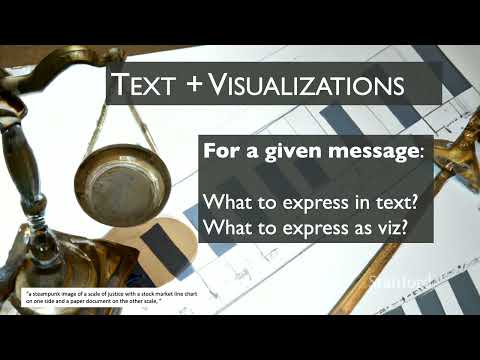
For more information about Stanford’s graduate programs, visit: https://online.stanford.edu/graduate-education March 13, 2026 This lecture covers: • Text, visualization, and their combination • The role of language in information visualization • How to decide what to express...
For more information about Stanford’s graduate programs, visit: https://online.stanford.edu/graduate-education
March 13, 2026
This lecture covers:
• Text, visualization, and their combination
• The role of language in information visualization
• How to decide what to express via language vs via visualization
• How to choose what kind of text to use when creating visualizations, and does that choice matter?
• Does anyone prefer text over visuals, under what circumstances, and why?
• How multimodal large language models figure into this
To follow along with the seminar schedule, visit: https://hci.stanford.edu/
Marti Hearst is a Professor in the UC Berkeley School of Information and the Computer Science Division.
For more information about Stanford’s Artificial Intelligence professional and graduate programs, visit: https://stanford.io/ai For information on the graduate course, CS229 Machine Learning, including the syllabus and course materials, visit the course's website:...
For more information about Stanford’s Artificial Intelligence professional and graduate programs, visit: https://stanford.io/ai
For information on the graduate course, CS229 Machine Learning, including the syllabus and course materials, visit the course's website: https://cs229.stanford.edu/index.html-spr26
Teaching Team:
Chris Ré, Professor of Computer Science
Tengyu Ma, Assistant Professor of Computer Science
For more information about Stanford’s Artificial Intelligence professional and graduate programs, visit: https://stanford.io/ai For information on the graduate course, CS229 Machine Learning, including the syllabus and course materials, visit the course's website:...
For more information about Stanford’s Artificial Intelligence professional and graduate programs, visit: https://stanford.io/ai
For information on the graduate course, CS229 Machine Learning, including the syllabus and course materials, visit the course's website: https://cs229.stanford.edu/index.html-spr26
Teaching Team:
Chris Ré, Professor of Computer Science
Tengyu Ma, Assistant Professor of Computer Science
For more information about Stanford’s Artificial Intelligence professional and graduate programs, visit: https://stanford.io/ai For information on the graduate course, CS229 Machine Learning, including the syllabus and course materials, visit the course's website:...
For more information about Stanford’s Artificial Intelligence professional and graduate programs, visit: https://stanford.io/ai
For information on the graduate course, CS229 Machine Learning, including the syllabus and course materials, visit the course's website: https://cs229.stanford.edu/index.html-spr26
Teaching Team:
Chris Ré, Professor of Computer Science
Tengyu Ma, Assistant Professor of Computer Science
For more information about Stanford’s Artificial Intelligence professional and graduate programs, visit: https://stanford.io/ai For information on the graduate course, CS229 Machine Learning, including the syllabus and course materials, visit the course's website:...
For more information about Stanford’s Artificial Intelligence professional and graduate programs, visit: https://stanford.io/ai
For information on the graduate course, CS229 Machine Learning, including the syllabus and course materials, visit the course's website: https://cs229.stanford.edu/index.html-spr26
Teaching Team:
Chris Ré, Professor of Computer Science
Tengyu Ma, Assistant Professor of Computer Science
For more information about Stanford’s Artificial Intelligence professional and graduate programs, visit: https://stanford.io/ai For information on the graduate course, CS229 Machine Learning, including the syllabus and course materials, visit the course's website:...
For more information about Stanford’s Artificial Intelligence professional and graduate programs, visit: https://stanford.io/ai
For information on the graduate course, CS229 Machine Learning, including the syllabus and course materials, visit the course's website: https://cs229.stanford.edu/index.html-spr26
Teaching Team:
Chris Ré, Professor of Computer Science
Tengyu Ma, Assistant Professor of Computer Science
For more information about Stanford’s Artificial Intelligence professional and graduate programs, visit: https://stanford.io/ai For information on the graduate course, CS229 Machine Learning, including the syllabus and course materials, visit the course's website:...
For more information about Stanford’s Artificial Intelligence professional and graduate programs, visit: https://stanford.io/ai
For information on the graduate course, CS229 Machine Learning, including the syllabus and course materials, visit the course's website: https://cs229.stanford.edu/index.html-spr26
Teaching Team:
Chris Ré, Professor of Computer Science
Tengyu Ma, Assistant Professor of Computer Science
For more information about Stanford’s Artificial Intelligence professional and graduate programs, visit: https://stanford.io/ai For information on the graduate course, CS229 Machine Learning, including the syllabus and course materials, visit the course's website:...
For more information about Stanford’s Artificial Intelligence professional and graduate programs, visit: https://stanford.io/ai
For information on the graduate course, CS229 Machine Learning, including the syllabus and course materials, visit the course's website: https://cs229.stanford.edu/index.html-spr26
Teaching Team:
Chris Ré, Professor of Computer Science
Tengyu Ma, Assistant Professor of Computer Science
The DEC PDP computers from decades ago now comfortably run on a cheap computer such as a Raspberry Pi. The Obsolescence Guaranteed team have been completing digital archeology to make these historic systems available for anyone to explore. Lars Brinkhoff and Oscar Vermeulen...
The DEC PDP computers from decades ago now comfortably run on a cheap computer such as a Raspberry Pi. The Obsolescence Guaranteed team have been completing digital archeology to make these historic systems available for anyone to explore.
Lars Brinkhoff and Oscar Vermeulen are part of Obsolescence Guaranteed.
Find out more about them and the project at:
https://obsolescence.dev/
Computerphile is supported by Jane Street. Learn more about them (and exciting career opportunities) at: https://jane-st.co/computerphile
This video was filmed and edited by Sean Riley.
Computerphile is a sister project to Brady Haran's Numberphile. More at https://www.bradyharanblog.com
Microsoft published the source code to its 6502 version of BASIC a while ago. It used to run on computers like the Apple II and the Commodore Pet. It has now been ported to C so that you can try it on a modern PC with Windows, Linux, or macOS. ---...
Microsoft published the source code to its 6502 version of BASIC a while ago. It used to run on computers like the Apple II and the Commodore Pet. It has now been ported to C so that you can try it on a modern PC with Windows, Linux, or macOS.
---
https://github.com/garyexplains/BASIC-M6502-CPORT/tree/main
X: https://twitter.com/garyexplains
GitHub: https://github.com/garyexplains
#garyexplains
For more information about Stanford’s Artificial Intelligence professional and graduate programs, visit: https://stanford.io/ai For information on the graduate course, CS229 Machine Learning, including the syllabus and course materials, visit the course's website:...
For more information about Stanford’s Artificial Intelligence professional and graduate programs, visit: https://stanford.io/ai
For information on the graduate course, CS229 Machine Learning, including the syllabus and course materials, visit the course's website: https://cs229.stanford.edu/index.html-spr26
Teaching Team:
Chris Ré, Professor of Computer Science
Tengyu Ma, Assistant Professor of Computer Science
For more information about Stanford’s Artificial Intelligence professional and graduate programs, visit: https://stanford.io/ai For information on the graduate course, CS229 Machine Learning, including the syllabus and course materials, visit the course's website:...
For more information about Stanford’s Artificial Intelligence professional and graduate programs, visit: https://stanford.io/ai
For information on the graduate course, CS229 Machine Learning, including the syllabus and course materials, visit the course's website: https://cs229.stanford.edu/index.html-spr26
Teaching Team:
Chris Ré, Professor of Computer Science
Tengyu Ma, Assistant Professor of Computer Science
For more information about Stanford’s Artificial Intelligence professional and graduate programs, visit: https://stanford.io/ai For information on the graduate course, CS229 Machine Learning, including the syllabus and course materials, visit the course's website:...
For more information about Stanford’s Artificial Intelligence professional and graduate programs, visit: https://stanford.io/ai
For information on the graduate course, CS229 Machine Learning, including the syllabus and course materials, visit the course's website: https://cs229.stanford.edu/index.html-spr26
Teaching Team:
Chris Ré, Professor of Computer Science
Tengyu Ma, Assistant Professor of Computer Science
For more information about Stanford’s Artificial Intelligence professional and graduate programs, visit: https://stanford.io/ai For information on the graduate course, CS229 Machine Learning, including the syllabus and course materials, visit the course's website:...
For more information about Stanford’s Artificial Intelligence professional and graduate programs, visit: https://stanford.io/ai
For information on the graduate course, CS229 Machine Learning, including the syllabus and course materials, visit the course's website: https://cs229.stanford.edu/index.html-spr26
Teaching Team:
Chris Ré, Professor of Computer Science
Tengyu Ma, Assistant Professor of Computer Science
For more information about Stanford’s Artificial Intelligence professional and graduate programs, visit: https://stanford.io/ai For information on the graduate course, CS229 Machine Learning, including the syllabus and course materials, visit the course's website:...
For more information about Stanford’s Artificial Intelligence professional and graduate programs, visit: https://stanford.io/ai
For information on the graduate course, CS229 Machine Learning, including the syllabus and course materials, visit the course's website: https://cs229.stanford.edu/index.html-spr26
Teaching Team:
Chris Ré, Professor of Computer Science
Tengyu Ma, Assistant Professor of Computer Science
For more information about Stanford’s Artificial Intelligence professional and graduate programs, visit: https://stanford.io/ai For information on the graduate course, CS229 Machine Learning, including the syllabus and course materials, visit the course's website:...
For more information about Stanford’s Artificial Intelligence professional and graduate programs, visit: https://stanford.io/ai
For information on the graduate course, CS229 Machine Learning, including the syllabus and course materials, visit the course's website: https://cs229.stanford.edu/index.html-spr26
Teaching Team:
Chris Ré, Professor of Computer Science
Tengyu Ma, Assistant Professor of Computer Science
ITS is the Incompatible Timesharing System. Academics at the MIT AI Lab didn't like earlier incarnations of time-sharing so they invented their own. Lars Brinkhoff and Oscar Vermeulen explain and demonstrate this segment of Computing history which they've worked to bring back...
ITS is the Incompatible Timesharing System. Academics at the MIT AI Lab didn't like earlier incarnations of time-sharing so they invented their own.
Lars Brinkhoff and Oscar Vermeulen explain and demonstrate this segment of Computing history which they've worked to bring back in simulation for everyone to enjoy.
Find out more about them and the project at:
https://obsolescence.dev/
Computerphile is supported by Jane Street. Learn more about them (and exciting career opportunities) at: https://jane-st.co/computerphile
This video was filmed and edited by Sean Riley.
Computerphile is a sister project to Brady Haran's Numberphile. More at https://www.bradyharanblog.com
For more information about Stanford’s Artificial Intelligence professional and graduate programs, visit: https://stanford.io/ai For information on the graduate course, CS229 Machine Learning, including the syllabus and course materials, visit the course's website:...
For more information about Stanford’s Artificial Intelligence professional and graduate programs, visit: https://stanford.io/ai
For information on the graduate course, CS229 Machine Learning, including the syllabus and course materials, visit the course's website: https://cs229.stanford.edu/index.html-spr26
Teaching Team:
Chris Ré, Professor of Computer Science
Tengyu Ma, Assistant Professor of Computer Science
For more information about Stanford’s Artificial Intelligence professional and graduate programs, visit: https://stanford.io/ai For information on the graduate course, CS229 Machine Learning, including the syllabus and course materials, visit the course's website:...
For more information about Stanford’s Artificial Intelligence professional and graduate programs, visit: https://stanford.io/ai
For information on the graduate course, CS229 Machine Learning, including the syllabus and course materials, visit the course's website: https://cs229.stanford.edu/index.html-spr26
Teaching Team:
Chris Ré, Professor of Computer Science
Tengyu Ma, Assistant Professor of Computer Science
For more information about Stanford’s Artificial Intelligence professional and graduate programs, visit: https://stanford.io/ai For information on the graduate course, CS229 Machine Learning, including the syllabus and course materials, visit the course's website:...
For more information about Stanford’s Artificial Intelligence professional and graduate programs, visit: https://stanford.io/ai
For information on the graduate course, CS229 Machine Learning, including the syllabus and course materials, visit the course's website: https://cs229.stanford.edu/index.html-spr26
Teaching Team:
Chris Ré, Professor of Computer Science
Tengyu Ma, Assistant Professor of Computer Science
For more information about Stanford’s Artificial Intelligence professional and graduate programs, visit: https://stanford.io/ai For information on the graduate course, CS229 Machine Learning, including the syllabus and course materials, visit the course's website:...
For more information about Stanford’s Artificial Intelligence professional and graduate programs, visit: https://stanford.io/ai
For information on the graduate course, CS229 Machine Learning, including the syllabus and course materials, visit the course's website: https://cs229.stanford.edu/index.html-spr26
Teaching Team:
Chris Ré, Professor of Computer Science
Tengyu Ma, Assistant Professor of Computer Science
Enrollment in the graduate course AA228 Decision Making Under Uncertainty is open now: https://stanford.io/AA228 Browse all graduate courses available this autumn quarter: https://stanford.io/Autumn-2026 Associate Professor of Aeronautics and Astronautics Mykel Kochenderfer...
Enrollment in the graduate course AA228 Decision Making Under Uncertainty is open now: https://stanford.io/AA228
Browse all graduate courses available this autumn quarter: https://stanford.io/Autumn-2026
Associate Professor of Aeronautics and Astronautics Mykel Kochenderfer explains POMDP and how using it can maximize decision-making.
Learn details about our Generative AI: Technology, Society, and Business Program ➡️ https://stanford.io/Gen-AI Professor James Landay, Co-Founder and Co-Director of the Stanford Institute for Human-centered Artificial Intelligence (HAI), explains the AI skills that matter most.
Learn details about our Generative AI: Technology, Society, and Business Program ➡️ https://stanford.io/Gen-AI
Professor James Landay, Co-Founder and Co-Director of the Stanford Institute for Human-centered Artificial Intelligence (HAI), explains the AI skills that matter most.
The excitement of video games from the 8-bit home video era but decades earlier and with a few zeroes added to the price tag the PDP10 was a lot of machine for the late '60's! Computerphile is supported by Jane Street. Learn more about them (and exciting career opportunities)...
The excitement of video games from the 8-bit home video era but decades earlier and with a few zeroes added to the price tag the PDP10 was a lot of machine for the late '60's!
Computerphile is supported by Jane Street. Learn more about them (and exciting career opportunities) at: https://jane-st.co/computerphile
This video was filmed and edited by Sean Riley.
Computerphile is a sister project to Brady Haran's Numberphile. More at https://www.bradyharanblog.com
Learn details about our Generative AI: Technology, Society, and Business Program ➡️ https://stanford.io/Gen-AI James Landay is a Professor of Computer Science and the Anand Rajaraman and Venky Harinarayan Professor in the School of Engineering at Stanford University. He...
Learn details about our Generative AI: Technology, Society, and Business Program ➡️ https://stanford.io/Gen-AI
James Landay is a Professor of Computer Science and the Anand Rajaraman and Venky Harinarayan Professor in the School of Engineering at Stanford University. He specializes in human-computer interaction. Landay is the Co-Founder and Co-Director of the Stanford Institute for Human-centered Artificial Intelligence (HAI).
Enrollment in the graduate course AA228 Decision Making Under Uncertainty is open now: https://stanford.io/AA228 Hear about this course and learn why Associate Professor of Aeronautics and Astronautics, Mykel Kochenderfer, loves it. Discover what you'll learn and how it will...
Enrollment in the graduate course AA228 Decision Making Under Uncertainty is open now: https://stanford.io/AA228
Hear about this course and learn why Associate Professor of Aeronautics and Astronautics, Mykel Kochenderfer, loves it. Discover what you'll learn and how it will impact your decision-making process.
The Decision Making Under Uncertainty graduate course is designed to increase awareness and appreciation for why uncertainty matters, particularly for aerospace applications.
Browse all graduate courses available this autumn quarter: https://stanford.io/Autumn-2026
View past AA228 Decision Making Under Uncertainty lectures here: https://www.youtube.com/playlist?list=PLoROMvodv4rNXnHUlDJ1jnvZgNN5Q60d3
The PDP6 was a DEC computer from the early 1960's - Angelo Papenhoff takes us through the machine and shows us some Lisp 'Poetry' Computerphile is supported by Jane Street. Learn more about them (and exciting career opportunities) at: https://jane-st.co/computerphile This...
The PDP6 was a DEC computer from the early 1960's - Angelo Papenhoff takes us through the machine and shows us some Lisp 'Poetry'
Computerphile is supported by Jane Street. Learn more about them (and exciting career opportunities) at: https://jane-st.co/computerphile
This video was filmed and edited by Sean Riley.
Computerphile is a sister project to Brady Haran's Numberphile. More at https://www.bradyharanblog.com
TerraMaster TOS 7 has OpenClaw integrated directly into the OS including special skills for administering the NAS unit. It understands drives, networks shares, backups, system management, etc. In this video I show you how to set up and use OpenClaw on a TerraMaster F6-425...
TerraMaster TOS 7 has OpenClaw integrated directly into the OS including special skills for administering the NAS unit. It understands drives, networks shares, backups, system management, etc. In this video I show you how to set up and use OpenClaw on a TerraMaster F6-425 Pro.
---
Amazon link for the F6-425 Pro:
https://www.amazon.com/dp/B0H4FDN7ZW
X: https://twitter.com/garyexplains
GitHub: https://github.com/garyexplains
#garyexplains
Discover the power of LLM Tool Calling (also known as function calling). In this video, you'll learn how Large Language Models can intelligently call external tools, APIs, and functions to solve real-world tasks, access live data, and use local computing power. --- X:...
Discover the power of LLM Tool Calling (also known as function calling). In this video, you'll learn how Large Language Models can intelligently call external tools, APIs, and functions to solve real-world tasks, access live data, and use local computing power.
---
X: https://twitter.com/garyexplains
GitHub: https://github.com/garyexplains
#garyexplains
MIT 14.129 Blockchain and the Design of Financial Systems, Spring 2025 Instructor: Robert M. Townsend View the complete course: https://ocw.mit.edu/courses/14-129-blockchain-and-the-design-of-financial-systems-spring-2025 YouTube Playlist:...
MIT 14.129 Blockchain and the Design of Financial Systems, Spring 2025
Instructor: Robert M. Townsend
View the complete course: https://ocw.mit.edu/courses/14-129-blockchain-and-the-design-of-financial-systems-spring-2025
YouTube Playlist: https://www.youtube.com/playlist?list=PLUl4u3cNGP60gb6cVqrZQXQ217r0PwZJg
This lecture covers the commodity space, the policy objective, implementation with privately issued securities, uncoordinated Issues, and market crises.
License: Creative Commons BY-NC-SA
More information at https://ocw.mit.edu/terms
More courses at https://ocw.mit.edu
Support OCW at http://ow.ly/a1If50zVRlQ
We encourage constructive comments and discussion on OCW’s YouTube and other social media channels. Personal attacks, hate speech, trolling, and inappropriate comments are not allowed and may be removed. More details at https://ocw.mit.edu/comments.
MIT 14.129 Blockchain and the Design of Financial Systems, Spring 2025 Instructor: Robert M. Townsend View the complete course: https://ocw.mit.edu/courses/14-129-blockchain-and-the-design-of-financial-systems-spring-2025 YouTube Playlist:...
MIT 14.129 Blockchain and the Design of Financial Systems, Spring 2025
Instructor: Robert M. Townsend
View the complete course: https://ocw.mit.edu/courses/14-129-blockchain-and-the-design-of-financial-systems-spring-2025
YouTube Playlist: https://www.youtube.com/playlist?list=PLUl4u3cNGP60gb6cVqrZQXQ217r0PwZJg
This lecture covers auctions, hybrid credit, and insurance.
License: Creative Commons BY-NC-SA
More information at https://ocw.mit.edu/terms
More courses at https://ocw.mit.edu
Support OCW at http://ow.ly/a1If50zVRlQ
We encourage constructive comments and discussion on OCW’s YouTube and other social media channels. Personal attacks, hate speech, trolling, and inappropriate comments are not allowed and may be removed. More details at https://ocw.mit.edu/comments.
MIT 14.129 Blockchain and the Design of Financial Systems, Spring 2025 Instructor: Robert M. Townsend View the complete course: https://ocw.mit.edu/courses/14-129-blockchain-and-the-design-of-financial-systems-spring-2025 YouTube Playlist:...
MIT 14.129 Blockchain and the Design of Financial Systems, Spring 2025
Instructor: Robert M. Townsend
View the complete course: https://ocw.mit.edu/courses/14-129-blockchain-and-the-design-of-financial-systems-spring-2025
YouTube Playlist: https://www.youtube.com/playlist?list=PLUl4u3cNGP60gb6cVqrZQXQ217r0PwZJg
This lecture addresses liquidity and the value of key players versus contagion dynamics.
License: Creative Commons BY-NC-SA
More information at https://ocw.mit.edu/terms
More courses at https://ocw.mit.edu
Support OCW at http://ow.ly/a1If50zVRlQ
We encourage constructive comments and discussion on OCW’s YouTube and other social media channels. Personal attacks, hate speech, trolling, and inappropriate comments are not allowed and may be removed. More details at https://ocw.mit.edu/comments.
MIT 14.129 Blockchain and the Design of Financial Systems, Spring 2025 Instructor: Robert M. Townsend View the complete course: https://ocw.mit.edu/courses/14-129-blockchain-and-the-design-of-financial-systems-spring-2025 YouTube Playlist:...
MIT 14.129 Blockchain and the Design of Financial Systems, Spring 2025
Instructor: Robert M. Townsend
View the complete course: https://ocw.mit.edu/courses/14-129-blockchain-and-the-design-of-financial-systems-spring-2025
YouTube Playlist: https://www.youtube.com/playlist?list=PLUl4u3cNGP60gb6cVqrZQXQ217r0PwZJg
This lecture covers private information, the incentives to report and take actions, the Byzantine Generals problem, and the differences between economics' and computer science's approaches to algorithms and trust.
License: Creative Commons BY-NC-SA
More information at https://ocw.mit.edu/terms
More courses at https://ocw.mit.edu
Support OCW at http://ow.ly/a1If50zVRlQ
We encourage constructive comments and discussion on OCW’s YouTube and other social media channels. Personal attacks, hate speech, trolling, and inappropriate comments are not allowed and may be removed. More details at https://ocw.mit.edu/comments.
MIT 14.129 Blockchain and the Design of Financial Systems, Spring 2025 Instructor: Robert M. Townsend View the complete course: https://ocw.mit.edu/courses/14-129-blockchain-and-the-design-of-financial-systems-spring-2025 YouTube Playlist:...
MIT 14.129 Blockchain and the Design of Financial Systems, Spring 2025
Instructor: Robert M. Townsend
View the complete course: https://ocw.mit.edu/courses/14-129-blockchain-and-the-design-of-financial-systems-spring-2025
YouTube Playlist: https://www.youtube.com/playlist?list=PLUl4u3cNGP60gb6cVqrZQXQ217r0PwZJg
This lecture covers fragmented markets, policy objectives, regulatory solutions, distributed ledgers as a technology solution, and statics.
License: Creative Commons BY-NC-SA
More information at https://ocw.mit.edu/terms
More courses at https://ocw.mit.edu
Support OCW at http://ow.ly/a1If50zVRlQ
We encourage constructive comments and discussion on OCW’s YouTube and other social media channels. Personal attacks, hate speech, trolling, and inappropriate comments are not allowed and may be removed. More details at https://ocw.mit.edu/comments.
MIT 14.129 Blockchain and the Design of Financial Systems, Spring 2025 Instructor: Tomaž Fleischman View the complete course: https://ocw.mit.edu/courses/14-129-blockchain-and-the-design-of-financial-systems-spring-2025 YouTube Playlist:...
MIT 14.129 Blockchain and the Design of Financial Systems, Spring 2025
Instructor: Tomaž Fleischman
View the complete course: https://ocw.mit.edu/courses/14-129-blockchain-and-the-design-of-financial-systems-spring-2025
YouTube Playlist: https://www.youtube.com/playlist?list=PLUl4u3cNGP60gb6cVqrZQXQ217r0PwZJg
This lecture explains how analysis of financial networks can reveal loops of trade credit, which can be eliminated to clear outstanding debts of multiple parties at once.
License: Creative Commons BY-NC-SA
More information at https://ocw.mit.edu/terms
More courses at https://ocw.mit.edu
Support OCW at http://ow.ly/a1If50zVRlQ
We encourage constructive comments and discussion on OCW’s YouTube and other social media channels. Personal attacks, hate speech, trolling, and inappropriate comments are not allowed and may be removed. More details at https://ocw.mit.edu/comments.
MIT 14.129 Blockchain and the Design of Financial Systems, Spring 2025 Instructor: Samuel Bruce View the complete course: https://ocw.mit.edu/courses/14-129-blockchain-and-the-design-of-financial-systems-spring-2025 YouTube Playlist:...
MIT 14.129 Blockchain and the Design of Financial Systems, Spring 2025
Instructor: Samuel Bruce
View the complete course: https://ocw.mit.edu/courses/14-129-blockchain-and-the-design-of-financial-systems-spring-2025
YouTube Playlist: https://www.youtube.com/playlist?list=PLUl4u3cNGP60gb6cVqrZQXQ217r0PwZJg
This lecture covers algorithmic game theory using correlated equilibria and computationally feasible algorithms,
License: Creative Commons BY-NC-SA
More information at https://ocw.mit.edu/terms
More courses at https://ocw.mit.edu
Support OCW at http://ow.ly/a1If50zVRlQ
We encourage constructive comments and discussion on OCW’s YouTube and other social media channels. Personal attacks, hate speech, trolling, and inappropriate comments are not allowed and may be removed. More details at https://ocw.mit.edu/comments.
MIT 14.129 Blockchain and the Design of Financial Systems, Spring 2025 Instructor: Robert M. Townsend View the complete course: https://ocw.mit.edu/courses/14-129-blockchain-and-the-design-of-financial-systems-spring-2025 YouTube Playlist:...
MIT 14.129 Blockchain and the Design of Financial Systems, Spring 2025
Instructor: Robert M. Townsend
View the complete course: https://ocw.mit.edu/courses/14-129-blockchain-and-the-design-of-financial-systems-spring-2025
YouTube Playlist: https://www.youtube.com/playlist?list=PLUl4u3cNGP60gb6cVqrZQXQ217r0PwZJg
In this lecture, Prof. Townsend gives a quick summary of the topics to be covered in the course.
License: Creative Commons BY-NC-SA
More information at https://ocw.mit.edu/terms
More courses at https://ocw.mit.edu
Support OCW at http://ow.ly/a1If50zVRlQ
We encourage constructive comments and discussion on OCW’s YouTube and other social media channels. Personal attacks, hate speech, trolling, and inappropriate comments are not allowed and may be removed. More details at https://ocw.mit.edu/comments.
MIT 14.129 Blockchain and the Design of Financial Systems, Spring 2025 Instructor: Robert M. Townsend View the complete course: https://ocw.mit.edu/courses/14-129-blockchain-and-the-design-of-financial-systems-spring-2025 YouTube Playlist:...
MIT 14.129 Blockchain and the Design of Financial Systems, Spring 2025
Instructor: Robert M. Townsend
View the complete course: https://ocw.mit.edu/courses/14-129-blockchain-and-the-design-of-financial-systems-spring-2025
YouTube Playlist: https://www.youtube.com/playlist?list=PLUl4u3cNGP60gb6cVqrZQXQ217r0PwZJg
This lecture covers public and private keys, encoded messages, hashes, cryptographic puzzles, homomorphic encryption, multiparty computation, and zero knowledge proofs.
License: Creative Commons BY-NC-SA
More information at https://ocw.mit.edu/terms
More courses at https://ocw.mit.edu
Support OCW at http://ow.ly/a1If50zVRlQ
We encourage constructive comments and discussion on OCW’s YouTube and other social media channels. Personal attacks, hate speech, trolling, and inappropriate comments are not allowed and may be removed. More details at https://ocw.mit.edu/comments.
MIT 14.129 Blockchain and the Design of Financial Systems, Spring 2025 Instructor: Robert M. Townsend View the complete course: https://ocw.mit.edu/courses/14-129-blockchain-and-the-design-of-financial-systems-spring-2025 YouTube Playlist:...
MIT 14.129 Blockchain and the Design of Financial Systems, Spring 2025
Instructor: Robert M. Townsend
View the complete course: https://ocw.mit.edu/courses/14-129-blockchain-and-the-design-of-financial-systems-spring-2025
YouTube Playlist: https://www.youtube.com/playlist?list=PLUl4u3cNGP60gb6cVqrZQXQ217r0PwZJg
This lecture provides a unified view of distributed ledgers and financial accounts as databases, distinct views of money, and the larger community perspective.
License: Creative Commons BY-NC-SA
More information at https://ocw.mit.edu/terms
More courses at https://ocw.mit.edu
Support OCW at http://ow.ly/a1If50zVRlQ
We encourage constructive comments and discussion on OCW’s YouTube and other social media channels. Personal attacks, hate speech, trolling, and inappropriate comments are not allowed and may be removed. More details at https://ocw.mit.edu/comments.