Want to restore the planet’s ecosystems and see your impact in monthly videos? The first 100 people to join Planet Wild with my code DOMAIN4 will get the first month for free: https://planetwild.com/r/domainofscience/join If you want to get to know them better first, check...
Want to restore the planet’s ecosystems and see your impact in monthly videos? The first 100 people to join Planet Wild with my code DOMAIN4 will get the first month for free: https://planetwild.com/r/domainofscience/join
If you want to get to know them better first, check out their mission fighting ocean plastic in India: https://planetwild.com/r/domainofscience/m34
Since starting this channel I've made 17 maps covering many areas of physics. And one thing this has taught me is that physics itself is still incomplete, there are many mysteries in the universe we still don't understand. This makes me wonder, in the future, will we ever be able to complete physics, and understand everything in the universe? And if not, what's stopping us?
Get the maps: https://www.dosmaps.com
Here's my Instagram: https://www.instagram.com/dcwalliman
Patreon: https://www.patreon.com/ScienceMaps
Showing exactly where our knowledge of the Universe comes from. Get yourself both a 30-day free trial and 20% off a Brilliant premium subscription here: https://brilliant.org/dos/ It's amazing what we know about the Universe based on our observations, but I wondered exactly...
Showing exactly where our knowledge of the Universe comes from. Get yourself both a 30-day free trial and 20% off a Brilliant premium subscription here: https://brilliant.org/dos/
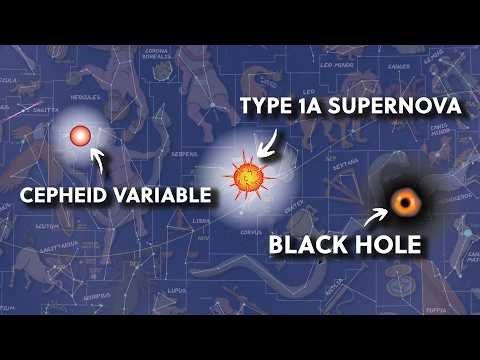
It's amazing what we know about the Universe based on our observations, but I wondered exactly where our knowledge comes from. Literally. So here are the most important locations in the night sky and what they unlocked in our undersanding of the Universe.
Get the maps: https://www.dosmaps.com
Here's my Instagram: https://www.instagram.com/dcwalliman
Patreon: https://www.patreon.com/ScienceMaps
Images from the NASA archive
https://images.nasa.gov/
Music by Bloopatron
https://bloopatron.bandcamp.com/
00:00 Introduction
01:12 Galaxies and Cepheid Varaible Stars
04:18 Supernovae
07:51 Dark Matter
09:55 Gravitational Waves and Black Holes
12:11 Signals from Space
13:15 Nebulae
14:50 Exoplanets
Here's a roundup of all the science advanced of 2025 from space, physics, nuclear fusion, quantum computing, materials science, engineering, 3d printing, chemistry, palaeontology, anthropology, biology, medicine, climate change, environment, AI and maths Wikipedia science...
Here's a roundup of all the science advanced of 2025 from space, physics, nuclear fusion, quantum computing, materials science, engineering, 3d printing, chemistry, palaeontology, anthropology, biology, medicine, climate change, environment, AI and maths
Wikipedia science 2025 https://en.wikipedia.org/wiki/2025_in_science
Quanta Physics 2025 video https://youtu.be/CPoQkE9KaAY?si=Vmy4JDql5uD2Wx_A
Quanta Math 2025 video https://youtu.be/hRpcWpAeWng?si=MnFjCOHnDXZOPcBn
Shoutout to @__gavin__ for the chapter markers
0:00 Intro
2:46 Space
16:07 Physics
21:44 Nuclear Fusion
23:41 Quantum Computing
28:03 Material Science
30:13 Engineering
34:23 3D Printing
35:11 Chemisty
40:04 Electronics (nominally under "chemistry", but clearly misplaced)
43:57 Weird Stuff
46:11 Palaeontology
46:54 Anthropology
47:47 Biology
49:49 Medicine
1:13:17 Climate
1:20:52 Environment
1:26:03 AI
1:31:35 Maths
1:36:43 Book recommendations
Every Constellation In the Sky. Get yourself both a 30-day free trial and 20% off a Brilliant premium subscription here: https://brilliant.org/dos/ I wanted to learn all the constellations so I drew them all, and here they are, all 88 constellations, where they sit in the...
Every Constellation In the Sky. Get yourself both a 30-day free trial and 20% off a Brilliant premium subscription here: https://brilliant.org/dos/
I wanted to learn all the constellations so I drew them all, and here they are, all 88 constellations, where they sit in the night sky and the people who defined them. I also look at the geometry of the night sky, the ecliptic, the constellations of the zodiac and the coverage of the entire northern and southern hemisphere.
Get the maps: https://www.dosmaps.com
Here's my Instagram: https://www.instagram.com/dcwalliman
Patreon: https://www.patreon.com/ScienceMaps
Chapters
00:00 Introduction
00:58 The Constellations and Regions of the Sky
02:05 The Zodiac Constellations
04:00 Geometry of the Sky
09:25 Ptolemy’s Constellations
11:54 Johanas Helevils’ Constellations
14:07 Ptolemy Southern Hemisphere
16:32 Petrus Plancius’ Constellations
18:14 De Lacaille’s Constellations
20:01 It’s Brilliant
The Fascinating World of Fungi. Get yourself 20% off a Brilliant premium subscription here: https://brilliant.org/dos/ In this map of fungi we learn everything we can about fungi in about 20 minutes. They are hugely underappreciated as they are an entire kingdom of life, as...
The Fascinating World of Fungi. Get yourself 20% off a Brilliant premium subscription here: https://brilliant.org/dos/
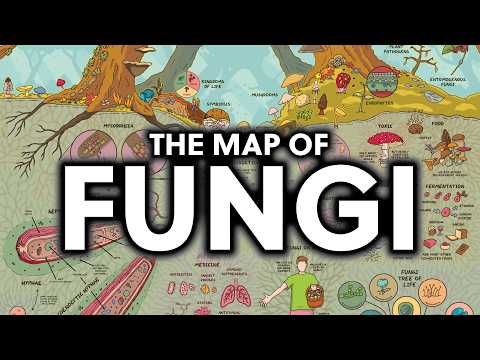
In this map of fungi we learn everything we can about fungi in about 20 minutes. They are hugely underappreciated as they are an entire kingdom of life, as rich as plants and animals, and we use them so much in our day to day lives beyond eating their mushrooms. They are really important for medicine (antibiotics, statins and many more) and nearly all plants on Earth rely on fungi to live. Amazing stuff. I learned so much making this video!
Get the maps: https://www.dosmaps.com
Here's my Instagram: https://www.instagram.com/dcwalliman
Patreon: https://www.patreon.com/ScienceMaps
Special thanks for fact checking and scritp writing support:
Andreas Emilio
Leila Battison
Dr. Irina Druzhinina
Lydia Shellien-Walker
References
Penicillin fermentation By Matt Brown - Flickr, CC BY 2.0, https://commons.wikimedia.org/w/index.php?curid=44757313
Penicillin mould By Teresa María López - Own work, CC BY 4.0, https://commons.wikimedia.org/w/index.php?curid=84327071
Glass phial of penicillin By https://wellcomeimages.org/indexplus/obf_images/12/d4/a9331961bf9ec04b09fa2f7fffb8.jpgGallery: https://wellcomeimages.org/indexplus/image/L0059573.htmlWellcome Collection gallery (2018-03-29): https://wellcomecollection.org/works/xkbnmutd CC-BY-4.0, CC BY 4.0, https://commons.wikimedia.org/w/index.php?curid=36214535
Fungal Highway https://www.life-science-alliance.org/content/3/12/e202000878/tab-figures-data
Therapy brain connections By G. Petri, P. Expert, F. Turkheimer, R. Carhart-Harris, D. Nutt, P. J. Hellyer and F. Vaccarino - https://doi.org/10.1098/rsif.2014.0873, CC BY-SA 4.0, https://commons.wikimedia.org/w/index.php?curid=109269936
Mycelium image By Christian Scheckhuber - Own work, CC BY-SA 4.0, https://commons.wikimedia.org/w/index.php?curid=44748236
Oomycete By (Reproduced courtesy of Matteo Garbelotto, UC Berkeley [A, D], and Edwin R. Florance, Lewis & Clark College [Portland, Oregon, United States] and the USDA Forest Service Pacific Southwest Research Station in Albany, California [B, C].) - Nicholls H: Stopping the Rot. PLoS Biol 2/7/2004: e213. https://dx.doi.org/10.1371/journal.pbio.0020213, CC BY 2.5, https://commons.wikimedia.org/w/index.php?curid=1374427
Slime mould By Alexis Tinker-Tsavalas - https://www.inaturalist.org/photos/176600092, CC BY 4.0, https://commons.wikimedia.org/w/index.php?curid=128264220
Chapters
00:00 Introduction to Fungi
01:19 Fungal Biology
05:43 Ecology
07:09 Mycorrhiza
08:37 Other Fungal Relationships
10:26 Zombie Ants
11:19 Fungi in Medicine
12:50 Bacterial Highways
13:37 Technology, Food and Poison
15:31 Psychotropics and Fermentation
16:55 Fungi on Us
18:01 Fungal Reproduction
18:51 Spores
19:57 Fungal Tree of Life
Today is July the 3rd. And for us humans on earth, today is the day that we're the furthest away from the sun that we’ll be all year. So why is it so warm? Where I live, it's summertime and we've just gone through our first heatwave of the year, and you'd think it would be...
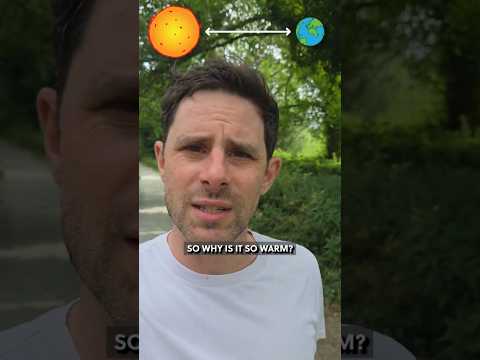
Today is July the 3rd. And for us humans on earth, today is the day that we're the furthest away from the sun that we’ll be all year. So why is it so warm? Where I live, it's summertime and we've just gone through our first heatwave of the year, and you'd think it would be cold when you're far away from the sun and warm when you're close to the sun. On the 3rd of January. But it's the other way around. This can all be explained by the fact the earth has a tilted axis like my head. Right now, in the summer, we're tilted towards the sun, so we're getting more heat from it. Just to give you some concrete numbers. We're getting about 7% less energy from the sun by being far away now compared to January the 3rd, when we're closer, we get 7% more. But the difference in tilt means tilting towards the sun gives about 500 percent as much energy as being tilted away. For here in London. It obviously varies depending on how high up or down in latitude you are. And obviously everything's flipped for the southern hemisphere because it's their winter at the moment, so it does kind of make sense for them. But it's interesting. This combination means that in the Northern Hemisphere we have slightly longer summers and slightly shorter winters, whereas in the southern hemisphere it's the opposite way around. They have slightly shorter summers and slightly longer winters. So in conclusion, as they always say, nobody cares how far away you are from the sun. If you've got a wonky axis.
I recently got to visit the anti-matter factory at CERN. This is the only place in the world where they've managed to make antihydrogen. This is antihydrogen. It's an atom of antimatter made of an anti electron, also known as a positron and an antiproton in the middle. This...
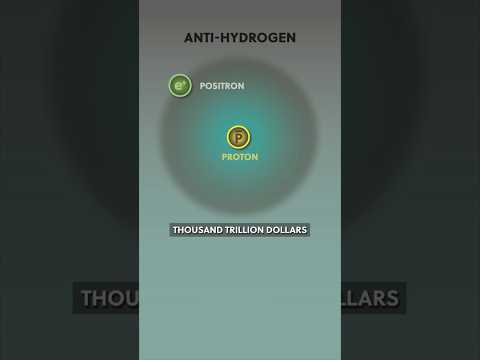
I recently got to visit the anti-matter factory at CERN. This is the only place in the world where they've managed to make antihydrogen. This is antihydrogen. It's an atom of antimatter made of an anti electron, also known as a positron and an antiproton in the middle. This is arguably the most expensive material in the world, costing an estimated thousand trillion dollars per gram.
They have to be incredibly careful with this antimatter, because it's a kind of opposite matter to what our world's made from. So if the antimatter touches literally anything, it will annihilate, immediately turning all of its mass into pure energy. Fortunately, antihydrogen is slightly magnetic, so the scientists at CERN can stop it from touching anything by hovering it in a magnetic field called a penning trap.
After the Big Bang, half of the universe was made of anti-matter and the other half normal matter. According to many of our best theories of cosmology. But today we don't see any antimatter in the universe and is a mystery where it went. So making anti-matter in the lab means we can study its properties, which might give us some clues about what happened to half a universe’s worth of anti-matter.
This experiment I visited tested which direction antihydrogen would fall in gravity. Would it fall down like matter? Or because it's anti-matter? Would it fall up? Turns out it did fall down slightly. Disappointing, because now I can't invent hoverboards. But it's really cool for me to actually see the actual experiment from when all of that news came out. So it's pretty cool to be in an anti-matter factory.
For a great overview of all of particle physics, check out this YouTube video The Map of Particle Physics, and you can grab the poster at dosmaps dot com
It might look like I'm using my Jedi powers to control a droid, but in reality, I'm at CERN in Switzerland and I'm in their robotics lab. This is where they build the robots to help them with their high energy experiments. This is a mock up of the beamline, and this is used...
It might look like I'm using my Jedi powers to control a droid, but in reality, I'm at CERN in Switzerland and I'm in their robotics lab. This is where they build the robots to help them with their high energy experiments. This is a mock up of the beamline, and this is used to test out their robots. The beam line is where they fire high energy particles at each other underground.
And this isn't a safe environment for humans because of radiation. So instead we can send in robots, which we can control remotely, which was what I was doing here. This robot's got wheels, which lets it move in every direction, even sideways, like a crab. So these can be controlled with a keyboard or with a gamepad, or even through this augmented reality display.
This robot has a spinning lidar scanner that builds a 3D model of the room it's in, and it can fit through small holes. And this one runs on a rail and can reach all around the beam line. It's got a radiation detector which monitors radiation levels after the beam is turned off, to see when it's safe for humans to come back into the tunnels.
If you want to find out more, check out my map of Particle Physics video and poster on YouTube.
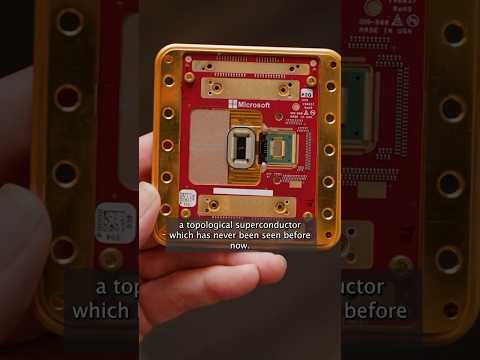
Microsoft just announced their first qubit which is made out of a novel material called a topological superconductor, or topoconductor for short. This is how it is made, using a superconductor layer on top of a semiconductor. If you want to find out more check out Microsoft's...
Microsoft just announced their first qubit which is made out of a novel material called a topological superconductor, or topoconductor for short. This is how it is made, using a superconductor layer on top of a semiconductor. If you want to find out more check out Microsoft's blog:
https://azure.microsoft.com/en-us/blog/quantum/
Microsoft's just unveiled a qubit that uses a topological superconductor material, this is why this material is exciting for quantum computer development, it's resitance to noise. Read more on their blog here: https://azure.microsoft.com/en-us/blog/quantum/
Microsoft's just unveiled a qubit that uses a topological superconductor material, this is why this material is exciting for quantum computer development, it's resitance to noise.
Read more on their blog here: https://azure.microsoft.com/en-us/blog/quantum/
Microsoft have just announced their first topological qubit for their future quantum computers. They use a brand new material to science known as a topological superconductor which gives the qubits some robust proteciton against noise Find out more on Microsoft's blog:...
Microsoft have just announced their first topological qubit for their future quantum computers. They use a brand new material to science known as a topological superconductor which gives the qubits some robust proteciton against noise
Find out more on Microsoft's blog: https://azure.microsoft.com/en-us/blog/quantum/
This is what Google's new development means for the fueld of quantum computing. Google recently unveiled a new quantum computer called willow, and with it they’ve achieved some cool results. Basically here are all the steps you need to accomplish to build a useful quantum...
This is what Google's new development means for the fueld of quantum computing.
Google recently unveiled a new quantum computer called willow, and with it they’ve achieved some cool results.
Basically here are all the steps you need to accomplish to build a useful quantum computer, this is a useful quantum computer here, we’re not there yet, google just made the step from here to here.
That’s a really cool step because it means that they can now do this thing called error correction.
The building blocks of quantum computers are qubits, but these qubits drift away from doing what they should do; it's an unavoidable property of quantum systems called decoherence.
So to make a useful quantum computer you have to keep nudging the qubits back into coherence, that’s called error correction, and it’s really hard to do. So this is a really cool achievement, and it means they can start working on the next steps.
But I should be clear, this quantum computer is not breaking encryption or solving any useful real world problems yet, to do anything useful you need to get to the end of these steps and each of these stepping stones is a huge engineering challenge.
If you want to learn more about quantum computers check out other videos, especially my map of quantum computing video.
#quantum #willow #scitech #science #quantumcomputing
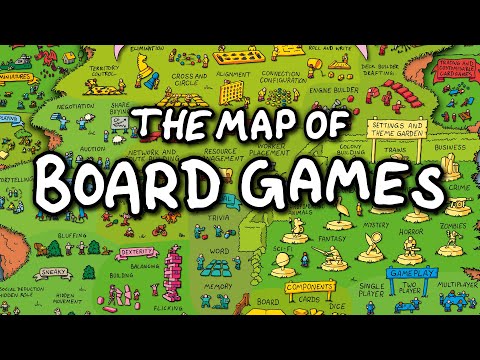
Mapping out all the different kinds of board games. To try everything Brilliant has to offer for free for a full 30 days, visit https://brilliant.org/DOS/ or scan the QR code onscreen. You’ll also get 20% off an annual premium subscription. Get Stabbin’ in the Cabin, Map of...
Mapping out all the different kinds of board games. To try everything Brilliant has to offer for free for a full 30 days, visit https://brilliant.org/DOS/ or scan the QR code onscreen. You’ll also get 20% off an annual premium subscription.
Get Stabbin’ in the Cabin, Map of Board games or the bundle here: https://store.dftba.com/collections/domain-of-science
Get the maps: https://www.dosmaps.com
Here's my Instagram: https://www.instagram.com/dcwalliman
Patreon: https://www.patreon.com/ScienceMaps
Some Awesome People
And many thanks to my $10 supporters and above on Patreon, you are awesome!
Tut Arom
Anja
Jason Evans
machinator rimor
Mirik Gogri
Eric Epstein
Theodore Chu
Special Thanks to Richard Garfield and George Elias for their expertice and help.
Image attributions
Ludo Micha L. Rieser, Attribution, via Wikimedia Commons
https://upload.wikimedia.org/wikipedia/commons/1/10/Ludo-3.jpg
Snakes and Ladders By Jain Miniature - http://www.herenow4u.net/index.php?id=72923, Public Domain, https://commons.wikimedia.org/w/index.php?curid=11471979
Root image by Marco Bakera https://boardgamegeek.com/image/7102726/root
Chapters
00:00 Introduction
01:30 Abstract Games
03:29 Game Categorisation
05:23 Optimisation Mechanics
08:37 Interaction Mechanics
09:26 Board Game Adjacent Games
11:27 Stabbin’ in the Cabin
13:08 Casual Games
14:30 Settings and Themes
15:38 Eurogame vs. Ameritrash
17:36 Styles of Gameplay
19:33 Brilliant Ad