The DEC PDP computers from decades ago now comfortably run on a cheap computer such as a Raspberry Pi. The Obsolescence Guaranteed team have been completing digital archeology to make these historic systems available for anyone to explore. Lars Brinkhoff and Oscar Vermeulen...
The DEC PDP computers from decades ago now comfortably run on a cheap computer such as a Raspberry Pi. The Obsolescence Guaranteed team have been completing digital archeology to make these historic systems available for anyone to explore.
Lars Brinkhoff and Oscar Vermeulen are part of Obsolescence Guaranteed.
Find out more about them and the project at:
https://obsolescence.dev/
Computerphile is supported by Jane Street. Learn more about them (and exciting career opportunities) at: https://jane-st.co/computerphile
This video was filmed and edited by Sean Riley.
Computerphile is a sister project to Brady Haran's Numberphile. More at https://www.bradyharanblog.com
ITS is the Incompatible Timesharing System. Academics at the MIT AI Lab didn't like earlier incarnations of time-sharing so they invented their own. Lars Brinkhoff and Oscar Vermeulen explain and demonstrate this segment of Computing history which they've worked to bring back...
ITS is the Incompatible Timesharing System. Academics at the MIT AI Lab didn't like earlier incarnations of time-sharing so they invented their own.
Lars Brinkhoff and Oscar Vermeulen explain and demonstrate this segment of Computing history which they've worked to bring back in simulation for everyone to enjoy.
Find out more about them and the project at:
https://obsolescence.dev/
Computerphile is supported by Jane Street. Learn more about them (and exciting career opportunities) at: https://jane-st.co/computerphile
This video was filmed and edited by Sean Riley.
Computerphile is a sister project to Brady Haran's Numberphile. More at https://www.bradyharanblog.com
The excitement of video games from the 8-bit home video era but decades earlier and with a few zeroes added to the price tag the PDP10 was a lot of machine for the late '60's! Computerphile is supported by Jane Street. Learn more about them (and exciting career opportunities)...
The excitement of video games from the 8-bit home video era but decades earlier and with a few zeroes added to the price tag the PDP10 was a lot of machine for the late '60's!
Computerphile is supported by Jane Street. Learn more about them (and exciting career opportunities) at: https://jane-st.co/computerphile
This video was filmed and edited by Sean Riley.
Computerphile is a sister project to Brady Haran's Numberphile. More at https://www.bradyharanblog.com
The PDP6 was a DEC computer from the early 1960's - Angelo Papenhoff takes us through the machine and shows us some Lisp 'Poetry' Computerphile is supported by Jane Street. Learn more about them (and exciting career opportunities) at: https://jane-st.co/computerphile This...
The PDP6 was a DEC computer from the early 1960's - Angelo Papenhoff takes us through the machine and shows us some Lisp 'Poetry'
Computerphile is supported by Jane Street. Learn more about them (and exciting career opportunities) at: https://jane-st.co/computerphile
This video was filmed and edited by Sean Riley.
Computerphile is a sister project to Brady Haran's Numberphile. More at https://www.bradyharanblog.com
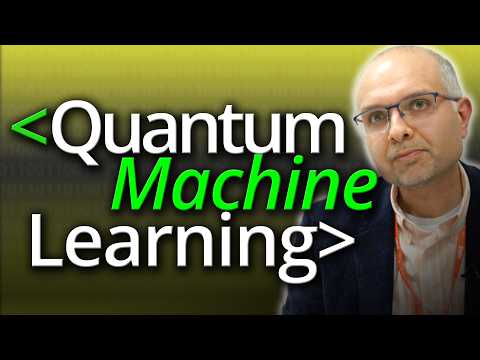
Exploring how quantum computing can have an impact on the established area of Machine Learning. Professor Mohammad Reza Mousavi is a Professor of Software Engineering in the Department of Informatics at King's College London. Computerphile is supported by Jane Street. Learn...
Exploring how quantum computing can have an impact on the established area of Machine Learning. Professor Mohammad Reza Mousavi is a Professor of Software Engineering in the Department of Informatics at King's College London.
Computerphile is supported by Jane Street. Learn more about them (and exciting career opportunities) at: https://jane-st.co/computerphile
This video was filmed and edited by Sean Riley.
Computerphile is a sister project to Brady Haran's Numberphile. More at https://www.bradyharanblog.com
Something odd was going on with the signals broadcast by the GPS satellites. Steven Murdoch of University College London explains how he used statistical analysis to work out what might be going on. To read more about Steven's findings:...
Something odd was going on with the signals broadcast by the GPS satellites. Steven Murdoch of University College London explains how he used statistical analysis to work out what might be going on.
To read more about Steven's findings: https://sjmurdoch.github.io/gps-special-messages/
Computerphile is supported by Jane Street. Learn more about them (and exciting career opportunities) at: https://jane-st.co/computerphile
This video was filmed and edited by Sean Riley.
Computerphile is a sister project to Brady Haran's Numberphile. More at https://www.bradyharanblog.com

We brought a computer scientist and a physicist together to talk about Shor's algorithm - a famous factorisation algorithm for that can break some currently used encryption techniques if implemented in the quantum realm. Phil's accompanying blog post:...
We brought a computer scientist and a physicist together to talk about Shor's algorithm - a famous factorisation algorithm for that can break some currently used encryption techniques if implemented in the quantum realm.
Phil's accompanying blog post: https://muircheartblog.wpcomstaging.com/2026/05/26/quantum-computing-one-universe-is-more-than-enough/
Computerphile is supported by Jane Street. Learn more about them (and exciting career opportunities) at: https://jane-st.co/computerphile
This video was filmed and edited by Sean Riley.
Computerphile is a sister project to Brady Haran's Numberphile. More at https://www.bradyharanblog.com
After changes to pricing structures for LLM powered code assistants, Mike looks at how a seemingly simple task can burn through tokens when an agent 'looks after it' for you. Published with three potential titles on a YouTube test: Extreme Token Use of Agentic AI -...
After changes to pricing structures for LLM powered code assistants, Mike looks at how a seemingly simple task can burn through tokens when an agent 'looks after it' for you.
Published with three potential titles on a YouTube test:
Extreme Token Use of Agentic AI - Computerphile
Why AI Tokens are so Expensive - Computerphile
What is a token and why does it cost so much? - Computerphile
Computerphile is supported by Jane Street. Learn more about them (and exciting career opportunities) at: https://jane-st.co/computerphile
This video was filmed and edited by Sean Riley.
Computerphile is a sister project to Brady Haran's Numberphile. More at https://www.bradyharanblog.com
Clever Hans was a horse that could do maths, or was it using some other trick? Is AI music classification working like a 'Clever Hans?' David Kelly is based at Kings College London. His paper is in preprint here: https://arxiv.org/pdf/2601.16675 Computerphile is supported by...
Clever Hans was a horse that could do maths, or was it using some other trick? Is AI music classification working like a 'Clever Hans?'
David Kelly is based at Kings College London. His paper is in preprint here: https://arxiv.org/pdf/2601.16675
Computerphile is supported by Jane Street. Learn more about them (and exciting career opportunities) at: https://jane-st.co/computerphile
This video was filmed and edited by Sean Riley.
Computerphile is a sister project to Brady Haran's Numberphile. More at https://www.bradyharanblog.com

With the UK planning to follow Australia in a ban on social media for under 16s, we ask how it might work? Dr Mike Pound is an Associate Professor at the University of Nottingham. Computerphile is supported by Jane Street. Learn more about them (and exciting career...
With the UK planning to follow Australia in a ban on social media for under 16s, we ask how it might work? Dr Mike Pound is an Associate Professor at the University of Nottingham.
Computerphile is supported by Jane Street. Learn more about them (and exciting career opportunities) at: https://jane-st.co/computerphile
This video was filmed and edited by Sean Riley.
Computerphile is a sister project to Brady Haran's Numberphile. More at https://www.bradyharanblog.com
Network Basics story continues with the second part of the TCP segment. Richard G Clegg is based at Queen Mary University London. Richard's Code: https://github.com/richardclegg/computerphile_demos/ RFC 5681 https://datatracker.ietf.org/doc/html/rfc5681 Computerphile is...
Network Basics story continues with the second part of the TCP segment. Richard G Clegg is based at Queen Mary University London.
Richard's Code: https://github.com/richardclegg/computerphile_demos/
RFC 5681 https://datatracker.ietf.org/doc/html/rfc5681
Computerphile is supported by Jane Street. Learn more about them (and exciting career opportunities) at: https://jane-st.co/computerphile
This video was filmed and edited by Sean Riley.
Computerphile is a sister project to Brady Haran's Numberphile. More at https://www.bradyharanblog.com
Continuing the deep dive down the network stack, Richard begins the story of TCP. Richard G Clegg is based at Queen Mary University London. Next in the playlist: https://youtu.be/nKVML4YaBqs RFC793 https://datatracker.ietf.org/doc/html/rfc793 RFC 9293...
Continuing the deep dive down the network stack, Richard begins the story of TCP. Richard G Clegg is based at Queen Mary University London.
Next in the playlist: https://youtu.be/nKVML4YaBqs
RFC793 https://datatracker.ietf.org/doc/html/rfc793
RFC 9293 https://datatracker.ietf.org/doc/html/rfc9293
Computerphile is supported by Jane Street. Learn more about them (and exciting career opportunities) at: https://jane-st.co/computerphile
This video was filmed and edited by Sean Riley.
Computerphile is a sister project to Brady Haran's Numberphile. More at https://www.bradyharanblog.com
Fuzzing is a technique to find programming bugs by testing with random inputs - but there are smarter ways to go about it! Professor Alastair F Donaldson leads the Multicore Programming research group at Imperial College. Computerphile is supported by Jane Street. Learn more...
Fuzzing is a technique to find programming bugs by testing with random inputs - but there are smarter ways to go about it! Professor Alastair F Donaldson leads the Multicore Programming research group at Imperial College.
Computerphile is supported by Jane Street. Learn more about them (and exciting career opportunities) at: https://jane-st.co/computerphile
This video was filmed and edited by Sean Riley.
Computerphile is a sister project to Brady Haran's Numberphile. More at https://www.bradyharanblog.com
Knuth talked about "Literate Programming" over forty years ago, but what does it mean to have code that a developer and a client can agree on? Dr Robert Chatley of Imperial College London demonstrates how it might work. Computerphile is supported by Jane Street. Learn more...
Knuth talked about "Literate Programming" over forty years ago, but what does it mean to have code that a developer and a client can agree on? Dr Robert Chatley of Imperial College London demonstrates how it might work.
Computerphile is supported by Jane Street. Learn more about them (and exciting career opportunities) at: https://jane-st.co/computerphile
This video was filmed and edited by Sean Riley.
Computerphile is a sister project to Brady Haran's Numberphile. More at https://www.bradyharanblog.com
Long division can be arduous - division in general is something that even computer processors try to avoid with a simple technique. Matt Godbolt demos it and then shows how a simple C program can cause a compiler to employ this trick. Computerphile is supported by Jane...
Long division can be arduous - division in general is something that even computer processors try to avoid with a simple technique. Matt Godbolt demos it and then shows how a simple C program can cause a compiler to employ this trick.
Computerphile is supported by Jane Street. Learn more about them (and exciting career opportunities) at: https://jane-st.co/computerphile
This video was filmed and edited by Sean Riley.
Computerphile is a sister project to Brady Haran's Numberphile. More at https://www.bradyharanblog.com
Learn more and apply to Jane Street’s WiSE program in New York, London or Hong Kong: https://jane-st.co/Computerphile-WiSE-2026 (episode sponsor) Professor Azalea Raad leads the Veritas Lab at Imperial College London... More information about this video in the full...
Learn more and apply to Jane Street’s WiSE program in New York, London or Hong Kong: https://jane-st.co/Computerphile-WiSE-2026 (episode sponsor)
Professor Azalea Raad leads the Veritas Lab at Imperial College London... More information about this video in the full description below.
This video is about how Weak Memory Concurrency can cause multiple threads to do unexpected things!
Azalea Raad: https://profiles.imperial.ac.uk/azalea.raad
Learn more and apply to Jane Street’s WiSE program in New York, London or Hong Kong: https://jane-st.co/Computerphile-WiSE-2026
Computerphile is supported by Jane Street. Learn more about them (and exciting career opportunities) at: https://jane-st.co/computerphile
This video was filmed and edited by Sean Riley.
Computerphile is a sister project to Brady Haran's Numberphile. More at https://www.bradyharanblog.com
The PDP1 was a groundbreaking computer from the 1950's - but where does it fit into computing history and how would you use it? Thanks to Angelo Papenhoff from "Obsolescence Guaranteed" for demonstrating the PiDP1 emulator! Obsolescence Guaranteed: https://obsolescence.dev/...
The PDP1 was a groundbreaking computer from the 1950's - but where does it fit into computing history and how would you use it? Thanks to Angelo Papenhoff from "Obsolescence Guaranteed" for demonstrating the PiDP1 emulator!
Obsolescence Guaranteed: https://obsolescence.dev/
Minskytron online: https://www.masswerk.at/minskytron/
Computerphile is supported by Jane Street. Learn more about them (and exciting career opportunities) at: https://jane-st.co/computerphile
Code for the circle:
00001 / circle
00002 100/
000100 200113 00003 go, lac x
000101 761000 00004 lup, cma
000102 675017 00005 sar 4s
000103 400114 00006 add y
000104 240114 00007 dac y
000105 220114 00008 lio y
000106 675017 00009 sar 4s
000107 400113 00010 add x
000110 240113 00011 dac x
000111 730007 00012 dpy
000112 600101 00013 jmp lup
00014
000113 200000 00015 x, 200000
000114 000000 00016 y, 0
00017
00018 start go
This video was filmed and edited by Sean Riley.
Computerphile is a sister project to Brady Haran's Numberphile. More at https://www.bradyharanblog.com
When you're setting your hardware design out using automated tools is essential, but what if the tools themselves have bugs in them? John P Wickerson is based at Imperial College London. The paper that John's team wrote about the work:...
When you're setting your hardware design out using automated tools is essential, but what if the tools themselves have bugs in them? John P Wickerson is based at Imperial College London.
The paper that John's team wrote about the work: https://johnwickerson.github.io/papers/fuzzing_pnr.pdf
An accessible blogpost John wrote about the work: https://johnwickerson.wordpress.com/2026/01/06/finding-bugs-in-fpga-place-and-route-tools/
Computerphile is supported by Jane Street. Learn more about them (and exciting career opportunities) at: https://jane-st.co/computerphile
This video was filmed and edited by Sean Riley.
Computerphile is a sister project to Brady Haran's Numberphile. More at https://www.bradyharanblog.com
B is the forerunner to C - but seemed lost - Angelo Papenhoff decided to change it and brought it back from the brink! Here he tries to recreate Brian Kernighan's original 'Hello World' with a few wrinkles! Angelo's B compiler is here: https://github.com/aap/b Angelo's...
B is the forerunner to C - but seemed lost - Angelo Papenhoff decided to change it and brought it back from the brink! Here he tries to recreate Brian Kernighan's original 'Hello World' with a few wrinkles!
Angelo's B compiler is here: https://github.com/aap/b
Angelo's emulators: https://github.com/aap/blincolnlights
There's a type in the end of the video, it should of course read "Obsolescence"
Computerphile is supported by Jane Street. Learn more about them (and exciting career opportunities) at: https://jane-st.co/computerphile
This video was filmed and edited by Sean Riley.
Computerphile is a sister project to Brady Haran's Numberphile. More at https://www.bradyharanblog.com
If you run out of headroom with your chosen sample rate, how do you avoid the problems of unwanted harmonics? - Dave Domminney Fowler explains how oversampling can help. Computerphile is supported by Jane Street. Learn more about them (and exciting career opportunities) at:...
If you run out of headroom with your chosen sample rate, how do you avoid the problems of unwanted harmonics? - Dave Domminney Fowler explains how oversampling can help.
Computerphile is supported by Jane Street. Learn more about them (and exciting career opportunities) at: https://jane-st.co/computerphile
This video was filmed and edited by Sean Riley.
Computerphile is a sister project to Brady Haran's Numberphile. More at https://www.bradyharanblog.com
Prepping for Post-Quantum, Mike Pound explains why now! -- Try Jane Street’s neural net puzzle: https://jane-st.co/computerphile-neural-net-puzzle (channel sponsor) -- More links in full description below ↓↓↓ Computerphile is supported by Jane Street. Learn more about ML at...
Prepping for Post-Quantum, Mike Pound explains why now! -- Try Jane Street’s neural net puzzle: https://jane-st.co/computerphile-neural-net-puzzle (channel sponsor) -- More links in full description below ↓↓↓
Computerphile is supported by Jane Street. Learn more about ML at Jane Street here: https://jane-st.co/Computerphile-JS-ML
As we move toward a world where Quantum Computing can break certain cryptographic codes, a post-quantum period, things are changing in the world of cryptograhy. Dr Mike Pound is based at the University of Nottingham.
Computerphile is supported by Jane Street. Learn more about them (and exciting career opportunities) at: https://jane-st.co/computerphile
This video was filmed and edited by Sean Riley.
Computerphile is a sister project to Brady Haran's Numberphile. More at https://www.bradyharanblog.com
Haptics, often associated with video game controllers, are systems that provide a touch sensation for users, but how do we calculate the forces involved? Associate Professor of Robotics and Autonomous Systems Dr Ayse Kucukyilmaz is based at the University of Nottingham....
Haptics, often associated with video game controllers, are systems that provide a touch sensation for users, but how do we calculate the forces involved? Associate Professor of Robotics and Autonomous Systems Dr Ayse Kucukyilmaz is based at the University of Nottingham.
Computerphile is supported by Jane Street. Learn more about them (and exciting career opportunities) at: https://jane-st.co/computerphile
This video was filmed and edited by Sean Riley.
Computerphile is a sister project to Brady Haran's Numberphile. More at https://www.bradyharanblog.com
When considering how things connect together in a network, time can be an extremely important factor. Dr Richard G Clegg of Queen Mary University London takes us through networks using Page rank and Lord of the Rings. nb. this film contains two fellas getting the facts of...
When considering how things connect together in a network, time can be an extremely important factor. Dr Richard G Clegg of Queen Mary University London takes us through networks using Page rank and Lord of the Rings.
nb. this film contains two fellas getting the facts of Lord of the Rings wrong on multiple occasions, we look forward to the inevitable comments.
Richard's github: https://github.com/richardclegg/computerphile_demos/
The open source software Richard mentioned can be found at https://raphtory.com
Computerphile is supported by Jane Street. Learn more about them (and exciting career opportunities) at: https://jane-st.co/computerphile
This video was filmed and edited by Sean Riley.
Computerphile is a sister project to Brady Haran's Numberphile. More at https://www.bradyharanblog.com
Computerphile is supported by Jane Street. Learn more about them (and exciting career opportunities) at: https://jane-st.co/computerphile This video was filmed and edited by Sean Riley. Computerphile is a sister project to Brady Haran's Numberphile. More at...
Computerphile is supported by Jane Street. Learn more about them (and exciting career opportunities) at: https://jane-st.co/computerphile
This video was filmed and edited by Sean Riley.
Computerphile is a sister project to Brady Haran's Numberphile. More at https://www.bradyharanblog.com