• maiweb v0.1.0
  • ★
  • Feedback

reason.com

Visit site ↗

All items hosted on this domain, most recent first.

  • Reason reason.com news politics us-news us-politics 2026-06-18 22:05
    ↗

    From Judge Kyle Dudek (M.D. Fla.) today in Reilly v. U.S. Att'y Gen.: This case presents a conflict between individual… The post Plaintiff Can't Litigate Claim That "Security Clearance Process" Was Used "as a Pretextual Weapon to Execute an Ideological Purge" appeared first...

    From Judge Kyle Dudek (M.D. Fla.) today in Reilly v. U.S. Att'y Gen.:

    This case presents a conflict between individual rights and executive sovereignty. On one side are liberties guaranteed by the First and Fifth Amendments—specifically, the right of a public employee to be free from political viewpoint discrimination and the foundational promise of due process. On the other side sits an equally formidable principle of structural governance: the Executive Branch's exclusive Article II authority to control access to national security secrets. The friction between these two forces becomes acute when, as here, a plaintiff alleges that the Executive Branch used its security clearance process not to protect classified information, but as a pretextual weapon to execute an ideological purge.

    The Supreme Court has left little room to maneuver when determining which of these constitutional interests wins out. See Dep't of Navy v. Egan (1988). Egan treats national security as a virtually impenetrable executive enclave. The Court held that no judicial body has authority to audit the substance of an underlying security clearance determination when reviewing an adverse employment action. And at least in the Eleventh Circuit, this limitation applies not only to the revocation of a security clearance, but also to decisions made at the suspension or investigatory stage. Hill v. White (11th Cir. 2003). "To review the initial stages of a security clearance determination is to review the basis of the determination itself regardless of how the issue is characterized."

    The combined weight of Egan and Hill dictates the outcome here. Plaintiff Kelli-Ann Reilly sues the FBI and several officials "for politically motivated" retaliation and unlawful termination of her employment. She brings a few different claims, but they all center on the same "core issue": "the FBI revoked her security clearance to punish disfavored political viewpoints and enforce ideological conformity." Under Hill and its progeny, if the alleged malfeasance is tied to the security clearance pipeline, as here, the inquiry is at an end.

    Make no mistake, the factual allegations in this complaint are troubling. Reilly's charge that the FBI transformed its background check process into an instrument for political screening is profoundly troubling. But institutional discomfort cannot hand a federal court jurisdiction it does not possess. Because evaluating Reilly's claims requires inquiry into the security clearance process itself, her case "is not within the jurisdiction of the courts." …

    Here are the relevant facts from Reilly's complaint, which must be accepted as true at this stage. Reilly worked at the FBI as a financial analyst for twenty-six years. She held a Top-Secret security clearance and successfully passed several periodic security-clearance reviews. She steered clear of any disciplinary actions or internal misconduct. Her record, in short, was spotless.

    Then the 2020 presidential election happened. Reilly told her supervisor that she felt the election "involved irregularities and might be overturned through lawful judicial processes." The institutional reaction was quick. Within a month, her security clearance was suspended. As the FBI tells it, she had relayed "baseless conspiracy theories associated with" possibly violent or criminal organizations. Concluding that these viewpoints rendered her "potentially vulnerab[le] to manipulation and coercion," the FBI stripped her security clearance and placed her on unpaid administrative leave pending a full investigation.

    The FBI Security Division conducted that investigation and probed Reilly on a wide range of politically charged topics. They included not just the 2020 election's legitimacy, but also questions about Covid-19's origin, the efficacy of mask wearing, and Jeffrey Epstein. Unhappy with her responses, the FBI formally revoked Reilly's security clearance in June 2021. The investigation found that she was "delusional" and made "unfounded conspiratorial statements." According to the FBI, her personal conduct and psychological condition presented unacceptable risks. Left with her paycheck frozen, her security credentials stripped, and her professional reputation in tatters, Reilly ultimately elected to take early retirement—a choice she contends was no real choice at all, but rather a forced constructive discharge.

    Perhaps understandably, Reilly feels persecuted. She now sues the FBI, its director, the United States Attorney General, and the United States Department of Justice (collectively, "the Government"). Her complaint raises a trio of constitutional claims and attaches alternative requests for declaratory or mandamus relief to the back of them.

    Reilly first alleges that the FBI "constructively discharged [her] and revoked her" security clearance in direct retaliation for her perceived political alignment, which amounts to viewpoint-discrimination under the First Amendment. She then switches to the Fifth Amendment, lodging a procedural due-process challenge against the "unlawful, politically driven litmus test" she claims the FBI deployed to investigate her security clearance. She rounds out the core constitutional charges with a "stigma-plus" due process claim premised on the "false and defamatory smears" regarding her mental stability that the FBI published as part of the investigation. Relying on these underlying constitutional violations, Reilly bootstraps two final claims. First, she seeks a declaratory judgment "to establish that her constructive discharge was a legal nullity." Finally, she requests "a writ of mandamus commanding defendants to return her to her former FBI employment." …

    Egan held that the decision to deny or revoke a security clearance belongs solely to the Executive Branch. The Court observed that such decisions fall squarely within the President's core powers under Article II, § 2 of the Constitution. It interpreted that section to award the Executive Branch unfettered authority over who may or may not be made privy to government secrets. And it stressed how impossible it would be "for an outside nonexpert body" to referee such "sensitive and inherently discretionary judgment call[s]." Egan's instruction is thus clear: only the Executive Branch gets to decide who gets a security clearance, and the judiciary cannot interfere with those decisions. While some courts have read Egan as leaving room for claims attacking the security clearance process apart from the ultimate decision, the Eleventh Circuit has not. Hill.

    Against this backdrop, our hands are tied. This Court cannot entertain claims targeting the preliminary, investigatory, or final stages of a security clearance revocation, no matter how artfully framed. To hold otherwise would run headlong into Hill's core structural command that prohibits judicial oversight of the security clearance process.

    Yet that is precisely what Reilly seeks. Although she carefully dresses her grievances in the language of independent constitutional violations, each calls on this Court to audit an unreviewable executive pipeline.

    Her First Amendment claim takes direct aim at not only the final revocation but also the decision to launch the background check in the first place. Yet that maneuver runs headlong into Hill's explicit command that the opening stages of an investigation are structurally inseparable from its final conclusion.

    Her due process counts fare no better, targeting the mechanics of the investigatory phase and the specific findings underlying the FBI's security assessment. To evaluate whether those investigative steps were a politically motivated sham, or whether those psychological findings were false and defamatory, the factfinder would have to dissect the FBI's process and decision-making—the very diagnostic task Egan takes off the table..

    Boiled down, Reilly's lawsuit is a direct assault on the FBI's motives. Her complaint is saturated with allegations attacking the basis of her clearance investigation, suspension, and ultimate revocation. In her own words, the FBI's investigation was a "politically motivated," "pretextual" "ideological inquisition" designed "to probe [her] political beliefs" in "retaliation" for her being "politically affiliated with President Trump." The FBI denies that politics or retaliation played any role in its decisions. So for this case to proceed, a factfinder would have to weigh these competing assertions and determine who is telling the truth. And the FBI would have to defend and explain its security clearance determinations, along with the motivations driving its investigation. That is simply a dead end under Hill and its progeny….

    To be sure, a handful of courts have considered this issue and declined to stretch Egan far enough to swallow constitutional claims. The anxiety driving those decisions is easy enough to understand. Nobody is eager to hand the Executive Branch what looks like a blank check to bypass constitutional guarantees in this arena.

    But whatever the wisdom of those cases, they do not write the law for this circuit. Egan carved out a national security enclave, and the Eleventh Circuit has endorsed its most expansive boundaries. If Congress (or a higher court) wants to recalibrate this structural balance and allow review of security clearance decisions, it is entirely free to do so. Until those bodies choose to act, however, "we must apply Egan according to its terms." …

    Kevin Huguelet represents the government.

    The post Plaintiff Can't Litigate Claim That "Security Clearance Process" Was Used "as a Pretextual Weapon to Execute an Ideological Purge" appeared first on Reason.com.


  • Reason reason.com news politics us-news us-politics 2026-06-18 20:20
    ↗

    a joint, a cannabis leaf, and a gun against a backdrop of the Supreme Court's decision in United States v. Hemani

    a joint, a cannabis leaf, and a gun against a backdrop of the Supreme Court's decision in United States v. Hemani | Adani Samat/Midjourney

    The Supreme Court on Thursday unanimously ruled that the government may not strip people of their Second Amendment rights or prosecute them for illegal gun possession simply because they are marijuana users. In United States v. Hemani, the Court held that neither policy is "consistent with this Nation's historical tradition of firearm regulation," the constitutional test established by its 2022 decision in New York State Rifle & Pistol Association v. Bruen.

    Given the tenor of questions during oral argument in March, the result is not surprising. But the fact that the justices all agreed the government had failed to meet the Bruen test underlines the weakness of the Trump administration's argument in favor of disarming cannabis consumers, which relied on a plainly inapt analogy to the historical treatment of "habitual drunkards." The decision also reflects the blatant illogic of 18 USC 922(g)(3), which makes it a felony, punishable by up to 15 years in prison, for an "unlawful user" of "any controlled substance" to receive or possess a firearm.

    The consensus is nevertheless striking given the Supreme Court's history of facilitating the war on drugs by whittling away at constitutional restraints on searches and seizures. The Court's deference to drug warriors has been so extensive that critics have long perceived a "drug exception" to the Fourth Amendment. But in Hemani, the Court makes it clear there is no drug exception to the Second Amendment.

    The case involved Ali Hemani, a Texas man who was charged with violating Section 922(g)(3) based on two facts: He owned a pistol, and he admitted to using marijuana a few times a week. Although that would have been enough to convict him, the case never went to trial. A federal judge dismissed the charge on Second Amendment grounds in February 2024, and the U.S. Court of Appeals for the 5th Circuit upheld that decision in January 2025.

    That result, the 5th Circuit said, was consistent with its August 2024 ruling in United States v. Connelly, which held that the Second Amendment bars Section 922(g)(3) prosecutions when they are based on nothing more than the elements specified in the statute. The Trump administration, despite its avowed commitment to "protecting Second Amendment rights," asked the Supreme Court to reject the 5th Circuit's reasoning in Connelly and reinstate the charge against Hemani.

    The government's lawyers may have hoped the circumstances of the house search that discovered Hemani's gun and marijuana, which stemmed from an FBI terrorism investigation that went nowhere, would color the Court's perception of him. If so, they badly miscalculated. While Justice Neil Gorsuch's majority opinion mentions that the FBI "suspect[ed] Mr. Hemani and his family members of terrorism-related activities," that detail does not figure in his analysis at all.

    It is not hard to see why. The government "asks us to conclude that anyone who regularly uses marijuana is categorically violent and dangerous without any further showing," Gorsuch notes. The Trump administration's defense of Hemani's prosecution did not entail any claim that he was an especially dangerous cannabis consumer, and the absence of any such allegation proved fatal to its case.

    "Ali Hemani uses marijuana a few times a week," Gorsuch notes. "That fact alone, the government says, means he is automatically banned from possessing a firearm under federal law. And because Mr. Hemani admits he owns a gun despite this ban, the government now seeks to prosecute him, imprison him for up to 15 years, and disarm him for life." That last consequence flows from another gun law, 18 USC 922(g)(1), which bans firearm possession by anyone who has been convicted of a crime punishable by more than a year of incarceration.

    In seeking to justify such severe penalties for a man with no history of violence, the Trump administration argued that Section 922(g)(3) resembles early laws that authorized confinement of "habitual drunkards" in jails, workhouses, or asylums. The justices had no trouble recognizing the fallaciousness of that comparison.

    In the 18th and 19th centuries, a habitual drunkard was not simply someone who regularly consumed alcohol, even in amounts that today might be viewed as extreme. "Had habitual drunkard laws applied to those who simply drank regularly, many notable early Americans could have faced trouble," Gorsuch notes. "John Adams took 'a tankard of hard cider' with his 'daily breakfast.' Some say James Madison 'consumed a pint of whiskey daily.' George Washington often drank three glasses of madeira in the evening—'not enough to be considered a heavy drinker in his day.'"

    Gorsuch also cites the bar tab for Washington's 1787 "farewell party" at City Tavern in Philadelphia. The 55 guests, he notes, "are said to have ordered 54 bottles of madeira, 60 bottles of wine, 8 bottles of 'Old stock,' 22 bottles of porter, 8 bottles of cider, 12 bottles of beer, and 7 large bowls of punch."

    Even the American Temperance Society viewed people who "drank 12 ounces of hard liquor daily" as merely "occasional drunkards," Gorsuch notes. In that organization's view, "it took 24 ounces" to qualify as a "confirmed drunkard."

    Given the "culture of copious drinking" in early America, Gorsuch says, it should be obvious that labeling someone a "habitual drunkard" required more. Historically, that category was limited to people whose drinking was so out of control that it seriously disrupted their lives. "The government's historical laws targeted habitual drunkards not merely because they regularly used intoxicants, or even sometimes used them to excess," Gorsuch writes. "Instead, those laws focused on habitual drunkards because their drinking rendered them practically incapacitated and incapable of managing their affairs."

    The Trump administration's analogy between occasional or regular cannabis consumers and habitual drunkards, in other words, fails right out of the gate. "The habitual drunkard laws on which the government relies here differ dramatically from [Section] 922(g)(3)'s unlawful user provision on every single metric the government invites us to consider," Gorsuch writes. "They targeted different kinds of people, did so for different purposes, and operated in different ways."

    The government argued that Section 922(g)(3) makes sense because it aims to protect the public from "unusually dangerous" people who commit "violent crime." It claimed laws deployed against habitual drunkards served a similar purpose. Gorsuch disagrees.

    The vagrancy laws cited by the government "targeted individuals who 'did not meet the societal expectation of work,'" Gorsuch notes. "Laws like these might have sought to promote productivity and suppress any number of real or perceived vices." But contrary to the government's gloss, they were not aimed at a category of "unusually dangerous" people. Civil commitment laws likewise "did not seek to protect the public from violence so much as to protect habitual drunkards from themselves and their families from financial devastation," Gorsuch writes.

    The government also cited surety laws, which required people to post bonds that would be forfeited if they behaved badly. But those laws did not resemble Section 922(g)(3) either. "Under those laws, a judicial officer could impose a surety of good behavior on individuals who threatened a 'scandal,'" Gorsuch notes. "A scandal could include anything from 'haunting bawdy houses' to 'evesdropp[ing]' to, yes, being a 'common drunkar[d].'" Imposing a surety "did not normally require a showing that an individual posed a threat of violence."

    Gorsuch notes another important distinction: The purported historical analogs cited by the government all entailed some form of judicial review before people's rights could be restricted. Section 922(g)(3), by contrast, "automatically divests an individual of his constitutional right to bear arms the moment he becomes an unlawful user and until he ends his drug use—all without any pre-deprivation process."

    Gorsuch also questions the government's claim that Section 922(g)(3) is designed to prevent violence. He notes that it applies to any drug listed in one of the Controlled Substances Act's five schedules, which are based on criteria, such as medical utility and abuse potential, that have nothing to do with violence.

    In addition to Schedule I drugs, which are completely prohibited, controlled substances include a wide range of medications that can be used legally by prescription. But if you take one of those drugs without a doctor's approval, you qualify as an "unlawful user." As Gorsuch notes, that means "a husband who regularly takes his wife's prescription Ambien to sleep" or "a college student who routinely uses a friend's Adderall to cram for exams" thereby loses his Second Amendment rights under Section 922(g)(3).

    "The drug involved makes no difference," Gorsuch writes. Nor "does it matter how much an individual uses or the effects it has on him. That someone regularly uses any substance found on any of the CSA's five schedules for anything other than its 'prescribed purpose' is enough. Without more, the government asks us to analogize all such persons to habitual drunkards. To state the analogy is to expose its deficiency."

    According to the government, "it doesn't matter what controlled substance an individual uses, in what amounts he does so, or whether his drug use has ever made him a danger to himself or others," Gorsuch writes. "It doesn't even matter why he keeps a gun or how safely he does so."

    That policy is neither fair nor sensible. And according to a unanimous Supreme Court, it is not constitutional either.

    The decision, like the 5th Circuit's ruling in Connelly, leaves open the possibility that "the government could bring a prosecution under §922(g)(3) accompanied by individualized proof that the defendant's use of marijuana (or any other drug) renders him a danger to himself or others," Gorsuch notes. But it rules out any prosecution that does not include such evidence.

    When the Trump administration asked the Supreme Court to take up this case, Solicitor General D. John Sauer warned that the 5th Circuit's understanding of the Second Amendment "invalidates Section 922(g)(3) in the lion's share of its applications." Contrary to Sauer's view, that's a good thing.

    The post Supreme Court Makes It Clear There Is No Drug Exception to the Second Amendment appeared first on Reason.com.

  • Reason reason.com news politics us-news us-politics 2026-06-18 18:55
    ↗

    Alligator Alcatraz

    Alligator Alcatraz | Photo: Pedro Portal/TNS/Newscom

    After reports that the Trump administration and state of Florida are considering abandoning the "Alligator Alcatraz" detention center in the Florida Everglades, the Department of Homeland Security (DHS) says it has transferred detainees out of the tent camp in preparation for hurricane season.

    Florida news outlet WINK News first reported Tuesday that all detainees had been moved out of the Everglades detention camp. "As we enter into hurricane season, ICE and the state of Florida have moved illegal aliens from the soft sided facility. For the safety of the illegal alien detainees, we transferred them to other facilities," an Immigration and Customs Enforcement (ICE) official told the outlet.

    A DHS spokesperson gave an identical statement to Reason. DHS did not respond to follow-up questions asking if the camp was currently empty and if it would resume operations after hurricane season.

    At a press conference Tuesday, Republican Florida Gov. Ron DeSantis said the camp had always been a temporary solution to help the federal government ramp up immigration enforcement after it had been "neutered" by the Biden administration. With the recent huge increases in funding to DHS and more cooperation between the federal government and Florida law enforcement, DeSantis said the camp may have served its purpose.

    "We were never going to make that a permanent facility," DeSantis said.

    DeSantis' office referred requests for more information to the Florida Division of Emergency Management (FDEM), which did not respond to inquiries.

    Advocacy groups were still trying to confirm whether there were detainees left at the camp, but Noelle Damico, director of social justice for The Workers Circle, a progressive Jewish advocacy group, says the population significantly declined recently.

    "We heard from detainees that as of Sunday there were 60 people spread across five cages," Damico says, "and of course that's a far cry from earlier this year, when there were upwards of 1,400."

    The quiet drawdown of Alligator Alcatraz stands in contrast to its bombastic grand opening last July, during hurricane season, which included a tour by President Donald Trump and custom merchandise. The detention camp was also a blueprint for a new, legally dubious model of state-run immigration detention centers. However, the site has been dogged by constant allegations of inhumane conditions, brutality, excessively high operating costs, environmental violations, secrecy, and lack of due process.

    Civil rights and immigrant aid groups openly doubted ICE's justification for emptying the detention camp.

    "They opened this facility during hurricane season last year," Damico says. "To say that they're moving them for the safety of these people that have been detained—the same people that they have tortured, that they have not given sufficient food to, that they have kept in unsanitary conditions, that they have pepper-bombed, that they have shackled, that they have beaten—to suddenly have this great concern for their well-being defies credulity, frankly."

    One former Alligator Alcatraz detainee says in an interview with Reason that medical neglect was a constant problem at the detention camp. Luis Miguel Rubiano, a 29-year-old Venezuelan national with a pending asylum claim, spent six days in Alligator Alcatraz in January after being arrested by ICE while on his way to work at an Orlando-area auto parts warehouse.

    Although he was also detained at an ICE field office, a county jail, and another DHS detention center, Rubiano says "Alligator Alcatraz was the worst place for [medical] treatment."

    "They didn't have the tools," Rubiano says. "They always told us to wait for the next day or something like that. They were supposed to take my blood pressure, but the machine was without batteries for like two days straight."

    In addition to human rights complaints, Florida's choice of location for the detention center outraged conservation groups and local Native American tribes, who were appalled at the degradation of one of Florida's most treasured wildlife habitats.

    In a press conference Wednesday, environmental groups vowed to continue litigating a lawsuit filed last year alleging that the hasty construction of the detention camp violated environmental permitting laws and is damaging sensitive wetlands.

    "This administration never acknowledges when they have made an error," Paul Schwiep, an attorney at the law firm Coffey Burlington, said. "They don't accept responsibility for their mistakes. In this case they built a Soviet gulag in the Everglades without pulling one permit, one environmental review, and now they hope they can slink away in the middle of the night without explaining what they did."

    Environmentalists won a temporary victory last August when a federal judge issued a preliminary injunction halting operations at the camp, but that injunction was later vacated on appeal. The lawsuit is scheduled to continue proceeding toward trial later this month in a federal courthouse in Miami.

    Friends of the Everglades also pried loose records in court showing that Alligator Alcatraz is exorbitantly expensive. State documents estimated that the "burn rate" to hold 500 detainees there was $1.2 million a day. The FDEM requested a $1.49 billion grant from the federal government to offset the costs of running the facility.

    "The expense to taxpayers that has been borne as a result is inexcusable, particularly since it's being spent at the expense of the Everglades," Eve Samples, executive director of Friends of the Everglades, said.

    The Florida Phoenix reported Wednesday that Florida still owes at least $603 million in immigration enforcement contracts to 27 companies.

    At Wednesday's virtual press conference, one of the speakers, Jessica Namath, the founder of Floridians for Public Lands, called in from outside the entrance of Alligator Alcatraz.

    Namath said she'd seen about 40 to 50 fewer vehicles going in and out of the facility than normal, but there was still the usual procession of trucks and transport buses. A Florida Highway Patrol car was still stationed outside to shoo away protesters and tourists.

    "It still looks like business as usual here," Namath said.

    The post ICE Says It's Moved Detainees Out of 'Alligator Alcatraz' For Hurricane Season appeared first on Reason.com.

  • Reason reason.com news politics us-news us-politics 2026-06-18 18:40
    ↗

    An illustration of Trump in front of a factory

    An illustration of Trump in front of a factory | Adani Samat/Midjourney

    By taking equity stakes in more than a dozen private businesses, the Trump administration has stretched executive power to new heights—and now Congress is working to ensure that future presidents get the same opportunity.

    The Senate's version of the 2027 National Defense Authorization Act includes a provision to create a new slush fund within the U.S. Treasury for the purpose of buying stakes in more private businesses. The Pentagon would be able to tap the proposed Defense Equity Investment Account to make investments of up to $500 million in private companies involved in the production of "critical minerals, materials, and chemicals" or batteries.

    The provision, which is buried within the 1,500-word bill drafted this week by the Senate Armed Services Committee, would allow the "direct or indirect purchase, acquisition, or commitment of funds by the Department of Defense in exchange for an ownership interest, convertible interest, warrant, revenue-sharing instrument, or other similar financial instrument in a non-Federal entity."

    Besides the $500 million cap on those investments, the government is also forbidden from taking more than a 50 percent ownership stake in any private business. Other than that, however, there seem to be few limitations or guardrails on how the new equity account could be used.

    During a closed-door session last week, the Senate Armed Services Committee reportedly voted down an amendment that would have prohibited the Trump administration from taking equity stakes in businesses with ties to the president, his family members, and members of his cabinet.

    Some of the Trump administration's investment decisions have seemingly benefited those close to Trump. Vulcan Elements, which makes magnets out of rare earth elements, got a $620 million loan from the Pentagon's Office of Strategic Capital. Donald Trump Jr. is a partner at the company.

    Sen. Elissa Slotkin (D–Mich.) told NOTUS that Republicans rejected that proposal after expressing worries about how Trump would react. "Over and over we heard in the NDAA markup a number of my Republican colleagues express concern that they didn't want to insult the president, they didn't want to send a negative message to the president, they didn't want to offend the president, or they were scared of his reaction," Slotkin said.

    It would be a good idea for lawmakers to prevent the president from using a new Pentagon slush fund to enrich his relatives and allies. But it would be better to avoid creating this account in the first place. Congress should not be codifying Trump's socialist behavior and should not be making it easier (and legal) for future presidents to follow suit.

    "If Washington wants more domestic or allied production of minerals, magnets, chemicals, or batteries, it has tools that do not require making taxpayers shareholders," like removing permitting and regulatory hurdles or following the regular government procurement process, writes Tad DeHaven, a policy analyst at the Cato Institute. "What it shouldn't do is pick favored companies and make the federal government an investor, customer, regulator, and political patron."

    The post Trump Has Used Taxpayer Money To Purchase Stakes in Dozens of Companies. Congress Is About to Make It Easier. appeared first on Reason.com.

  • Reason reason.com news politics us-news us-politics 2026-06-18 17:06
    ↗

    A notable 9-0 Second Amendment decision that features three concurring opinions, all of which make good points.

    AI-generated image.

    Today, in United States v. Hemani, the Supreme Court ruled that the Second Amendment prevents the federal government from banning gun ownership by marijuana users. Unusually for a Second Amendment case, the ruling is unanimous. It's a significant application and extension of the Court's 2022 ruling in the 2022 Bruen case, which sought to put more meat on the bones of Second Amendment rights by establishing a "history and tradition" test for reviewing gun regulations.  It's a great moment for those of us who both support strong Second Amendment rights and hate the War on Drugs (elsewhere, I have argued that most of the federal War on Drugs is itself unconstitutional). The ruling also features a joint concurring opinion by Justice Alito joined by Justice Kagan - a rarely seen combination.

    Justice Neil Gorsuch wrote the opinion for the Court, joined by seven justices in all. Here's an excerpt:

    To determine when the government infringes the Second Amendment, we begin by asking whether the Amendment's terms cover the conduct in question. Bruen, 597 U. S., at 24. If so, the Constitution "presumptively" protects it. Ibid. To overcome that presumption, the government then bears the burden of showing its regulatory efforts are "consistent with the Nation's historical tradition of firearm regulation."  Ibid….

    §922(g)(3)'s unlawful user provision burdens conduct presumptively protected by the Second Amendment. After all, that statute bans a class of people including Mr. Hemani
    from possessing essentially any firearm for any purpose. As a result, the government acknowledges, it has a burden to carry….

    To meet its burden of showing a law like that is consistent with the Nation's tradition of firearm regulation, the government relies on an analogy to what it calls "habitual drunkard" laws. These laws, the government submits, enjoy deep roots in the country's history and are "relevantly similar" to the regulation it wishes to enforce against Mr.
    Hemani….

    We disagree. We appreciate that drugs and guns can sometimes make for a dangerous mix. We appreciate, too, that the government's effort to analogize a modern statute
    addressing drug use to historical laws must be approached with a sensitivity to the fact that many drugs well known today were unknown in early America. As we have put it,
    the Second Amendment "can, and must, apply to circumstances beyond those the Founders specifically anticipated." Bruen, 597 U. S., at 28. But, even taking all that
    into account, the government cannot carry the burden it has set for itself. We decide cases "based on the historical record" and arguments "compiled by the parties" before us. Id., at 26, n. 6. And the habitual drunkard laws on which the government relies here differ dramatically from §922(g)(3)'s unlawful user provision on every single metric the government invites us to consider: They targeted different kinds of people, did so for different purposes, and operated in different ways. Whether any one of these problems taken in isolation would prove fatal to the government's cause, we need not decide. Taken cumulatively, we hold, they certainly do. And, apart from pointing to habitual drunkard laws, the government has not even attempted to prove that any other specific historical principle might justify its prosecution in this case….

    Gorsuch goes on to point out that habitual drunkards are fundamentally different from people who merely drink alcohol - or use marijuana - on a regular basis:

    Had habitual drunkard laws applied to those who simply drank regularly, many notable early Americans could have faced trouble. John Adams took "a tankard of hard cider"
    with his "daily breakfast….". Some say James Madison "consumed a pint of whiskey daily." D. Okrent, Last Call: The Rise and Fall of Prohibition 8 (2010)…. George Washington often drank three glasses of madeira in the evening—"not enough to be considered a heavy drinker in his day." Id., at 5. Thomas Jefferson enjoyed "3 or 4 glasses [of wine] at dinner…."

    There was, in short, a "culture of copious drinking" in early America. D. Korostyshevsky, Incapable of Managing His Estate: Habitual Drunkards and the Expansion of Guardianship in the Nineteenth-Century United States, 43 Law & Hist. Rev. 795, 800 (2025)….

    Given all this, it seems the government's historical laws targeted habitual drunkards not merely because they regularly used intoxicants, or even sometimes used them to excess. Instead, those laws focused on habitual drunkards because their drinking rendered them practically incapacitated and incapable of managing their affairs….

    The law [at issue in this case], the government insists, does not require it to show that a particular individual is regularly incapacitated, much less incapable of conducting his
    affairs or a threat to himself or others. Put simply, on the government's telling, §922(g)(3) sweeps in large numbers of people without regard to whether their substance use has the kind of incapacitating effect on them that historical habitual drunkard laws normally required. This case illustrates the disconnect. The government considers Mr. Hemani an unlawful user of a controlled substance because he admits to using marijuana about every other day. But how much marijuana does Mr. Hemani use, in what potency, and to what effect? Is he routinely unable to manage his affairs, a risk to himself or his family?….. We do not know and, the government says, it doesn't matter…

    Importantly, the Court's reasoning isn't limited to disarming marijuana users alone. Justice Gorsuch emphasizes that one problem with the government's position is that it would allow denying gun rights to anyone who uses a drug in a way restricted by federal law, regardless of whether the user becomes dangerously incapacitated or not:

    Nor does the government's theory stop at Mr. Hemani. It extends equally to a husband who regularly takes his wife's prescription Ambien to sleep and a college student who routinely uses a friend's Adderall to cram for exams. Id., at 56–58. The drug involved makes no difference. Nor, again, does it matter how much an individual uses or the effects it has on him. That someone regularly uses any substance found on any of the CSA's five schedules for anything other than its "prescribed purpose" is enough…. Without more, the government asks us to analogize all such persons to habitual drunkards. To state the analogy is to expose its deficiency….

    [W]e do not question that sometimes an individual's unlawful use of marijuana (or any other controlled substance) may render him a danger to others. But, again, the government disclaims the need to show anything like that in this case. Instead, it asks us to conclude that anyone who regularly uses marijuana is categorically violent and dangerous without any further showing. All based on little more than its current say-so, one at odds with its own regulatory actions. And affording the government that
    kind of "broad power to designate any group as dangerous and thereby disqualify its members from having a gun" would risk allowing it to "quickly swallow" the Second
    Amendment. Kanter v. Barr, 919 F. 3d 437, 465 (CA7 2019)(Barrett, J., dissenting).

    This suggests that mandated disarmament of other types of users of illegal or restricted drugs is also unconstitutional, except in cases where the users are incapacitated or dangerous in ways similar to "habitual drunkards."

    Gorsuch does stress that the ruling is in many respects…a narrow one." It does not definitively resolve the issue of how to address alls laws disarming users of various illegal or restricted drugs. Nor does it deal with situations where the law bans possession of a gun while the user is actually intoxicated or high. But the Court's reasoning nonetheless clearly sweeps beyond the specific circumstance of marijuana use.

    In his concurring opinion, Justice Alito, joined by Kagan, applies slightly different reasoning:

    Although I agree with the Court on [various key] points, I would affirm on a different ground from those on which the majority relies. As the opinion of the Court explains, the habitual-drunkard laws that the Government cites did not allowofficials to disarm all those who "regularly used intoxicants," or even just those who "sometimes used them to excess…."  These laws instead threatened disarmament only for those whose use of an intoxicant "rendered them practically incapacitated and incapable of managing
    their affairs…."

    The mismatch between the Government's historical analogues and the theory on which the Government defends the constitutionality of §922(g)(3) as applied to respondent is
    clear. All that we know about respondent's marijuana use is that he used the drug about every other day. We do not know how much he used, the strength of the marijuana he used, how many times he used it on the days in question, the time of day when he used it, where he used it, or the degree to which this use affected his ability to exercise judgment and perform daily tasks responsibly….

    Marijuana consumption is increasingly common in this country. Many States have legalized its use and sale, and although possession of the drug remains a federal crime,
    very few persons are convicted of that offense each year. The Government has largely tolerated the production and sale of marijuana when done in accord with state law, and it has allowed a multi-billion-dollar marijuana business to develop….

    In these circumstances, marijuana use today is like alcohol use at the founding. It is widespread and increasingly considered socially acceptable in many quarters. And from
    a practical standpoint, law enforcement widely tolerates the use of marijuana.
    These similarities underscore the deficiency of the Government's analogues. To succeed, the Government would need to identify a regulatory principle that justified disarmament of persons who are relevantly similar to the occasional marijuana user. But whereas the Government's analogues allowed disarmament only of those whose extreme use of an intoxicant (alcohol) incapacitated them habitually, §922(g)(3) as applied to respondent allows disarmament of those who do no more than "regularly us[e]" a similar intoxicant (marijuana) unlawfully….

    I agree with both the majority and with Alito's uncharacteristically civil-libertarian concurrence.

    In a concurring opinion joined by Justice Sotomayor, Justice Ketanji Brown Jackson agrees that the Court rightly applied the Bruen "history and tradition" framework, but argues that that framework is itself badly flawed, relying on dubious and difficult-to-apply historical analogies. She argues, instead, for applying "means-ends scrutiny." I think she's largely right about that. But the solution is not to weaken judicial protection for Second Amendment rights to but use a different approach to enforcing them. On that point, I agree with much of Randy Barnett and Nelson Lund's critique of Bruen, published soon after the ruling:

    [H]istorical analogies will frequently provide insufficient guidance, particularly for novel gun control laws that address modern problems. Looking at whether individuals could have knives and guns on eighteenth-century ships, for instance, does not provide a persuasive reason either to uphold or invalidate a modern regulation prohibiting
    weapons on commercial aircraft. That law is designed to prevent aircraft hijackings, a danger quite unlike the threat of mutinies in previous centuries.

    What's the alternative? Rather than relying on specious historical traditions, courts could evaluate gun laws against the purpose of protecting the right to keep and bear arms: facilitating the exercise of the fundamental right of personal and collective self-defense. In particular, judges could require the government to prove that a challenged restriction of the right to keep or bear arms does not vitiate the ability of Americans to use firearms to defend themselves against violent threats that the government cannot or will not prevent. In this way, judges can distinguish regulations that reasonably regulate this fundamental right from those that unreasonably obstruct it.

    Better to start with the text and purpose of the Amendment and apply that to the facts of particular gun regulations, than the reverse! And the Barnett-Lund approach strikes me as compatible with Jackson's advocacy of "means-ends scrutiny," though I'm not sure either they or she would agree. Courts should consider whether the purpose and operation of the law in question is incompatible with the rights protected by the Second Amendment, and - if the purpose is permissible - whether the means used nonetheless unduly "obstruct" the right to bear arms.

    Finally, Justice Clarence Thomas has a concurring opinion arguing that the law in question not only runs afoul of the Second Amendment, but also goes beyond Congress's authority under its power to regulate interstate commerce. The Commerce Clause does not authorize Congress to criminalize  intrastate possession of guns "solely on the ground
    that they crossed state lines at some point in the past."  I agree! Congress may only restrict the interstate sale and transportation of goods, not their mere intrastate use and possession. And this point, as Thomas has recognized in past opinions, applies to the War on Drugs, as well.

    In sum, not only is this an excellent decision, but it's a rare case where we have four different opinions by various justices, all of which are largely right. I wish there were more rulings like this one!

    The post Supreme Court Rules Government Cannot Bar Marijuana Users From Owning Guns appeared first on Reason.com.

  • Reason reason.com news politics us-news us-politics 2026-06-18 16:15
    ↗

    A landmark win for the right to keep and bear arms in United States v. Hemani.

    Ali-Hemani-6-18 | Ali Hemani/cunyclear.org/Marielam1/Envato/Adani Samat

    Until today, the federal law that prohibits "unlawful users" of controlled substances from possessing a gun was generally understood to cover all unlawful users of marijuana. But in a landmark decision issued this morning, the U.S. Supreme Court found the federal prosecution of a gun-possessing marijuana user to be in violation of that man's Second Amendment rights.

    The decision came in the case of United States v. Hemani. "We do not question that sometimes an individual's unlawful use of marijuana (or any other controlled substance) may render him a danger to others," observed the majority opinion of Justice Neil Gorsuch. But here the government "asks us to conclude that anyone who regularly uses marijuana is categorically violent and dangerous without any further showing."

    And that was simply too much to ask of the Court. To allow "the government that kind of 'broad power to designate any group as dangerous and thereby disqualify its members from having a gun,'" Gorsuch wrote, "would risk allowing it to 'quickly swallow' the Second Amendment."

    Gorsuch was equally dismissive of the government's argument that historical laws regulating the conduct of "habitual drunkards" could form a justification for this sort of modern gun control prosecution. "The habitual drunkard laws on which the government relies here differ dramatically from [the federal] unlawful user provision on every single metric the government invites us to consider," Gorsuch wrote. "They targeted different kinds of people, did so for different purposes, and operated in different ways. Whether any one of these problems taken in isolation would prove fatal to the government's cause, we need not decide. Taken cumulatively, we hold, they certainly do." And, Gorsuch added, "apart from pointing to habitual drunkard laws, the government has not even attempted to prove that any other specific historical principle might justify its prosecution in this case."

    I expected the federal government to lose this case, given the current Supreme Court's generally hawkish stance on the Second Amendment. But I am somewhat surprised by just how overwhelming the government's loss turned out to be. Gorsuch's majority opinion was joined in full by Chief Justice John Roberts and Justices Clarence Thomas, Sonia Sotomayor, Brett Kavanaugh, Amy Coney Barrett, and Ketanji Brown Jackson. Meanwhile, Justice Samuel Alito, joined by Justice Elena Kagan (an unusual pairing to say the least), wrote separately in concurrence to say that they would have ruled for Hemani "on a different ground from those on which the majority relies."

    In short, all nine justices agreed that the federal government's prosecution of this particular nonviolent marijuana user for possessing a gun violated the constitutional right to keep and bear arms. To call this decision a huge win for the Second Amendment would be an understatement.

    The post SCOTUS Says Federal Prosecution of Marijuana-Using Gun Owner Violates the Second Amendment appeared first on Reason.com.

  • Reason reason.com news politics us-news us-politics 2026-06-18 15:59
    ↗

    And a tour around town.

    This evening, I will be speaking to students with The Fund for American Studies. As is my usual custom with June trips to DC, I went to the Court for opinion hand downs. And, as per my usual custom, I rolled up to First Street around 9:20 a.m. Usually, the bar section is completely empty in June, but today was different. The officer at the front gate said there were more than 200 people seeking bar admissions today, and that I might not even get a seat. That was something I hadn't experienced before.

    I was asked to wait in the cafeteria to see how many empty seats there would be in the bar section. Also waiting was John Coghlan of Torridon Law, who was there to see his sister get sworn in. (Fun fact: John was the first lawyer to argue in person at the Court after the COVID shutdown on October 4, 2021.) Thankfully, we were let upstairs shortly before 10:00. Only three bar members would be allowed in.

    I was seated just as Justice Gorsuch began announcing the majority opinion in Hemani. That meant no opinions from Justices Jackson, Barrett, or Kavanaugh. As Gorsuch read the summary of the facts, it became clear he wasn't buying the government's "habitual" drunkard argument. He dropped a few laugh lines about how much John Adams and James Madison drank. The Fifth Circuit would be affirmed here. But not in the next case.

    Justice Kagan had the opinion of the Court for Hunter v. United States. This case concerned when a defendant was not bound by an appeal waiver. Kagan said that the government proposed an unforgiving standard, the Fifth Circuit adopted a middle standard, and other circuits adopted a forgiving standard. It was obvious who was going to win here. The Fifth Circuit was reversed.

    Justice Sotomayor was next with T.M. v. University of Maryland. I had written about this case before. Elizabeth Prelogar was a last minute substitute for Kannon Shanmugam. Respondent was represented by Lisa Blatt. Justice Sotomayor made clear that the Court was not going to overrule the Rooker-Feldman doctrine, as Prelogar had asked for. She also rejected Prelogar's backup argument. But to my surprise, the opinion split 5-4 in an unusual fashion. The majority had Sotomayor, Thomas, Alito, Kavanaugh, and Jackson. Barrett dissented, joined by Roberts, Kagan, and Gorsuch. I will note that Justice Thomas cited the Heritage Guide to the Constitution (Third Edition).

    In 1780, the Confederation Congress created a court under that authority whose jurisdiction allowed it to "hear new evidence without deference to state courts'" legal conclusions. W. Pryor, The Appellate Jurisdiction Clause, in The Heritage Guide to the Constitution 499 (3d ed. 2025) (Pryor)

    I hope this is the first of many Supreme Court citations for this important book. Whatever baggage the Heritage brand may have should not override the amazing scholarship in the book from Judge Pryor and others.

    I did notice the Justices seemed tense. They weren't talking to each other. I didn't see them laughing or joking around. Justice Alito was closely reading something. I thought he had an opinion to deliver, but it was apparently something else. Chief Justice Roberts was staring up at the ceiling for an extended period of time while Justice Sotomayor was reading. Justice Barrett was just looking forward intently. The only moment of levity came when Justice Gorsuch joked about our alcoholic founders. These vibes do not augur for a pleasant end-of-term.

    After Sotomayor finished reading her opinion, the Chief Justice asked the clerk to begin the admissions process. Most of the members of the press box left at that point, somewhat disappointed at the lack of blockbusters. For a Thursday in June, this was a slow day. And given the federal holiday tomorrow, there are no more opinions for this week.

    I stepped out of the Court to grab a copy of the bench opinions. It had been some time since I waited for a paper copy, and didn't realize the binding had changed. Two staples are visible on the spine. Mark Walsh, whose father was in the printing business, told me it is called a "Perfect Binding."

    Mark also told me that there would be no opinions on Monday, and the next batch is scheduled for Tuesday. There is also a scheduled hand down for Thursday. So next week will likely add a Wednesday or Friday session. The consensus from several reporters I spoke with is that the term will end on June 30 or July 1.

    A few other miscellaneous notes as I traveled around town.

    Yesterday, out of curiosity, I walked past the White House to see the renovated reflecting pool. It is difficult to convey how large the UFC Claw was. It towers over the White House. It can be seen from both Pennsylvania and Constitution Avenue.

    The reflecting pool was green. It was filled with algae and other growth. I did not see American Flag Blue.

    On the way back from the Court, I passed the "86-47" tent outside the D.C. Circuit Court House. Free Speech in action.

    One last point. I have always been bothered by the "Man Controlling Trade" statue outside of the FTC building. This sculpture was made in 1942 to symbolize how the federal government controls the unbridled energy of the market. That certainly would have been how the Roosevelt administration viewed the power of the federal government. But it makes little sense for the present moment. Shouldn't the man let the horse run free? Maybe this is another item of D.C. architecture that warrants a change.

    The post A Slow Thursday At The Court appeared first on Reason.com.

  • Reason reason.com news politics us-news us-politics 2026-06-18 15:54
    ↗

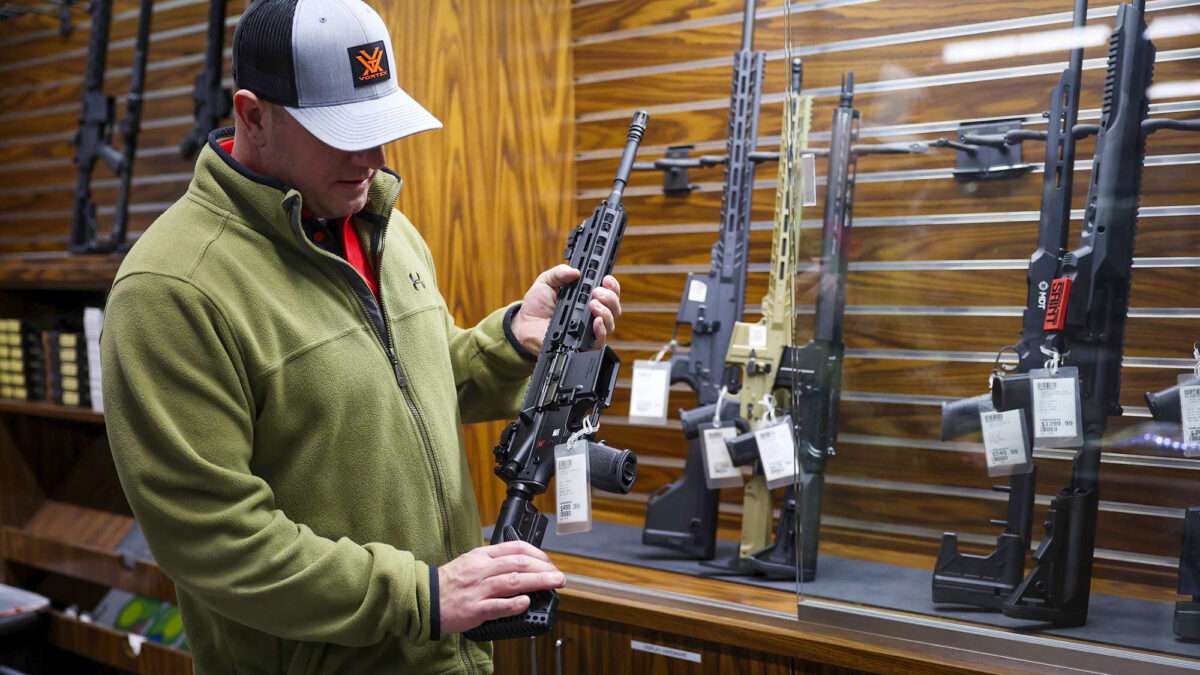
    Man holding a firearm in a store

    Man holding a firearm in a store | Photo: John J. Kim/TNS/Newscom

    A new Colorado law has raised the hackles of a coalition of gun owners in the state, leading them to challenge its constitutionality in federal court.

    Signed into law on June 2 by Colorado Democratic Gov. Jared Polis, the Requirements for Firearms Dealers Act requires all gun sellers in the state to allow any "duly authorized peace officer" to inspect their sales records "at all times."

    The bill follows in the footsteps of 11 other states and Washington, D.C., by extending the state's record-keeping requirements for firearms dealers to all retail transactions, including transfers. Dealers will be required to note the customer's name, age, and address, as well as the firearm's serial number, letters, make, and caliber. Failure to comply could result in a fine of up to $75,000, the loss of a dealer's license, and up to a year in jail. 

    Gun owners in the state are pushing back against this overreach. Ten days after Polis signed the bill into law, three firearms dealers and two firearms associations filed a joint civil suit in the U.S. District Court for the District of Colorado, arguing that the bill is a "warrantless-inspection scheme for firearms dealers" that violates the Fourth Amendment because it includes no stipulations for warrants or probable cause and no restrictions on time or frequency.

    Colorado's law would make it easier for law enforcement to engage in fishing expeditions. Under the law, a Colorado police officer could presumably demand that a dealer provide records of firearms sales for the last month, with no mention of a crime being committed or a suspect in mind. While the bill does prohibit law enforcement from creating or maintaining a firearms registry, that provision seems moot if firearms dealers are themselves forced to maintain the registry for cops. 

    While the court challenge is ongoing, it's difficult to see how Colorado's law complies with the Supreme Court's precedents on warrantless searches. 

    In New York v. Burger (1987), the Court ruled that a warrantless search of a "closely regulated" industry violates the Fourth Amendment unless it satisfies three criteria: the state must have a substantial interest in regulating the industry; the warrantless inspections must directly serve that interest, be necessary for the regulatory scheme; and the statute must offer a constitutionally adequate warrant substitute, such as notification and limits on "time, place, and scope," to "impose appropriate restraints" on an officer's discretion. 

    Colorado's law might satisfy the first criterion. But it appears to fall short of the other two entirely, especially since the law is broad enough to allow sheriffs and campus security alike to inspect the records of any firearms dealer in the state.

    Even when the law permits the government to inspect a business without a warrant—an administrative search—the Supreme Court ruled in Los Angeles v. Patel (2015) that the subject must be afforded a review by a "neutral decisionmaker" for the search to be constitutional. Colorado law does not provide firearms dealers with an opportunity for such a review before inspection.

    Aside from the record-keeping provisions, the bill adds new administrative burdens for firearms dealers by requiring businesses in the state to provide the Department of Revenue with a "comprehensive security plan." It also tasks the department with adopting rules on acceptable security measures that dealers must comply with. Those requirements will go into effect in October 2027.

    State Sen. Cathy Kipp (D–Fort Collins), a cosponsor of the bill, told Complete Colorado the new law "builds on a new bureaucracy established in 2024" to stop "preventable shooting deaths" and reduce gun violence. But another outcome is far more likely: treating gun owners and firearm dealers like de facto criminals.

    Colorado lawmakers have created an environment ripe for confrontation between law enforcement and legally armed Americans, all while violating Coloradans' right to privacy.

    The post Colorado Gun Owners Sue Over New Law Allowing Warrantless Access to Dealer Records appeared first on Reason.com.

  • Reason reason.com news politics us-news us-politics 2026-06-18 14:42
    ↗

    Leave it to the Rooker-Feldman doctrine to divide the justices in an unusual way.

    Today the Supreme Court decided T.M. v. University of Maryland Medical System Corp., a case concerning the application of the Rooker-Feldman doctrine, under which federal district court review of state court decisions is generally barred.

    The justices split 5-4 on the application of the doctrine here. Justice Sotomayor wrote for the Court. She summarized the issue in T.M. this way:

    Under what has become known as the Rooker-Feldman doctrine, federal district courts lack jurisdiction over "cases brought by state-court losers complaining of injuries caused by state-court judgments rendered before the district court proceedings commenced and inviting district court review and rejection of those judgments." Exxon Mobil Corp. v. Saudi Basic Industries Corp., 544 U. S. 280, 284 (2005). This case asks whether this rule bars suit when the state court judgment at issue is subject to further review in state appellate proceedings. A straightforward application of the logic and reasoning underlying Rooker-Feldman leads to one conclusion: It does. Because this suit falls within the narrow doctrine's limits, the Court of Appeals for the Fourth Circuit properly affirmed its dismissal.

    The line-up this decision produced is what is particularly interesting. Justice Sotomayor was joined by Justices Thomas, Alito, Kavanaugh, and Jackson. (Justice Thomas also wrote a separate concurrence, defending Rooker "as an original matter.")

    Justice Barrett dissented, joined by the Chief Justice and Justices Kagan and Gorsuch. Her opinion begins:

    Twenty years ago, this Court held that the Rooker-Feldman doctrine is "confined" to the procedural circumstances of the two cases from which the doctrine draws its name. Exxon Mobil Corp. v. Saudi Basic Industries Corp., 544 U. S. 280, 284, 291 (2005); see Rooker v. Fidelity Trust Co., 263 U. S. 413 (1923); District of Columbia Court of Appeals v. Feldman, 460 U. S. 462 (1983). In "both cases," we emphasized, the federal action was brought "after the state proceedings ended." Exxon, 544 U. S., at 291. Seven Courts of Appeals took us at our word, refusing to apply Rooker-Feldman when the underlying state action remained pending. They were right to hold the line. Because the Court has chosen to relax it, I respectfully dissent.

    Her dissent concludes:

    The upshot of today's decision is that the Court has muddied waters that were hardly clear to begin with. That is unfortunate, because there was a better path available: treating Rooker-Feldman as "the §1257 Rule." VanderKodde, 951 F. 3d, at 409 (Sutton, J., concurring). Doing so would have been both clearer and more faithful to Exxon.

    Still, the news is not all bad. Although the Court expands Rooker-Feldman beyond Exxon's line, it repeatedly emphasizes that the doctrine is "narrow." See ante, at 1, 7, 8, 18. Courts should not lose sight of that message. In the end, Rooker-Feldman has been given an inch—it should not be allowed to take a mile.

    T.M. was not the only decision today to produce an interesting lineup. The Court was unanimous in the judgment in United States v. Hemani--a potentially important Second Amendment case--but split on the rationale. Justice Gorsuch wrote for the Court. Justice Alito wrote separately, only concurring in the judgment and was joined by Justice Kagan. (Yes, you read that correctly.) Justices Thomas and Jackson also authored concurring opinions.

    The post The Most Interesting Supreme Court Opinion Line-Up You Will See This Year appeared first on Reason.com.

  • Reason reason.com news politics us-news us-politics 2026-06-18 14:30
    ↗

    Figures on a boat looking at money

    Figures on a boat looking at money | Illustration: Midjourney

    As the 250th anniversary of the signing of the Declaration of Independence nears, it looks like Americans overwhelmingly approve of their country's cardinal principles.

    That's the top-line finding from a recent survey conducted by the American Enterprise Institute (AEI) about the legacy of America's founding. While its results did reflect a generational divide—baby boomers were much friendlier to the Founding than Gen Z—73 percent of the younger generation still agreed that "the founders deserve respect…for how they set up the United States." And 74 percent of Gen Z respondents agreed that "studying the political principles of the founding fathers can help inform our decisions today."

    Support for Founding principles was also impressively robust across party lines: 92 percent of Republicans and 77 percent of Democrats said that it was "more important than ever to teach all kids the history of the founding fathers."

    But though the sentiment is generally popular, its specific implementations tend to be rather controversial. In Florida, a recently devised A.P. U.S. History alternative, which casts the Founding and its Enlightenment-influenced classical liberalism in a rosier light, has been characterized by the media as an "anti-woke" reaction and a specifically "conservative" reform. 

    The AEI survey also revealed surprisingly broad support for capitalism. Among 5,306 respondents, 82 percent said it was "very" or "somewhat important" to teach about "the benefit of free market capitalism" in high schools. Only 4 percent said that it should not be taught.

    The result stands in stark contrast with other recent polling on the popularity of capitalism. For instance, a Gallup survey from last September found that just 54 percent of Americans have a positive opinion of the economic system, down from 61 percent in 2010.

    There have been other prominent indications that Americans' faith in the free market could be slipping. New York City, for instance, elected a self-avowed socialist for mayor, who used his inauguration speech to decry "the frigidity of rugged individualism." (Washington, D.C., may soon follow in NYC's footsteps.)

    Still, not all of the AEI survey results tell a story of Americans eager to "accentuat[e] positive views of America." Among parents surveyed in 1998, 50 percent said they would be upset if their children's teacher "constantly criticized America's economic and political system"—this year, only 32 percent agreed.

    But beneath the malaise, it would seem that Americans are fundamentally committed to the values and freedoms of the Founding. "Much has changed since the late 1990s," the AEI report reads, but "still, most Americans in 2026 report that they are familiar with our founding documents and endorse long-standing civic ideals such as freedom of speech, freedom of religion, and equal opportunity."

    The post Americans Still Believe in the Founding—and Want Schools To Teach Capitalism appeared first on Reason.com.

  • Reason reason.com news politics us-news us-politics 2026-06-18 13:30
    ↗

    Plus: Iran deal, J.D. Vance on morality, L.A. hemorrhages population, and more...

    Grocery receipt | Illustration: Adani Samat/Envato

    What affordability discourse gets wrong: "Nearly half of U.S. families couldn't afford basic necessities in 2024, report finds," reads an NPR headline from last week. "Half of Americans can't afford to dine out or vacation in a cost of living crisis," reads a Fortune headline from a few months ago. Meanwhile, Axios reports that "sewer socialism" is catching on across the country, describing it as an approach that "focuses on expanding government programs for the public good, like affordable housing, child care and public transportation."

    Technically, "sewer socialism" is a very old term that's just being co-opted now to refer more vaguely to an almost New Deal sensibility: a "universal everything," as opposed to means-tested social safety net preference. ("Sewer socialism" has historically referred to the good governance of the nitty-gritty unsexy things that cities provide: sanitation (thus the name), public housing, utilities, and streets.) But it's true that something is afoot, related to both cost of living and quality of life—especially in urban areas—and that the policy discourse muddies a few issues by jumbling them together. Call it what you want.

    "It's like, yeah, good job reading the polls that tell you that affordability is the number one issue. Do you understand why that is the case? It's because people can't f--king afford to eat, so of course that's their main issue," Democratic strategist Jesse Lehrich told Axios. This argument crops up over and over again—that a substantial portion of Americans can't afford essentials—and is increasingly used to justify all manner of state intervention. But is it at all true?

    "A real but small share of Americans are in genuinely miserable financial situations. They have more bills than they can pay. They are one missed paycheck from eviction. They frequently have literally zero money. The unemployable woman with the worthless degree from the fraudulent for-profit college is in this category. So is the 58-year-old who got laid off from a manufacturing job, exhausted his savings, can't get hired anywhere, and watches his wife work double shifts at Walmart," write Aaron Brown, Michael Mendelson, and Clifford Asness for The Dispatch. "These people need money. The institutions that make their lives worse—the for-profits that produce unemployable graduates, and the medical billing systems designed to confuse people into paying twice—need to be regulated or eliminated. Both of those statements are true, and neither is in serious political dispute." They continue:

    "The second problem is the squeezed-talent class, and it's harder to explain because the people involved look fine on paper. Picture a 32-year-old physician married to a 32-year-old software engineer. Combined household income, $400,000. They cannot buy a house in San Francisco or Boston or New York within a sane commute of their jobs. They cannot afford to have three kids, pay for childcare, and put them in decent schools. They are doing every single thing the meritocratic American dream told them to do, and the dream is not being delivered. Their parents, at the same age, with worse credentials and lower real incomes, owned a house and had three kids on one salary. Something is broken here, and it isn't their fault, and it isn't fixed by transfers. Giving this couple a $5,000 childcare credit doesn't move the needle on $4 million houses—and worse, by raising effective demand for childcare without doing anything about the supply, the credit makes childcare more expensive for the people behind them in line. The right tends to dismiss this couple as coastal-elite complainers. The left tends to dismiss them because they're already in the top 5 percent of incomes. Both are wrong. This is a talent-allocation problem of the first order, and a country pays a real price when its most productive young people can't form families or live near their work. These two problems require completely different policy responses."

    Note that the squeezed-talent class is also distinct (though sometimes overlapping) from the "why-should-I-live-within-my-means" types: The people who came of age as millennial lifestyle subsidies were expiring, who never really learned how to budget or sacrifice, who believed upward mobility would be available to them too, but became rather accustomed to a high standard-of-living in childhood and weren't able to build on it much in adulthood (or even meet it at all).

    "A lot of people set their goal as how can I have the same experience as ordering out, only at home? and the answer is you can't!" comments The Washington Post's Megan McArdle. "The current generation is earning more at their age than previous generations did at their age; when you combine the fact that they have more income, and more opportunities to spend that income on food, and that all of us really love something delicious at the end of a hard day of work, food is one of the easiest things to indulge yourself with. And, on an individual, per-indulgence basis, it's one of the cheapest."

    "The problem is people are sufficiently rich to eat a lot of takeout, but they aren't necessarily sufficiently rich to be financially healthy (or physically healthy) if they do so," adds McArdle. It's partly a problem of high costs, and partly a problem of high expectations (to the extent that it's a problem at all). And it's also partly a problem of real gains in quality of life being obscured and taken for granted.

    Each set of needs requires different public policy solutions. And I'd argue that last group doesn't need a public policy solution at all—just a remedial home economics class (or, in their eyes, a socialist to save them).

    Memorandum signed at Versailles: "The Islamic Republic of Iran and the United States, together with their allies in the current war, declare upon the signing of this Memorandum of Understanding an immediate and permanent end to the war on all fronts, including Lebanon, and undertake that from now on they will not launch any hostile action against each other, and will refrain from the threat or use of force against each other," reads a draft of the memo, reported by Bloomberg. President Donald Trump signed the memorandum in Versailles, France, yesterday. "The agreement lifts the U.S.-imposed naval blockade of Iranian ports and, most crucially, grants Iran waivers to begin exporting its oil even before the negotiation of a final agreement on its nuclear program," reports The New York Times. 

    The more complicated issues will get hammered out over the coming weeks, starting tomorrow, when American delegates meet with their Iranian counterparts in Switzerland. "This time, the Iranians will come to the table armed with valuable knowledge: They can survive the worst the Americans can throw at them," speculates Yaroslav Trofimov over at The Wall Street Journal. "President Trump and Israeli Prime Minister Benjamin Netanyahu gambled that their fierce campaign of airstrikes, launched on Feb. 28 and lasting 40 days, would overthrow Iran's theocratic regime, or at the very least force it to make major concessions. None of that happened, despite the killing of much of Iran's senior leadership, including Supreme Leader Ayatollah Ali Khamenei, and the decimation of the country's navy, air force and other military assets."


    Scenes from New York: Yesterday, an 18-year-old Indian tourist died after falling from a horse-drawn carriage in Central Park when the horse bolted. Some are advocating for carriage-horses to be regulated away, following the accident.


    QUICK HITS

    • "The Trump administration's budget office has redirected $352 million that was intended in part for Secret Service training and recruitment to what it described as security measures at the White House, a government database shows," reports The Washington Post.
    • "It's been quaint this week to see the G7—that talking shop for downwardly mobile world powers, plus the US—follow the White House's Anthropic bombshell by issuing a draft communique pledging to 'discuss' the opportunities and risks of AI for the financial sector," writes Lionel Laurent at Bloomberg.
    • New, must-listen Ross Douthat episode: "JD Vance on the Morality of the Trump Administration." His description: "I asked the vice president what is Christian about this White House."
    • "Los Angeles County saw the largest decline of any county in the United States in 2025, according to new census data published on March 26," reports KTLA. "Nearly 54,000 people moved out of L.A. County between July 1, 2024 and July 1, 2025, U.S. Census data shows."
    • Who says romance is dead?

    Trump on Egyptian President el-Sisi: "He was in a hotel and I met him. We fell in love, deeply in love … we didn't know each other before that." pic.twitter.com/oN1kjKfb6o

    — NewsWire (@NewsWire_US) June 17, 2026

    The post Who Can't Afford Food? appeared first on Reason.com.

  • Reason reason.com news politics us-news us-politics 2026-06-18 12:05
    ↗

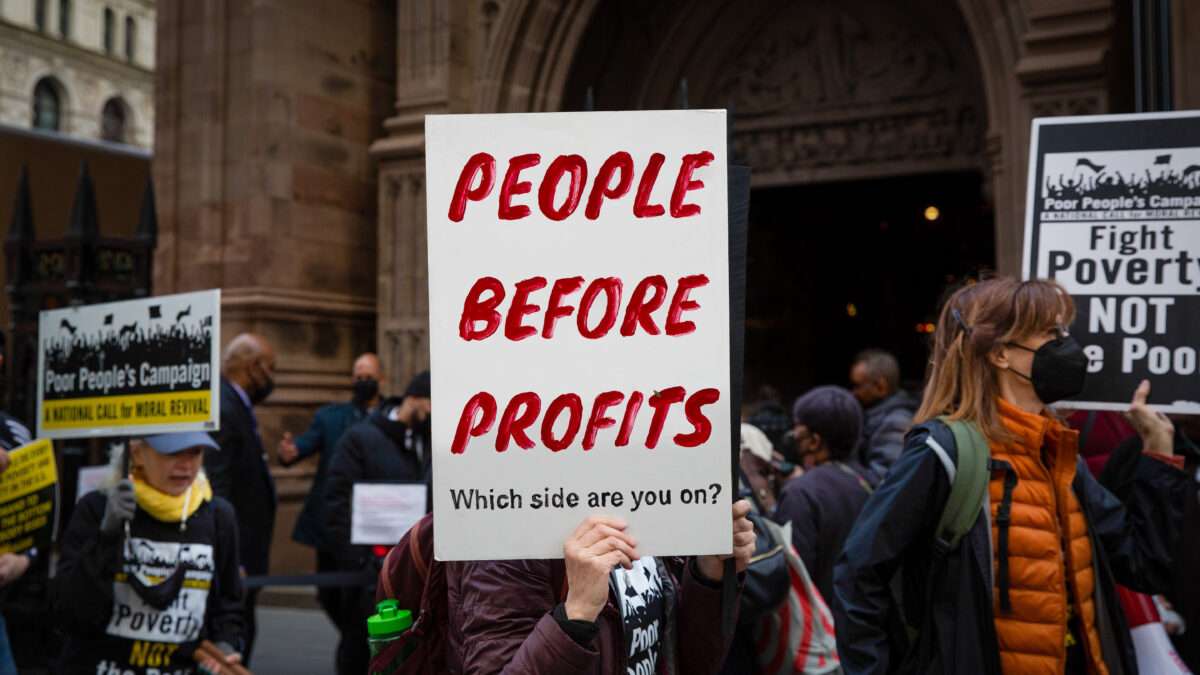
    'People Before Profits' protest sign

    'People Before Profits' protest sign | Gina M Randazzo/ZUMAPRESS/Newscom

    The new Global Justice Report by the World Inequality Lab in France—which calls for caps on economic growth in rich countries, top income-tax rates of 90 percent, and a World Sovereign Fund to redistribute wealth to the Global South—has reignited one of the oldest debates in economics: How do we actually lift people out of poverty?

    The data have never left much question. The answer is economic growth. Nonetheless, many development economists have spent decades arguing that growth isn't enough or as important as development aid. The French report is simply a radical expression of a popular view. So, it's worth reviewing the evidence again.

    Stated plainly, every country that has gotten richer overall has also reduced poverty. More importantly, no poor country has ever achieved decent living standards without first getting genuinely richer. Obviously, wealth and basic human well-being move together, but the relationship is so reliable that it's more like a physical law than a social-science finding.

    People in poverty have little access to food, clean water, decent shelter, basic medical care, and schooling. Adequate amounts do not exist in nature; they must be produced. As an economy grows, it produces more of these things. This enables more growth which, in turn, lifts the masses out of poverty.

    Two centuries ago, roughly three-quarters of the world could not afford more than tiny living spaces, enough food to avoid malnutrition, and some minimum heating capacity. Since then, the share of people in this type of poverty has fallen dramatically. The reason is an explosion in production that began with the Industrial Revolution and has yet to stop.

    Unfortunately, the belief that economic growth in poor countries benefits richer residents and bypasses the needy remains commonplace. A large body of economic literature shows that this is nonsense. For instance, the work of World Bank economists David Dollar and Aart Kraay and others find that when average incomes rise, the incomes of the poorest 20 percent of a population rise at essentially the same rate. In other words, growth is not systematically biased against the poor.

    Further, even in the worst cases where growth skews toward elites, the impact on well-being in poor countries is too powerful to ignore. In a recent Substack post, development economist Lant Pritchett showed that elite-skewed growth in Ethiopia does four times more to improve basic human well-being—clean water, child survival, schooling—than uniform growth in Denmark. Denmark has already achieved those basics. Ethiopia has not.

    As such, the most important question for poor countries is not who gains most from growth. It is whether growth happens at all. The countries that are home to most of the world's remaining extreme poor—places like Madagascar, the Democratic Republic of the Congo (DRC), Mozambique, Malawi, and Burundi—have not grown for decades. Our World in Data's Max Roser points out that Madagascar's gross domestic product (GDP) per capita today is roughly the same as it was in 1950.

    The reason isn't a lack of development aid. These are among the world's most aid-dependent economies. The DRC has received tens of billions of dollars in foreign aid over decades and $1.3 billion in 2024 from the U.S. alone. In past years, Mozambique received as much as half of its government budget from foreign aid. These countries have been the focus of development programs, nongovernmental organization activity, World Bank projects, bilateral donor attention, and charitable intervention for generations.

    Countries don't get stuck in extreme poverty because the world has ignored them. They get stuck because they do not produce. And they do not produce because the institutional conditions that make production possible—secure property rights, the rule of law, open markets, protection from predatory government—are largely absent. Countries ranking at or near the bottom of economic freedom indexes are also the poorest. Those that liberalize experience across-the-board income increases.

    Economist Vincent Geloso's research finds that economic freedom is one of the strongest predictors of who escapes persistent poverty and who stays trapped. Colin Doran and Thomas Stratmann have found much the same. The mechanism is straightforward: Property rights give people an incentive to produce. Lower regulatory barriers let businesses form and labor move toward opportunity. Freedom from predatory government encourages long-term investment. Remove these conditions and countries stagnate, no matter how much aid they get.

    Growth is both necessary and sufficient. No country has escaped poverty without it. Every country that has achieved higher GDP per capita has also achieved high levels of basic human well-being. Targeted aid can be useful at the margin, but it's no substitute. Although many supposed poverty fighters are blind to this reality, serious policy makers shouldn't be.

    COPYRIGHT 2026 CREATORS.COM

    The post The War on Economic Growth Is a War on the Poor appeared first on Reason.com.

  • Reason reason.com news politics us-news us-politics 2026-06-18 12:01
    ↗

    From yesterday's Complaint in Spatz v. Stewart & TheaterMania (S.D.N.Y.): This is an action for libel per se, and false… The post Libel by "Buddy Comedy" appeared first on Reason.com.
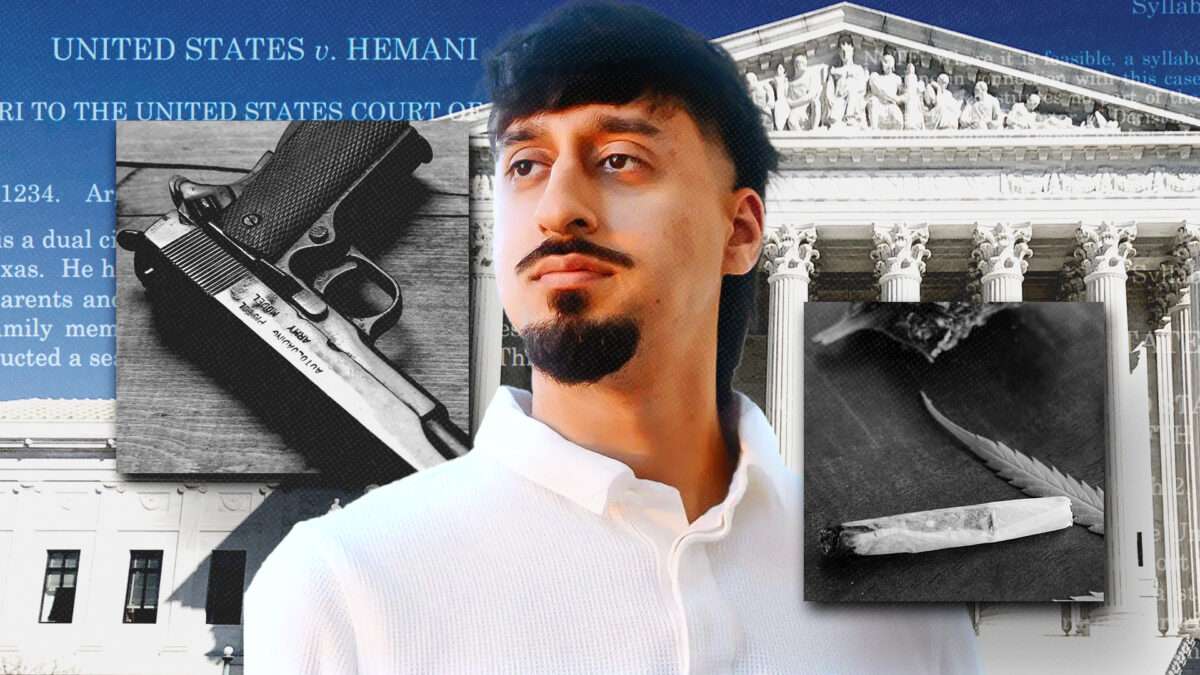
    From yesterday's Complaint in Spatz v. Stewart & TheaterMania (S.D.N.Y.):

    This is an action for libel per se, and false statements causing special damages. Defendant Zachary Stewart, a theater critic writing for Defendant TheaterMania, authored and published a review of a theatrical production written and presented by Plaintiff. The production was a serious, historically grounded drama confronting the Holocaust, the founding of the State of Israel, the 1948 Arab-Israeli War, the tragedy of a miscarriage, and the racially motivated execution of a Black man for loving a white woman. Yet it was deliberately, falsely, and maliciously described that production as a "buddy comedy." …

    Plaintiff believes and therefore alleges that Defendant Stewart's false and injurious characterization was not an act of good-faith criticism, but rather an act of ideological sabotage, motivated by Stewart's known and documented hostility toward the State of Israel and the Jewish people, and his sympathies with the Palestinian and Gaza cause….

    The Play is, in all respects, a serious drama. It does not contain comedic plot lines, comedic characters, physical comedy, comic timing, comic volley, or any other element associated with the buddy comedy genre or any comedy genre.

    Rather, the Play examines, with gravity, emotional depth, and historical fidelity, the following subjects:
    (a) The Holocaust—the systematic genocide of six million Jewish people—and its shattering impact on Jewish identity, memory, and historical consciousness as addressed by one of the characters and the death of his wife and two children in Auschwitz;
    (b) President Harry Truman's role in the founding of the modern State of Israel and the political, moral, and historical forces that gave rise to it;
    (c) The 1948 Arab-Israeli War, including its causes, conduct, and consequences;
    (d) The racially motivated execution of a Black man, Mr. Willie McGee, whose appeal was handled by Bella Abzug in real life. He was put to death for engaging in a loving, consensual interracial relationship with a white woman—an actual historical injustice representing the brutal reality of American racial violence;
    (e) A devastating miscarriage suffered by Bella Abzug (one of the referenced "buddies" and Truman's attorney in the Play) suffered just after the McGee hearing, presented with honesty and emotional weight;
    (f) The dropping of two atomic bombs on Japan, three days apart; …

    The review is reproduced at pp. 15-17 of the Complaint, and the title is "Review: Truman vs. Israel, the Harry Truman-Bella Abzug Buddy Comedy Nobody Asked For." I'm pretty skeptical about the case, since in context "buddy comedy" appears to be an opinionated characterization, which can't be proved true or false. You can read the rest of the review there and see for yourself.

    Also, the allegedly false allegation focuses on the qualities of the play, not the qualities of the playwright, so the proper claim would presumably be trade libel, not ordinary defamation. (I oversimplify the inquiry slightly here.) And the headline is a "fair index" of the contents of the article, which is part of the test for libel-by-headline under New York law.

    The post Libel by "Buddy Comedy" appeared first on Reason.com.
  • Reason reason.com news politics us-news us-politics 2026-06-18 11:30
    ↗

    Jesse Merriam and I discuss the conservative tent and antisemitism.

    Last week I recorded a FedSoc forum with Professor Jesse Merriam at Patrick Henry College. The topic was "No Enemies to the Right? Antisemitism and the Big Tent." Usually, when I do one of these events, I am talking about something newsworthy. But this forum was a bit more personal, as I was the newsworthy event. I discuss my resignation from Heritage, and provide some updates of what has happened since.

    This video is worth watching.

    The post FedSoc Forum: "No Enemies to the Right? Antisemitism and the Big Tent" appeared first on Reason.com.

  • Reason reason.com news politics us-news us-politics 2026-06-18 11:00
    ↗

    Supreme Court building with text across the image

    Supreme Court building with text across the image | Ken Cole/Dreamstime

    The U.S. Supreme Court just added a new case to its upcoming 2026–27 docket that should interest fans of early American history.

    At issue in Kian v. Florida is whether the Sixth Amendment right to trial by jury requires 12-person juries in all criminal cases. Florida law says it does not. According to that state's statute books, "twelve persons shall constitute a jury to try all capital cases, and six persons shall constitute a jury to try all other criminal cases." Hamed Kian, who was tried by a six-person Florida jury and sentenced to prison for practicing chiropractic medicine with a suspended license, wants the Supreme Court to overturn his conviction and restore the 12-person jury in the Sunshine State and the handful of other states that currently lack it.

    To win, Kian will have to persuade a majority of the justices to overrule the Supreme Court's 1970 precedent in Williams v. Florida, which allowed the use of six-person juries. "Williams was incorrectly decided," Kian argues, "and is contrary to the understanding of the Sixth Amendment at the time of the Founding."

    At least one member of the Supreme Court seems more than ready to reach that same conclusion and rule in Kian's favor. In 2022, the Supreme Court declined to hear a similar case about the constitutionality of an eight-person jury called Khorrami v Arizona. Dissenting from that denial of certiorari, Justice Neil Gorsuch argued that "a mountain of evidence suggests that, both at the time of the [Sixth] Amendment's adoption and for most of our Nation's history, the right to a trial by jury for serious criminal offenses meant a trial before 12 members of the community—nothing less."

    Two years later, the Court declined to take up a six-person jury case called Cunningham v. Florida (2024). And once again, Gorsuch filed a sharp dissent. "Florida does what the Constitution forbids because of us," he declared. "In Williams v. Florida, this Court in 1970 issued a revolutionary decision approving for the first time the use of 6-member panels in criminal cases." And "in doing so," Gorsuch continued, "the Court turned its back on the original meaning of the Constitution, centuries of historical practice, and a 'battery of this Court's precedents.'"

    Gorsuch's historical argument is convincing. The Sixth Amendment's right to trial by jury was rooted in the British common law. And that British common law right, as William Blackstone explained in 1769 in his widely read Commentaries on the Laws of England, rested on the existence of 12-person juries. "The founders of the English law," Blackstone observed, "have, with excellent forecast, contrived, that…the truth of every accusation, whether preferred in the shape of indictment, information, or appeal, should afterwards be confirmed by the unanimous suffrage of twelve of his equals and neighbours, indifferently chosen, and superior to all suspicion."

    To say that the right to trial by jury was of paramount importance to America's founding generation would be putting it mildly. Among the "repeated Injuries and Usurpations" charged against King George III in the Declaration of Independence, for example, is the fact that the crown "depriv[ed] us, in many Cases, of the Benefits of Trial by Jury."

    Likewise, when the Anti-Federalists complained in the late 1780s about the lack of a Bill of Rights in the new U.S. Constitution, they frequently lamented the lack of additional jury trial safeguards. "How does your trial by jury stand?" Patrick Henry demanded of the Virginia Ratification Convention on June 5, 1788. "In civil cases gone—not sufficiently secured in criminal—this best privilege is gone." The Sixth Amendment was ultimately added to the Constitution to assuage such Anti-Federalist concerns.

    Kian v. Florida thus presents the Supreme Court with the opportunity to both correct one of its past mistakes and vindicate a venerable constitutional right the founding generation clearly held dear.

    The post The Founders Revered the Right to Trial by Jury. Will SCOTUS Now Follow Their Example? appeared first on Reason.com.

  • Reason reason.com news politics us-news us-politics 2026-06-18 11:00
    ↗

    6/18/1787: Alexander Hamilton introduces his plan to the Constitutional Convention. The post Today in Supreme Court History: June 18, 1787 appeared first on Reason.com.
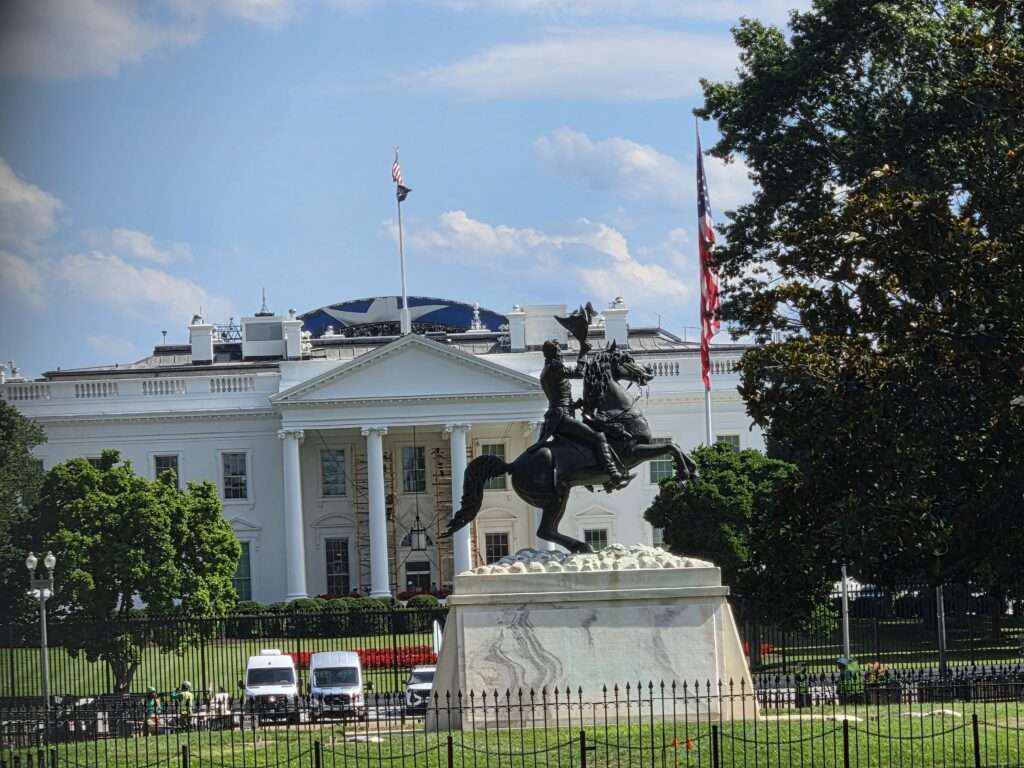
    6/18/1787: Alexander Hamilton introduces his plan to the Constitutional Convention.

    Alexander Hamilton

    The post Today in Supreme Court History: June 18, 1787 appeared first on Reason.com.

  • Reason reason.com news politics us-news us-politics 2026-06-18 10:00
    ↗

    The man known only as "A Farmer" warned against the "sword of government."

    farmer | Illustration: Joanna Andreasson, ChatGPT-5.4; Source images: Wikimedia

    This is part of 1776 All-Stars, a series about Reason's favorite American Founders. Read more here.

    Joanna Andreasson

    I do not know my favorite Founder's name. I just know that in 1788 a Baltimore newspaper published a series of pseudonymous essays where he warned against standing armies, called for a bill of rights, and declared, paraphrasing Jonathan Swift, that "laws are cobwebs, catching only the flies and letting the wasps escape." See-sawing between fears of an aristocratic legislature and a tyrannical executive, he argued that we'd be best off with the highly decentralized democracy found in certain Swiss cantons. "If I am told that the people are incapable of governing themselves" like the Swiss, he wrote, "I shall answer that [it has] never been tried in America, except among the native Indians, who are free and happy, and who prove that self-government is the growth of our soil." He signed these articles "A Farmer."

    The essayist was an Anti-Federalist, part of that band of skeptics who thought the proposed Constitution granted too much power to the federal government. I do not share some of his opinions—he liked sumptuary laws, for example, and would have limited the vote to property holders. And yes, his idealized vision of rural Swiss life missed the ways that even that system restricted liberty. Well, no one's perfect. He still wrote one of the era's most spirited attacks on concentrated authority.

    His series' high point was its third installment, which rejected the idea that a national regime would ensure domestic peace. The "sword of government," A Farmer argued, was more likely to inflict one group's preferences on another, bringing "that series of desolation, which France, Spain, and the other great kingdoms of the world have suffered, in order to bring so many separate States into uniformity." Better, he wrote, to let Americans "separate and divide as interest or inclination prompted."

    Nor did A Farmer accept the idea that a national government would better protect us from foreign subversion or invasion. "The only foreign, or at least evil foreign influence, must be obtained through corruption," he argued—and the "facility of corruption is increased in proportion as power tends…to a concentration in the hands of a few."

    After offering reasons to doubt a confederation would be more attractive to invaders, his essay warned of the opposite danger—that America itself would become an empire. "It was the extensive territory of the Roman republic that produced a Sylla, a Marius, a Caligula, a Nero, and an Elagabalus," he wrote. Decentralism magnified not just the power of voice but also the power of exit: "In small independent States contiguous to each other, the people run away and leave despotism to reek its vengeance on itself."

    It's a fiery anti-authoritarian jeremiad, and part of me wants to learn more about the man who wrote it. Did he fight in the Revolution? Was he politically active in other ways? Was he actually a farmer, or was that just a convenient mask?

    But another part of me prefers not to know how much this man's life matched his rhetoric. Some historians have guessed that A Farmer was future Maryland Gov. John Francis Mercer, a planter who owned slaves and eventually joined the centralizing Federalist Party. The evidence for Mercer's authorship is pretty thin, though, basically coming down to the fact that he offered some overlapping arguments elsewhere. So I'll take these essays on their own. If their author enslaved people, joined the Hamiltonian coalition, or otherwise departed from the ideals in these editorials, the uncertainties of history have severed such unhappy facts from the words on the page.

    Of all those words, my favorite passage comes in that third essay, when our farmer-writer addressed those who think a national government is better suited for "cutting a figure in history." They are correct, he conceded. But "the silence of historians is the surest record of the happiness of a people. The Swiss have been four hundred years the envy of mankind, and there is yet scarcely an history of their nation. What is history, but a disgusting and painful detail of the butcheries of conquerors, and the woeful calamities of the conquered?"

    1776 All-Stars, a series about Reason's favorite American Founders:

    • Benjamin Franklin
    • Samuel Adams
    • Thomas Jefferson
    • George Mason
    • A Farmer
    • George Washington
    • Patrick Henry

    The post 1776 All-Stars: Why a Pseudonymous Anti-Federalist Is My Favorite Founder appeared first on Reason.com.

  • Reason reason.com news politics us-news us-politics 2026-06-18 08:00
    ↗

    The sign of the SoLIT Café in Montreal, Quebec

    The sign of the SoLIT Café in Montreal, Quebec | SoLIT Café/Instagram

    When Maryam Rahimi opened SoLIT Café in downtown Montreal five years ago, she says she never imagined she would spend so much time dealing with the Office québécois de la langue française (OQLF), Quebec's language watchdog that enforces Quebec laws requiring services are provided in French. Rahimi says years of complaints and inspections have forced her to change menus, signs, and receipts, and she claims inspectors even wanted her to find a French word for nachos, a request she found absurd. She says the repeated investigations feel like harassment and have cost her thousands of dollars, while the OQLF says it is responding to complaints and enforcing Quebec's language laws.

    The post Brickbat: Sacré Bleu appeared first on Reason.com.

  • Reason reason.com news politics us-news us-politics 2026-06-18 07:00
    ↗

    What’s on your mind?

    The post Open Thread appeared first on Reason.com.

  • Reason reason.com news politics us-news us-politics 2026-06-17 21:48
    ↗

    So argues Prof. Jack Goldsmith (Harvard) in his Executive Functions post. An excerpt: The United States in the MOU pledges… The post "The President is Legally Barred from Waiving Iranian Sanctions as Pledged in the Iran [Memorandum of Understanding]" appeared first on Reason.com.

    So argues Prof. Jack Goldsmith (Harvard) in his Executive Functions post. An excerpt:

    The United States in the MOU pledges "immediately" to "issue waivers for export of Iranian crude oil, petroleum products and derivatives, and all associated services, including banking transactions, insurances, transportation, etc." (Emphasis added here and throughout.) These waivers presumably include waivers of U.S. statutory sanctions against Iran.

    I don't think the president has the authority under domestic law to issue these waivers. The Iran Nuclear Agreement Review Act (INARA) of 2015 applies here and temporarily bars a president from waiving sanctions against Iran. The executive branch has counterarguments, to be sure. And it's doubtful that any institution will make the president comply with INARA in any event….

    Read the post for much more.

    The post "The President is Legally Barred from Waiving Iranian Sanctions as Pledged in the Iran [Memorandum of Understanding]" appeared first on Reason.com.

  • Reason reason.com news politics us-news us-politics 2026-06-17 21:28
    ↗

    From In re Gregorwicz v. Villa-Kennedy, decided today by Arizona Court of Appeals Judge Veronika Fabian, joined by Presiding Judge… The post Disclosing One's HIV+ Status Isn't Criminal Harassment of Ex appeared first on Reason.com.

    From In re Gregorwicz v. Villa-Kennedy, decided today by Arizona Court of Appeals Judge Veronika Fabian, joined by Presiding Judge Michael J. Brown and Vice Chief Judge David D. Weinzweig:

    [An] order of protection was based on the superior court's finding that Father's social media post, which disclosed his own HIV status and identified Mother as a former partner, was criminal harassment. Because Father's social media post was protected free speech, this Court vacates the order of protection….

    Mother and Father were at one time in a relationship, which resulted in the birth of their child in 2024.

    In May 2025, Mother posted a message on social media from an account with the name "Shelby Starbuck" to a group of more than 600 members. The post included an image of an HIV negative patch and this text:

    Ordering a bunch of these lmao. Im sure you'd be surprised which of your friends cant wear it, but hey lets be transparent. Be safe out there! If anyone wants one lmk

    Days later, Father posted his own message, using his real name, to the same group, which read:

    It has come to my attention that there is someone in this group that has taken the liberty to share some deeply personal information with members that shouldn't have been. With that said….

    I had a relationship with Shelby Starbuck. And prior to that relationship even becoming a relationship I disclosed with her that I live with HIV. She was informed and aware and made the decision to be in a relationship with me. We obviously had sexual relationship that led to the birth of our daughter. Neither Shelby nor our daughter contracted HIV. Nor has any sexual partners I have had. For Shelby to take it up on herself to use this deeply sensitive and personal information in some way to hurt me should be self evident of her character. Beyond that. I am now forced to put myself out there to combat any further rumors or misinformation being told. I post this here for two reasons. 1 being Mike runs free page and I know this post will not be taken down. 2 this is where most the rumors are being shared. I will be only address[ing] the topic of HIV as any further rumors about me or my relationship with Shelby and our daughter should be none of your concern. And frankly I believe my status should have remained none of your concern as well. But to advocate.

    HIV is no longer a death sentence. Millions of people live healthy normal lives with HIV. The current medication available makes it untransmittable. It has become a chronic illness now where it was a terminal illness before. I lead a healthy normal life. I made bad life choices and one of those will forever remind me of actions have consequences. But there are people out there who contract HIV of no fault of their own and the stigma is a real and scary thing. I write this now sitting in the bathroom at work fighting back tears so I can see clearly. I am terrified at the friends and respect I will lose but at the same time I can not idly stand by to be made look bad when it something out of my control and further I do everything to make sure I am healthy and the people I care about are safe.

    After Mother read the post, she texted Father and asked him to remove it. Father refused, explaining his post "was made in response to [Mother's] post," which "started rumors and talk," and to "help educate and … try and lessen the stigma." …

    The trial court issued a protective order, including a prohibition on gun possession by Father, finding that "[Father's] act in posting to an electronic forum to more than 600 people shows repeated acts of harassment which were meant to annoy, harass or intimidate [Mother]." The court of appeals reversed, reasoning:

    To issue an order of protection, a court must find reasonable cause to believe the defendant may commit an act of domestic violence or has committed an act of violence in the past year. Domestic violence means a criminal "offense prescribed in … § 13-2916 [or] 13-2921" in the context of various domestic relationships. In issuing the initial and continued orders of protection, the superior court found that Father's social media post constituted the offense of "harassment" under both A.R.S. §§ 13-2916 and 2921….

    If speech or expressive conduct is constitutionally protected, then Arizona harassment statutes do not apply, and an order of protection based on that speech or conduct is improper. See A.R.S. § 13-2916(C) ("This section does not apply to … Constitutionally protected speech or activity ….")…. Because Father's social media post was pure speech, the government may not punish his words unless they are within "narrowly limited classes of speech." Such speech includes statements intended to incite imminent lawless action, obscenity, defamation, speech integral to criminal conduct, fighting words, and true threats.

    Mother argues speech that harasses a protected party is one of the classes of speech not protected by the First Amendment. There is, however, no categorical "harassment exception" to the First Amendment. "Legislatures are free to punish nonspeech conduct, as well as narrow categories of constitutionally unprotected speech, such as true threats. But they cannot label speech that mentally distresses people 'stalking' [or 'harassment'] and then punish all such speech." …

    In issuing the initial order of protection, the superior court found that the First Amendment was not implicated because Father's post defamed Mother and defamation is not protected speech. To establish defamation, "a publication must be false and must bring the defamed person into disrepute, contempt, or ridicule, or must impeach plaintiff's honesty, integrity, virtue, or reputation." … Father's post was neither false nor was it a statement of opinion implying a false assertion of fact. Instead, Father stated the truth—that he had HIV and that Mother and the parties' daughter did not.

    Sue A. Jones (Sloma Law Group) represents Father.

    The post Disclosing One's HIV+ Status Isn't Criminal Harassment of Ex appeared first on Reason.com.

  • Reason reason.com news politics us-news us-politics 2026-06-17 21:05
    ↗

    A Throne Labs unit on the left, Zohran Mamdani on the right

    A Throne Labs unit on the left, Zohran Mamdani on the right | Theodore Parisienne/TNS/Newscom/TrashOfTheTitans/Wikimedia Commons

    New York City mayors have attempted to solve the city's public bathroom problem for decades. Now, Mayor Zohran Mamdani is taking his turn. 

    On Wednesday, the New York City Economic Development Corporation (NYCEDC) announced that Throne Labs Inc. won the city's $4 million contract to install and maintain 17 new bathrooms across the city. Should the project stay on budget, that price tag is relatively low compared to New York City's past bathroom boondoggles. 

    In 2019, The City Reporter noted that the average cost for a city Parks and Recreation Department bathroom had "nearly tripled to $3.6 million since 2011." One $4.7 million restroom facility in Ferry Point Park took 12 years to complete, according to the outlet. And parkgoers told the Reporter that the bathroom was "typically inaccessible in the winter."

    Former Parks Department commissioner Adrian Benepe told the Reporter at the time that comfort stations, a now apparently politically incorrect term for the city park bathrooms, were the "bane of [his] existence."

    "There's a built-in inefficiency at every level and too many reviews," he said. 

    John Stossel visited a New York City park bathroom in 2017 that cost the city $2 million to build, a price Mitchell Silver, then the New York City Parks commissioner,  said was "a good deal" because New York City is "the most expensive market in the world." The final product, however, was far from luxe.

    "There were no gold-plated fixtures. It's just a little building with four toilets and four sinks," Stossel wrote at the time. 

    Stossel has juxtaposed the costly NYC Parks restroom with the crown jewel of Midtown Manhattan restrooms: the privately owned and managed Bryant Park bathroom. The bathroom, which often has a long line, is guarded by private security, cleaned regularly, and has flowers and artwork inside. 

    The Throne units are not as glamorous as the Bryant Park restrooms, but they may prove to be cleaner and better maintained than other public restrooms. The units will be solar-powered, "odor-managed, and use 21 sensors and ratings from users to monitor real-time data on the restroom's status, cleanliness, and usage," according to NYCEDC. According to an Axios reporter who used Throne's toilets in downtown Detroit, the "facilities were spotless and easy to use." 

    The most encouraging part of the Throne rollout is the design. Unlike past public bathroom rollouts, Throne units do not "need to be hooked up to sewers or other utilities," according to Gothamist. This way, the installation process will not be bogged down by as much red tape as previous projects. 

    Mamdani is clearly no cost-cutting mayor, but he has said he wants New Yorkers to get more for their taxpayer dollars. Given the countless past failures of city bathroom rollouts, the bar for a successful public bathroom project is extremely low (in the toilet?), so hopefully this plan can provide New Yorkers some relief without flushing away too many public funds. Installation is expected to begin later this summer, and if all goes well, New Yorkers should be able to test the toilets by the fall.

    The post New York City Has a History of Public Bathroom Failures. Will This New Plan Flush Away More Tax Dollars? appeared first on Reason.com.

  • Reason reason.com news politics us-news us-politics 2026-06-17 20:45
    ↗

    A child tinted blue against a blue background with golden rice at the bottom of the image

    A child tinted blue against a blue background with golden rice at the bottom of the image | Midjourney

    Greenpeace and its activists allies have blocked for more than two decades the adoption of Golden Rice, which is genetically enhanced to produce the vitamin A precursor beta-carotene. The result, according to new calculations by DC Abundance founder and research director at the Golden Gate Institute for AI Abi Olvera, is that "delay has killed about 106,000 children and left another 210,000 to 425,000 blind."

    Her conservative calculations of the deaths and disabilities caused by Greenpeace's scientifically ridiculous opposition to Golden Rice are focused on 11 countries in which the consumption of rice makes up a significant proportion of their people's diets.

    As Olvera reports, the World Health Organization (WHO) has estimated that "250 000–500 000 children who are vitamin A-deficient become blind every year, and half of them die within 12 months of losing their sight." Vitamin A deficiency contributes to increased morbidity and mortality from common childhood infections. As the WHO notes, "Even mild, subclinical deficiency can be a problem, because it may increase children's risk for respiratory and diarrhoeal infections, decrease growth rates, slow bone development and decrease the likelihood of survival from serious illness." And it is the world's leading preventable cause of childhood blindness.

    I have been debunking Greenpeace's unscientific opposition to Golden Rice since 2000 when the activist group claimed: "Greenpeace opposes golden rice because it has all the risks of any [genetically modified] crop." In my 2013 article, "Scientists Call Out Greenpeace for Killing and Blinding Kids," I hailed the blistering editorial in Science that asserted, "If ever there was a clear-cut cause for outrage, it is the concerted campaign by Greenpeace and other nongovernmental organizations, as well as by individuals, against Golden Rice."

    In 2016, I reported the open letter by 100 Nobel Prize laureates calling on "Greenpeace to cease and desist in its campaign against Golden Rice specifically, and crops and foods improved through biotechnology in general." The laureates suggested that Greenpeace was committing a "crime against humanity." And as recently as 2024, I warned that Greenpeace's crusade against Golden Rice will continue to blind and kill children when reporting that the anti-technology activist group had persuaded a Philippine court to block local farmers from planting the grain.

    For over 25 years, Greenpeace and its anti-technology allies have blocked this lifesaving crop. Although it is way past time, Greenpeace's blockade may be coming to an end. As it has become more normal for poorer countries to engineer their own genetically enhanced crops, Olvera optimistically concludes, "the harder it gets to keep blocking the one that should have come first."

    The post Over 100,000 Kids Have Died Due to Greenpeace Blocking Genetically Enhanced Rice, New Calculation Shows appeared first on Reason.com.

  • Reason reason.com news politics us-news us-politics 2026-06-17 20:30
    ↗

    A man distributes leaflets about vegetarianism outside an arena

    A man distributes leaflets about vegetarianism outside an arena | Adani Samat/Midjourney/Google Maps

    Six years ago, Richard Hershey was distributing religious leaflets on a public sidewalk in a public park surrounding a public arena in Bossier City, Louisiana, when he was accosted by police officers who insisted that he stop. Hershey, who was promoting the views of the Christian Vegetarian Association outside a Christian rock concert at the Bossier City Arena, pointed out that he was exercising his constitutionally guaranteed freedom of speech and freedom of religion. He also noted that the officers had not interfered with another leafleteer, who was advertising a local radio station.

    The cops were unmoved. If Hershey did not leave immediately, they said, he would be arrested, and he likewise would be carted off to jail if he ever dared return to the park.

    It would be hard to imagine a more blatant violation of First Amendment rights. But last October, the U.S. Court of Appeals for the 5th Circuit held that Hershey could not sue the officers responsible for it because they were protected by qualified immunity, a doctrine that bars federal civil rights claims unless they allege violations of "clearly established" law. Now Hershey is asking the Supreme Court to overrule that jaw-dropping conclusion, which illustrates how broad interpretations of qualified immunity prevent victims of outrageous police misconduct from vindicating their rights.

    "The right to evangelize in public, free of viewpoint-based government suppression, is as clearly established as any right in the firmament," Hershey's lawyers, who include former Solicitor General Paul Clement and litigators at the First Liberty Institute, note in a Supreme Court petition filed last Friday. "It is squarely protected by two separate but overlapping clauses of the First Amendment—the Free Speech and Free Exercise Clauses—and by decisions of this Court underscoring that viewpoint discrimination is verboten and that discrimination against religious speech is viewpoint discrimination (im)pure and simple. No government official should need an on-point circuit precedent to illustrate what the Constitution itself and this Court's cases make clear beyond cavil."

    Hershey filed his lawsuit under 42 USC 1983, which authorizes people to sue state or local officials for violating statutory or constitutional rights under color of law. That provision, which dates back to the Civil Rights Act of 1871, says nothing about qualified immunity. The Supreme Court invented that doctrine in the 1982 case Harlow v. Fitzgerald on the theory that officials should be liable under Section 1983 only when they had fair notice that their conduct was illegal or unconstitutional.

    As interpreted by lower courts, qualified immunity evolved into a requirement that plaintiffs cite precedents involving nearly identical facts, which can be especially challenging when plaintiffs allege abuses so egregious that they are rarely committed, documented, or litigated. But beginning with Hope v. Pelzer in 2002, the Supreme Court made it clear that victims of "obvious" constitutional violations do not have to cite closely similar cases. The Court reiterated that point in the 2020 case Taylor v. Rojas.

    Although Hope and Taylor involved Eighth Amendment claims of "cruel and unusual" punishment, most federal appeals courts have understood the "obviousness" exception to qualified immunity as a general principle that also applies to alleged violations of other constitutional rights. But the 5th Circuit has declined to recognize that exception outside of the Eighth Amendment context. In particular, it has prevented plaintiffs from seeking damages for obvious First Amendment violations, such as arresting a reporter for asking questions, unless they can locate a 5th Circuit precedent that is directly on point.

    Fifth Circuit Judge James Ho has repeatedly expressed his dismay at that situation. He nevertheless concurred when a 5th Circuit panel blocked Hershey's lawsuit in October, saying he was bound by the appeals court's precedents.

    Hershey's claims "should have been amply sufficient to defeat qualified immunity at this preliminary stage of the proceedings" and "allow Hershey to proceed to trial," Ho wrote in his concurring opinion. "After all, the Supreme Court has repeatedly denied qualified immunity where it found the constitutional violation so 'obvious' that it didn't require the plaintiff to identify factually indistinguishable case law."

    Under Hope and Taylor, "it should be enough to defeat qualified immunity that the alleged constitutional violation is obvious," Ho wrote. "And this 'obviousness' principle should be intuitive to all who treasure our constitutional rights." Ho quoted an observation that Supreme Court Justice Neil Gorsuch made as a 10th Circuit judge in 2015: "Some things are so obviously unlawful that they don't require detailed explanation."

    Gorsuch added that "sometimes the most obviously unlawful things happen so rarely that a case on point is itself an unusual thing." He thought "it would be remarkable if the most obviously unconstitutional conduct should be the most immune from liability only because it is so flagrantly unlawful that few dare its attempt."

    Ho said he "most certainly" agreed with Gorsuch. But in the 5th Circuit, he said, "Hope and Taylor apply only to the Eighth Amendment claims of incarcerated criminals." Ho thought the court made that clear in 2024, when it rejected the First Amendment lawsuit that Laredo, Texas, journalist Priscilla Villarreal filed after she was charged with two felonies because she had asked a police officer to confirm information about a fatal car crash and a public suicide.

    In Villarreal v. City of Laredo, the majority noted that Hope and Taylor were "Eighth Amendment cases," which it said established only a "narrow" exception that Villarreal could not invoke. Ho joined six other judges in vigorously dissenting from that decision. But although the Supreme Court vacated the ruling against Villarreal later that year, Ho noted, "our court has now reinstated it." On remand in April 2025, the 5th Circuit again blocked Villarreal's lawsuit, saying its previous decision was "superseded" only to the extent that it addressed the requirements for proving a retaliatory arrest.

    Given Ho's objections to the 5th Circuit's take on the "obviousness" exception, it may seem puzzling that he concurred when the court rejected the city's petition for an en banc rehearing of Hershey's case last December. But that petition dealt with a different issue: the city's liability under Monell v. Department of Social Services for failing to properly train its police officers. The 5th Circuit panel had allowed Hershey to proceed with that claim, and the city was trying to reverse that aspect of the decision.

    Although Ho voted against granting the city's petition, he made it clear where he stood on the qualified immunity question. "It should go without saying," Ho wrote, that "the freedom of speech secured by the First Amendment includes religious speech," and "the obviousness of that right should have been enough to defeat qualified immunity in this case, without the need for a factually identical case saying so."

    The seven judges who voted to rehear the case nevertheless chided Ho for passing up an opportunity to reconsider the appeals court's understanding of Hope and Taylor. "According to Judge Ho, our court's approach to qualified immunity in First Amendment cases is deeply flawed," Judge Andrew Oldham wrote in an opinion joined by the six other dissenters. "If our precedent is that bad, however, we should obviously go en banc to overturn it. It's surpassing strange to say, 'our precedent requires persecution of Christians,' and then say, 'we should not go en banc to fix it!'"

    Ho described that criticism as "disingenuous," since "Defendants' petition for rehearing en banc (obviously) doesn't ask the court to reverse its qualified immunity win by revisiting Villarreal." The city's petition "is solely about Monell," he said, and "the en banc poll is solely about Monell."*

    Whatever you make of that spat, Hershey's lawyers argue that it is now the Supreme Court's responsibility to correct the 5th Circuit's crabbed reading of the "obviousness" exception. "The decision below got an exceptionally important issue exceptionally wrong," they write. "Compelled by erroneous precedent, a Fifth Circuit panel granted qualified immunity to police and security officers who violated First Amendment rights that have been clearly established for decades."

    Defenders of qualified immunity often argue that it is necessary to protect officers from liability for good-faith decisions made in challenging circumstances. But the cops who threatened Hershey "had no split-second, life-or-death decision to make," the petition notes. "All the officers had to do to avoid liability was to do nothing."

    Instead, the cops "needlessly committed an obvious constitutional violation, threatening to arrest petitioner, compelling him to leave, and banishing him indefinitely from a public park on pain of arrest, all while leaving the commercial leafleteer alone," Hershey's lawyers write. "Constitutional violations do not come any plainer than that, and [Section 1983] unambiguously promises a remedy."

    Americans "have a clear right to engage in peaceful leafletting, and the prohibition on viewpoint discrimination, especially disfavoring religious viewpoints, is pellucidly clear," the petition says. "Government officials do not need an on-point circuit precedent to tell them as much. Indeed, one would hope that there is no on-point circuit precedent precisely because the constitutional line is so clearly established that no one has previously crossed it. There is no reason to grant officers immunity simply because they have gone where no prior officer ever dared to tread."

    *This article has been revised to clarify Ho's dispute with the judges who wanted to rehear Hershey's case.

    The post Louisiana Cops Threatened To Arrest a Man for Handing Out Religious Leaflets. They Got Qualified Immunity. appeared first on Reason.com.

  • Reason reason.com news politics us-news us-politics 2026-06-17 20:15
    ↗

    Janeese Lewis George

    Janeese Lewis George | Credit: Adnan Masri/Wikimedia Commons

    While votes are still being counted, it appears that D.C. Councilmember Janeese Lewis George has won a commanding victory in the city's Democratic mayoral primary. 

    The initial count shows her earning 52 percent of the vote, while former D.C. Councilmember Kenyan McDuffie trails with just 36 percent support. A handful of minor candidates' vote totals are running in the low single digits.   

    Barring either a dramatic pro-McDuffie shift in the votes yet to be counted, and nothing short of a miracle in the general election, the self-described socialist Lewis George will be the district's next mayor. 

    She's not the only leftist to triumph on election day. 

    Down-ballot, progressive candidates for D.C. Council and other open positions also maintain a commanding lead. 

    Grading on the curve of big, blue city governance, D.C., under outgoing three-term Mayor Muriel Bowser, has generally been an island of moderation. No longer.

    Every indication is that the district's next government will be controlled by hardline progressives and socialists. 

    How panicked should we be? This district resident is of two minds. 

    On the pessimistic side, Lewis George ran on a left-wing platform of childcare for all, social housing, tax increases on businesses, a generally more activist City Hall, and a much more confrontational approach to the Trump administration. Voters rewarded her handsomely for it. 

    A sizable portion of voting district residents are mad as hell about the Trump administration's various interventions in the city, from National Guard patrols to federalization of the city's police department to Department of Government Efficiency (DOGE) cuts that have had a depressive effect on the city's economy. 

    Bowser spent the tail end of her mayoralty avoiding confrontation with Donald Trump in an effort to prevent additional federal meddling. It was a thankless task, and the voters just made clear they want someone who "fights."

    As Lewis George herself told a reporter on election night, "Residents said to me, 'If Trump doesn't like you, I love you.'" 

    In an interview tonight, I asked Janeese Lewis George if she thinks Trump's threat to take federal control of D.C. if she won helped her campaign.

    "Yeah, I'll be honest about that…Yeah, I think so."

    Her full remarks @CityCast_DC: pic.twitter.com/HkbbKApbmE

    — Emma Uber (@EmmaUber7) June 17, 2026

    The city is also in the middle of a bruising budget fight, where councilmembers are trying to figure out which programs they'll cut to close a budget gap. 

    It's in that fiscal context that voters went hard for a mayor who ran on a platform of universal childcare, affordable housing spending, and an endless string of other tax credits and subsidies. 

    All of that is to say that Lewis George faces few incentives from the electorate to moderate her left-wing impulses once she's in office. 

    On the more optimistic side, Lewis George faces several binding constraints that might force moderation on her and save all of us from a truly omnipotent City Hall. 

    Everyone, including Lewis George's campaign, is quick to compare her to another socialist upstart politician: New York Mayor Zohran Mamdani. 

    There's a lot to that comparison, including the fact that Lewis George, like Mamdani, is entering office during a period of fiscal retrenchment. 

    The district government has a persistent $570 million gap between recurring expenditures and recurring revenues, per the D.C. Policy Center's analysis. 

    Because D.C. is required to balance its budget, that fiscal shortfall will need to be addressed by the next mayor and council too. Before Lewis George can go about creating new programs and entitlements, she'll have to figure out how to pay for the city's existing obligations. 

    In New York, Mamdani wanted to close his city's budget gap and pay for his socialist spending priorities by raising taxes on the rich. The New York state government, which needs to sign off on most of the tax increases he wanted, largely prevented him from doing that. 

    Here in D.C., any tax increases Lewis George might want can be vetoed by Congress, which, for the moment, is still in Republican hands. 

    Indeed, because the D.C. local government is a creation of Congress, effectively any policy the district wants to pass can be blocked by the federal legislature. If it wanted, Congress could end home rule entirely and govern D.C. directly. 

    One could hope that Congress could put some outer limits on any truly disastrous left-wing experimentation considered by D.C.'s next mayor and council.

    Of course, there's also a lot of danger in counting on the federal government as a backstop to bad local policy in D.C. Trump's shows of force with federal law enforcement and national guard deployments helped prime the D.C. electorate to vote for a socialist to begin with. 

    If Lewis George continues to be a "fighter" once in office, something voters have clearly signaled they want, the response from the GOP-controlled federal government will likely be more than a congressional veto of a tax increase or two. 

    "Maybe we'll take back Washington, run it on a federal basis," said Trump when asked by reporters in the Oval Office about Lewis George. "We won't put up with it. We're not going to lose our businesses." 

    One can at least appreciate the irony of the district's current political dynamic. Trump's local interventions prime residents to vote for a socialist mayor, whose radicalism then begets more federal intervention.

    Some D.C.-based readers might think that maybe a Republican-led federal takeover of D.C. might not be such a bad thing, if the alternative is letting a bunch of socialists run wild at city hall. 

    I'm unconvinced. 

    For all its flaws, home rule does allow voters to impose some measure of accountability on the officials they elect. If Lewis George tanks D.C.'s economy with a bunch of socialist policies, voters will have the option of picking someone better next time. 

    Meanwhile, literally the only voters no member of Congress has to care about are the ones who live in D.C. 

    With Donald Trump in the White House, increased federal control over D.C. probably won't result in lower taxes, timely trash pickups, and the legalization of flavored nicotine products. It's more probable that it would produce a lot of showy MAGA interventions that do not benefit district residents or individual liberty more broadly. 

    There are a lot of roadblocks to Lewis George implementing much of her left-wing agenda. The fear is that the roadblock that actually stops her is a Trumpian takeover of local government. 

    The post How Worried Should We Be About a Socialist Mayor in D.C.? appeared first on Reason.com.

  • Reason reason.com news politics us-news us-politics 2026-06-17 20:00
    ↗

    Keir Starmer against a red-tinted picture of soccer fans

    Keir Starmer against a red-tinted picture of soccer fans | Ian Davidson/SOPA Images/Sipa USA/Newscom/David Buono/Action Plus/Newscom

    The British are coming! England fans have descended on Dallas ahead of Wednesday's England World Cup opener against Croatia. Almost 15,000 England supporters are expected to have journeyed to the Lone Star State, with fans enjoying all they can of southern America—cattle drives, rodeos, Texas beer, and baseball—according to The Times.

    But while England fans are free to sample Texan hospitality, they are still subject to speech restrictions reminiscent of the United Kingdom.

    As The Times reports, FIFA, the global governing body that runs the World Cup and sets the stadium rules, has warned rowdy fans not to chant politically charged messages during World Cup games. Doing so would violate FIFA's World Cup Stadium Code of Conduct, which prohibits fans from bringing in or displaying banners, flags, fliers, apparel, and other paraphernalia that are of a "political, offensive and/or discriminatory nature." It also bans spectators from cursing or chanting "in a political, offensive and/or discriminatory manner," or using foul or abusive language. Failure to comply could result in removal from the stadium, the cancellation of tickets, or, in some cases, civil or criminal fines and penalties.

    The warning appears to be prompted by fans shouting "Keir Starmer is a wanker," at England's warm-up game against Costa Rica in Orlando last week. At least one flag with the same message has also been spotted in Dallas, according to Daily Mail.

    This is not the only colorful flag English fans have sported. The Football Association (F.A.), England's national football governing body, is also reportedly aware of an England flag bearing the message "Keir Starmer is a nonce," a British slang word meaning pedophile.

    But it's not just banners displaying bad words that are being targeted by FIFA rules. As Daily Mail reports, some fans were unable to secure written permission from FIFA officials to bring in flags that honor and bear the image of fallen British soldiers. The rifles on these flags, fans were told, were in breach of the event's flag regulations.

    While these fun-sponge rules make games less boisterous, FIFA and the stadium operators are well within their rights to set the rules inside their own venues. Still, FIFA's control only extends so far. The F.A.'s official allocation for England supporters was only 4,022 tickets, meaning most England fans who have travelled to Dallas will be watching from nearby bars, fan zones, or wherever they can find a screen.

    FIFA can confiscate a flag at the turnstiles, but it cannot stop thousands of Englishmen in Texas from taking advantage of America's speech laws—which are especially lenient compared to the U.K.'s—and saying what they think about the prime minister back home. In the land of the free, England fans will undoubtedly jump at every available opportunity to name-call their deeply unpopular leader, all while reveling in the glory of supporting a brilliant team.

    The post England Fans Warned Not To Chant 'Keir Starmer's a Wanker' at World Cup appeared first on Reason.com.

  • Reason reason.com news politics us-news us-politics 2026-06-17 19:45
    ↗

    Sen. Adam Schiff (D–Calif.) and a movie clapboard

    Sen. Adam Schiff (D–Calif.) and a movie clapboard | Illustration: Tom Williams/CQ Roll Call/Newscom/Kckate16/Envato

    While everybody struggled through the COVID-19 pandemic, Hollywood has yet to recover: Box office receipts and ticket sales remain below pre-pandemic levels.

    Eager to cut costs, studios increasingly shoot films and TV shows overseas. Unsurprisingly, one lawmaker thinks the government should help.

    "Los Angeles has been the world's entertainment capital for 100 years and still has an unmatched concentration of talent and infrastructure," Gene Maddaus writes at Variety. "But in an age of globalization, with easy international travel and communication, the city is losing its edge."

    While still synonymous with the entertainment industry, fewer and fewer projects are actually filmed in Hollywood.

    The problem primarily comes down to cost. "Everything costs more in L.A., starting with labor, due to the high cost of living and elaborate union agreements," Maddaus writes. "Other states and countries have developed crew bases of their own, are more solicitous of producers' needs and offer more generous incentives."

    It's that latter problem that lawmakers seem so keen on solving.

    "In order to save this industry in America, we need to be competitive with tax credits," Sen. Adam Schiff (D–Calif.) told Variety. Schiff wants a federal film production tax credit; he said in March he had "largely drafted" a bill but that he needed bipartisan support.

    Last year, when President Donald Trump pledged to impose a 100 percent tariff on films "produced in Foreign Lands," Schiff countered that, instead, "Congress should pass a bipartisan globally-competitive federal film incentive to bring back production and jobs."

    But adding a new tax credit for U.S. film production would not solve the problem. In fact, it would create new problems of its own.

    More than half of all U.S. states and territories currently offer film and TV incentives.

    Georgia's program, which began in 2005, lets any studio that spent at least $500,000 filming in Georgia could claim a tax credit worth up to 30 percent of its total in-state production expenses.

    Since then, states have tried to keep up, in a race to the bottom to see who can offer the most generous incentives at taxpayer expense.

    That includes California: "[Gov. Gavin] Newsom doubled the state program to $750 million in 2025," Maddaus notes. "Everyone seems to agree it should be more—maybe a lot more—and that it should cover above-the-line salaries for actors, writers and producers."

    "Even Massachusetts has better tax credits than Hollywood," said reality star Spencer Pratt, who recently lost his race for Los Angeles mayor. In 2021, Massachusetts funded as much as 60 percent of the production budget for Don't Look Up, a satirical film about climate change that premiered on Netflix after a perfunctory limited theatrical release.

    As mayor, Pratt pledged to fight for "uncapped" production tax credits, which would mean the state can spend an unlimited amount on production incentives. But even that can't keep cameras rolling forever. Georgia's program is uncapped, but that didn't stop Marvel Studios from moving production of its new Spider-Man and Avengers films to the United Kingdom, which has lower labor and production costs.

    And Marvel is not alone. "Now, millions of square feet of production facilities sit empty," The Wall Street Journal reported in January about the current state of Georgia's film industry. "It turns out that bribing studios with taxpayer dollars isn't a strategy to create a healthy industry—it's a way to be out-bribed."

    Besides, studies repeatedly show that production incentives aren't worth the cost.

    "Film Tax Incentives Are a Giant Waste of Money, New Study Finds," according to the headline of a 2016 Variety piece also by Maddaus, the author of the article this week about lawmakers' attempts to spend even more money on them. That study found little or no film industry job growth in states that implemented production incentives.

    "Consistent with studies of other state film tax incentives programs, the State of Georgia loses money," according to a 2023 audit by Georgia State University. "We calculate a state fiscal [return on investment] of 0.19 for FY 2024, or a loss of 81 percent."

    Further, few credits actually benefited their intended recipients. Studios have very few state tax liabilities, but Georgia's law allows them to sell any unused credits to other state taxpayers, meaning studios pocket the proceeds of the sale and the state still loses out on revenue. "Approximately 97% of credits generated in tax year 2016 were transferred to another taxpayer (e.g., sold), while less than 1% of credits were used by the production companies against their own income tax liability or their employee income tax withholding," according to a 2022 report from the Georgia Department of Audits and Accounts.

    A 2017 report found that Virginia's tax credit "has little effect on film location decisions, a negligible benefit to the Virginia economy, and provides a negligible return on the state's investment."

    Rather than job creators, the credits are subsidies to the wealthy. The 2023 audit found that Georgia's incentives cost the state "$160,009 for every net job" they ostensibly create. In 2015, Massachusetts determined that its credit costs taxpayers $118,000 per job.

    The simple fact is that Hollywood studios, like any other major company, will go wherever their dollar will stretch the farthest. Free money from the state is nice, but not enough to overcome cheaper costs overall.

    The best option would be a feat of mutual disarmament, in which states simply get rid of their production incentives altogether. In the absence of that, the least we could do is stop throwing good money after bad.

    The post Adam Schiff Wants Federal Tax Credits for Movie and TV Production appeared first on Reason.com.

  • Reason reason.com news politics us-news us-politics 2026-06-17 18:41
    ↗

    It therefore concludes (exercising its supervisory power over Pennsylvania state court proceedings) that the state Attorney General's office must be given a chance to intervene in all such proceedings from Philadelphia.

    From yesterday's decision in Commonwealth v. Brown, written by Justice Kevin Dougherty, joined by Justices Sallie Updyke Mundy, Kevin Brobson, and Daniel McCaffery; all the opinions put together come to 70K words, so all I include are short excerpts:

    The prosecutor does not decide whether a defendant is entitled to relief under the Post Conviction Relief Act (PCRA). This is the exclusive province of the PCRA court.

    Nonetheless, while not dispositive, a prosecutor's concession of relief is undoubtedly influential. Courts have long been instructed to give such concessions "great weight[.]"

    But when the prosecutor sides with a defendant, there generally is no adversarial testing of the defendant's entitlement to relief, and the court is left without the benefits of opposing advocacy, including the presentation of counterarguments and exposure of misrepresentations of fact and law. The PCRA court's review is limited to the record before it. If relevant evidence is withheld from the court, this pertinent information goes unconsidered. The court is not permitted to conduct its own independent investigation of extra-record materials, and it is not equipped to do so in any case. For these reasons, an unreliable prosecutorial concession substantially risks the erroneous grant of relief by the court.

    This is not to say a prosecutor should never concede relief. A prosecutor bears the responsibility of a minister of justice and not simply that of an advocate. Hence, a prosecutor is duty-bound to confess error, provided the facts and law call for it.

    But the proviso is critical. When relief is not dictated by the record and law but merely advocated for personal, political, ideological, policy, or other non-legal reasons, a prosecutor's concession does not minister justice; it facilitates injustice.

    Here, in this case reviewed under our King's Bench jurisdiction, the Philadelphia District Attorney's Office (DAO), on behalf of the Commonwealth, conceded that Lavar Brown (Brown), a convicted murderer sentenced to death for a separate murder, was entitled to a new trial based upon a facially untimely claim under the PCRA.

    Upon careful review, we conclude this concession was not reliable. More specifically, we find the DAO conceded relief although none was warranted based on the existing record, violated its duty of candor to the PCRA court, withheld material evidence from the court, opposed efforts by amici to gain access to this evidence, submitted a false stipulation of fact, misstated facts in its pleadings, failed to conduct a reasonable investigation, and opposed a required evidentiary hearing. The predictable result was the erroneous grant of a new trial.

    These circumstances, troubling as they are, would not warrant a remedy beyond reversal of the PCRA court's order in this particular case if they were confined to this one case. Unfortunately, they aren't. Since 2018, the DAO has conceded relief well over 100 times, mostly in murder cases like this one. There have been numerous instances of untrustworthy concessions, lack of candor, misrepresentations of fact, lack of adequate investigation, and avoidance of hearings. And the problems are poised to continue. There are apparently more than 1,000 cases yet to be reviewed by the DAO's Conviction Integrity Unit (CIU), and the DAO vigorously defends its checkered concession program as a necessary corrective to past misdeeds by prior administrations.

    The DAO's active, ongoing, and problematic concession program requires broader remedial action to promote just outcomes. {Under our state constitution, this Court has "the power to prescribe general rules governing practice, procedure and the conduct of all courts … if such rules are consistent with th[e c]onstitution and neither abridge, enlarge nor modify the substantive rights of any litigant[.]"} Accordingly, in addition to reversing the PCRA court's grant of a new trial here, we also hold that in any PCRA case in which the DAO concedes relief, the PCRA court shall grant the Office of Attorney General (OAG) notice and the right to intervene in the case before ruling on the concession. Regardless of the OAG's position on the concession if it chooses to intervene — it may well agree relief is warranted — its independent assessment and participation will enhance the reliability of the proceedings and the PCRA court's ultimate decision…. Our holding applies only in Philadelphia County, but that is because that is where the problem is….

    A brief excerpt from Justice Brobson's concurrence, joined by Justice Mundy (both fully joined the majority opinion as well):

    [W]hat happens if the prosecutor acts in a way that calls into question the reliability of the PCRA proceeding itself? What happens if the prosecutor concedes error where none exists? Even worse, what happens if the prosecutor withholds record evidence that contradicts the prosecutor's concession, causing a PCRA court to upend a lawful verdict against the interest of the community? Following this cascade, the absence of any adverse party at the table means the PCRA court's erroneous action, based on misleading advocacy from the Commonwealth's representative, escapes appellate review….

    [A] jury of Brown's peers convicted him in Philadelphia County and sentenced him to life in prison for his crimes. As we explained in Brown I, the community "has an interest in the verdict, which may … be disrupted only if a court finds legal error." To me, that is what this case is about and why we invoked our seldom used King's Bench authority here—to protect the community's interest in a verdict from prosecutor misfeasance or malfeasance in a subsequent PCRA proceeding….

    [T]he Majority employs remedies properly aimed only at Philadelphia County. I am of the view, however, that PCRA courts throughout the Commonwealth will benefit from the lessons learned in this case when faced with similar circumstances….

    Justice McCaffery also concurred; an excerpt:

    I write separately to note my recognition of the problem and the need to remediate, but would order a different procedure to address these concerns. My proposed resolution [of having the OAG handle these cases -EV] would … not be limited to one county, one District Attorney and one limited class of cases but would apply statewide to any case where a PCRA petition alleges prosecutorial misconduct as the basis for a new trial, since I believe the law requires disqualification of any District Attorney's Office from investigating, evaluating, or litigating such a claim. Further, since the PCRA is civil in nature, the Commonwealth Attorneys Act and our Rules of Professional Conduct mandate that the Office of the Attorney General represent and defend the Commonwealth in all such proceedings….

    Justice Christine Donohue, joined by Chief Justice Debra Todd, dissented (except for a concurrence on one particular matter, "the PCRA court's failure to hold an evidentiary hearing"); an excerpt:

    In my view, our decision in Commonwealth v. Brown (Pa. 2018) ("Brown I") answers the question of what procedure must be followed and sets the guardrails for granting relief based upon concessions of error. We instructed PCRA courts that an independent review of the record is required when considering such a petition. That mandate presumes that the PCRA court will utilize its authority to conduct the proceedings in such a way that it is satisfied that the record supports relief.

    The Majority's fabrication of a third-party intervention rule only in Philadelphia County proceedings is unnecessary. Moreover, it undermines the authority of PCRA courts in Philadelphia County to control their own courtrooms and underestimates the ability of these courts to ensure the adequacy of the record presented by the parties. Most critically, the rule crafted by the Majority far exceeds this Court's authority under the Pennsylvania Constitution….

    The Majority relies on cases handpicked by the Office of the Attorney General ("OAG") to demonstrate "unreliable concessions and erroneous grants of relief" by DAO. To the contrary, from my reading, these examples demonstrate that these courts effectively engaged in independent review in conducting concession of error proceedings. The tools at a court's disposal ensure the effective administration of justice.

    In each of the cases discussed by the Majority that involved factual concessions, the courts denied relief, demonstrating independent review of concessions of error. The courts, inter alia, determined whether there was a need for an evidentiary hearing based on any inadequacies in the record. In each of the cases discussed by the Majority, the courts utilized existing resources to resolve the petitions without reliance on a concession of error. We are continuing to see PCRA courts in Philadelphia County rely on these tools in concession of error proceedings throughout the pendency of this case….

    Finally, this Court cannot invoke King's Bench powers to counteract policy choices of elected officials. By restructuring PCRA procedures in Philadelphia County where the elected District Attorney concedes error, the Majority abuses our King's Bench authority. Creating an intervention rule in these isolated concessions of error PCRA proceedings diminishes the District Attorney's authority and interferes with his obligation to rectify the injustice of a conviction improperly obtained….

    And from Justice David Wecht's dissent:

    The Majority's edict will force common pleas judges in our most populous county to disregard the will of the people's duly elected prosecutor, to gratuitously involve Pennsylvania's Office of the Attorney General ("OAG"), and to encourage the OAG to intervene on behalf of the Commonwealth as a categorical matter in a class of PCRA cases. This novel procedure is neither mandated nor permitted by statute or rule….

    The Majority claims that its remedy is necessary to "promote just outcomes." While all aspire to that worthy goal, the manner in which the Majority seeks to effectuate it far exceeds the power and role of the judiciary. If Philadelphians do not approve of the way in which their elected prosecutor is performing his duties, they can replace him. It is not our job to do so….

    The Majority proclaims that it cannot "ignore the reality that the PCRA court's erroneous grant of relief in this case was abetted by the DAO's lack of candor and failure to conduct a reasonable investigation." The Majority identifies what it believes to be a litany of ethical violations committed by the DAO throughout the history of this case.

    The Majority does not explain how a discussion of those purported violations falls within the appropriate limits of our King's Bench power. It bears repeating that King's Bench cannot be invoked merely as an alternative to existing and available processes and procedures. All Pennsylvania lawyers must abide by our Rules of Professional Conduct. Any violations of those rules must be alleged first in a complaint to the Office of Disciplinary Counsel. These are adjudicated before the Court's Disciplinary Board, and this Court thereafter renders a final decision. In the face of this, the Majority nonetheless bypasses established procedures and publicly declares the DAO guilty of various ethical violations sua sponte—without hearings, counsel, briefing, or any other procedural protections. This endeavor far exceeds the intentions and boundaries of our King's Bench power….

    For a post on a related issue, see Paul Cassell's post from two years ago, The Third Circuit Affirms Sanctions Against the Philadelphia D.A.'s Office for Failing to Confer with Crime Victims.

    The post Pennsylvania S. Ct. Finds Pattern of "Lack of Candor" in Philadelphia D.A. Krasner's Filings Urging Reversal of Murder Convictions appeared first on Reason.com.

  • Reason reason.com news politics us-news us-politics 2026-06-17 18:25
    ↗

    Tulsi Gabbard

    Tulsi Gabbard | IMAGO/Samuel Corum / Pool via CNP /MediaPunch/IMAGO/MediaPunch/Newscom/Bumbleedee/Dorothy Merrimon Crawford

    Russian propagandists asserted in March 2022 that the U.S. was funding bioweapons laboratories in Ukraine as a justification for their armed forces' brutal invasion of that country. "During a special military operation, the facts of the Kiev regime's emergency cleanup of traces of a military biological program funded by the US Department of Defence implemented in Ukraine were revealed," asserted a Russian spokesperson on March 6, 2022. A Chinese spokesman joined in, declaring "This Russian military operation has uncovered the secret of the U.S. labs in Ukraine, and this is not something that can be dealt with in a perfunctory manner." Ironically, this outrageous allegation comes from a regime that refused to allow independent researchers to investigate the origins of the COVID-19 virus in Wuhan, China.

    That authoritarian regimes lie is not surprising. However, this Russian propaganda was also parroted by prominent American right-wing figures in the United States, including former Fox News commentator Tucker Carlson and podcaster Steve Bannon.

    Former congresswoman Tulsi Gabbard quickly joined in, releasing a video on March 13, 2022 in which she stated: "Here are the undeniable facts: There are 25 to 30 U.S.-funded biolabs in Ukraine. According to the U.S. government, these biolabs are conducting research on dangerous pathogens."

    There are 25+ US-funded biolabs in Ukraine which if breached would release & spread deadly pathogens to US/world. We must take action now to prevent disaster. US/Russia/Ukraine/NATO/UN/EU must implement a ceasefire now around these labs until they're secured & pathogens destroyed pic.twitter.com/dhDTH5smIG

    — Tulsi Gabbard 🌺 (@TulsiGabbard) March 13, 2022
    Gabbard did not outright claim that the labs were researching bioweapons, although she hinted that they could be conducting "gain-of-function" experiments that could make the pathogens more dangerously infectious. Calling her "our friend," Russian propagandists widely promoted her remarks as evidence for their claims about secret U.S. bioweapons labs in Ukraine. One Russian commentator even speculated, perhaps jokingly, that she was "some kind of Russian agent."

    In response, Sen. Mitt Romney (R–Utah) on March 13, 2022, tweeted: "Tulsi Gabbard is parroting false Russian propaganda. Her treasonous lies may well cost lives."

    Both American and international organizations thoroughly debunked the Russian disinformation campaign.

    Despite her conspiracy theory–adjacent shenanigans, President Donald Trump nominated Gabbard to head the Office of the Director of National Intelligence. The ODNI integrates and coordinates the activities of the entire U.S. intelligence community, focusing on counterterrorism, counterintelligence and security, counterproliferation, cyberintegration, and counterinfluence. Gabbard became the director of national intelligence in February 2025.

    In May, Gabbard announced that she was resigning as DNI to support her husband as he undergoes treatment for a rare form of bone cancer. Fair enough. On her way out of the door, Gabbard issued a June 12 press release that purportedly "reveals evidence of U.S. taxpayer-funded global lab program." The release further claimed:

    Until now, evidence regarding the full existence and funding of these laboratories had been knowingly withheld from the American people. The information surrounding the existence, history, locations, and funding of these US funded biolabs has been intentionally covered up by powerful people falsely, claiming that they do not exist and accusing anyone who says otherwise to be foreign assets and traitors to America.

    Well, no. The Ukrainian biological research labs were not secret nor was information about them "knowingly withheld." The U.S. Department of Defense issued a fact sheet on March 11, 2022, noting:

    The United States, through BTRP [Biological Threat Reduction Program], has invested approximately $200 million in Ukraine since 2005, supporting 46 Ukrainian laboratories, health facilities, and diagnostic sites. BTRP has improved Ukraine's biological safety, security and surveillance for both human and animal health.

    Gabbard's defensive line about "foreign assets and traitors" suggests Romney's observation about her biolab innuendos struck a nerve.

    So what did Gabbard's "newly declassified evidence" actually show? The U.S. government has been funding a lot of veterinary research laboratories focused on wild animal and livestock infectious diseases. Below is a list from Gabbard's new revelations:

    ODNI

    Very suspicious, right? Not at all. The allegedly secret table of projects is evidently drawn from this openly published 2019 federal contractor report outlining Ukraine's country science plan for researching infectious diseases.

    So why study the pathogens listed in the above contracts? African swine fever is endemic in eastern Europe's wild boar population and affects pork production in those countries as well. Fortunately, the last outbreak of classical swine fever in Ukraine was in 2015. The disease was also eliminated from Europe in that year. However, the virus is endemic in Central and South America and many countries in Asia. Avian influenza still afflicts wild birds and poultry in Europe and Ukraine. Additionally, infectious disease researchers are concerned that avian flu could gain a foothold among humans. These are actually reasonable studies by U.S. and Ukrainian researchers aimed at monitoring these and other concerning infectious diseases.

    In the face of the Russian bombardment and invasion, the World Health Organization prudently advised in March 2022 that Ukrainian research laboratories destroy pathogens to prevent potential spills that might lead to disease outbreaks.

    No evidence of a nefarious bioweapons plot has emerged. The contracted studies cited by Gabbard have not been covered up nor knowingly withheld. Our director of national intelligence is once again peddling Russian propaganda. The question is, why?

    The post Tulsi Gabbard's Not-So-Shocking Revelation of U.S.-Funded Veterinary Biolabs in Ukraine appeared first on Reason.com.

  • Reason reason.com news politics us-news us-politics 2026-06-17 18:10
    ↗

    John Stossel is seen next to models with peptides

    John Stossel is seen next to models with peptides | Stossel TV

    People are excited about peptides.

    The internet is filled with claims: Peptides raise your energy, boost metabolism, clear your skin, slow down aging, build more muscle, repair injuries.

    I want some!

    But there's a problem: The Food and Drug Administration (FDA) bans most of them.

    Why?

    Anita Gupta, an anesthesiologist and pharmacist who was on the FDA committee that recommended the ban, explains, "There is a lot of hype. We all want to hack into our health, right? Get better really quickly. But we can't reboot our own bodies, can't undo an injection. There could be an immune response."

    "Could" be.

    But peptides are definitely useful. Insulin is a peptide. So are the new GLP-1 weight loss drugs.

    "People can lose up to a third of their body weight," says neuroscientist Andrew Huberman.

    Popular young influencers boast about other results.

    "I built more muscle and became much stronger overall," claims YouTuber Manuel Enrique.

    "My best secret weapon to heal!" writes Instagram influencer Nikki Martin.

    "They're not medical professionals," responds Gupta.

    She points out that no government agency checks the ingredients. "Are you actually getting what you think you're getting?…That's the problem."

    It's a problem made worse by the FDA. Because of its ban, most American peptides come from overseas labs, often from China. They skirt rules by claiming their peptides are "not for human use," but for "research purposes only."

    Since black market Chinese products dominate the market, how does the FDA's ban actually "protect" us?

    I confront Gupta in my new video: "Because the FDA makes peptides illegal, it's harder to check out the source. People sneak it in the country. If they just said, 'It's your choice,' there'd be American products. Why do you doctors get to be the gatekeepers? It's my body. Can't I make my own choice?"

    "We have to respect patient's autonomy," she replies, "but at the same time we have to provide informed consent."

    "I consent!" I say.

    "Consent to what? Do you know all the risks?"

    There are plenty of risks.

    Some people experience allergic reactions. Some go into anaphylactic shock. Others develop high blood pressure.

    But the FDA shutting down American suppliers doesn't prevent that.

    I'm glad the FDA has protected Americans from bad drugs. But that protection also costs lives by denying people good drugs.

    Beta blockers saved lives for years overseas before they were finally approved here. The FDA's delay may have cost 100,000 lives.

    The FDA is a creaky bureaucracy. It can take 10 to 15 years to approve a new drug.

    In the meantime, people die from black market drugs, and others miss out on products that might extend our lives.

    "We're still in the early stages of trying to figure out if peptides are truly an innovation," says Gupta. "Sure, there is a possibility that there is a great breakthrough that we're about to see, but the long-term study has not been done."

    Still, the FDA now at least says they may ease restrictions the Biden administration put on popular peptides. Maybe they'll do it because Secretary of Health and Human Services Robert F. Kennedy Jr. is a "big fan" of peptides.

    My question: In a "free country," why do bureaucrats have the right to tell us what we may and may not put in our own bodies?

    Don't we own our bodies?

    It should be our choice.

    I got stronger after the internet told me to take daily creatine and protein powder. Protein breaks down into peptides. I'm old. Maybe I should take the new peptides?

    I'm scared to try.

    Still, it should be my choice.

    There should be 1,000 experiments instead of our one-size-must-fit-all FDA.

    COPYRIGHT 2026 BY JFS PRODUCTIONS INC.

    The post How the FDA Created a Peptide Black Market appeared first on Reason.com.

  • Reason reason.com news politics us-news us-politics 2026-06-17 17:55
    ↗

    The recently reintroduced American Innovation and Choice Online Act is a departure from America’s current antitrust regime, not an improvement.

    AICOA-6-16 | Adani Samat/Midjourney

    Last week, a group of bipartisan lawmakers reintroduced the American Innovation and Choice Online Act (AICOA). Although it promises to deliver innovation and choice in the technology sector, AICOA would undermine both.

    As currently written, AICOA would place restrictions on "systemically important platforms"—Amazon, Apple, Google, Meta, and Microsoft—and limit their ability to engage in a wide range of common business practices. These practices include self-preferencing, ranking or presenting results in ways users find useful, tying products or services together, and using nonpublic data from their business users to "compete with products or services offered by business users," among others. 

    If AICOA's goal is to "restore online competition," as its supporters claim, it shouldn't make it harder for platforms to compete. But as a coalition of more than 30 organizations and individuals makes clear in a letter to Sens. Chuck Grassley (R–Iowa) and Dick Durbin (D–Ill.), that is precisely what the bill does by abandoning key features of the current antitrust enforcement framework. 

    Under the Sherman Antitrust Act, plaintiffs typically must establish three things to successfully sue a firm for anticompetitive conduct: that the firm has market power; that the conduct has resulted, or is likely to result, in anticompetitive harm; and that the conduct's net anticompetitive effects outweigh any procompetitive justifications, such as facilitating innovation by allowing firms to recoup platform investments more easily.   

    AICOA breaks with this established framework at every turn. 

    First, it requires no demonstration that a covered platform even has market power before its rules apply. Instead, it targets firms based on arbitrary user and revenue thresholds. Second, showing harm to competition is not required for most of the practices specified in the bill to be presumptively illegal. Finally, AICOA provides defendants with only a handful of admissible procompetitive justifications, and those defenses are subject to strict scrutiny.

    U.S. antitrust laws have already proven more than capable of addressing allegedly anticompetitive behavior by Big Tech. For example, last year, the Justice Department won both of its lawsuits against Google for its alleged monopolization of the search and online advertising markets under the Sherman Act. Such victories in hotly contested cases undercut the claim that regulators lack adequate tools under existing law.

    As AICOA sets off an unnecessary departure from the longstanding antitrust legal paradigm, it also risks harming the economy. 

    The law, if passed, would immediately harm consumers by chilling pro-competitive business practices. For example, the bill's presumptive ban on platforms using nonpublic business-user data to launch competing products would prevent Amazon from using aggregated seller data from its platform to introduce private-label products, such as Amazon Basics, to the market—depriving consumers of comparable-quality products at lower prices. 

    AICOA would also stymie innovation by undermining Big Tech's ability to monetize the multibillion-dollar investments required to generate and sustain new products on their platforms. For example, the bill's presentation and interoperability requirements could force Google either to limit its use of Gemini to provide AI-generated overviews within Google Search or to provide comparable access and visibility to third-party AI providers within Google's search results. The former would deprive users of a popular feature, while the latter would allow Google's rivals to freeride on the huge investments the company makes in its integrated ecosystem as it helps drive frontier AI development. Indeed, Google spent more than $91 billion on capital expenditures in 2025 alone and is projected to spend roughly $190 billion this year. 

    The potential damage the bill could cause is not limited to the United States: It could also compromise America's ability to defend its engines of growth abroad.  

    Specifically, adopting AICOA would undermine the United States' credibility when it attempts to push back against analogous attacks on American tech companies abroad, which threaten U.S. global technology leadership. Case in point: The E.U.'s Digital Markets Act, which bans U.S. tech leaders from engaging in many of the very same practices restricted by AICOA, has already resulted in nearly $800 million in fines and imposes an estimated $1 billion in annual compliance costs. Worse, the model is spreading worldwide, with countries like the U.K. and Japan adopting similar regimes, and many others considering it.  

    Still, the fact that this legislation has fewer cosponsors today than when it was first introduced nearly five years ago gives reason for cautious optimism that this atrocious importation of European-style competition policy will never receive a floor vote.

    The post A New Bipartisan Bill Promises Innovation and Choice. It Will Deliver Neither. appeared first on Reason.com.

  • Reason reason.com news politics us-news us-politics 2026-06-17 17:32
    ↗

    Jane and I discuss whether sending a sexually explicit image of Shrek to a politician can constitute criminal harassment.

    For more on the general question of listener protection and criminal harassment, see my Protecting Listeners from Unwanted One-to-One Speech, pp. 1432-33 (So. Cal. L. Rev. 2025) and, in much more detail, One-to-One Speech vs. One-to-Many Speech, Criminal Harassment Laws, and "Cyberstalking" (Northwestern U. L. Rev. 2013). For more on the underlying case, see the coverage by FIRE (Daniel Burnett & Aaron Terr).

    Past Free Speech Unmuted episodes:

    • The First Amendment and Privacy Rights
    • 'Defamacast' and More: How American Defamation Law Works
    • Speech, Not "Conduct": Supreme Court Rules on Conversion Talk Therapy
    • Equal Time, Stephen Colbert, and the Future of Political Broadcasting
    • Student Speech, Threats, and the First Amendment
    • Can Journalists Be Charged for Involvement in Protests? The Don Lemon Dilemma
    • 2025: The Year In Free Speech
    • Does the First Amendment Protect Supposedly "Addictive" Algorithms?
    • Defamation Law in the Age of AI with Lyrissa Lidsky
    • Free Speech and the Future of Legal Education
    • From Brandenburg to Britain: Rethinking Free Speech in the Digital Era with Eric Heinze
    • Kimmel, the FCC, and the Government's Power Over Broadcast Speech
    • A Conversation with FIRE's Greg Lukianoff
    • A Burning First Amendment Issue: President Trump's Executive Order on Flag Desecration
    • Free Speech and Doxing
    • The Supreme Court Rules on Protecting Kids from Sexually Themed Speech Online
    • Free Speech, Public School Students, and "There Are Only Two Genders"
    • Can AI Companies Be Sued for What AI Says?
    • Harvard v. Trump: Free Speech and Government Grants
    • Trump's War on Big Law
    • Can Non-Citizens Be Deported For Their Speech?
    • Freedom of the Press, with Floyd Abrams
    • Free Speech, Private Power, and Private Employees
    • Court Upholds TikTok Divestiture Law
    • Free Speech in European (and Other) Democracies, with Prof. Jacob Mchangama
    • Protests, Public Pressure Campaigns, Tort Law, and the First Amendment
    • Misinformation: Past, Present, and Future
    • I Know It When I See It: Free Speech and Obscenity Laws
    • Speech and Violence
    • Emergency Podcast: The Supreme Court's Social Media Cases
    • Internet Policy and Free Speech: A Conversation with Rep. Ro Khanna
    • Free Speech, TikTok (and Bills of Attainder!), with Prof. Alan Rozenshtein
    • The 1st Amendment on Campus with Berkeley Law Dean Erwin Chemerinsky
    • Free Speech On Campus
    • AI and Free Speech
    • Free Speech, Government Persuasion, and Government Coercion
    • Deplatformed: The Supreme Court Hears Social Media Oral Arguments
    • Book Bans – or Are They?

    The post Shrexting: Free Speech or Criminal Harassment?, on Free Speech Unmuted appeared first on Reason.com.

  • Reason reason.com news politics us-news us-politics 2026-06-17 15:57
    ↗

    Donald Trump and Emmanuel Macron

    Donald Trump and Emmanuel Macron | Illustration: Abd Rabbo Ammar/ZUMAPRESS/Newscom

    President Donald Trump's mercurial nature has been on display at the G7 summit in France this week. 

    On Tuesday, Trump met with Ukrainian President Volodymyr Zelenskyy at least three times, telling reporters he would "do whatever" he could to end the conflict, according to CNBC. Yet, in the same discussion, the president also said the war has "no impact" on the U.S., other than the sale of weapons, according to the New York Times. Then, on Wednesday, the president signed onto a statement that promises "unwavering" and "further support" for Ukraine and increased pressure on the Russian economy—likely through sanctions on its oil—now that the war in Iran is over. 

    While European leaders are surely relieved that the president has engaged on the issue, his ever-changing position on the war in Ukraine has been a point of tension with U.S. allies. Europe has, in turn, drawn the ire of Trump—starting with the continent's reliance on American military power in NATO and the bloc's refusal to join the war in Iran. French President Emmanuel Macron and German Chancellor Friedrich Merz openly chided the administration's prosecution of the Iran war, though they have since changed their tune.

    Still, American taxpayers can look to one silver lining in Trump's indecisiveness with European foreign policy: It's encouraged the continent to become more self-sufficient, especially in its military. 

    In April, while unveiling a new military strategy aptly titled "Responsibility for Europe," Germany declared its intent to "assume a leading role in NATO" and "become the strongest conventional army in Europe" by 2039. 

    In the same month, the French government updated its military planning law, adding $42 billion to the $483 billion already allocated to its defense budget for 2024–2030. Armed Forces Minister Catherine Vautrin said the impetus was to ensure French forces were "capable of responding" to unpredictable engagements, according to Le Monde. Meanwhile, British Defense Secretary John Healey resigned in protest earlier this month, spurred by Prime Minister Keir Starmer's failure to increase defense spending. 

    Separately, the European Union is also taking steps to "transform" its defense industry and establish a military mobility area that would allow "troops, equipment and military assets" to be rapidly deployed where needed. Member states have also committed to raising around $927 billion by 2030 as the bloc takes responsibility for its "own security means." 

    With the U.S. set to withdraw a third of the fighter jets it has provided to NATO and American approval of NATO in decline, it seems Europe is adjusting to the Trump administration's doctrine of self-reliance, which should be welcome news to taxpayers. The U.S. spent $880 billion on NATO in 2023 and $753 billion in 2024. Under the current cost-sharing model, America will remain the chief financier of Europe's defense, accounting for 15 percent of NATO's budget through 2027. Considering there are 31 other NATO member countries, the president's call for member nations to increase defense spending to at least 5 percent of their gross domestic product (GDP) is a reasonable ask. 

    The circumstances under which it happens have not been ideal. Still, Europe now recognizes that it must take ownership of its defense, rather than rely on the generosity of American taxpayers.

    The post Is Europe Finally Taking Responsibility for Its Own Defense? appeared first on Reason.com.

  • Reason reason.com news politics us-news us-politics 2026-06-17 15:30
    ↗

    The Iranian flag, with silhouettes of Donald Trump and Ali Khamenei in the foreground

    The Iranian flag, with silhouettes of Donald Trump and Ali Khamenei in the foreground | illustration: Michele Ursi/Nabil Kassir/Dreamstime

    President Donald Trump's memorandum of understanding to end the war in the Middle East is running into a familiar criticism. "We're going to be releasing billions of dollars to this enemy," Sen. Cory Booker (D–N.J.) told the BBC. Sen. Chris Murphy (D–Conn.) called the memorandum "a payment to Iran" in a speech to reporters. Trump's former secretary of state, Mike Pompeo, accused Trump of trying to "pay the IRGC [Islamic Revolutionary Guard Corps] to build a WMD [Weapon of Mass Destruction] program and terrorize the world."

    It was, ironically, the same criticism that Trump had levied against Democratic outreach to Iran. "American taxpayer dollars helped fund [Hamas] attacks, which many reports are saying came from the Biden administration," he said in 2023, speaking of a deal to unfreeze Iranian bank accounts in Qatar. Trump was also obsessed with the image of President Barack Obama giving "pallets of cash" to Iran. Then, as now, hawks are confusing and deceiving the public about what sanctions relief really is.

    A copy of the memorandum of understanding leaked to Bloomberg and CNN promises to gradually lift the U.S. economic sanctions that ban doing business with Iran. Because most international trade is done in U.S. dollars, these sanctions have been especially devastating to Iran's ability to export oil, to access its own money in foreign bank accounts, and to attract international investment, even from non-American businesses.

    White House spokesman Steven Cheung denied the authenticity of the leaked memorandum without giving details. Nonetheless, Trump and Vice President J.D. Vance have confirmed the broad strokes of the deal in their public statements. The real agreement differs from the leaked text on a few non-sanctions-related details, reports Mohammad Ali Shabani, editor of Amwaj.media, a British news outlet that covers the Middle East.

    Iran is "not getting a single dime of American money," Vance says. In exchange for Iran reopening the Strait of Hormuz, the memorandum immediately lifts the U.S. military blockade of Iranian ports and waives sanctions on Iranian oil exports and the "banking, insurance, transportation, and the like" that the state-run oil industry needs, according to the leaked text.

    The document promises that the two sides will work to trade "the fate of enriched [Iranian nuclear] material and the fate of all other mutually agreed nuclear-related issues" for "all types of sanctions currently facing the Islamic Republic of Iran."

    Two big numbers have been floating around: $24 billion and $300 billion. The first number, $24 billion, refers to the total value of Iranian money frozen in foreign bank accounts, most of which is revenue from oil sales that Iran was paid but never able to withdraw due to sanctions. The second number, $300 billion, refers to prospective private investments in Iran's reconstruction.

    The Trump administration has been recruiting private businesses to offer loans, credit lines, and direct investments in reconstruction as an incentive for Iran to finish a deal—since those offers can only work if sanctions are lifted. Reuters reported on Tuesday that the effort has so far secured $150 billion in commitments, and the memorandum promises to double that number. Vance suggested to CBS that the money is coming from oil-rich Arab countries. (Of course, talk is cheap; last year, Arab petrostates also promised Trump trillion-dollar investments that are unlikely to ever happen.)

    It is ironic that something the U.S. had to extract from Venezuela by force—the ability of foreign businesses to invest in the country—is considered a U.S. concession to Iran. The same goes for oil waivers. Iran's greatest point of leverage had been its ability to attack global energy supplies. Now it is asking for a role in refilling the world's oil reserves.

    Of course, the Iranian government is asking for sanctions relief because it will benefit, both from directly state-owned oil revenues and from the general improvement of the country's economy. On the other hand, these benefits will make Iran more dependent on its new trading partners. Iran is less likely to bomb Arab oil fields when its reconstruction is being paid for with Arab oil money. In other words, "you only get the benefits of the bargain if you change your behavior," as Vance told the Megyn Kelly Show.

    As for Obama's "pallets of cash," those had nothing to do with sanctions relief. In January 2016, the Obama administration flew a plane carrying $1.7 billion to Iran, ostensibly to settle a court case over a trade dispute from the 1970s. The administration later admitted that the money was connected to negotiations to free American captives from Iran. The uproar over this apparent ransom payment got folded into the debate about Obama's separate deal to lift sanctions in exchange for Iranian nuclear concessions.

    Aside from the confusion about whether Iran is getting American taxpayer money, hawks have several honest, coherent reasons for opposing sanctions relief. Probably the largest reason is that they don't want to give up leverage so easily. Hawks' most common complaint about Obama's deal was that it didn't win concessions on other issues, such as Iran's conflicts with Israel and Arab states. Max Meizlish, a senior fellow at the neoconservative Foundation for Defense of Democracies, similarly complained that Trump's deal leaves out "Iran's support for terrorism and its ballistic missile program."

    Another common slogan of hawks is that "money is fungible." As Wall Street Journal editorial board member Elliot Kaufman warned, every extra dollar freed up for food and medicine allows the Iranian government to spend "its other funds on weapons." In other words, they want U.S. policy to keep Iranians hungry and poor in order to destroy Iranian military strength. But many of these hawks can't quite bring themselves to admit it. Kaufman, for example, has previously denied that sanctions are to blame for Iranians suffering from a poor economy.

    That ties into another often-unspoken motivation for keeping sanctions: the belief that keeping Iranians poor makes them more likely to overthrow their government. Secretary of the Treasury Scott Bessent, for example, claimed that the January 2026 uprising in Iran was the "grand culmination" of U.S. sanctions policy. In a recent New York Post op-ed, two members of the Foundation for Defense of Democracies called sanctions relief a "lifeline" to the Islamic Republic's "internal repression."

    Yet the first major uprising against the Islamic Republic, the Green Movement of 2009, came before Obama unleashed the brunt of U.S. sanctions against Iranian oil. Another wave of protests, from December 2017 to January 2018, came after Obama lifted those sanctions and before Trump reimposed them. Doves commonly argue that sanctions actually hurt the Iranian opposition. The disorganized masses of the hungry and desperate, they say, are less of a threat to Iran's theocracy than an educated middle class tied to international trade.

    Whether sanctions really help or hurt the opposition, sanctions relief means that the U.S. government is stepping out of its involvement in Iranian politics. Like the famous Baskin Robbins in Hanoi, a McDonald's in Tehran would be a sign that the conflict is truly over. And that might be what bothers hawks the most viscerally. Speaking about Trump's memorandum, Foundation for Defense of Democracies founder Mark Dubowitz complained about the "uniquely American conceit" that "prosperity will trump ideology, and wealth will outweigh power, ambition, and fanaticism." That's a bet he doesn't want to take.

    The post No, Trump Isn't 'Paying' Iran $24 Billion To End the War appeared first on Reason.com.

  • Reason reason.com news politics us-news us-politics 2026-06-17 15:13
    ↗

    An illustration of a border town, with a wall highlighted in red

    An illustration of a border town, with a wall highlighted in red | Adani Samat/Midjourney

    Landowners along the southern border are feeling the consequences of a Donald Trump campaign promise more than a decade in the making: the creation of a border wall. 

    Equipped with billions of dollars in taxpayer funds, Customs and Border Protection (CBP) has begun surveying remote West Texas land for wall construction. For some in Texas' Big Bend region, these surveys may mean forfeiting their property rights, some for land their families have held for generations. 

    Earlier this year, CBP sent Right of Entry for Construction (ROE-C) letters to Texas landowners along the border, offering a signing bonus of up to $5,000 in exchange for allowing government contractors to survey their property for border wall construction. Failing to comply with the request or refusing to quickly sell their property, the letters warned, would risk a government lawsuit condemning their property or an eminent domain seizure, which many private landowners lack the legal and financial resources to challenge.

    "I don't want a wall, but if they're going to build it, how am I supposed to fight it?" Adan Madrid, a Redford, Texas, farmer, told The Texas Tribune earlier this week. Madrid recently received a ROE-C letter offering $2,500 for the right of passage or risk losing his property through eminent domain, reports the Tribune.

    Some local leaders doubt the viability of the government's plan to add a physical barrier across the area's harsh mountainous and desert terrain. In a joint statement, five West Texan sheriff's offices claimed modern surveillance techniques would be a feasible alternative to a physical wall. 

    "Border security is not a one-size-fits-all proposition," the statement reads. "Strategies that may be appropriate in high-traffic urban sectors are not necessarily appropriate in geographically remote areas such as ours. Sound policy must be informed by local terrain, operational realities, and fiscal responsibility."

    Confusingly, the potential land seizures for a wall expansion come as the Department of Homeland Security (DHS) reports historic lows in illegal border crossings. Despite the government's classification of the region as an area of "high illegal entry," the sector was reporting some of the lowest instances of illegal migration along the southern border, even before the Trump administration's immigration crackdown, per the Tribune. CBP data recorded 3,096 apprehensions in FY 2025, a 74 percent decline from two years earlier.

    But it's not just private property that is at risk under the government's expansion plan. Last week, the administration waived several environmental regulations to allow physical barriers to be erected within Big Bend National Park, even though the DHS website outlines plans for the region that only included utilizing vehicle barriers and "Technology & Patrol Roads" in specific sectors along parklands. A measure proposed by Rep. Henry Cuellar (D–Texas) that would have prevented the DHS' budget from being used to construct fencing or waterborne barriers within the parks was shot down along GOP lines last week.

    Large private owners also have faced the brunt of the government initiative. Last month, in neighboring New Mexico, the federal government filed a land condemnation lawsuit against the Catholic Diocese of Las Cruces in order to extend the border wall to the foot of Mount Cristo Rey, a well-traveled Catholic pilgrimage site sitting on diocesan-owned land adjacent to the border. In publicly available court documents, the government detailed that the public purpose for its eminent domain claim is to construct structures designed to help further secure the United States-Mexico border. The diocese instead claims that the federal government has used its eminent domain lawsuit to attack its religious freedom.

    "This is an example of religious freedom—the ability to have this pilgrimage," Las Cruces-based Franciscan Brother Joseph Bach said in an interview with the National Catholic Reporter. "And if (President Donald Trump is) taking that sacred site away, then he's taking away the people's freedom to exercise their faith."

    The message from these latest developments is clear: the Trump administration is increasingly willing to sacrifice basic foundational rights and countless acres of private property to prioritize a costly pet project. The remaining question, however, is how much farther is the administration willing to go?

    The post Texas Landowners Face a Difficult Decision: Allow Border Wall or Lose Right to Property appeared first on Reason.com.

  • Reason reason.com news politics us-news us-politics 2026-06-17 15:00
    ↗

    Matt Welch appears laughing on the left. Nick Gillespie appears to look surprised on the right. An image of a 1976 bicentennial American flag is seen in the center square. Bold text across the top of the screen reads "DID WE FORGET?"

    Today's guest is Matt Welch, editor at large at Reason and co-host of The Fifth Column podcast.

    Welch joins Nick Gillespie for a look back at the summer of 1976 and what it can tell us about America nearly 50 years later. They discuss the surprising reality of the bicentennial, why many observers expected it to be a failure, and how local celebrations ultimately made it a success.

    They also examine the cultural impact of Roots, the enduring appeal of The Bad News Bears, and what both works revealed about race, identity, family, and American life in the 1970s. Along the way, they revisit the 1976 Montreal Olympics, the Cold War rivalry between the United States and the Soviet Union, and the uniquely messy spirit of the era.

    Finally, Welch and Gillespie discuss what the bicentennial got right about patriotism, why America works best as a creedal nation, and whether the country's strength lies in its ability to embrace multiple stories rather than a single national narrative.


    0:00—The realities of the bicentennial

    11:25—America 250

    19:15—The Bad News Bears

    35:28—The cultural impact of Roots

    53:10—The 1976 Montreal Olympics

    57:53—Bruce Jenner

    1:03:42—Does America need a single narrative?

    The post What 1976 Got Right About America appeared first on Reason.com.

  • Reason reason.com news politics us-news us-politics 2026-06-17 14:45
    ↗

    A smartphone with an age verification screen

    A smartphone with an age verification screen | Illustration: Nandovidal81/Dreamstime/Midjourney (edited)

    U.K. Prime Minister Keir Starmer wants tech companies to stop teenagers from sending and receiving nude images. But this ostensibly well-intentioned proposal would be a disaster for adult privacy.

    "I'm calling on tech companies operating in this country to introduce device controls that prevent children from sending and receiving sexually explicit images," Starmer said on June 8, during London Tech Week. "If they choose not to, then we will act, and we will change the law."

    Starmer makes it sound as if what he's proposing is easy and tech companies are simply being negligent by not doing it. But there is no simple—or non-invasive—way for phone and device companies to comply. And authorities gave tech companies just three months to implement these new controls.

    Bringing on the Selfie Snoops

    One track tech companies could take is heavier-handed monitoring of all text messages. Encrypted messaging would obviously be off-limits under this scheme.

    An algorithm could determine whether images involved nudity or semi-nudity, and attempt to estimate the age of the person depicted. But humans would have to get involved at some point, too—to assess images, to review decisions, and so on. That means anyone—adult or minor—could have their most personal images subject to prying eyeballs.

    And with fines and legal action possible, you can bet that phone companies are going to err on the side of caution. That means plenty of adults would be blocked from sending sexy images, too. There's no clear way to tell from many photos—especially those that don't show faces—if someone is 17 or 23 or 35.

    Of course, age-assessing images would only half accomplish what Starmer says must happen. It wouldn't be able to stop minors from receiving sexually oriented images, just from sending them.

    Bringing on Universal ID Checks

    To really do what Starmer wants, tech companies would have to identity check everyone at the device level. That means every mobile phone or tablet user would have to submit a government ID or biometric data to prove their age.

    "Adults would ⁠still ⁠be able to take, ⁠share ​or view nude content through an age verification process," as Reuters puts it.

    That really drives home the dystopian aspect, doesn't it?

    If a British adult wants to send their spouse a topless photo, they had better be prepared to upload an ID card. If a British adult wants to receive a striptease video from a paramour, they must be prepared to have their face scanned first. If a British sex worker wants to text some sexy videos to clients, they're going to have to expose their true identity to tech companies and probably whatever government agency wants to ask for that information, too.

    And, of course, device-level verification means you're going to get carded or face-scanned even if you have no interest in sexting. Most likely, everyone would have to do it (or else, at a minimum, face a range of restrictions on their device).

    Starmer wants spyware to be installed on every single phone in the country — that's unlikely to actually protect children but will raise significant risks for your privacy. https://t.co/pQXwz5twbU

    — Matthew Lesh (@matthewlesh) June 8, 2026

    Even with device-level verification, this scheme would still seem to require a lot of monitoring of minors' text messages. In the name of protecting teens from people seeing them naked, we would be exposing their naked images.

    Privacy Tradeoffs…for What?

    For all of this, would the U.K. actually be able to stop minors from sending or receiving sexually oriented images? After all, text messages aren't the only way to exchange photos. Even if you ban kids from texting and from social media (something Britain is also proposing), they can still access email, encrypted messaging platforms, private forums, Google Drive, Dropbox, and so on.

    Either you entirely stop people under age 18 from communicating digitally, or you're going to have an utterly toothless plan to stop them from sending sexually explicit images. And even if you take a hard line, it could still fail if kids can game the age verification process.

    Australia's under-16 social media ban has shown that kids are quite good at doing this.

    Ultimately, all of Starmer's scheme would be good for is making sure that there's a verified identity attached to every single phone and tablet.

    "Protecting children online is vital, but these are outrageous plans that will fail to address the underlying causes of online harm," said Big Brother Watch in a statement. "This will only result in population-wide ID checks for all of us to use our phones, tablets and laptops."

    "No one in a democracy should need to show their passport just to get online," it added.

    This isn't an issue just confined to the U.K., mind you. In the United States, device-level ID laws are gaining in popularity. "Two US states have already passed laws requiring your operating system to collect your age, and a federal law is under discussion," notes PC Mag.


    In The News

    Do you have the right visa to post that reel? People visiting the U.S. on a tourist visa cannot take any photos or videos that they plan to post online in a way that could be monetized. Essentially, it's illegal for foreign tourists to create content—and the Trump administration may be ready to step up enforcement of this rule.

    "Immigration authorities have warned that individuals entering the country on a tourist visa may not use their stay to produce content intended to generate income on YouTube, TikTok, Facebook or other online platforms," notes the Spanish newspaper El País.

    "Coming to the United States with the sole purpose of creating content (as an influencer), thereby generating earnings from the United States while in the country, is considered work and requires the appropriate visa," U.S. Customs and Border Protection and the Department of Homeland Security told El País. "People who enter the United States under a visitor program and receive income from a U.S. source would be violating the conditions of their admission status."

    This could mean deportation and restrictions on reentering the country.

    The idea seems to be preventing people from working in this country but not paying U.S. taxes on their earnings. But is potentially squeezing out a little more tax revenue really worth banning influential tourists from sharing photos and videos of their time in this country?


    On Substack

    Anti-tech elites are out of touch. The sort of anti-Big Tech rhetoric we see coming from politicians left and right is not a populism-driven response, notes The Argument:

    Big Tech firms are popular. In The Argument's most recent national survey, fielded from May 29 to June 3, most Americans had a favorable opinion of four large tech companies: Google, Amazon, Microsoft, and Apple.

    For instance, 30 percent of the people surveyed had a "very favorable" view of Amazon, and an additional 32 percent had a "somewhat favorable" view. Just 19 percent had a very or somewhat unfavorable view.

    Google was viewed somewhat favorably by 35 percent of those surveyed and very favorably by an additional 29 percent.

    This is in keeping with previous polling on big tech company popularity:

    What is the most popular institution in America? It's not a government agency — it's Amazon, followed closely by the military, Google, and the police.

    That's according to a 2023 survey from the Harris Poll and the Center for American Political Studies at Harvard. And it's not a one-off: Harris and CAPS found that Amazon was the second-most popular institution (after the military) in a 2021 survey. Morning Consult's 2023 polling found that Amazon was the third-most-trusted brand in the United States and the single most trusted tech or e-commerce brand.

    The Argument suggests that hating Amazon may be a "luxury belief." Amazon's favorability was greater among people with lower incomes and people who did not have college degrees.

    Interestingly, conservatives were also more likely than liberals to view Amazon favorably. Nearly three-quarters of those who described themselves as "very conservative" had a somewhat or very favorable view. And 72 percent of those who simply called themselves conservative had favorable views. Meanwhile, just 53 percent of people labeling themselves as liberal and 38 percent of those who called themselves very liberal viewed Amazon favorably.


    Read This Thread

    Last week, Sen. Banks proposed a FTC-enforced national age-verification for site with "sexual material harmful to minors" — the SAFE for Kids Act.He believes this should include "gender ideology."

    — Mike Stabile (@mikestabile.bsky.social) 2026-06-15T16:52:01.898Z


    More Sex & Tech

    • In a big press conference featuring the Nebraska governor and the FBI, Col. Bryan Waugh of the Nebraska State Patrol said that "the Nebraska Information Analysis Center today fields about 30,000 human trafficking-related tips a year, compared to a few thousand annually decades ago," notes The Plains Sentinel. But when the paper reached out to state police for a fact check, a spokesman said there were actually only 88 calls in 2025.

    • "The Federal Communications Commission (FCC) wants to stop pesky robocallers, but its proposed fix might make it extremely difficult for Americans to have burner phones," reports Reason's Meagan O'Rourke.

    • Republican attorneys general are going all in on trying to restrict abortion pills by declaring them a water contamination risk. Some "14 state officials wrote in a Friday letter to EPA Administrator Lee Zeldin that increased access to mifepristone is 'resulting in tons of chemically tainted medical waste being flushed into American waterways,'" notes The Huffington Post. (As I wrote in this newsletter last year, "no one has produced any evidence that abortion pills are getting into the water supply in sufficient amounts and/or causing health problems.")

    • Inside the social gaming platform Roblox's attempts at age verification. As of recently, all users must show ID or undergo biometric age checks in order to prove their age.

    • Ohio lawmakers want to mandate that schools teach people to get married before having babies. "Ohio Senate Bill 276 passed 58-36 during [the June 10] House session and the Ohio Senate concurred with the changes made to the bill later that night before going on summer break," the Ohio Capital Journal reports.

    The post Carded Before Sexting? appeared first on Reason.com.

  • Reason reason.com news politics us-news us-politics 2026-06-17 13:30
    ↗

    Donald Trump and Volodymyr Zelenskyy at G7 meeting

    Donald Trump and Volodymyr Zelenskyy at G7 meeting | Hu Yousong / Xinhua News Agency/Newscom

    Will Trump turn to Ukraine next? He bombed some boats in the Caribbean. He deposed Nicolas Maduro. (He mostly left the region, and it's not totally clear what's been solved.) Something similar happened in Iran: He assassinated some nuclear scientists, targeted some nuclear sites, and deposed Supreme Leader Ali Khamenei. (The enriched-uranium stockpile appears to at least partially remain, and, again, it's not totally clear what's been solved.)

    Never one to stick around and actually really get to the bottom of a foreign-policy situation, President Donald Trump may now be setting his sights on Russia's war in Ukraine.

    "I'm the boss," Trump told world leaders at the G7 summit yesterday, at which Ukrainian President Volodymyr Zelenskyy aims to make his case to the American president that Ukraine has been faring better lately and is worth supporting. (Trump said he'd had a "very good" meeting with Zelenskyy on Tuesday.)

    "There has been a change in position on the part of the United States and President Trump," Canadian Prime Minister Mark ​Carney told the press, per Reuters. "There is a position that is harder toward Russia and more realistic, in our view, of the situation on the ground of the war." It also "remains to be ​seen if Washington will allow waivers to lapse on sanctions restricting Russian oil exports, now that he has secured a preliminary Iran deal."

    It's possible Trump will just keep plugging away at each of these foreign policy situations—Russia, Venezuela, Iran—biding his time, waiting until he's well-positioned to make more progress. At minimum, it will be interesting to see whether Zelenskyy's patience has paid off, whether he'll be asked to "say thank you" again, and what Trump asks of European allies. He's communicated, over the course of his two terms, his desire to have them step up and depend less on the U.S. for defense. Will he finally start to truly force this self-reliance?

    MAID contagion? Is the media covering assisted suicide all wrong? asks Valerie Pavilonis over at The Dispatch. "A study of assisted suicides in Basel, Switzerland, from 1992 to 1996 found a statistically significant rise in assisted death in the two-year period following extensive media coverage of the assisted deaths of a prominent couple in the area in March 1995," she adds. "More recently, two researchers in Vienna published an article in January about possible contagion effects of assisted dying: 'It appears likely that the social and psychological mechanisms for imitation effects also apply in principle to assisted suicide, and that sensationalist reporting has a strong advertising effect.'"

    For a long time, journalistic ethics dictated that coverage of suicide—the methods used, the intimate details of the person who did it—be very careful, so as to not lead to a contagion effect. But now that Medical Aid in Dying (MAID) has become increasingly legal and accepted, no similar ethical standard has been adopted in the United States. Instead, profiles of people covered by MAID are frequently flattering and detailed. (I am in favor of a tighter ethical code that treats assisted suicide and conventional suicide more similarly, but my biases on this topic—and objection to MAID—are also well-documented.)


    Scenes from New York: 

    Knicks 'chip on film. 📸🎞 pic.twitter.com/kgD99hnVpE

    — Jenny Fischer (@jennylynnfisch) June 16, 2026


    QUICK HITS

    • Interesting possible pitfall:

    Lifting the IRGC's FTO designation would almost certainly be required to implement the broad sanctions relief the admin has outlined under the MOU, per multiple senior Hill staffers who wrote the 2024 bill.

    Trump can waive 4-year requirement if he tells Congress it's "vital" for…

    — Andrew Desiderio (@AndrewDesiderio) June 16, 2026

    • "There is a path here that leads to nationalization in all but name and a path that leads to a kind of de facto corporate takeover of the government, or at least a too-big-to-fail symbiosis," writes Ross Douthat on the Anthropic/Trump administration battles covered earlier this week. "And along the way there may be not just conflicts between presidents and A.I. executives but also increasingly ruthless corporation-on-corporation action, out of fear that the A.I. landscape is winner-take-all to an extent we've never seen in capitalism before."
    • "Early Tuesday, SpaceX formally agreed to buy Cursor in a deal that will entitle the startup's investors to SpaceX stock," reports Bloomberg. (Censor is an AI coding startup.) "In doing so, Elon Musk is signaling his desire for SpaceX's xAI to rapidly rebuild and catch up to rivals including Anthropic PBC and OpenAI that have capitalized on demand for artificial intelligence-powered coding tools in a way that his AI business hasn't." This means that SpaceX is now valued more highly than Amazon and Microsoft.
    • "A Maryland church is gearing up to sue Ocean City officials for threatening to impose thousands of dollars in fines for hosting an indoor homeless shelter," reports The Christian Post. "St. Paul's By-the-Sea Episcopal Church of Ocean City will soon file the lawsuit in federal court, according to the Rev. Jill Williams, rector and spokesperson of the congregation."
    • I'm following this:

    Since moving back to San Francisco last fall, I've been struck by how everyone seems to be chasing material comforts, and moral vision is in short supply. But I also think that San Francisco is just a reflection of the world a few years ahead, and that this isn't its final… https://t.co/sPLbVYeQRi

    — Nadia Asparouhova (@nayafia) June 16, 2026

    • Baseball players for the San Francisco Giants are in trouble for writing "Gen. 9:12-16" on their (mandated) Pride-themed hats:

    This is the bible verse in question. I would imagine their statement is about the coopting of the rainbow and the forced allegiance to LGBTQ inclusivity which might violate their faiths. https://t.co/sP1oOdRddA pic.twitter.com/dxPFvlbLGj

    — Liz Wolfe (@LizWolfeReason) June 16, 2026

    It's not clear to me why we need corporations or sports leagues or any form of bureaucracy to do "Pride night" or any sort of Pride-related programming. It seems like it just invites conflict—conflict of conscience, conflict of values, conflict of tactics—and sullies otherwise-wholesome acts, like just playing baseball. (Never forget the Kramer/AIDS plotline from Seinfeld, which feels all the more prescient now.) It also seems like they could do away with all other themed nights, to just get back to the actual sport.

    The post Turn to Europe appeared first on Reason.com.

  • Reason reason.com news politics us-news us-politics 2026-06-17 12:01
    ↗

    Sometimes no, holds the Colorado Supreme Court.

    A short excerpt from Monday's long decision of the Colorado Supreme Court in Moreno v. Circle K Stores, Inc., written by Justice Maria Berkenkotter:

    Seventy-two-year-old Mary Ann Moreno … sued her employer, Circle K Stores, Inc. … for wrongful termination. She asserted that she was fired for lawfully exercising her right to self-defense after she was cornered by an armed robber during one of her shifts and that her termination violated Colorado public policy….

    This court first recognized a public-policy exception to the at-will employment doctrine in Martin Marietta Corp. v. Lorenz (Colo. 1992). There, we identified a number of circumstances under which an at-will employee may bring a claim for wrongful discharge: if the employee was terminated for (1) refusing to engage in an illegal act, (2) performing a public duty, or (3) exercising an important job-related right or privilege. To serve as the basis for such a claim, the right must be clearly expressed, sufficiently public, and granted to workers….

    This case requires us to decide if the right to self-defense, established either by section 18-1-704, C.R.S. (2025) ("section 704"), or by article II, section 3 of the Colorado Constitution ("article II, section 3"), meets the test we articulated in Martin Marietta. In answering the certified question, we first determine that both the statute and the constitutional provision clearly express the boundaries and extent of the right to self-defense based on their explicit language and the extensive and well-defined body of case law regarding self-defense.

    Next, we decide that the right to self-defense is inherently a public right, rather than an individual proprietary right, because it is an essential, inalienable right guaranteed to all people. Finally, we conclude that the right to self-defense, as expressed by both the statute and the constitutional provision, is a right that is job-related insofar as the need to exercise the right to defend oneself from an unprovoked attack can occur anywhere, including at work.

    While we conclude that this is a right granted to all people that is not left at the door simply because a person enters the workplace, we emphasize that the scope of the exception that we recognize today is narrow. It is limited, importantly, to self-defense as an essential, inalienable right. And, critically, the exception applies only when an employee lawfully exercises the right in response to an unprovoked attack at work.

    It is also important to understand what this case is not about. The certified question asks us only to answer if an exception exists. We are not called on to decide whether Circle K's policy bars its employees from acting in self-defense—as Moreno claims—or whether the policy simply prohibits employees from confronting shoplifters—as Circle K claims. We also need not decide if Moreno acted in self-defense or if Circle K fired Moreno for defending herself. We offer no opinion on any of those matters….

    Moreno was working at Circle K one evening when Tyler Wimmer approached the register holding several items, including two hunting knives. He placed the knives on the U-shaped counter that separated him from Moreno. After Wimmer told Moreno to get him a pack of cigarettes, Moreno asked what brand he wanted and retrieved them from the display case behind her. When Moreno began to ring up the cigarettes, Wimmer said something to the effect of, "[J]ust give them to me for free." Moreno refused.

    Wimmer then picked up the knives and began to walk around the counter. Moreno twice told Wimmer, "[D]on't come back here." Undeterred, and with knives in hand, Wimmer continued to approach. When Moreno was within Wimmer's reach, Moreno extended her arms. In Moreno's telling, she instinctively did this to defend herself and to prevent Wimmer from coming closer to her. Wimmer grabbed a pack of cigarettes, left the store, and was subsequently arrested for armed robbery. {Later, Wimmer pleaded guilty to menacing with a deadly weapon.}

    Circle K terminated Moreno for violating its "Don't Chase or Confront" policy. The policy instructs employees not to "confront[,] follow, pursue, track, chase, fight[,] or follow" any customer suspected of shoplifting. Moreno sued Circle K in state court, claiming, in pertinent part, that she was wrongfully discharged in violation of Colorado public policy because she was exercising her right to self-defense and trying to protect herself from being attacked.

    {As previously noted, the only issue before us is the purely legal one set forth in the certified question. Moreno contends that Circle K's "Don't Chase or Confront" policy prohibits its employees from exercising their right to self-defense. Circle K contends it does not. It asserts that the company's policy aims to prevent employees from provoking encounters with shoplifters and placing themselves in situations where self-defense is necessary. For the reasons we have already explained, we express no opinion on this dispute.} …

    First, we consider if section 704 and article II, section 3 clearly express a public policy in favor of the right to self-defense. Section 704 sets out by whom, when, and how the right to self-defense may be exercised. Any person, including any employee, may justifiably use force when they reasonably believe they face the "use or imminent use of unlawful physical force by [another] person." They may not use excessive force. And with limited exceptions, they are not justified in using force if they were the initial aggressor. …

    Additionally, a statute setting out a criminal right or defense is as much an expression of the General Assembly's intent as a statute setting out criminal or civil liability and is no less a source of public policy. As we observed in Martin Marietta, an employee should not have to "choose between losing their job[ ] or engaging in criminal conduct." So too with the right to self-defense: An employee should never have to choose between their job and their safety. Thus, section 704 is strong evidence of Colorado's public policy in favor of self-defense.

    Article II, section 3 similarly provides a clear mandate. It concisely and unambiguously recognizes that "[a]ll persons have … the right of enjoying and defending their lives." Despite its brevity, it provides a common understanding of when it's appropriate to exercise the right of self-defense….

    Next, we consider whether the right to self-defense is a public right…. [T]he right to self-defense is an essential, inalienable right expressed in this state's constitution—one that has been statutorily recognized for longer than Colorado has been a state. Though this essential, inalienable right is possessed and exercised by individuals, its impact is necessarily public….

    Cases from other jurisdictions have similarly concluded that self-defense is a public right. As the Utah Supreme Court noted in a case similar to this one, "A policy favoring the right of self-defense preserves and protects human life …. [Such a policy] protects individuals from serious injuries and deters the completion of crime." Ray v. Wal-Mart Stores, Inc. (Utah 2015). Similarly, the West Virgina Supreme Court has recognized that the right to self-defense affects the safety of the public. Feliciano v. 7-Eleven, Inc. (W. Va. 2001). These cases support our conclusion that section 704 and article II, section 3 both set forth a sufficiently public right affecting the safety of the broader public….

    Finally, we consider whether an employer's firing of an at-will employee for exercising their right to self-defense constitutes termination based on the employee's exercise of a job-related right…. To be sure, at-will employment gives employers broad discretion over the terms of employment. It does not, however, allow employers to require employees to commit illegal acts. Nor does it allow employers to prevent employees from reporting legal violations or from performing legal duties, or from exercising important job-related rights. One broad, unifying principle in cases analyzing the public-policy exception—here and across the country—is that an employer may not use termination to penalize an employee for exercising a constitutional or statutory right that reflects an important, clearly expressed public policy that affects the public. Applying these principles here, we conclude that an employer may not lawfully terminate an employee for properly exercising their essential, inalienable right to self-defense if the employee suffers an unprovoked attack at work.

    The employment relationship should not be used to strip workers of the ordinary legal privileges every person possesses. The right to self-defense has never been cabined by role or location. It is a unique, essential, and inalienable right that exists for workers, students, retirees, and the unemployed alike. It allows people to protect themselves in their homes, schools, houses of worship, and workplaces under very specifically defined circumstances. Here, it is the very breadth of the right—of the policy—that informs the analysis. It makes no sense to suggest that everyone has an inalienable right to defend themselves if faced with imminent danger, unless they are at work. Rather, the right follows the employee from home to work and back and everywhere in between.

    Put another way, the right to self-defense is job-related insofar as the need to lawfully defend oneself from an unprovoked attack can occur at work. Thus, even though the right to self-defense—constitutional and statutory—does not explicitly mention workers, it is nonetheless a right guaranteed to workers within the meaning of Martin Marietta. Under the law, it is an essential, inalienable right guaranteed to everyone, including people at work. It is not a right that is left at the door when a person enters the workplace….

    Chief Justice Monica Márquez, joined by Justice William Hood, dissented:

    I not only disagree with the majority's reasoning that a constitutional provision can be the source of a claim for termination in violation of public policy against a private employer, but I also fear that the practical implications of today's ruling will tie employers' hands and ultimately undermine workplace safety….

    For more details from the long dissent, or from the long majority, see the full opinions. For more on the state constitutional right to self-defense, see State Constitutional Rights of Self-Defense and Defense of Property (especially, as to employment law, pp. 411-12).

    The post Can Employer Fire You for Self-Defense on the Job? appeared first on Reason.com.

  • Reason reason.com news politics us-news us-politics 2026-06-17 11:00
    ↗

    Sens. Ted Cruz and Ron Wyden, against the backdrop of a press release announcing the JAWBONE Act

    Sens. Ted Cruz and Ron Wyden, against the backdrop of a press release announcing the JAWBONE Act | Illustration: Tom Williams/CQ Roll Call/Michael Brochstein/ZUMAPRESS/Newscom/Ron Wyden

    When the state is so big and intrusive that people need its permission to do everything from building a house to merging businesses, it's easy for the lines to blur between conversations in which government officials merely voice preferences and those in which they twist arms to get their way. That creates room for partisans to defend "jawboning"—government bullying of private parties to do what officials won't or can't do themselves—as nothing more than casual chats.

    The best way to handle jawboning is to strip government of power so it has little coercive leverage, and we should always work to do just that. Another good approach, embodied in legislation cosponsored by Sens. Ted Cruz (R–Texas) and Ron Wyden (D–Ore.), is to make it easier to monitor government communications with private parties and to punish officials who cross the line.

    Leveling the Playing Field Against Government Pressure

    "Nearly all of Americans' speech—including TV news, online streams and social media—flows through private corporations that are highly susceptible to government pressure. Regular Americans can't count on those companies to stand up to government jawboning, they need a way to level the playing field," Wyden said while announcing the Justice Against Weaponized Bureaucratic Overreach to Networked Expression Act (JAWBONE) Act.

    Being a Democrat, Wyden cites concerns around the Trump administration "threatening cable companies because he doesn't like their late-night shows." Cruz, a Republican, cautions that "the Biden administration weaponized the Cybersecurity and Infrastructure Security Agency to pressure Big Tech into 'canceling' Americans who spoke out against vaccine mandates and election fraud."

    That both have credible complaints about the misbehavior of officials from both major parties shows that jawboning is a concern for everybody, and their proposed legislation demonstrates a bipartisan willingness to rein in abuses that cross party lines. It's past time to address the problem, since politicians are increasingly comfortable using regulatory power to coerce private parties into bypassing constitutional protections for individual liberty.

    "In America, government censorship is limited by the First Amendment," the Cato Institute's Will Duffield wrote in 2022. But "government officials can use informal pressure—bullying, threatening, and cajoling—to sway the decisions of private platforms and limit the publication of disfavored speech. The use of this informal pressure, known as jawboning, is growing. Left unchecked, it threatens to become normalized as an extraconstitutional method of speech regulation."

    Last September, the Senate Commerce Committee, of which Cruz is chairman, released a report which built on revelations in the Twitter files, the Facebook files, and more to conclude that the Biden administration used the Cybersecurity and Infrastructure Security Agency (CISA) as "an unaccountable censorship agency" that suppressed speech by leaning on social media platforms.

    Cruz, to his credit, also criticized the Trump administration for pressuring ABC to muzzle Trump critic Jimmy Kimmel. He likened Federal Communications Commission Chairman Brendan Carr to "a mafioso coming into a bar going, nice bar you have here, it'd be a shame if something happened to it," which captures the essence of jawboning.

    Improved Transparency and Lawsuits Against Government Bullies

    Cruz and Wyden want to address this sort of misbehavior no matter who is in office by creating greater transparency and allowing lawsuits for government bullying.

    "The JAWBONE Act would create a cause of action against any government agency or employee that engages in jawboning, regardless of whether the censorship succeeds, and allow plaintiffs to seek monetary damages. It would also require agencies to submit to Congress certain communications with companies, ultimately strengthening oversight and accountability," according to a press release from the senators.

    The text of the bill acknowledges that "not all government communication to a private speech platform is coercive," so it proposes to subject such communications to reporting requirements and scrutiny. The bill also specifies that "it shall be unlawful for an agency, or an officer or employee of the United States under color or pretense of office or employment, to coerce or attempt to coerce a broadcaster, a provider of an interactive computer service, or a provider of an artificial intelligence system within the United States (including the territories of the United States) for the purpose of, or if a reasonable person would understand the coercion or attempted coercion to be for the purpose of, incentivizing the broadcaster or provider to take a content action."

    Restrictions on Government Should Appeal Across Party Lines

    That wouldn't fully preclude back-channel arm-twisting. But it would clarify that such efforts violate the law and create grounds for legal action.

    "Jawboning isn't a hypothetical, rare, or partisan problem," commented Carolyn Iodice, Legislative and Policy Director for the Foundation for Individual Rights and Expression (FIRE), which endorses the bill. "It threatens the rights of anyone who uses social media or AI platforms. But there's currently little to no recourse for victims to fight back against this pernicious kind of censorship. The JAWBONE Act fixes that."

    "Government officials are free to speak, persuade, inform the public, and enforce the law. What they cannot do is use threats or regulatory power to coerce private intermediaries into suppressing protected speech," agreed Nadine Farid Johnson, policy director at the Knight First Amendment Institute. "The JAWBONE Act would create an important mechanism for accountability when government jawboning crosses the constitutional line, and we appreciate the leadership of Senators Cruz and Wyden in introducing this bill."

    What's encouraging about the JAWBONE Act is that it restricts the federal government across the board, without regard to who is in office. Supporters of the bill don't have to agree on whether Democrats or Republicans pose the greater threat to free expression; they just have to concur that government officials shouldn't be able to bypass First Amendment protections by bullying third parties. That's a point on which everybody who claims to believe in free speech should be able to agree. We'll see if they do.

    The next step, of course, is to strip government of the coercive power to grant and withhold favors, to regulate, and to punish—everything that makes jawboning threats credible. A transparent government subject to rules is good. A defanged and less dangerous government is even better.

    The post Bipartisan JAWBONE Act Targets Government Censorship Threats appeared first on Reason.com.

  • Reason reason.com news politics us-news us-politics 2026-06-17 11:00
    ↗

    6/17/1963: Sherbert v. Verner is decided. The post Today in Supreme Court History: June 17, 1963 appeared first on Reason.com.

    6/17/1963: Sherbert v. Verner is decided.

    The post Today in Supreme Court History: June 17, 1963 appeared first on Reason.com.

  • Reason reason.com news politics us-news us-politics 2026-06-17 08:00
    ↗

    A judge hits a robot with the Google logo on the head with a gavel, against the backdrop of the German flag.

    A judge hits a robot with the Google logo on the head with a gavel, against the backdrop of the German flag. | Illustration: Midjourney/Claudiodivizia/Dreamstime/Google

    A court in Germany has ruled that Google is legally responsible for false information generated by its AI Overviews, treating those summaries as Google's own words rather than merely search results. The case began after Google's AI falsely linked two publishing companies to scams and dishonest business practices, even though the cited sources did not make those claims. The court rejected Google's argument that users should verify AI answers themselves, ruling that the company is responsible because it creates and controls the AI-generated summaries. The decision could have major consequences for Google and other AI companies by making them legally liable when their systems produce false or defamatory information.

    The post Brickbat: In Your Own Words appeared first on Reason.com.

  • Reason reason.com news politics us-news us-politics 2026-06-17 07:00
    ↗

    What’s on your mind?

    The post Open Thread appeared first on Reason.com.

  • Reason reason.com news politics us-news us-politics 2026-06-17 04:01
    ↗

    White House Deputy Chief of Staff Stephen Miller

    White House Deputy Chief of Staff Stephen Miller | Tom Williams/CQ Roll Call/Newscom

    Since illegal immigration is an "invasion," Deputy White House Chief of Staff Stephen Miller told reporters in May 2025, the Trump administration was "actively looking" at suspending the writ of habeas corpus to facilitate its mass deportation campaign. It turns out that Miller was not just spitballing: According to recent reporting by The New York Times, his comment reflected a serious internal debate about whether to unilaterally override the ancient principle that people nabbed by the government have a right to challenge their detention in court.

    That episode is alarming insofar as it illustrates the Trump administration's disregard for civil liberties. But it is also at least a little reassuring, since Miller's jaw-dropping proposal was ultimately nixed by objections from White House Staff Secretary Will Scharf, a conservative attorney who explained why it was a legal nonstarter.

    Miller was right that letting detainees seek judicial review makes it harder to eject unwanted foreigners from the country. But he was wrong in thinking that President Donald Trump could avoid that requirement by executive fiat.

    Just a month before, the Supreme Court had unanimously ruled that alleged Venezuelan gang members detained under the Alien Enemies Act (AEA) had a due process right to file habeas corpus petitions in the district where they were held. Foreign students likewise had used such petitions to challenge the claim that they were "subject to removal" because their political opinions undermined U.S. foreign policy interests.

    Miller thought he had a solution to the inconvenience of due process. "The Constitution is clear," he said. "The privilege of the writ of habeas corpus can be suspended in a time of invasion."

    The Constitution does say "the privilege of the writ of habeas corpus shall not be suspended, unless when in cases of rebellion or invasion the public safety may require it." But as became clear during litigation over Trump's invocation of the AEA, unauthorized immigration is not an "invasion" as the Framers defined the term.

    Another problem for Miller: The power to suspend habeas corpus has long been understood as belonging to Congress, not the president. "This is clear from the Constitution's text and structure," William & Mary law professor Jonathan Adler notes. "The suspension clause is in Article I, section 9," which includes "several enumerated constraints on legislative power."

    Scharf made that point in an April 2025 memo to White House Chief of Staff Susie Wiles, noting that "the courts have almost uniformly held that suspension of habeas corpus rights requires Congressional action." He also explained that previous suspensions had all been responses to wars or armed rebellion.

    The memo underlined the importance of the principle that Miller claimed could be nullified by a stroke of the president's pen. "The history of habeas corpus dates back to the very dawn of English common law," Scharf noted.

    "Denial of habeas corpus rights was a key grievance underlying the American Revolution," Scharf added, "and the right to apply to the federal courts for habeas review dates to the beginning of the Republic. It prevents, in effect, governmental actors from detaining, imprisoning, or executing individuals arbitrarily."

    Scharf also threw cold water on Miller's suggestion that Trump invoke the antiquated and dangerously vague Insurrection Act in response to protests against his immigration crackdown. In an October 2025 memo to Wiles, Scharf described the Insurrection Act as "a break-the-glass exception to the traditional, general prohibition on the use of the military in the domestic setting."

    Scharf said "most legal analysts agree" that the law gives the president "exceptionally broad" and "essentially unreviewable" powers. But he warned that its invocation probably "would result in vigorous litigation, potentially obviating any advantage to be gained in terms of the flexibility that it would provide to the President."

    As with Miller's idea of suspending habeas corpus, Scharf's calmer head prevailed. Luckily for us, it seems the Trump administration is not yet completely devoid of advisers who see a downside to proposals like these.

    © Copyright 2026 by Creators Syndicate Inc.

    The post The Trump Administration Seriously Considered Unilaterally Suspending the Writ of Habeas Corpus appeared first on Reason.com.

  • Reason reason.com news politics us-news us-politics 2026-06-16 21:52
    ↗

    Kohen Wiley

    Kohen Wiley | Facebook

    This week, police in Mississippi shot into a car, trying to stop a fleeing suspect. In the process, they killed a 1-year-old boy and put his aunt in the hospital.

    The scenario is tragic, but it's especially galling because in this case, what brought officers to the scene in the first place was a report of stolen diapers.

    On Sunday, police responded to a call about a possible shoplifter at a Walmart in Senatobia, Mississippi. "Officers said they encountered two adults and a small child running from the building and getting into a vehicle," reports Fox13. Cellphone footage from the scene shows officers running after the suspects on foot as they drove away.

    "Authorities said officers attempted to stop the vehicle, but the driver drove in the direction of officers and nearly struck one of them," adds WREG, citing the Mississippi Bureau of Investigation (MBI). "An officer then fired their weapon, according to MBI, and the vehicle fled the scene."

    The car went to a local hospital, where 1-year-old Kohen Wiley was pronounced dead. According to Wiley's family, the other occupants of the car were his mother and his aunt, who was admitted in critical condition.

    A witness later claimed he saw two women leaving the store, one holding the child and the other holding a box of diapers. It's not yet clear if they were actually shoplifting, but that's beside the point; even if they were, pilfering diapers hardly merits an armed response.

    In Mississippi, shoplifting is a misdemeanor, punishable by a fine or a few months in jail—certainly nothing that justifies deadly force. Investigators claim the suspects drove their car at one of the officers, but so far, there is no evidence to either confirm or contradict that claim. Cellphone footage shows them driving away, but it does not show either the car swerving toward an officer or the shooting itself.

    It's certainly plausible that investigators may be exaggerating, or even lying about, the threat the officer faced. In January 2026, U.S. Immigration and Customs Enforcement officer Jonathan Ross shot and killed Minneapolis motorist Reneé Good. Kristi Noem, then the secretary of the Department of Homeland Security, said Good had "weaponized her vehicle" by trying to hit him with her car, though footage at the scene indicated Good was actually trying to drive around Ross, who had positioned himself in front of her vehicle even as agents directed her to drive away.

    It's also not clear why the officers in Mississippi felt the need to give chase in the way they did. According to the MBI, officers saw the suspects leave the store and get into their car but chose to pursue on foot. Investigators also admit that officers saw there was a child in the car, yet they still chose not only to give chase but to deploy weapons.

    There are no national standards for foot pursuits, and few police departments even have set rules. A 2015 survey asked "several hundred law enforcement agencies in the United States" if they had a written policy on foot pursuits, and "the vast majority (86% or 414) indicated they did not."

    Of the departments that do have written policies, the Mississippi officers' actions would not pass muster.

    In its foot pursuit policy, the Madison Police Department in Madison, Wisconsin, cautions officers to "evaluate the risk involved to themselves, other officers, the subject, and the community to balance that risk with the need to pursue and immediately apprehend the subject." Potential factors include "whether the subject is armed or dangerous," "risk to officers and/or the community posed by the subject," and "ability to apprehend the subject at a later date."

    By each of those metrics, an officer should not pursue. There was no indication that the suspects were armed or that they posed a risk to the community, and any officers close enough to see the license plate could run the numbers and identify the driver.

    The Stanford Center for Racial Justice at Stanford Law School agrees, writing in a "model use of force policy" that for an officer to "initiate a foot pursuit," he must have not just reasonable suspicion that a crime has been committed, but he must determine that "the benefit of immediately apprehending the person outweighs the risks to public and officer safety."

    Besides, it's simply counterintuitive to pursue a car on foot. And petty shoplifting hardly seems to justify mounting a chase, whether on foot or by car.

    Unfortunately, police all too often find themselves using violence while pursuing a suspected shoplifter.

    In February 2023, police assigned to a mall in Tysons Corner, Virginia, responded to a report of a man shoplifting sunglasses from Nordstrom. When he ran, officers chased him into the woods, where they drew their weapons and fired, killing him.

    In 2024, a jury convicted one of the officers of recklessly handling a firearm, while acquitting him of manslaughter. A judge sentenced him to serve three years in prison out of a five-year sentence, but in January, outgoing Gov. Glenn Youngkin granted the officer an "absolute pardon."

    In October 2025, a security guard in Albuquerque shot and killed a man trying to shoplift less than $100 worth of merchandise from a Spirit Halloween.

    The death of Kohen Wiley is an unthinkable tragedy. But what's even worse is that it came as the result of police officers showing no regard for his safety, treating suspicion of misdemeanor shoplifting as an offense that justified lethal force.

    The post Police Kill 1-Year-Old Boy by Shooting Into Car of Suspected Shoplifters appeared first on Reason.com.

  • Reason reason.com news politics us-news us-politics 2026-06-16 21:25
    ↗

    A very short excerpt from yesterday's Seventh Circuit opinion in Betts v. Boone County, written by Chief Judge Michael Brennan… The post The Coroner "Kept Several Skulls as Trophies from the Deceased He Examined" appeared first on Reason.com.

    A very short excerpt from yesterday's Seventh Circuit opinion in Betts v. Boone County, written by Chief Judge Michael Brennan and joined by Judge Michael Scudder:

    The Coroner of Boone County, Illinois, engaged in abhorrent and macabre behavior. Wesley Hyland kept several skulls as trophies from the deceased he examined. One was that of Louise Betts. Over four decades later, after the coroner's death, the County returned her skull to the Betts family. The family sued the County under 42 U.S.C. § 1983 for violating the Due Process Clause of the Fourteenth Amendment.

    The question in this appeal is whether Hyland's actions established an "official policy" of unconstitutionally retaining human remains [which would make the County liable -EV]. We hold the answer is no. The County is not liable under Monell v. Department of Social Services (1978), because state law requires that coroners return bodily remains to families. Hyland frustrated an official policy rather than established one….

    The Bettses' § 1983 suit alleges that the County violated the Fourteenth Amendment by depriving them of property without due process. The first question is whether they have a property interest in their sister's remains….

    Illinois recognizes that family members have a property right to a next of kin's remains, as the district court concluded, and on appeal the County does not appear to disagree. As the Supreme Court of Illinois has held, "while in the ordinary sense, there is no property right in a dead body, a right of possession of a decedent's remains devolves upon the next of kin in order to make appropriate disposition thereof, whether by burial or otherwise." …

    [But] a municipality is not liable under § 1983 unless the deprivation of a constitutional right is caused by a municipal policy or custom. The problem, however, is defining "policy," as § 1983 does not use that term. To fill the gap, caselaw has established that a plaintiff may demonstrate a policy or custom that causes a constitutional deprivation in one of three ways: (1) an express policy of the municipality; (2) a widespread practice constituting custom or usage; or (3) an act by a person with final policymaking authority. This appeal concerns the third way….

    Here, a state statute unequivocally prohibited Hyland's actions: "That as soon as may be consistent with the performance of his duties under this [statute] the coroner shall release the body of the decedent to the decedent's next of kin." Hyland, after his investigation, kept Louise's skull; he did not "release the body of the decedent." Hyland acted contrary to this unequivocal statutory command, just like the police superintendent in Auriemma and the mayor in Killinger. Hyland "frustrated," rather than "implemented," the government's policy. Responsibility thus falls on him, not Boone County….

    The dissenting opinion submits that as long as the relevant official is elected and has general authority over a particular domain, his actions make the municipality liable—even if a law constrains his authority or discretion. This is respondeat superior by another name. It is not supported in our caselaw or that of other circuits, and it extends Monell liability too far. We decline to break with the great weight of the caselaw until instructed differently.

    Scores of plaintiffs are not left without redress for constitutional wrongs done to them by government, as the dissenting opinion suggests. The Bettses, or any hypothetical plaintiffs, are not without recourse. They can sue the sheriff in tort or under § 1983. The state could—and should—criminally prosecute government actors who commit crimes. But municipal liability does not arise simply because a rogue elected official acted unconstitutionally. Concluding otherwise stretches both Supreme Court and this court's rulings too far….

    And an excerpt from Judge David Hamilton's dissent:

    To pose the issue starkly, by the majority's reasoning, Monell liability would not apply to a county whose elected sheriff raped a prisoner while on the job. Nor would Monell liability apply when a mayor orders police to shut down a political march by his opponents or discriminates on the basis of religion or race. After all, rape is a crime in every state. Political speech, freedom of religion, and racial equality are protected by every state constitution. On the majority's reasoning, rape, political suppression, and religious and racial discrimination must therefore be contrary to every county's or city's policy, no matter what elected officials do under color of state law. Other circuits have had little difficulty in [such cases]. We should follow that course here….

    In this case, Coroner Hyland was an independently elected county official. In his work, he was accountable to the voters rather than to another county governing body or official. Under Illinois law, the elected coroner is the only person who may authorize the release of a body after an autopsy. In his work as coroner in general and for the purpose of releasing bodies in particular, he was the county's final policymaker….

    State law is significant insofar as it allocates final policymaking authority between various officials, not in whatever limits it imposes on how officials wield the authority given to them….

    The post The Coroner "Kept Several Skulls as Trophies from the Deceased He Examined" appeared first on Reason.com.

  • Reason reason.com news politics us-news us-politics 2026-06-16 20:59
    ↗

    A hand holds a smartphone against a blue background with cellphone outlines

    A hand holds a smartphone against a blue background with cellphone outlines | Mohdizzuanbinroslan/Envato/Rthanuthattaphong/Envato

    The Federal Communications Commission (FCC) wants to stop pesky robocallers, but its proposed fix might make it extremely difficult for Americans to have burner phones. 

    FCC Chairman Brendan Carr has stated combating robocalls is the agency's "top consumer protection priority," and the agency claims a proposed rule unveiled in May would ensure "that providers cannot turn a blind eye while U.S. phone networks are exploited and Americans are defrauded." 

    FCC rules already require providers to "take affirmative, effective measures to prevent new and renewing customers from using its network to originate illegal calls, including knowing its customers and exercising due diligence in ensuring that its services are not used to originate illegal traffic." These proposed measures would strengthen the agency's "Know-Your-Customer" requirements.

    According to the Notice of Proposed Rulemaking, the FCC seeks comment on requiring "originating providers to, at a minimum, obtain and retain the name, physical address, government issued identification number, and an alternate telephone number of any new and renewing customer before granting access to its services." 

    The proposed rules would also require consumers to fork over personal information to service providers, and phone providers who fail to comply could face $2,500 fines per illegal call.

    "The FCC would basically be deputizing telecom companies as ID verifiers and scrutinizers of user behavior, and they would be highly motivated to crack down on their customers heavily, because $2,500 per call in a country with billions of robocalls per year could be devastating," wrote Gizmodo's Mike Pearl. 

    The increased requirements, the FCC writes, would both enable law enforcement to deter and identify scammers. But scammers would not be the only ones affected by the rule changes. 

    Jay Stanley, a policy analyst at the American Civil Liberties Union (ACLU), warned 404 Media: "For decades, civil libertarians have looked overseas at authoritarian countries where the government requires people to register to get a mobile phone to ensure they can be tracked. We never thought that would happen here."

    "But make no mistake: with this rulemaking, the government is contemplating taking away people's ability to get a burner phone, which will hurt low-income people, domestic violence victims, and anyone else who cares about their privacy," he told the outlet.  

    Fox News' Kurt Knutsson has noted that the proposal does not mean the FCC is trying to ban burner phones outright. But, he warns, "phone providers must collect more identity details before activating or renewing service, anonymous or semi-anonymous phone access could become much harder to get."

    The FCC is aware of the proposal's threats to anonymity, and the agency asks commenters to consider: "What privacy concerns may arise from such a collection of personally identifiable information (PII) and how can we mitigate them?" 

    But given the security state's tendency to erode privacy rights while expanding its own surveillance powers, it would not be surprising if the rule is finalized. And if it is, journalists, whistleblowers, and Americans who simply want to speak privately would lose another mode of communication. 

    The post Robocalls Are Annoying. Eroding Privacy Is Not the Right Way To Stop Them. appeared first on Reason.com.

  • Reason reason.com news politics us-news us-politics 2026-06-16 19:50
    ↗

    OG Anunoby, Shohei Ohtani, and Folarin Balogun

    OG Anunoby, Shohei Ohtani, and Folarin Balogun | Takashi Kurosawa/Full-Count/AFLO/Karl Anderson/Icon Sportswire 272/Karl Anderson/Icon Sportswire/Newscom/Ariana Ruiz/ZUMAPRESS

    An immigrant saved the now-champion New York Knicks in Game 4 of the NBA Finals and demonstrated why U.S. companies seek the best talent regardless of where someone was born. Every fan expects their team's owner and general manager to draft, sign, or acquire the best talent available. Customers and shareholders also assume a company tries to hire the best people it can find.

    Trailing by one point after almost erasing a 29-point deficit in Game 4 of the NBA Finals, Knicks forward OG Anunoby hustled downcourt and blocked a layup by San Antonio Spurs guard De'Aaron Fox. Shortly after, in a now-famous play, Anunoby sprinted to the basket and tipped in a missed shot by teammate Jalen Brunson to secure an improbable comeback victory for the Knicks, paving the way for their first championship in half a century.

    A similar story played out in the World Cup last week. The U.S. beat Paraguay 4–1 in their opening match on the strength of two goals by striker Folarin Balogun. Immigration attorney Greg Siskind pointed out that if the U.S. did not have birthright citizenship, Balogun likely would not be playing for the U.S. team in the World Cup. "Balogun was born in Brooklyn, New York to Nigerian parents, but moved to the UK soon after and grew up in London, meaning that he was eligible to play for any of the three nations," according to ESPN. This is nothing new: In the 1950 World Cup, the U.S. team won an improbable victory over England on a goal by Haitian-born forward Joe Gaetjens.

    The pool for talented athletes is global. Approximately 25 percent of MLB players are foreign-born, with the Dominican Republic the leading country of origin. In the NBA, 30 percent of players are foreign-born, with Canada and France the leading countries. Foreign-born players have earned the NBA Most Valuable Player award in each of the past eight years, including multiple awards for Giannis Antetokounmpo (Greece), Nikola Jokić (Serbia), and Shai Gilgeous-Alexander (Canada).

    Elected officials like to applaud sports teams that employ many foreign-born stars, even as they criticize tech companies and universities for hiring high-skilled foreign nationals. Apple, Google, and other tech firms that hire recent international students on H-1B visas operate in a market environment no less competitive than that of professional sports franchises.

    When U.S. companies recruit on college campuses, they find that international students account for 80 percent of full-time graduate students at U.S. universities in computer and information sciences, 75 percent in electrical and computer engineering, 62 percent in mathematics and statistics, and a majority in industrial, civil, and mechanical engineering.

    In Texas, Republican Gov. Greg Abbott has prohibited state universities from hiring foreign-born researchers and professors on H-1B visas through May 2027 unless they ask the state government for permission. Attorney General Ken Paxton, the Republican Senate nominee, has claimed the authority to investigate companies using H-1B visas in the state, even though this is considered a federal responsibility. Neither man has complained that Spurs center Victor Wembanyama, born in France, has filled a job that an American might like.

    In December, President Donald Trump, a Knicks fan, issued a proclamation banning the entry of nearly all nationals from 39 countries. If the current 39-country ban had been in effect when Anunoby immigrated to the U.S. from the U.K. as a 4-year-old with his father, he could not have done so, since Anunoby's father, a professor, was born in Nigeria, one of the banned countries. (A January U.S. Citizenship and Immigration Services memo defines nationals by place of birth.)

    One could argue that a foreign-born professional athlete is more likely to "take" a job than immigrants in other sectors because there is no fixed number of jobs in the U.S. economy, whereas the number of players on a team roster is numerically limited. Despite this, no one hears American athletes complaining that they lost their jobs as power forwards or shortstops because of immigrants. In contrast to limited rosters, the number of U.S.-born workers employed in computer science and mathematical occupations increased by over 2.7 million, or 141 percent, between 2003 and 2024, according to the Bureau of Labor Statistics.

    Immigrants create jobs. "Immigrants have founded or cofounded 59% (455 of 775) of America's privately held startup companies valued at $1 billion or more," according to a study by the National Foundation for American Policy, the organization I lead. U.S. unicorn companies with immigrant founders have created an average of 833 jobs each. About 70 percent of the San Francisco Bay Area's unicorn companies have an immigrant founder.

    Hiring athletic talent from around the world has enhanced the quality of play and attracted more fans domestically and internationally, boosting team revenues and allowing for higher salaries. "Why is foreign talent so important to the United States?" asked L. Rafael Reif, then-president of the Massachusetts Institute of Technology, in a 2020 New York Times op-ed. "For the same reason the Boston Red Sox don't limit themselves to players born in Boston: The larger the pool you draw from, the larger the supply of exceptional talent."

    Los Angeles Dodgers fans learned this lesson during the 2025 World Series. Japanese pitcher Yoshinobu Yamamoto threw 2 2/3 scoreless innings to win Game 7. "That came one day after throwing 96 pitches in the Dodgers' Game 6 win," reported ESPN. "Yamamoto's arms were so tired, he needed help lifting the World Series MVP trophy."

    Japan's Shohei Ohtani, likely the world's best-known baseball player, set a record during a playoff game against the Milwaukee Brewers last year by hitting three home runs and striking out 10 batters. Infielder Miguel Rojas, born in Venezuela, saved the Dodgers with a game-tying home run in the ninth inning of Game 7 of the World Series.

    More open immigration policies will produce companies better able to compete in global markets, benefiting U.S. consumers, employees, and investors, and expanding opportunities for American students and workers inside the United States. Foreign-born professional athletes are no different than other highly skilled immigrants. We just get to cheer for them on TV and in sold-out stadiums. No sports fan complains that their championship-winning team employs too many immigrants.

    The post Sports Fans Don't Complain Their Championship-Winning Team Employs Too Many Immigrants appeared first on Reason.com.

  • Reason reason.com news politics us-news us-politics 2026-06-16 19:30
    ↗

    Kenyan McDuffie and Janeese Lewis George

    Kenyan McDuffie and Janeese Lewis George | Tom Williams/CQ Roll Call/Newscom

    Happy Tuesday, and welcome to another edition of Rent Free. 

    It's election day here in D.C., so our lead story looks at the district's mayoral race, where the two leading candidates both talk a good game on building more housing, but also have some anti-supply skeletons in their closets. 

    Additionally, the newsletter includes stories on:

    • Yet another church being told its homeless shelter violates the local zoning code
    • An inventive challenge to city-sponsored affordable housing in Phoenix, Arizona
    • A new federal bill that would suspend "Buy America" requirements for federally funded housing developments

    In the D.C. Mayor's Race, Socialist Democrats and Liberal Democrats Try To Out-YIMBY Each Other

    Today, Washington, D.C., voters head to the polls to vote in their respective party primaries. 

    Given how blue the district is, the Democratic primary might as well be the general election. Most eyes are on the mayoral contest that will pick the likely successor to retiring, three-term Mayor Muriel Bowser. 

    The most recent polling shows that D.C. Councilmember Janeese Lewis George has a commanding lead over former councilmember Kenyan McDuffie. 

    Lewis George is a member of the Democratic Socialists of America, who is running to the left of McDuffie, a former councilmember who's generally seen as the status quo successor to Bowser. 

    That puts plenty of distance between the two candidates on issues of taxation and public safety. On housing, McDuffie and Lewis George are remarkably aligned. 

    If you scan their housing platforms, both talk about the need to cut entitlement times, build more housing near transit, allow more "missing middle" homes in existing neighborhoods, reduce minimum parking requirements, and pass a more aggressive comprehensive plan. 

    That's driven a split within the district's wider-tent housing-supply movement that wants to see D.C. build its way to being a more affordable city. 

    The local D.C. YIMBY chapter and the city's main urbanist policy think tank, Greater Greater Washington, both endorsed Lewis George. 

    The various real estate trade associations have lined up behind McDuffie, as have some prominent YIMBY commentators like Matt Yglesias. 

    The pro–Lewis George YIMBYs point to her more ambitious growth targets (she wants D.C. to build 72,000 housing units, as opposed to McDuffie's 12,000) and more full-throated support for zoning reform and other YIMBY housing and transportation policies. 

    In an op-ed published by Greater Greater Washington, Lewis George herself made sure to cite Austin, Texas, and Minneapolis as models to emulate. The two cities have a good reputation among YIMBYs for upzoning and building more housing. 

    Her critics argue that her other left-wing commitments on housing undermine her more full-throated embrace of zoning reform. Lewis George voted against a bill aimed at reducing the massive eviction backlog in D.C. courts and reforming its easily exploitable Tenant Opportunity to Purchase Act. 

    McDuffie, in contrast, voted to speed up the clogged eviction process, which was causing a nonpayment crisis for a lot of affordable housing. While he's a little less practiced at urbanist speak, he's also consistently campaigned on the need to cut red tape to ensure that D.C. builds more. 

    On the flip side, the longtime councilmember has not always been a consistent vote for upzoning and permit streamlining. While he voted in favor of recent reforms to D.C.'s eviction process, he's also supported laws that prevent landlords from screening tenants based on their criminal history. 

    Contra other big, blue cities, D.C. actually has a decent record of building new housing and staying relatively affordable as a result. A major question in the mayor's race then is who can keep that growth going.

    Much of D.C.'s housing growth has been concentrated in formerly industrial and commercial areas in the NoMa and Navy Yard neighborhoods. With those sites now developed, new housing will need to go into existing residential neighborhoods. 

    Which candidate is going to be better about permitting that infill housing they both say they want? 

    One could say McDuffie, as the more pro-business candidate, would be better at ensuring that new infill development is financeable and isn't blocked by overgenerous "tenant protections," affordable housing mandates, and other policies Lewis George favors.   

    On the other hand, McDuffie's base is generally older voters more worried about crime than housing affordability. Perhaps Lewis George, who is backed by younger renters, would be more willing to push through controversial upzonings. 

    Ultimately, it's a question of trust and bigger-picture priorities.

    As Joe Bishop-Henchman, an Advisory Neighborhood Commissioner in the Eckington neighborhood and occasional Reason contributor, put it to me recently, "[McDuffie and Lewis George] are saying the same thing on housing, so pro-housing people are having to judge which candidate they support by which one they believe will do the pro-housing things they're saying."


    Another Good Samaritan Runs Afoul of the Zoning Code

    Another day, another church is cited for zoning violations for letting the homeless sleep on its property. 

    The Christian Post reports on a case out of Ocean City, Maryland, where city officials threatened St. Paul's By-the-Sea Episcopal Church with $1,000 daily fines for opening an overnight homeless shelter in its parish hall. 

    The church had initially allowed the homeless to set up tents on its property. When that proved controversial with the city, they brought the homeless inside. But Ocean City officials allege that the church's zoning does not allow for "barracks-style living quarters." 

    The church says that they plan to sue the city in federal court to protect their right to operate a homeless shelter. 

    Churches' charitable activities often run afoul of local zoning codes. Shelters in commercial zones, soup kitchens in residential areas, even prayer gatherings in private residences all have attracted citations from local officials. 

    Federal law and the First Amendment provide some additional protections to religious land uses. But that doesn't stop every zoning administrator from trying to fine the good Samaritan.


    In Arizona, a Lawsuit Tests the Boundaries of a Ban on 'Mandatory' Affordable Housing

    Arizona is one of four states that ban "mandatory" inclusionary zoning policies that require developers to include discounted affordable housing units in their projects. 

    A Phoenix property owner now claims this ban prohibits his city from selling land to a developer on the condition that it be turned into a deed-restricted affordable housing development. 

    Per the Arizona Republic, Bramley Paulin has sued the city of Phoenix over its agreement to sell a plot of downtown real estate to affordable housing developer Pennrose, which plans to build a 64-unit development on the site. 

    Paulin, who is represented by the Goldwater Institute, makes two claims against the sale. One argues that the land is being sold at below market value, in violation of the Arizona Constitution's gift clause. 

    Because the city requested proposals that include affordable housing, the lawsuit argues that the development agreement between Phoenix and Pennrose also violates the state's ban on mandatory inclusionary zoning policies. 


    New Bill Would Suspend Feds' Buy America Requirements for Affordable Housing

    On Monday, Reps. Mike Flood (R–Neb.) and Maggie Goodlander (D–N.H.) introduced a bill that would temporarily exempt federally subsidized affordable housing from "Buy America" requirements. 

    The federal government has long had requirements that major infrastructure projects use American-made steel and iron. The infrastructure law passed in 2021 under President Joe Biden expanded both the number of materials that needed to be American-made and the range of projects that were subject to Buy American provisions. 

    Under the 2021 infrastructure law, federally subsidized affordable housing developments now had to source American-made copper, glass, and drywall for the first time. 

    Because American-made materials are more expensive (hence the need to require project sponsors to buy them), the costs of delivering federally subsidized housing projects increased. 

    Flood and Goodlander's bill, the Building Housing Affordably Act, would suspend most federally funded housing projects from the need to comply with Buy America provisions while the Department of Housing and Urban Development (HUD) completes a study on those requirements. 

    The bill would also direct HUD to create a faster process for reviewing developers' requests for waivers from Buy America provisions.


    Quick Links

    • California lawmakers continue to introduce bills that prevent homeowners in the wildfire-ravaged areas of Los Angeles from using state streamlining laws and zoning reforms to help rebuild their properties.
    • The Gotham Housing Alliance, a group representing landlords, hired actors in zombie makeup to lurch toward a Rent Guidelines Board hearing as a protest of a rent-stabilization law they say is leaving "zombie" apartments vacant.
    • The back-and-forth over Congress' housing bill continues, with the Senate proposing its own compromise measure.
    • Homebuilders report being in a glum mood over high material costs and mortgage rates.

    The post Pick Your YIMBY appeared first on Reason.com.

  • Reason reason.com news politics us-news us-politics 2026-06-16 19:02
    ↗

    An excellent resource from Prof. Ed Lee (Santa Clara). The focus is on tort lawsuits brought against AI companies or… The post AI Tort Lawsuit Tracker appeared first on Reason.com.

    An excellent resource from Prof. Ed Lee (Santa Clara). The focus is on tort lawsuits brought against AI companies or otherwise based on defendants' use of AI software; this is separate from Damien Charlotin's AI Hallucination Cases Database.

    The post AI Tort Lawsuit Tracker appeared first on Reason.com.

  • Loading more…
Maibook — your private personalized AI community
  • rcanand.com
  • mlaillc.com
  • @rcanand (X)
  • LinkedIn
  • Feedback
  • Credits