Viewers like you help make PBS (Thank you 😃) . Support your local PBS Member Station here: https://to.pbs.org/donateinfi Thank you everyone. This show was a joy to produce and it was the audience that made it incredible. Gabe Perez-Giz @fizziksgabe Tai-Danae Bradley @math3ma...
Viewers like you help make PBS (Thank you 😃) . Support your local PBS Member Station here: https://to.pbs.org/donateinfi
Thank you everyone. This show was a joy to produce and it was the audience that made it incredible.
Gabe Perez-Giz
@fizziksgabe
Tai-Danae Bradley
@math3ma
http://www.math3ma.com/mathema/2015/2/1/a-math-blog-say-what
Viewers like you help make PBS (Thank you 😃) . Support your local PBS Member Station here: https://to.pbs.org/donateinfi Imagine you have a square-shaped room, and inside there is an assassin and a target. And suppose that any shot that the assassin takes can ricochet off the...
Viewers like you help make PBS (Thank you 😃) . Support your local PBS Member Station here: https://to.pbs.org/donateinfi
Imagine you have a square-shaped room, and inside there is an assassin and a target. And suppose that any shot that the assassin takes can ricochet off the walls of the room, just like a ball on a billiard table. Is it possible to position a finite number of security guards inside the square so that they block every possible shot from the assassin to the target?
Tweet at us! @pbsinfinite
Facebook: facebook.com/pbsinfinite series
Email us! pbsinfiniteseries [at] gmail [dot] com
Solution to the Assassin Puzzle:
www.math3ma.com/mathema/2018/5/17/is-the-square-a-secure-polygon
Previous Episode:
Instant Insanity Puzzle
https://www.youtube.com/watch?v=Lw1pF47N-0Q&t=1s
Let’s walk through this puzzle a little more precisely. First, instead of thinking of a physical room with actual people inside, I really want you to think of a square in the xy plane. Pick any two points in the square, and let’s call one of those points A for “assassin,” and the other point T for “target.” Now a “shot” from the assassin is really just a ray emanating out of the point A which can, like a ball on a billiard table, bounce back and forth between the sides of the square. But unlike an actual game of pool, let’s assume the trajectory has constant speed and that it can bounce back and forth for forever!
Written and Hosted by Tai-Danae Bradley
Produced by Eric Brown
Graphics by Matt Rankin
Assistant Editing and Sound Design by Mike Petrow and Linda Huang
Made by Kornhaber Brown (www.kornhaberbrown.com)
Special thanks to Roman Pinchuk for supporting us on our Converse level on Patreon.
Along with thanks to Matthew O'Connor, Yana Chernobilsky, and John Hoffman who are supporting us on Patreon at the Identity level!
And thanks to Mauricio Pacheco and Andrew Poelstra who are supporting us at the Lemma level!
Viewers like you help make PBS (Thank you 😃) . Support your local PBS Member Station here: https://to.pbs.org/donateinfi Imagine you have four cubes, whose faces are colored red, blue, yellow, and green. Can you stack these cubes so that each color appears exactly once on...
Viewers like you help make PBS (Thank you 😃) . Support your local PBS Member Station here: https://to.pbs.org/donateinfi
Imagine you have four cubes, whose faces are colored red, blue, yellow, and green. Can you stack these cubes so that each color appears exactly once on each of the four sides of the stack?
Tweet at us! @pbsinfinite
Facebook: facebook.com/pbsinfiniteseries
Email us! pbsinfiniteseries [at] gmail [dot] com
Now, the coloring on these cubes is very important. In other words: we’re only considering THESE four particular cubes. So, for example, cube 1 has exactly three red faces, and one yellow, green, and blue face, moreover, those colors appear on the particular faces as indicated. Similarly for the other cubes.
Previous Episode:
Defining Infinity
https://www.youtube.com/watch?v=VCksQ6g2yh0
Written and Hosted by Tai-Danae Bradley
Graphics by Matt Rankin
Assistant Editing and Sound Design by Mike Petrow and Linda Huang
Made by Kornhaber Brown (www.kornhaberbrown.com)
Print off a template for the cubes shown in the video!
https://bit.ly/2HWYNaY
Resources:
Introduction to Graph Theory by Robin J. Wilson https://www.amazon.com/Introduction-Graph-Theory-Robin-Wilson/dp/027372889X
Special thanks to Roman Pinchuk for supporting us on our Converse level on Patreon.
Along with thanks to Matthew O'Connor, Yana Chernobilsky, and John Hoffman who are supporting us on Patreon at the Identity level!
And thanks to Mauricio Pacheco and Andrew Poelstra who is supporting us at the Lemma level!
Viewers like you help make PBS (Thank you 😃) . Support your local PBS Member Station here: https://to.pbs.org/donateinfi Set theory is supposed to be a foundation of all of mathematics. How does it handle infinity? Learn through active problem-solving at Brilliant:...
Viewers like you help make PBS (Thank you 😃) . Support your local PBS Member Station here: https://to.pbs.org/donateinfi
Set theory is supposed to be a foundation of all of mathematics. How does it handle infinity? Learn through active problem-solving at Brilliant: https://brilliant.org/InfiniteSeries
Tweet at us! @pbsinfinite
Facebook: facebook.com/pbsinfinite series
Email us! pbsinfiniteseries [at] gmail [dot] com
Previous Episode:
Unraveling DNA with Rational Tangles
https://www.youtube.com/watch?v=JXGyXtNsu14
Earlier videos referenced around 1:00 are:
Cantor's paradox: https://www.youtube.com/watch?v=TbeA1rhV0D0
What are Numbers Made of? https://www.youtube.com/watch?v=S4zfmcTC5bM
Peano axioms: https://www.youtube.com/watch?v=3gBoP8jZ1Is
Hiearchy of Infinities: https://www.youtube.com/watch?v=i7c2qz7sO0I
Vsauce How to Count Past Infinity
https://www.youtube.com/watch?v=SrU9YDoXE88
Brilliant infinity wiki:
https://brilliant.org/wiki/infinity/
Brilliant Number Theory course (with Exploring Infinity chapter):
https://brilliant.org/courses/basic-number-theory/
Set theory arose in part to get a grip on infinity. Early “naive” versions were beset by apparent paradoxes and were superseded by axiomatic versions that used formal rules to demarcate "legal" mathematical statements from gibberish.
Written and Hosted by Gabe Perez-Giz (@fizziksgabe)
Produced by Rusty Ward
Graphics by Ray Lux
Assistant Editing and Sound Design by Mike Petrow and Linda Huang
Made by Kornhaber Brown (www.kornhaberbrown.com)
Special thanks to Roman Pinchuk for supporting us on our Converse level on Patreon.
Along with thanks to Matthew O'Connor, Yana Chernobilsky, and John Hoffman who are supporting us on Patreon at the Identity level!
And thanks to Mauricio Pacheco and Andrew Poelstra who is supporting us at the Lemma level!
Viewers like you help make PBS (Thank you 😃) . Support your local PBS Member Station here: https://to.pbs.org/donateinfi When you think about math, what do you think of? Numbers? Equations? Patterns maybe? How about… knots? As in, actual tangles and knots? Tweet at us!...
Viewers like you help make PBS (Thank you 😃) . Support your local PBS Member Station here: https://to.pbs.org/donateinfi
When you think about math, what do you think of? Numbers? Equations? Patterns maybe? How about… knots? As in, actual tangles and knots?
Tweet at us! @pbsinfinite
Facebook: facebook.com/pbsinfinite series
Email us! pbsinfiniteseries [at] gmail [dot] com
Previous Episode:
How Big are All Infinities Combined? (Cantor’s Paradox)
https://www.youtube.com/watch?v=TbeA1rhV0D0
There is a special kind of mathematical tangle called a rational tangle, first defined by mathematician John Conway around 1970 which relates to biology and the study of DNA.
Written and Hosted by Tai-Danae Bradley
Produced by Rusty Ward
Graphics by Ray Lux
Assistant Editing and Sound Design by Mike Petrow and Linda Huang
Made by Kornhaber Brown (www.kornhaberbrown.com)
Resources:
Modeling protein-DNA complexes with tangles by Isabel Darcy
(the tangle examples in today’s episode can be found here)
https://www.sciencedirect.com/science/article/pii/S0898122107005718
Understanding Rational Tangles (Recreational Guide)
https://www.mathteacherscircle.org/assets/session-materials/JTantonRationalTangles.pdf
The Knot Book by Colin Adams
https://www.amazon.com/Knot-Book-Colin-Adams/dp/0821836781
Knot Theory and Its Applications by Kunio Murasugi
https://www.amazon.com/Theory-Applications-Modern-Birkh%C3%A4user-Classics/dp/081764718X
On the Classification of Rational Tangles by Louis Kauffman and Sofia Lambropoulou
https://arxiv.org/pdf/math/0311499.pdf
DNA Topology by Andrew Bates and Anthony Maxwell
https://www.amazon.com/Topology-Oxford-Biosciences-Andrew-Bates/dp/0198506554
Proof of Conway’s Rational Tangle Theorem
http://homepages.math.uic.edu/~kauffman/RTang.pdf
The Shape of DNA (video with Mariel Vasquez)
https://www.youtube.com/watch?v=AxxnziuL408
How DNA Unties its Own Knots (video on topoisomerase with Mariel Vasquez)
https://www.youtube.com/watch?v=UkmQNbvlK8s
Knots and Quantum Theory by Edward Witten
https://www.ias.edu/ideas/2011/witten-knots-quantum-theory
Tangles, Physics, and Category Theory
http://math.ucr.edu/home/baez/tangles.html
My Favorite Theorem Podcast
https://kpknudson.com/my-favorite-theorem/
Topics in Knots and Algebra (Online Course at Bridgewater State University)
https://www.youtube.com/watch?v=fpoGoAscqX4&list=PLL0ATV5XYF8BfT8CmmzKnfTlf3V9hQgj9
Special thanks to Roman Pinchuk for supporting us on our Converse level on Patreon.
Along with thanks to Matthew O'Connor, Yana Chernobilsky, and John Hoffman who are supporting us on Patreon at the Identity level!
And thanks to Mauricio Pacheco and Andrew Poelstra who is supporting us at the Lemma level!
Viewers like you help make PBS (Thank you 😃) . Support your local PBS Member Station here: https://to.pbs.org/donateinfi Infinities come in different sizes. There’s a whole tower of progressively larger "sizes of infinity". So what’s the right way to describe the size of the...
Viewers like you help make PBS (Thank you 😃) . Support your local PBS Member Station here: https://to.pbs.org/donateinfi
Infinities come in different sizes. There’s a whole tower of progressively larger "sizes of infinity". So what’s the right way to describe the size of the whole tower?
Tweet at us! @pbsinfinite
Facebook: facebook.com/pbsinfinite series
Email us! pbsinfiniteseries [at] gmail [dot] com
Previous Episode:
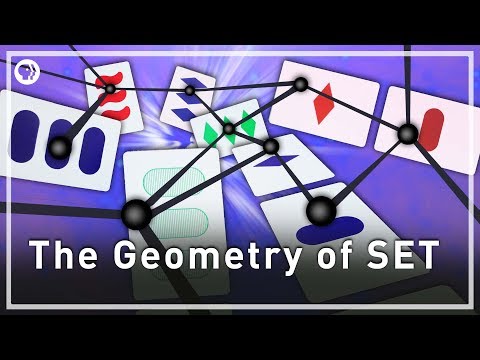
The Geometry of SET
https://www.youtube.com/watch?v=zurpOBPt4LI
Check out the solution to the Geometry of SET challenge problem right here: https://bit.ly/2Ggpw1d
Talking about the sizes of infinite things is tricky in part because the word “infinite” is often used in two distinct ways -- to refer to the sets themselves, and also to refer to the *sizes* of those sets. In what follows, let’s try to keep as sharp a distinction as we can between infinite sets and infinite set *sizes*, because doing so will let me highlight an especially paradoxical feature about infinite sizing that I don't think gets enough coverage. The technical term for a “size”, infinite or otherwise, is “cardinality”, and I should probably use a term like “numerousness” or “numerosity” rather than “size” because the idea it tries to generalize is the notion of "how many". Still, I’m going to say “size” a lot in this episode just because it’s easier.
Written and Hosted by Tai-Denae Bradley
Produced by Rusty Ward
Graphics by Ray Lux
Assistant Editing and Sound Design by Mike Petrow and Linda Huang
Made by Kornhaber Brown (www.kornhaberbrown.com)
Thanks to Peleg Shilo, Anurag Bishnoi, and Yael Dillies for your comments on last week's episode:
https://www.youtube.com/watch?v=zurpOBPt4LI&lc=UgzxzGjWJh8Pra57LDR4AaABAg
https://www.youtube.com/watch?v=zurpOBPt4LI&lc=Ugx2lMNH6inRYiTGFSx4AaABAg
https://www.youtube.com/watch?v=zurpOBPt4LI&lc=UgzA2HK0J9ytm01lUex4AaABAg
Special thanks to Roman Pinchuk for supporting us on our Converse level on Patreon.
Along with thanks to Matthew O'Connor, Yana Chernobilsky, and John Hoffman who are supporting us on Patreon at the Identity level!
And thanks to Mauricio Pacheco and Andrew Poelstra who are supporting us at the Lemma level!
Viewers like you help make PBS (Thank you 😃) . Support your local PBS Member Station here: https://to.pbs.org/donateinfi In the card game SET, what is the maximum number of cards you can deal that might not contain a SET? Tweet at us! @pbsinfinite Facebook:...
Viewers like you help make PBS (Thank you 😃) . Support your local PBS Member Station here: https://to.pbs.org/donateinfi
In the card game SET, what is the maximum number of cards you can deal that might not contain a SET?
Tweet at us! @pbsinfinite
Facebook: facebook.com/pbsinfinite series
Email us! pbsinfiniteseries [at] gmail [dot] com
Resources
Official SET game instructions
https://www.setgame.com/sites/default/files/instructions/SET%20INSTRUCTIONS%20-%20ENGLISH.pdf
Simple SET Game Proof Stuns Mathematicians (Quanta Magazine)
https://www.quantamagazine.org/set-proof-stuns-mathematicians-20160531/
The Problem with SET (NYTimes Puzzle)
https://www.nytimes.com/2016/08/22/crosswords/the-problem-with-set.html
Open Question: Best Bounds for Cap Sets (blog post by Terry Tao)
https://terrytao.wordpress.com/2007/02/23/open-question-best-bounds-for-cap-sets/
SET and Group Theory by Pavel Etingof (see p. 13ff)
http://www-math.mit.edu/~etingof/groups.pdf
This episodes challenge question is: Among the 9 cards shown in this episode what is the maximum number of them that may not contain a SET? Can you rephrase this question in an equivalent yet geometric way and then answer it using the hint - SETs correspond to lines in the Z/3Z grid?
Email your answers to pbsinfiniteseries@gmail.com with the subject line "SET Challenge" along with your proof. A random winner will be selected among the submissions to win a PBS Digital t-shirt.
(Spoiler Alert!) Here's the solution to the SET challenge problem: https://bit.ly/2Ggpw1d
Previous Episode:
What was Fermat’s “Marvelous" Proof?
https://www.youtube.com/watch?v=SsVl7_R2MvI
Let's talk about the card game SET. To play, you start with a deck of cards, each of which has a certain number of shapes in different colors and shadings. You deal out 12 cards and start looking for a SET---a collection of 3 cards that have either all the same or all different patterns. Now, once you deal those 12 cards, it’s possible that there might not be a SET among them. When that happens, you just deal out 3 more cards. And… in some cases, there still might not be a SET. So… you can add 3 more cards. And this begs the question: What is the maximum number of cards you can deal that might not contain a SET?
Written and Hosted by Tai-Danae Bradley
Produced by Rusty Ward
Graphics by Ray Lux
Assistant Editing and Sound Design by Mike Petrow and Linda Huang
Made by Kornhaber Brown (www.kornhaberbrown.com)
Special thanks to Roman Pinchuk for supporting us on our Converse level on Patreon.
Along with thanks to Matthew O'Connor, Yana Chernobilsky, and John Hoffman who are supporting us on Patreon at the Identity level!
And thanks to Mauricio Pacheco and Andrew Poelstra who are supporting us at the Lemma level!
Viewers like you help make PBS (Thank you 😃) . Support your local PBS Member Station here: https://to.pbs.org/donateinfi If Fermat had a little more room in his margin, what proof would he have written there? Tweet at us! @pbsinfinite Facebook: facebook.com/pbsinfinite series...
Viewers like you help make PBS (Thank you 😃) . Support your local PBS Member Station here: https://to.pbs.org/donateinfi
If Fermat had a little more room in his margin, what proof would he have written there?
Tweet at us! @pbsinfinite
Facebook: facebook.com/pbsinfinite series
Email us! pbsinfiniteseries [at] gmail [dot] com
Resources:
Contemporary Abstract Algebra by Joseph Gallian
https://www.amazon.com/Contemporary-Abstract-Algebra-Joseph-Gallian/dp/1133599702
Standard Definitions in Ring Theory by Keith Conrad
http://www.math.uconn.edu/~kconrad/blurbs/ringtheory/ringdefs.pdf
Rings and First Examples (online course by Prof. Matthew Salomone)
https://www.youtube.com/watch?v=h4UCMd8dyiM
Fermat's Enigma by Simon Singh
https://www.amazon.com/Fermats-Enigma-Greatest-Mathematical-Problem/dp/0385493622
Who was first to differentiate between prime and irreducible elements? (StackExchange)
https://hsm.stackexchange.com/questions/3754/who-was-first-to-differentiate-between-prime-and-irreducible-elements
Previous Episodes:
What Does It Mean to be a Number?
https://www.youtube.com/watch?v=3gBoP8jZ1Is
What are Numbers Made of?
https://www.youtube.com/watch?v=S4zfmcTC5bM
Gabe's references from the comments:
Blog post about the Peano axioms and construction of natural numbers by Robert Low:
http://robjlow.blogspot.co.uk/2018/01/whats-number-1-naturally.html
Recommended by a viewer for connections to formulation of numbers in computer science:
https://softwarefoundations.cis.upenn.edu/
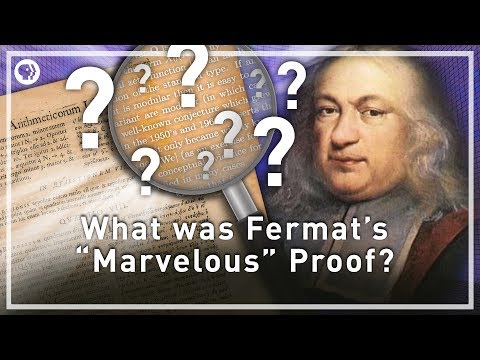
In 1637, Pierre de Fermat claimed to have the proof to his famous conjecture, but, as the story goes, it was too large to write in the margin of his book. Yet even after Andrew Wiles’s proof more than 300 years later, we’re still left wondering: what proof did Fermat have in mind?
The mystery surrounding Fermat’s last theorem may have to do with the way we understand prime numbers. You all know what prime numbers are. An integer greater than 1 is called prime if it has exactly two factors: 1 and itself. In other words, p is prime if whenever you write p as a product of two integers, then one of those integers turns out to be 1. In fact, this definition works for negative integers, too. We simply incorporate -1. But the prime numbers satisfy another definition that maybe you haven’t thought about: An integer p is prime if, whenever p divides a product of two integers, then p divides at least one of those two integers.
Written and Hosted by Tai-Danae Bradley
Produced by Rusty Ward
Graphics by Ray Lux
Assistant Editing and Sound Design by Mike Petrow and Linda Huang
Made by Kornhaber Brown (www.kornhaberbrown.com)
Special thanks to Roman Pinchuk for supporting us on our Converse level on Patreon.
Along with thanks to Matthew O'Connor, Yana Chernobilsky, and John Hoffman who are supporting us on Patreon at the Identity level!
And thanks to Mauricio Pacheco who are supporting us at the Lemma level!
Viewers like you help make PBS (Thank you 😃) . Support your local PBS Member Station here: https://to.pbs.org/donateinfi In the physical world, many seemingly basic things turn out to be built from even more basic things. Molecules are made of atoms, atoms are made of...
Viewers like you help make PBS (Thank you 😃) . Support your local PBS Member Station here: https://to.pbs.org/donateinfi
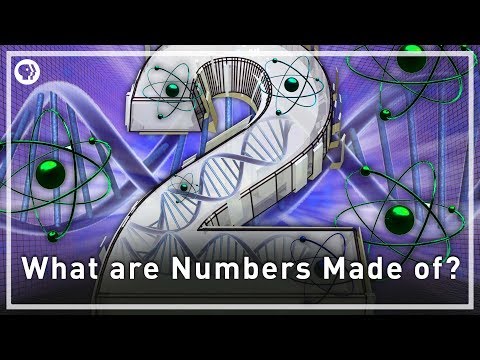
In the physical world, many seemingly basic things turn out to be built from even more basic things. Molecules are made of atoms, atoms are made of protons, neutrons, and electrons. So what are numbers made of?
Check out the previous episode to find out What It Means to be a Number
https://www.youtube.com/watch?v=3gBoP8jZ1Is
And to see Gabe's solution to the Torus Clock Challenge check out:
http://bit.ly/pbs_clock_challenge
Tweet at us! @pbsinfinite
Facebook: facebook.com/pbsinfinite series
Email us! pbsinfiniteseries [at] gmail [dot] com
Previous Episode:
What Does it Mean to Be A Number?
https://www.youtube.com/watch?v=3gBoP8jZ1Is
Torus Clock Challenge:
https://www.youtube.com/watch?v=KZT5hrYOERs
How to Divide by "Zero"
https://www.youtube.com/watch?v=uxpowBoPieQ&t=3s
Blog post about the Peano axioms and construction of natural numbers by Robert Low:
http://robjlow.blogspot.co.uk/2018/01/whats-number-1-naturally.html
Recommended by a viewer for connections to formulation of numbers in computer science:
https://softwarefoundations.cis.upenn.edu/
Any set N and function S that meet these conditions will *behave* , respectively, like the natural numbers and the operation "next" or "successor". You can even define operations that fully mimic run-of-the-mill addition and multiplication in terms of any suitable S, regardless of the details of how S works . In this sense, the Peano axioms distill numberhood down to its bare essentials.
Written and Hosted by Gabe Perez-Giz
Produced by Rusty Ward
Graphics by Ray Lux
Assistant Editing and Sound Design by Mike Petrow and Linda Huang
Made by Kornhaber Brown (www.kornhaberbrown.com)
Special thanks to Roman Pinchuk for supporting us on our Converse level on Patreon.
Along with thanks to Matthew O'Connor, Yana Chernobilsky, and John Hoffman who are supporting us on Patreon at the Identity level!
And thanks to Mauricio Pacheco who are supporting us at the Lemma level!
Viewers like you help make PBS (Thank you 😃) . Support your local PBS Member Station here: https://to.pbs.org/donateinfi If you needed to tell someone what numbers are and how they work, without using the notion of number in your answer, could you do it? Tweet at us!...
Viewers like you help make PBS (Thank you 😃) . Support your local PBS Member Station here: https://to.pbs.org/donateinfi
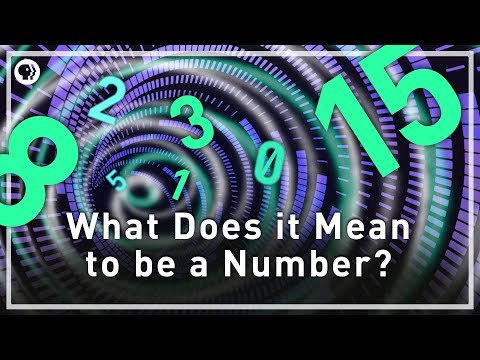
If you needed to tell someone what numbers are and how they work, without using the notion of number in your answer, could you do it?
Tweet at us! @pbsinfinite
Facebook: facebook.com/pbsinfinite series
Email us! pbsinfiniteseries [at] gmail [dot] com
Previous Episodes:
Telling Time on a Torus
https://youtu.be/KZT5hrYOERs
Crisis in the Foundation of Mathematics
https://www.youtube.com/watch?v=KTUVdXI2vng
How to Divide by "Zero"
https://www.youtube.com/watch?v=uxpowBoPieQ
Beyond the Golden Ratio
https://www.youtube.com/watch?v=MIxvZ6jwTuA
Are the natural numbers fundamental, or can they be constructed from more basic ingredients? It turns out that you can capture the essence of numberhood in a small set of axioms, analogous to Euclid’s axioms in geometry. They will allow us to build a set N that will behave just like the natural numbers without ever explicitly mentioning numbers or counting or arithmetic as we do so. These axioms were first published in 1889, more or less in their modern form, by Giuseppe Peano, building on and integrating earlier work by Peirce and Dedekind.
Written and Hosted by Gabe Perez-Giz
Produced by Rusty Ward
Graphics by Ray Lux
Assistant Editing and Sound Design by Mike Petrow and Linda Huang
Made by Kornhaber Brown (www.kornhaberbrown.com)
Special thanks to Roman Pinchuk for supporting us on our Converse level on Patreon.
Along with thanks to Matthew O'Connor, Yana Chernobilsky, and John Hoffman who are supporting us on Patreon at the Identity level!
And thanks to Mauricio Pacheco who is supporting us at the Lemma level!
Viewers like you help make PBS (Thank you 😃) . Support your local PBS Member Station here: https://to.pbs.org/donateinfi What shape do you most associate with a standard analog clock? Your reflex answer might be a circle, but a more natural answer is actually a torus....
Viewers like you help make PBS (Thank you 😃) . Support your local PBS Member Station here: https://to.pbs.org/donateinfi
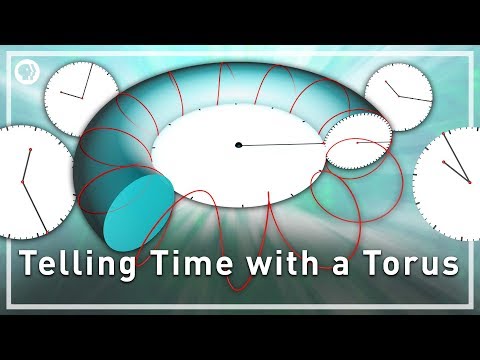
What shape do you most associate with a standard analog clock? Your reflex answer might be a circle, but a more natural answer is actually a torus. Surprised? Then stick around.
Tweet at us! @pbsinfinite
Facebook: facebook.com/pbsinfinite series
Email us! pbsinfiniteseries [at] gmail [dot] com
Previous Episode:
How to Divide by Zero
https://www.youtube.com/watch?v=uxpowBoPieQ
Some configurations of a clock, like the hour hand at 3 with the minute hand at 12, represent "valid" times of day -- if the hands sweep around continuously at their usual steady rates, this configuration will actually happen every 12 hours, at precisely 3 o'clock.
Written and Hosted by Gabe Perez-Giz
Produced by Rusty Ward
Graphics by Ray Lux
Assistant Editing and Sound Design by Mike Petrow and Meah Denee Barrington
Made by Kornhaber Brown (www.kornhaberbrown.com)
Special thanks to Roman Pinchuk for supporting us on our Converse level on Patreon.
Along with thanks to Matthew O'Connor, Yana Chernobilsky, and John Hoffman who are supporting us on Patreon at the Identity level!
And thanks to Nicholas Rose, Jason Hise, Thomas Scheer, Marting Sergio H. Faester, CSS, and Mauricio Pacheco who are supporting us at the Lemma level!
Viewers like you help make PBS (Thank you 😃) . Support your local PBS Member Station here: https://to.pbs.org/donateinfi What happens when you divide things that aren’t numbers? Tweet at us! @pbsinfinite Facebook: facebook.com/pbsinfinite series Email us! pbsinfiniteseries...
Viewers like you help make PBS (Thank you 😃) . Support your local PBS Member Station here: https://to.pbs.org/donateinfi
What happens when you divide things that aren’t numbers?
Tweet at us! @pbsinfinite
Facebook: facebook.com/pbsinfinite series
Email us! pbsinfiniteseries [at] gmail [dot] com
RESOURCES
Visual Group Theory by Nathan Carter https://www.amazon.com/Visual-Group-Theory-Problem-Book/dp/088385757X
Geek37 - The silver ratio and the octagon
https://www.youtube.com/watch?v=o-6kWnYfdVk
Polygons, Diagonals, and the Bronze Mean by Antonia Redondo
Buitrago
https://link.springer.com/content/pdf/10.1007/s00004-007-0046-x.pdfl
Previous Episodes:
Beyond the Golden Ratio
https://www.youtube.com/watch?v=MIxvZ6jwTuA&t=600s
The Multiplication Multiverse
https://www.youtube.com/watch?v=H4I2C3Ts7_w
The Mathematics of Diffie Hillman Key Exchange
https://www.youtube.com/watch?v=ESPT_36pUFc
How to Break Cryptography
https://www.youtube.com/watch?v=12Q3Mrh03Gk&t=130s&list=PLa6IE8XPP_glwNKmFfl2tEL0b7E9D0WRr&index=42
We all know you can’t divide by the number zero. But in some sense the notion of “dividing by zero” appears every time you use modular arithmetic! The structures that underlie this “modding business” are called equivalence relations and quotient sets. And that’s what I’d like to dive into today.
Written and Hosted by Tai-Danae Bradley
Produced by Rusty Ward
Graphics by Ray Lux
Assistant Editing and Sound Design by Mike Petrow and Meah Denee Barrington
Made by Kornhaber Brown (www.kornhaberbrown.com)
Special thanks to Roman Pinchuk for supporting us on our Converse level on Patreon.
Along with thanks to Matthew O'Connor, Yana Chernobilsky, and John Hoffman who are supporting us on Patreon at the Identity level!
And thanks to Nicholas Rose and Mauricio Pacheco for supporting us at the Lemma level!
Viewers like you help make PBS (Thank you 😃) . Support your local PBS Member Station here: https://to.pbs.org/donateinfi You know the Golden Ratio, but what is the Silver Ratio? Learn through active problem-solving at Brilliant: https://brilliant.org/InfiniteSeries Dive into...
Viewers like you help make PBS (Thank you 😃) . Support your local PBS Member Station here: https://to.pbs.org/donateinfi
You know the Golden Ratio, but what is the Silver Ratio? Learn through active problem-solving at Brilliant:
https://brilliant.org/InfiniteSeries
Dive into more open problem solving right here
https://brilliant.org/InfiniteSeriesOpenProblem
Tweet at us! @pbsinfinite
Facebook: facebook.com/pbsinfinite series
Email us! pbsinfiniteseries [at] gmail [dot] com
RESOURCES
Polygons, Diagonals, and the Bronze Mean by Antonia Redondo
Buitrago
https://link.springer.com/content/pdf/10.1007/s00004-007-0046-x.pdf
Previous Episode
Proving Brouwer's Fixed Point Theorem
https://youtu.be/djaSbHKK5yc
Cut a line segment into unequal pieces of lengths a and b such that the ratio a to b is the same as the ratio (a + b) to a --- that is, so that big over medium equals medium over small. This is how you construct the golden ratio Phi. If a rectangle has an aspect ratio of Phi, you can subdivide it forever into a square and another golden rectangle, and make fun logarithmic spirals by connecting the corners.
Written and Hosted by Gabe Perez-Giz
Produced by Rusty Ward
Graphics by Ray Lux
Assistant Editing and Sound Design by Mike Petrow and Meah Denee Barrington
Made by Kornhaber Brown (www.kornhaberbrown.com)
Special thanks to Roman Pinchuk for supporting us on our Converse level on Patreon.
Along with thanks to Matthew O'Connor, Yana Chernobilsky, and John Hoffman who are supporting us on Patreon at the Identity level!
And thanks to Nicholas Rose, Jason Hise, Thomas Scheer, Marting Sergio H. Faester, CSS, and Mauricio Pacheco who are supporting us at the Lemma level!
Viewers like you help make PBS (Thank you 😃) . Support your local PBS Member Station here: https://to.pbs.org/donateinfi There is a proof for Brouwer's Fixed Point Theorem that uses a bridge - or portal - between geometry and algebra. Tweet at us! @pbsinfinite Facebook:...
Viewers like you help make PBS (Thank you 😃) . Support your local PBS Member Station here: https://to.pbs.org/donateinfi
There is a proof for Brouwer's Fixed Point Theorem that uses a bridge - or portal - between geometry and algebra.
Tweet at us! @pbsinfinite
Facebook: facebook.com/pbsinfinite series
Email us! pbsinfiniteseries [at] gmail [dot] com
Previous Episode
The Mathematics of Diffie-Hellman Key Exchange
https://www.youtube.com/watch?v=ESPT_36pUFc&feature=youtu.be
Analogous to the relationship between geometry and algebra, there is a mathematical “portal” from a looser version of geometry -- topology -- to a more “sophisticated” version of algebra. This portal can take problems that are very difficult to solve topologically, and recast them in an algebraic light, where the answers may become easier.
Written and Hosted by Tai-Danae Bradley
Produced by Rusty Ward
Graphics by Ray Lux
Assistant Editing and Sound Design by Mike Petrow and Meah Denee Barrington
Made by Kornhaber Brown (www.kornhaberbrown.com)
REFERENCES
The functor in today’s episode is called “the fundamental group.” To learn more about the fundamental group and the proof of Brouwer’s Fixed Point Theorem, check out:
Brouwer's Fixed Point Theorem (Proof) on Math3ma:
http://www.math3ma.com/mathema/2018/1/18/brouwers-fixed-point-theorem-proof
Algebraic Topology by Allen Hatcher, page 31:
https://www.math.cornell.edu/~hatcher/AT/AT.pdf
A Concise Course in Algebraic Topology by Peter May, page 10: https://www.math.uchicago.edu/~may/CONCISE/ConciseRevised.pdf
Category Theory in Context by Emily Riehl, page 15: http://www.math.jhu.edu/~eriehl/context.pdf
To learn more about algebraic topology, check out:
Algebraic Topology: An Introduction by W. S. Massey https://www.amazon.com/Algebraic-Topology-Introduction-Graduate-Mathematics/dp/0387902716
Elements of Algebraic Topology by J. Munkres https://www.amazon.com/Elements-Algebraic-Topology-James-Munkres/dp/0201627280
To learn more about category theory and functors, check out:
“What is category theory, anyway?” http://www.math3ma.com/mathema/2017/1/17/what-is-category-theory-anyway
“What is a functor?” http://www.math3ma.com/mathema/2017/1/31/what-is-a-functor-part-1
VSauce - Fixed Points
https://www.youtube.com/watch?v=csInNn6pfT4
Congratulations to Robby Weintraub for being the winner of the Topology vs "a" Topology Challenge Question. https://www.youtube.com/watch?v=tdOaMOcxY7U
Special thanks to Roman Pinchuk for supporting us on our Converse level on Patreon.
Along with thanks to Matthew O'Connor, Yana Chernobilsky, and John Hoffman who are supporting us on Patreon at the Identity level!
And thanks to Nicholas Rose, Jason Hise, Thomas Scheer, Marting Sergio H. Faester, CSS, and Mauricio Pacheco who are supporting us at the Lemma level!
Viewers like you help make PBS (Thank you 😃) . Support your local PBS Member Station here: https://to.pbs.org/donateinfi Symmetric keys are essential to encrypting messages. How can two people share the same key without someone else getting a hold of it? Upfront asymmetric...
Viewers like you help make PBS (Thank you 😃) . Support your local PBS Member Station here: https://to.pbs.org/donateinfi
Symmetric keys are essential to encrypting messages. How can two people share the same key without someone else getting a hold of it? Upfront asymmetric encryption is one way, but another is Diffie-Hellman key exchange. This is part 3 in our Cryptography 101 series. Check out the playlist here for parts 1 & 2: https://www.youtube.com/watch?v=NOs34_-eREk&list=PLa6IE8XPP_gmVt-Q4ldHi56mYsBuOg2Qw
Tweet at us! @pbsinfinite
Facebook: facebook.com/pbsinfinite series
Email us! pbsinfiniteseries [at] gmail [dot] com
Previous Episode
Topology vs. “a” Topology
https://www.youtube.com/watch?v=tdOaMOcxY7U&t=13s
Symmetric single-key encryption schemes have become the workhorses of secure communication for a good reason. They’re fast and practically bulletproof… once two parties like Alice and Bob have a single shared key in hand. And that’s the challenge -- they can’t use symmetric key encryption to share the original symmetric key, so how do they get started?
Written and Hosted by Gabe Perez-Giz
Produced by Rusty Ward
Graphics by Ray Lux
Assistant Editing and Sound Design by Mike Petrow and Meah Denee Barrington
Made by Kornhaber Brown (www.kornhaberbrown.com)
Thanks to Matthew O'Connor, Yana Chernobilsky, and John Hoffman who are supporting us on Patreon at the Identity level!
And thanks to Nicholas Rose, Jason Hise, Thomas Scheer, Marting Sergio H. Faester, CSS, and Mauricio Pacheco who are supporting us at the Lemma level!