• maiweb v0.1.0
  • ★
  • Feedback

daringfireball.net

Visit site ↗

All items hosted on this domain, most recent first.

  • Daring Fireball daringfireball.net apple blog daring-fireball john-gruber tech technology 2026-08-03 17:19

    ↗

    For many years now, part of the co-marketing agreements between Apple and the Big Three is Apple agreeing to require a postpaid account with a Big Three carrier for all “special” iPhone financing deals, including the old iPhone Upgrade Program and the new Apple Upgrade leasing.

    Following up from last week, when I asked:

    When you lease an iPhone through Apple Upgrade, you need a cellular account on one of the big three U.S. carriers: AT&T, T-Mobile, or Verizon. That kind of stinks, and I’m not quite sure I understand why. You’re leasing the iPhone through Apple and Klarna, not the carrier, so I don’t know why Apple cares. If you know why, shoot me a message and explain it. Is it just a simplistic credit-risk evaluation, where prepaid plan-holders and MVNO users in general are viewed suspiciously?

    I got a slew of messages about this. Credit-risk assessment is seemingly part of it. There’s a lot of fraud in iPhone purchases specifically and cell phone service generally. The big three carriers do a significant amount of risk assessment before letting you open a new postpaid account; that you have an active account with one of them is a signal that you’re not trying to lease an iPhone using phony credentials in order to sell it.

    But the bigger reason is the complex nature of the contracts between Apple and each of the big three carriers. A reader who worked on the carrier team at Apple for a long time (but left a few years ago) wrote:

    In response to your question on why Apple would only offer iPhone on the “Big 3” for the new Upgrade Program: Every year, the Carrier Teams at Apple negotiate a deal/program (hundreds of millions of dollars) with each of those Big 3. In return for those dollars, Apple will make concessions exactly like this (or similar.) This is also why, for example, their logos appear more prominently or are the only ones called out on signage, commercials, etc… Although they really aren’t threatened by MVNO’s (the ones they don’t own) or regional carriers, it’s more like Apple is selling it as part of a package deal that’s exclusively offered to its biggest and best “tier 1” partners. It also acts as a carrot to perpetually try to motivate smaller partners into behavior Apple wants.

    This might change — some of the bigger MVNOs are trying to work their way into “tier 1” (or maybe create a new “tier 1.5”). But for many years now, part of the co-marketing agreements between Apple and the Big Three is Apple agreeing to require a postpaid account with a Big Three carrier for all “special” iPhone financing deals, including the old iPhone Upgrade Program and the new Apple Upgrade leasing.

    One interesting exception is that Boost Mobile is included alongside the Big Three for Apple Card Monthly Installments (ACMI), a program that offers 0% APR on certain products if you pay for them using an Apple Card. From the ACMI small print:

    In order to buy an iPhone with ACMI, you must select one of the following carriers (prepaid carrier plans are not supported): AT&T, Boost Mobile, T-Mobile, or Verizon. An iPhone purchased with ACMI is always unlocked, so you can switch carriers at any time, subject to your carrier’s terms.

    So perhaps some of the bigger MVNO carriers might work their way into Apple Upgrade — but if they do, it sounds like they’ll need to pay Apple for the privilege.

    With regard to fraud, a former Apple Store retail employee wrote:

    I left in 2019, but I’d estimate on some days a double digit percentage of in-person phone sales were fraudulent.

    This behavior absolutely exploded when you started to be able to do carrier financing in the store. They had stolen the identity of a legit account holder, come into the store with the info needed to access the account. They always wanted the highest end phone, and would pay the sales tax due at time of sale in cash. Never wanted any accessories. Never wanted to open the box or set up the phone.

    As bad as it was with the activation requirement, it would be way worse without it. I believe it’s gotten a lot better, and the carriers have more advanced systems in place to detect and deter this behavior now. But ultimately, the carriers ate the cost for millions of dollars in devices they never got paid for.

    I suspect that reader is correct that Apple, in collaboration with the carriers, has cracked down on this.

  • Hacker News - Front Page daringfireball.net community hacker-news links tech technology y-combinator 2026-08-03 00:22

    ↗

    Comments

    Comments
  • Daring Fireball daringfireball.net apple blog daring-fireball john-gruber tech technology 2026-07-31 22:50

    ↗

    Louie Mantia returns to the show to talk about the state of UI and icon design on Apple’s platforms, and some speculation on Apple’s trade secret lawsuit against OpenAI. Sponsored by: Notion: The collaborative AI workspace where teams and agents work side by side, with a...

    Louie Mantia returns to the show to talk about the state of UI and icon design on Apple’s platforms, and some speculation on Apple’s trade secret lawsuit against OpenAI.

    Sponsored by:

    • Notion: The collaborative AI workspace where teams and agents work side by side, with a Developer Platform teams can build on.
    • Even Realities: Even G2, the everyday display smart glasses. Use promo code talkshow to save 10% off the R1 Ring and/or Even Clip.
    • Squarespace: Save 10% off your first purchase of a website or domain using code TALKSHOW.
     ★ 
  • Daring Fireball daringfireball.net apple blog daring-fireball john-gruber tech technology 2026-07-31 18:27

    ↗

    Shop like a billionaire.

    Cabel Sasser on Mastodon:

    the temu app will be studied for generations.

    i opened the app, and recorded this unedited, nearly two minute, launch sequence. it somehow just gets funnier and more absurd

    I agree with this sentiment, right down to the fact that Temu doesn’t deserve capital letters.

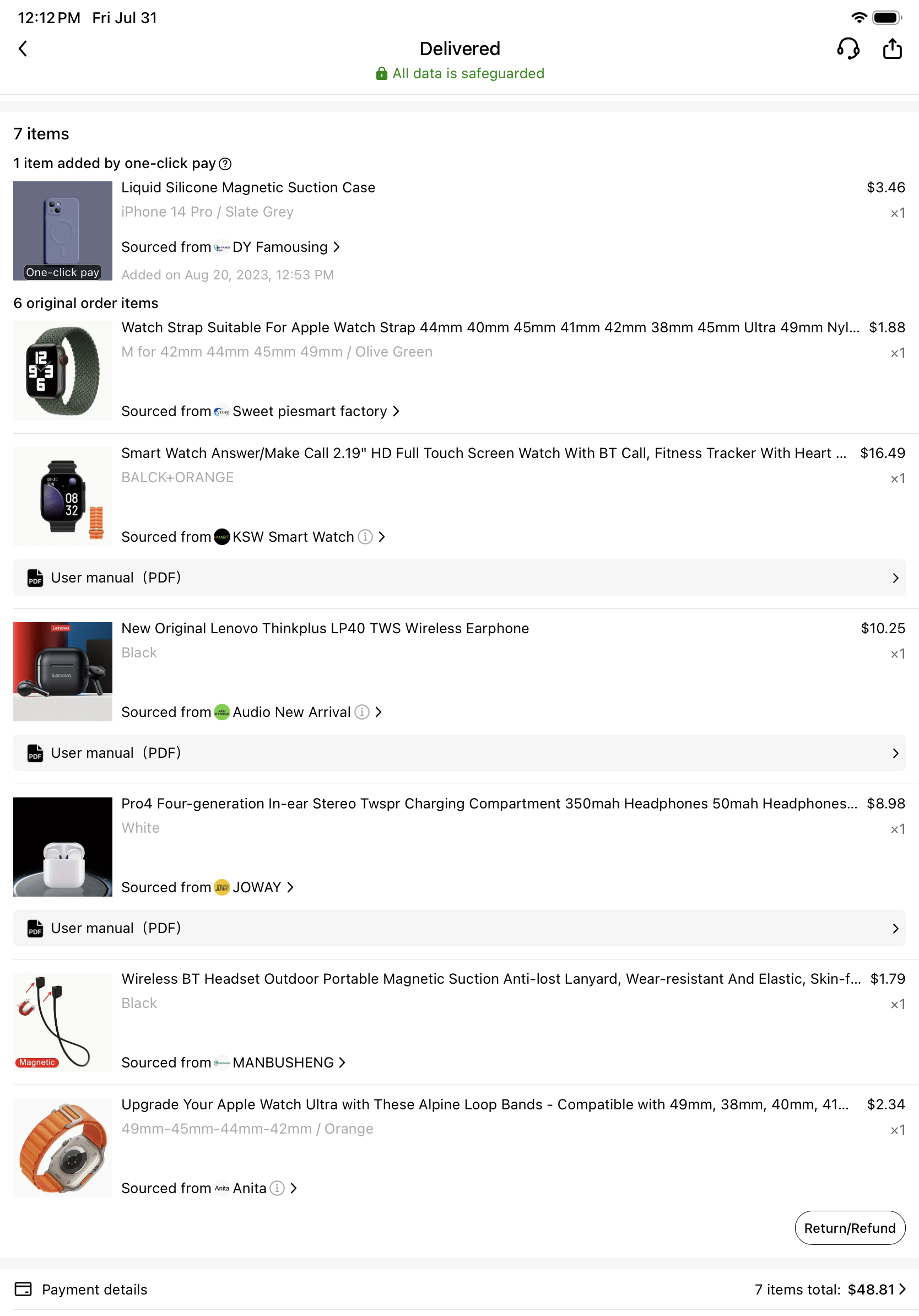
    I placed an order from Temu back in August 2023. At the time Temu was the #1 app in the App Store. I surmised it was some sort of crap store, but wanted to see for myself. It is in fact not merely a crap store but a spectacular crap store — like if a souvenir shop on a Jersey shore boardwalk were the size of a football stadium. Thousands of items, many of them rip-offs, at absurdly low prices. I bought (screenshot):

    • Two Apple Watch straps. One of them knocking off Apple’s Braided Solo Loop for $1.88; another knocking off the Apple Watch Ultra Alpine Loop for $2.34.
    • A pair of knock-off AirPods: $8.98.
    • Another pair of wireless earbuds branded “Lenovo” but definitely not made by Lenovo: $10.25.
    • A knock-off Apple Watch Ultra (“Smart Watch Answer/Make Call 2.19" HD Full Touch Screen Watch With BT Call, Fitness Tracker With Heart Monitor”), which included both orange and black (misspelled “balck”) rip-offs of Apple’s Ocean Band, for $16.49.
    • A “Magnetic Suction Anti-Lost Lanyard” for, I think, AirPods: $1.79.
    • An iPhone case: $3.46.

    Grand total for all seven items: $48.81. I ordered it all on 20 August 2023, and it arrived at my P.O. box on 2 September. The contents of the box looked less like it had been “packed” than “picked out of the trash and hurriedly stuffed into a box”.

    The iPhone case was so flimsy it didn’t properly snap onto the phone. The Apple Watch straps were ... OK? They were about as good as you could hope given that they cost around $2 each. The knock-off Apple Watch Ultra actually did sort of work, insofar as it had a color screen that turned on and showed watch-like screens (that looked nothing at all like WatchOS). The watch case was made of plastic, and watch straps did not snap into place in the slide-in channel where they connect — they just permanently slid around. I couldn’t get either of the bluetooth earbuds to work but I didn’t spend more than a few minutes trying with each, because I realized I had no intention of putting them into my ears. The lanyard I don’t remember.

    Temu today no longer tops the U.S. App Store’s Top Free Apps list, but it remains in the top 25. (It was at #19 this morning, and #22 this afternoon.) Temu’s slogan remains unchanged: “Shop like a billionaire.” Who am I to argue with that? We know one of them is on a lot of drugs — maybe all of them are, and Temu is what it’s like.

    After I placed that initial order, I started getting emails from Temu. Seven of the emails pertained to my order: an order confirmation, a shipping notice, a shipping update, another shipping update, a “we noticed your order didn’t arrive on time so here’s a $5 coupon” update, a delivery confirmation, and then a prompt to leave “an honest review detailing our product quality and your overall experience”. The emails kept coming. I decided to leave them turned on until I wrote about my Temu experience on Daring Fireball. As I type this sentence, I’ve received a grand total of 916 emails. That’s just under one per day for the 1,076 days since I placed my one and only order from them. Here’s a text file with the dates and Subject lines for all 916 emails. In the early months after placing my order, they sent me multiple emails per day, every single day. I particularly enjoy how, in the Subject lines, they occasionally abbreviate my name as “John Gru...” (for privacy?), despite the fact that (a) the emails are all sent to me, and (b) in many of the other messages, they spell out my full name in the Subject.

    Don’t do what I did and actually try Temu. Just watch Sasser’s video. It tells you everything you need to know.

  • Daring Fireball daringfireball.net apple blog daring-fireball john-gruber tech technology 2026-07-27 16:32

    ↗

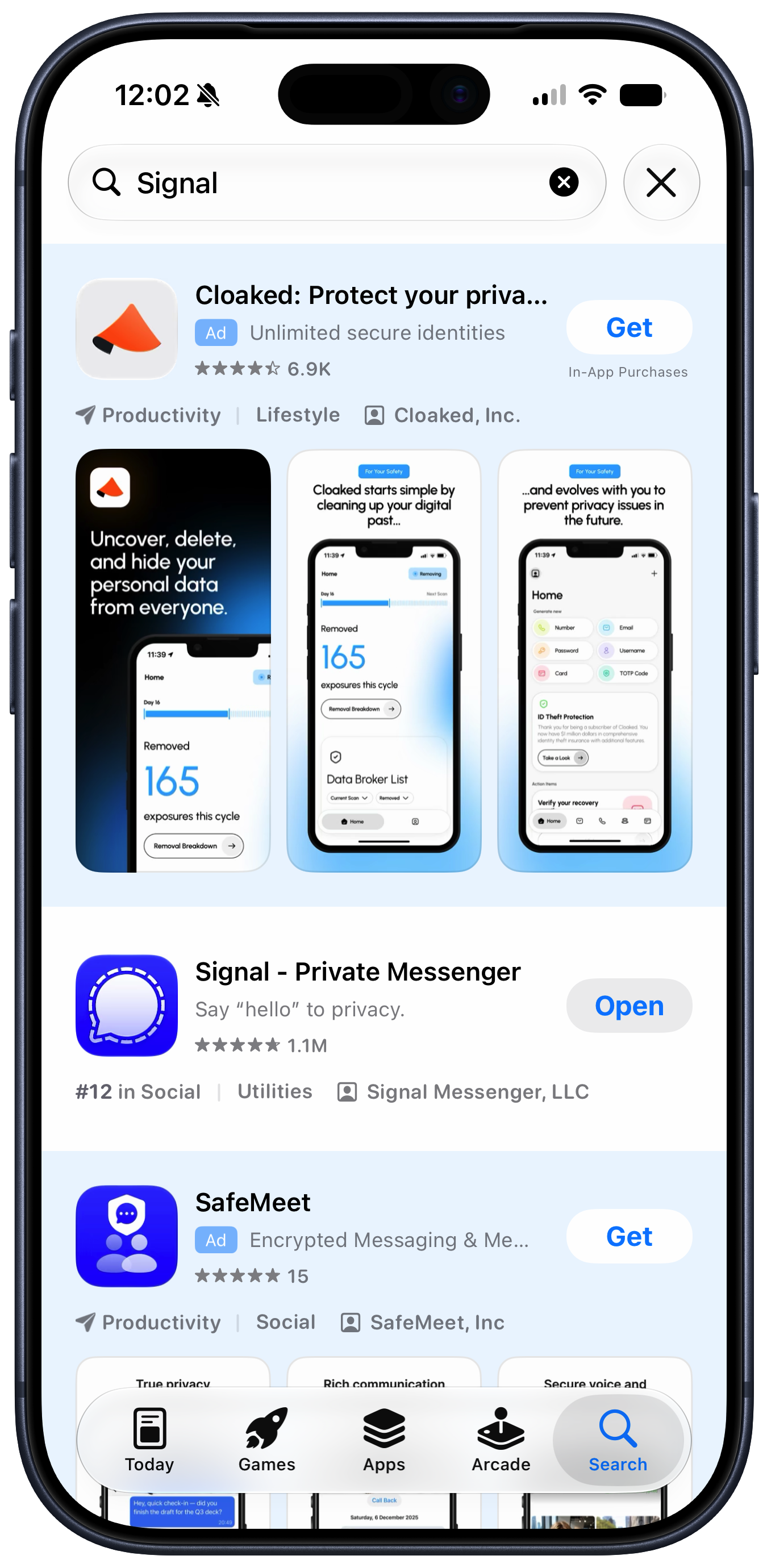
    Putting themselves in customers’ shoes today, how many ads do Apple’s executives want stuck in the results when they search for an app in the App Store?

    Regarding my recent pieces regarding Apple’s shitty ads in the App Store and Apple News (and, perhaps soon, Apple Maps), a friend sent me this pithy take:

    The ads Apple is happy to inflict on us in its apps are the equivalent of the stickers it would never allow on its physical products.

    Bullseye.

    That’s what those stickers on PCs are: they’re ads. Intel pays for the “Intel Inside” stickers that booger up PC laptop palm rests. Longtime readers will recall that back in August 2007, Apple held a Town Hall event to introduce new iMacs and some iLife and iWork software updates. In a post-event Q&A (imagine that), Bob Keefe of Cox Newspapers asked “Can you say why you all are not participating in the Intel Inside program, putting the stickers on your new or previous Macs?” This question was so absurd from the perspective of those who covered Apple closely that it prompted outright laughter. Jason Snell wrote a great column arguing that it was actually a good question.

    Here’s the whole exchange (via Dan Moren, then at MacUser). Give it a listen, it’s only 100 seconds or so:

    Keefe asks, Steve Jobs answers, Phil Schiller answers, and then Jobs closes it. Jobs broke the ice in his initial answer, with “What can I say? We like our own stickers better.” I was in the room, and that line killed. Jobs at his best. But you can tell that Jobs wasn’t really sure how to answer at first. He didn’t want to throw any shade at Intel, Apple’s partner, but he knew there was a key point to make here about Apple.

    The whole thing is funny because at a fundamental level we all just know in our bones that Apple never even considered putting “Intel Inside” stickers on Macs. But why? For eons, mankind knew that when you drop something, it will fall to the ground. But why? Gravity is worth asking about. Worth figuring out. I think that’s the point of Snell’s 2007 column arguing that people (like me) were wrong to mock Keefe for asking.

    It’s when Jobs comes back to the question, after Schiller, that we get the real answer:

    You know, we put ourselves in the customers’ shoes and we say, what do we want stuck on our product when we take it out of the box? And the answer is, nothing.

    That’s the answer. Apple still treats its hardware with that level of respect. With reverence. iPhones don’t even say “iPhone” on the hardware. No model or serial numbers. No small print. Just an Apple logo on the back.

    Putting themselves in customers’ shoes today, how many ads do Apple’s executives want stuck in the results when they search for an app in the App Store? We know the honest answer. But the answer evidenced by the actual App Store is “Two really big ones, including one in the first spot.”

  • Hacker News - Front Page daringfireball.net community hacker-news links tech technology y-combinator 2026-07-25 21:18

    ↗

    Comments

    Comments
  • Daring Fireball daringfireball.net apple blog daring-fireball john-gruber tech technology 2026-07-24 20:57

    ↗

    Ultimately, when you install a content blocker extension, you take responsibility for any overzealousness in what they block.

    Following up on the previous item today, re: content blockers and ad-blocking, I ran into a weird situation a few weeks ago with my column “John Ternus Should Reverse Apple’s Slide Down the Advertising Slippery Slope”. That article contains this sentence, in Markdown:

    And -- at this writing, still "coming soon" -- Apple is
    launching [ads on Apple Maps][🗺️].
    
    [🗺️]: https://ads.apple.com/maps
    

    The problem is that anyone reading that article in NetNewsWire saw it rendered like this, with the words “ads on Apple Maps”1 omitted:

    Screenshot of article text from NetNewsWire.

    It looks like I forgot to finish writing that sentence. NetNewsWire simply omits the hyperlinked words. After a few readers reported this, I immediately suspected the problem was the “ads.apple.com” domain. I’ve never linked to that domain before, and many ad blockers just block any domain that starts with a domain prefix like ads.*.

    And that’s exactly what the problem is. I had no idea that NetNewsWire filtered any content whatsoever (and I sort of think it shouldn’t), but DF reader Antonio Germano searched through NetNewsWire’s open-source code and found it in the core.css file, line 49:

    38  /*Block ads and junk*/
    39  
    40  iframe[src*="feedads" ],
    41  iframe[src*="doubleclick"],
    42  iframe[src*="plusone.google"] {
    43      display: none !important;
    44  }
    45  
    46  a[href*=".ads."],
    47  a[href*="feedads" ],
    48  a[href*="doubleclick"],
    49  a[href*="//ads."],
    

    The culprit identified, I dutifully pinged my friend Brent Simmons to report the problem. But then I had to decide what to do about it. I have no idea which feed readers are being used to read Daring Fireball’s feeds, but NetNewsWire is surely one of the most popular, and probably the most popular. It’s the feed reader I use personally. I can’t change the contents of NetNewsWire’s core.css file, so I can’t keep NetNewsWire from stripping out words that link to Apple’s ads.apple.com domain. What I could do is not link to ads.apple.com, like, say by changing my link from ads.apple.com/maps to a shorten-and-redirect URL like bit.ly/4wmXFSE that points back to Apple’s original URL.

    But I didn’t do that. I don’t like playing whack-a-mole to work around bugs in other software. I have enough trouble fixing my own mistakes. I also don’t like the idea of showing everyone a “Click it and find out where it actually goes” mystery URL from Bitly rather than the direct URL. It’s a general principle thing, and also a much better policy for links that are meant to last for decades.

    What I really don’t like about NetNewsWire’s ad-blocking here is that it just omits the linked text. It doesn’t remove the link but leave the words; it removes the words that are hyperlinked to the blocked domain. I’ve run into this with other content blocking extensions. For example, the Banish extension for Safari, which I recommended back in 2022. At some point a year or two ago, Banish started blocking links to Apple’s App Store domain, and it did so by removing the words that link to the App Store. That’s crazy. I linked to the App Store in my own post recommending Banish, which means if you have Banish installed and read that post, you won’t see the headline of the post (nor be able to follow the link). I think there are other content blockers that do the same thing with text that links to the App Store.2

    So what do I do about that? Do I stop linking to the App Store? That’s dumb. Do I create custom URL redirects for every single link I make to the App Store? That’s work I don’t need or want to do, and adds a layer of abstraction that confuses everyone who isn’t using a content blocker with such a stupid rule. So I just ignore it. But that means an untold number of readers, who are using such content blockers, are just missing words in my articles whenever I link to the App Store. Well, so be it. Ideally, content blockers “just work” — blocking only things you want blocked, never things you don’t want blocked. Nothing is perfect however. What’s pernicious about blockers that remove the actual words that link to certain domains is that that’s not expected behavior. From the reader’s perspective, it really just looks like an editing error on the part of the website, not a content blocker with an overzealous pattern-matching rule.

    Ultimately, though, when you install a content blocker extension, you take responsibility for any overzealousness in what it blocks.


    Let me use this opportunity to make a small personal request. The display ads on Daring Fireball are unobtrusive and limited to one per page. They are also entirely private, and always have been. There not only are no cookies or JavaScript that attempt to track you, but the ads themselves are served from the daringfireball.net domain. I turn down advertisers who request to serve images (or “tracking pixels”, which are just invisible images) from their domains. (Such requests are infrequent, thankfully.) I don’t display the ads in between paragraphs mid-article, a common practice that to me is disrespectful both to the writer and reader. In short, I try to keep the ads on Daring Fireball not merely unobjectionable, but something that actually adds to the site. I actually like the ads in certain high-quality print magazines, like The New Yorker. My goal for the ads on DF is for them to be like that.

    In short, I hope they’re the sort of ads readers don’t want to block. I’m pleased to say that most of the ad-blocking content blocking extensions I’ve personally tried do not block ads on Daring Fireball by default. In other cases, they do, but it’s easy to adjust the per-domain settings to allow them. In the previous post, I recommended uBlock Origin Lite (free, a bit complex) and Magic Lasso (paid, much simpler). Magic Lasso does not block ads on DF by default. I don’t remember what uBlock Origin does by default, but it’s trivial to change it to allow them.

    If you use an ad blocker and it currently blocks the ads on DF, I humbly ask you to consider taking a moment to tweak the settings to permit them. (If you are using a blocker that strips the ads from DF by default, you can do me an additional favor and shoot me a short email telling me which one. I’m curious.) If you are the developer of an ad blocker, I ask you to consider allowlisting Daring Fireball by default.

    If you are a reader and you really do want to block DF’s ads, please, go right ahead. I find that an odd mindset, but it’s your web browser and your call. No hard feelings. (Please further note that I have no JavaScript code that attempts to detect whether you’re blocking DF’s ads in order to nag you.)


    1. I omitted the Markdown creating a link on the words “still ‘coming soon’” for clarity, to emphasize only the problematic link in my original prose. (Also, it’s fun to use emoji as named link definitions, like in this example.) ↩︎︎

    2. I of course reported this to the developer of Banish, twice, but he never responded. I, err, banished Banish from my own devices, and upon finishing this article, I’m going to update my 2022 recommendation of Banish to un-recommend it. ↩︎

  • Daring Fireball daringfireball.net apple blog daring-fireball john-gruber tech technology 2026-07-24 16:43

    ↗

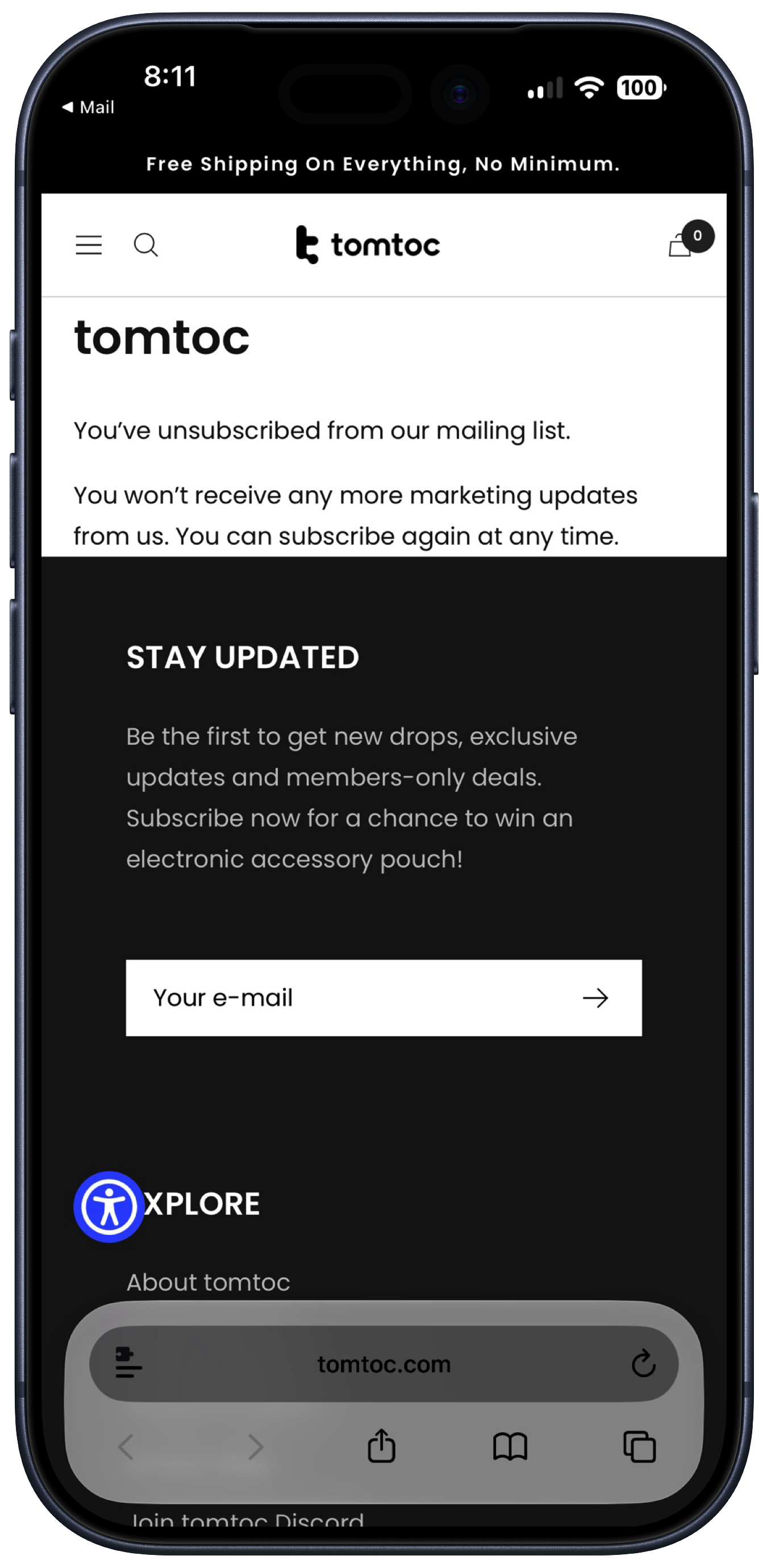
    Here’s a real gem that a reader sent me. Tomtoc is a maker of laptop bags and sleeves. Visit their homepage and, of course, you’ll get a dickover asking you to join their mailing list “for exclusive updates and get a chance to win a free tech pouch every month.” But here’s...

    Here’s a real gem that a reader sent me. Tomtoc is a maker of laptop bags and sleeves. Visit their homepage and, of course, you’ll get a dickover asking you to join their mailing list “for exclusive updates and get a chance to win a free tech pouch every month.” But here’s the gem. If you do subscribe, and you decide later to unsubscribe, you get this:

    Screenshot from an iPhone of Tomtoc’s “you’ve been unsubscribed from our mailing list” webpage presenting a dickover asking you to subscribe to their mailing list.

     ★ 
  • Daring Fireball daringfireball.net apple blog daring-fireball john-gruber tech technology 2026-07-24 15:44

    ↗

    Quinn Nelson returns to the show to discuss OpenAI’s ChatGPT/Codex “native” app migration fiasco, Siri AI in Apple’s OS 27 betas, MacOS 27 Golden Gate, and the hottest new cell phone of the year, the Trump T1. Sponsored by: Notion: Try the powerful, all-in-one Notion AI...

    Quinn Nelson returns to the show to discuss OpenAI’s ChatGPT/Codex “native” app migration fiasco, Siri AI in Apple’s OS 27 betas, MacOS 27 Golden Gate, and the hottest new cell phone of the year, the Trump T1.

    Sponsored by:

    • Notion: Try the powerful, all-in-one Notion AI today.
    • Factor: Healthy eating, made easy. Get 50% off your first box, plus free daily greens, with code talkshow50off.
    • Squarespace: Save 10% off your first purchase of a website or domain using code TALKSHOW.
     ★ 
  • Daring Fireball daringfireball.net apple blog daring-fireball john-gruber tech technology 2026-07-23 19:08

    ↗

    The obvious truth is that Apple’s ads just plain suck. They are not good at advertising-based services. And it shouldn’t be surprising that they’re not good at advertising-based services, because the incentives for advertising-based services are in direct opposition to the...

    Kirk McElhearn, back in February:

    I use Apple News to keep up on topics that I don’t find in sources I pay for (The Guardian and The New York Times). But there’s no way I’m going to pay the exorbitant price Apple wants for Apple News+ — £13 — because, while you get more publications, you still get ads.

    And those ads have gotten worse recently. Many if not most of them look like and probably are scams. Here are a few examples from Apple News today.

    One of the ads he examined was, supposedly, from a small company going out of business because the proprietor — supposedly a straight-out-of-Central-Casting kind old woman — was retiring after 26 years. McElhearn looked up the domain name and it had only just been created last year, and was registered from a company in China.

    Two years ago this very week, I wrote about Apple striking a deal with Taboola to sell ads for Apple News. In that post, I quoted Eric Seufert (of Mobile Dev Memo) posting on Threads:

    Regarding Taboola’s partnership with Apple: I’ve seen people claim that this is somehow hypocritical from a privacy perspective, assuming that Taboola’s somewhat obnoxious, clickbait-style ads must invasively target user profiles and browsing histories.

    They don’t. They are targeted entirely contextually. That’s the point.

    Want brash, garish advertising plastered all over the web? Reject ads personalization. Want relevant, informed advertising? Embrace ads personalization.

    Now quoting from myself in that same article:

    If you told me that the ads in Apple News have been sold by Taboola for the last few years, I’d have said, “Oh, that makes sense.” Because the ads in Apple News — at least the ones I see — already look like chumbox Taboola ads. Even worse, they’re incredibly repetitious. [...]

    So while I don’t think it’s good news that Apple is partnering with Taboola, I don’t expect it to make any discernible difference in the ad quality or frequency. Maybe it will improve the variety?

    Privacy is not the issue with Apple’s Taboola partnership, or Apple advertising in general. The issues are quality and user experience. I was correct that the partnership has made no discernible difference in ad quality or frequency. And it hasn’t made any improvement to variety either. Here’s a collection of ads I continue to see in Apple News — often with the same ad appearing 3–4 times in the same article, as I scroll. (I posted the same image in my recent article “John Ternus Should Reverse Apple’s Slide Down the Advertising Slippery Slope”, if you’re thinking it looks familiar.)

    The ads I see in Apple News are not relevant or informed. And, to be clear, I have “Personalized Ads” turned on in Settings → Privacy & Security → Apple Advertising (which makes me wonder if turning that off might actually make the ads even worse). The ads shown in the App Store never seem contextually relevant to me. So I have no faith that the ads that Apple is supposedly on the cusp of serving in Apple Maps are going to be good.

    Back in March I wrote:

    I’m not going to prejudge the actual experience, and you shouldn’t either. I also do not begrudge Apple for wanting to monetize Maps. But if the addition of ads does make the Apple Maps experience worse, why won’t Apple let us buy our way out of seeing them? Netflix doesn’t force us to watch their ads. YouTube Premium is arguably the best bang-for-the-buck in the entire world of content subscriptions. Why should Apple One subscribers still see these ads in Apple Maps?

    This to me is proof that Apple leadership is suffering from cognitive dissonance over their slide into advertising. They’re conflating cause and effect. The Apple brand stands for high-quality superior user experiences because the devices and software Apple makes traditionally deliver high-quality superior user experiences. The work Apple ships is what makes the brand what it is. But now they’re stricken with the mindset that it’s the Apple brand that makes something a high-quality superior experience. If it comes from Apple it must be great — that sort of thinking. The ads in Apple News and the App Store can’t be detrimental to the user experiences and at times even embarrassingly crude or downright scammy because Apple doesn’t ship things that are detrimental to the user experience or embarrassingly crude — and certainly never with even a whiff of scamminess.

    My theory is that’s why Apple isn’t allowing users to buy our way out of the ads. When streaming services like Netflix let you pay more money for ad-free tiers, it’s an explicit acknowledgement that the experience with ads is worse. Apple doesn’t offer ad-free tiers for the App Store or (soon) Apple Maps1 because, I think, they can’t bring themselves to admit that by adding ads to these services they have made them worse. If you refuse to admit that the ads make these services worse, you also can’t admit that there’s a reason to offer an ad-free experience. So the thinking is something like “Apple always focuses on the user experience, and never deliberately makes the user experience worse. Therefore, if an Apple service shows ads, those ads are high quality and don’t detract from the quality of the product or the experience of using it. Therefore, there’s no reason to offer users a paid ad-free tier, because there’s no reason to want to avoid Apple’s ads.”

    It’s a textbook case of Upton Sinclair’s famous adage: “It is difficult to get a man to understand something, when his salary depends upon his not understanding it.” The obvious truth is that Apple’s ads just plain suck. They are not good at advertising-based services. And it shouldn’t be surprising that they’re not good at advertising-based services, because the incentives for advertising-based services are in direct opposition to the incentives for everything Apple actually is good at. To wit: offering superior products worth paying a premium price for.

    One can argue that an ad-free Apple Maps experience ought to be included with the price of the devices Apple sells (which, of course, has been true until now). It’s even easier to argue that the App Store ought to be ad-free for everyone, based on its exclusive role in software distribution and the 15–30 percent commission Apple takes on every transaction. But if Apple simply made the App Store and Apple Maps ad-free for users paying for iCloud+ or Apple One, I’d stop complaining. That would make it clear: the full Apple experience requires not just an Apple device, but an Apple subscription. But the way things stand now, that ad-free experience isn’t even available.


    1. Apple News is different because the inclusion of ads is controlled by the publishers, not by Apple. If you read Daring Fireball on Apple News, for example, you don’t see their crummy chumbox ads, because I don’t participate in that system. Most of the cringe-inducing ads I see in Apple News are seemingly sold through Apple Ads, though, so I’m not arguing that Apple isn’t ultimately responsible for the Apple News reading experience. I’m saying they can’t just flip a switch and offer a paid-subscription no-ads Apple News experience without the agreement of every single participating publisher. The App Store and Apple Maps, however, are services under Apple’s complete control. Every ad shown in those apps is Apple’s choice to show. ↩︎

  • Daring Fireball daringfireball.net apple blog daring-fireball john-gruber tech technology 2026-07-21 22:49

    ↗

    What the EC is dictating to Google is just breathtaking in scope.

    The European Commission, last week:

    Today, the European Commission has issued two sets of binding specification measures to Google under the Digital Markets Act.

    The aim of the first specification measures is to ensure that competitors’ Artificial Intelligence (AI) services can compete with Google’s own AI services, such as Gemini, by having equal access to features on Google’s Android devices.

    The aim of the second specification measures is to rebalance the playing field by giving third-party search engines access to search data that only Google Search can collect at scale.

    They provide separate “Q&A” overviews of the guidance for Android AI interoperability and web search sharing, and the full guidance documents are PDFs (Case DMA.100220 for Android AI, Case DMA.100209 for web search). I suggest reading the two Q&A overviews, unless you’re having trouble falling asleep at night, in which case you’ll love the full PDF decisions.

    Both decisions are interesting. With search, Google is required to share with competitors — search engines and AI chatbots alike — a massive amount of user data from Google Search user interactions. What terms people search for, what they click on in results, what languages and devices they use. It’s all ostensibly anonymized but that’s tricky when it comes to search terms. A lot of the terms people type into web search fields are to some degree personally identifying. The EC seems to be saying it’s Google’s problem to filter out things like passwords and usernames and omit them from the shared datasets. Google can charge money for this access, but only under “fair, reasonable, and non-discriminatory (FRAND)” prices, based on a Commission-defined methodology.

    More interesting to me, however, is the guidance pertaining to on-device AI on Android devices. What the EC is dictating to Google is just breathtaking in scope. The EC is demanding that Google create APIs that allow third-party AI assistants to do everything Google Gemini does now, including:

    • Control hardware buttons (to invoke the assistant).
    • Capture anything on screen, from any app.
    • Seemingly unfettered access to microphones and cameras and other sensors on the device.
    • Unfettered background operation. Third-party AI assistants must be permitted to execute in the background whenever they want, for as long as they want.
    • Execute their own audio models on the digital signal processor, so they can listen at all times for their own custom “Hey Dingus” wake phrases/hot words.
    • Google must allow concurrent access to always-on hot word detection. So if you have Claude and ChatGPT and Grok and Meta AI installed, all of them — in addition to Gemini — must be permitted to have always-on audio detection concurrently. Google is permitted to do some vetting here, but this seems like madness.
    • Third-party models get access to Google’s on-device local models.

    Also, in my reading, the EC is demanding that Google make available to third-party AI assistants all information in Google’s own apps (Gmail, Google Calendar, Google Docs, Google Maps, etc.) that Gemini has access to. There is no opt-out for Google regarding data from their own apps. Nor, I think, does this guidance allow third-party apps from other developers to only support specific system-level AI models. Like, let’s say you’re Slack, and you use the APIs to make the content from within Slack available to Gemini on the device. These guidelines don’t permit Google to allow Slack to say that they trust Gemini but only Gemini. If a third-party app like Slack supports making its data available to any system-level AI provider, it must make its data available to every system-level AI provider.

    There’s a lot more. Basically, though, the EC is demanding that third-party AI assistants be enabled to become part of the system software, not just apps. I’m sure some people think this is a great idea. It’s the user’s device, they should be allowed to make ChatGPT or Claude or Meta AI part of their OS if they want. It’s up to them. Put users in control.

    This is how PCs have traditionally worked, but many normal people’s PCs are a mess of third-party software running in the background. That includes the Mac. If you ask a normal person “What third-party software runs in the background on your Mac or PC?” they would have no idea. It’s all just magic to them. If Google supports this guidance, it could turn Android phones in the EU into PCs. Honestly, some of the stuff the EC is requiring is lower-level than what MacOS and Windows allow third-party software to do.

    What the EC’s “guidance” describes in this document is an entirely different operating system than the Android that Google has designed. The European Commission obviously thinks it is their place to design operating systems. Maybe you do too. Google obviously disagrees, and so does Apple. And so should most people who have any idea how these devices work. This is a recipe for disaster, if Google were to enact it and third-party AI assistants took advantage of it.

    That second “if” is a big one. One possible scenario that I consider quite likely is that Google could spend years of engineering time and human resources building out APIs to enable all of this, in the safest and most private ways possible, and no major AI assistant adopts it. That’s the way it’s turned out with a whole slew of DMA compliance for Apple and Google. Apple built an entire complex set of APIs to enable third-party web browser rendering engines, exclusively for compliance with the DMA, and there exist no third-party web browser rendering engines for iOS. Not one. Because while the EU is a big market, it’s not big enough to justify building a custom web browser just for the EU alone.

    Ways I can see this playing out, in order of likelihood (most likely first):

    (A) Google enacts all of this and no major AI assistants support it because it’s only for Android, only in the EU. And it’s not like ChatGPT and Claude are seeing a lack of usage as things stand now. In this scenario Google just wastes massive time and engineering talent building APIs that never get used, and Android users in the EU get hassled with additional annoying choice and permission screens just to use the Gemini features that are built into Android.

    (B) Google enacts all of this and major AI assistants do support it. Unintended results include massive privacy violations where third-party assistants exfiltrate on-device data to the cloud, Meta uses on-device third-party data for the targeting of ads, and users who take advantage of these third-party assistants see significant battery life drain as third-party assistants run without limits in the background and run expensive inference locally to save on their own server costs.

    (C) Google enacts all of this, major AI assistants do support it, and there are no privacy scandals, nor any issues with battery life, because each of the companies that makes these assistants develops them with respect for user privacy and for device resources like CPU and memory consumption.

    (D) Google pulls system-integrated Gemini from Android in the EU, or severely restricts its capabilities. Rather than elevate third-party assistants from apps to system software, demote Gemini to the privileges of a mere app and leave Android users in the EU without a system-integrated AI assistant.

    Under all scenarios, future feature updates to system-level AI in Android will appear late or never in the EU. No future new features can debut in the EU at the same time as the rest of the world because for DMA compliance, Google will need to add support for third-party assistants to do the same things. And they’re not going to hold new features for the rest of the world waiting for that.

    I’m not even sure (D) is permitted under this Commission guidance, given that Google started shipping Gemini on Android last year. The entire guidance document is written under the presumption that Google will comply by building the APIs that the guidance demands, not by achieving parity by removing Gemini system integration features. It would be awkward and unpopular for Google to ship updates to Android that remove core AI features, but that might be more palatable than the alternative.1 Note that with iOS, to my recollection, Apple hasn’t pulled any existing features from the EU. They’ve only withheld or delayed new features. Google’s on-device Gemini horse is already out of the barn.

    Lastly, although this guidance document pertains to Android, not iOS, I see no reason to think the European Commission wouldn’t demand all or most of the same things from Apple. They haven’t given Apple any guidance yet, because it’s European Commission policy to give guidance only after a DMA-designator gatekeeper ships something that is then ruled non-compliant. But it’s hard to imagine Apple accepting most of these terms. Unfettered background processing and access to the microphone, cameras, and sensors? Third-party audio models running on the hardware DSP listening for wake words? Granting third-party assistants unsupervised access to all user data from apps published using App Intents?

    Apple unfortunately hasn’t shared any technical details describing its proposal for a “Trusted System Agent” that it shared with the EC last year. But whatever Apple’s vision for the Trusted System Agent is, I don’t see how the EC would deem it compliant with the DMA if they want from Apple anything close to what they are now demanding from Google. There are no checks and balances or oversight that Google is permitted to apply to third-party assistants in this guidance. If Gemini can do something, third-party agents must be able to as well. Because Gemini gets to run in the background as much as Google sees fit, third-party assistants must be permitted to run in the background as much as they see fit. And if those third-party assistant developers — OpenAI, Anthropic, xAI, and Meta — have different opinions than Google on how much CPU usage is appropriate in the background, how much RAM and storage is appropriate to consume, or how respectfully to treat users’ on-device data, well that’s just tough noogies. If the user OK’s it, then it’s OK.

    A month ago, after WWDC, when this guidance pertaining to Android AI was rumored to be forthcoming, I wrote:

    Google is learning the lesson Apple learned the hard way with all the existing features of iOS that were deemed noncompliant with the DMA when it went into effect. The “ship it first and ask forgiveness / hope it’s deemed compliant” strategy is not a good one in the EU.

    I genuinely wonder what the European Commission thinks the purpose of Android is. Google created Android for the benefit of its own services. Google was worried about Microsoft, not Apple, at the time, but they wanted to ensure their own services were available on a major mobile platform. I’m really not seeing how it’s more attractive to Google to comply with this guidance than to just pull system-level Gemini in the EU. Either they waste a small fortune building APIs no one will use, or, they spend that small fortune buildings APIs for the benefit of their biggest competitors. I get it that that’s the intended price to pay for being a designated DMA gatekeeper. But what’s the motivation for Google to do this rather than just walk away from system-integrated AI on Android in the EU? It certainly doesn’t look like the competing platform, iOS, is going to offer it in the EU anytime soon either.


    1. If you are handed a mandate that everyone must be able to run at the same speed, and you can’t figure out how to make slow people faster, you can comply by forcing the fast to wear weighted boots. This is where utopian egalitarian initiatives often lead. ↩︎

  • Daring Fireball daringfireball.net apple blog daring-fireball john-gruber tech technology 2026-07-19 00:38

    ↗

    I think maybe John Ternus is more of a “*Hey, what* would *Steve have done here?*” kind of guy. What would Steve Jobs do with this OpenAI situation? He’d go to war.

    ‘It Seems You Have a Different Policy’

    Ben Thompson, in a subscriber-only Stratechery update Tuesday:

    I got a fun email from former Apple executive, Nest founder, and one-time Stratechery Interview subject Tony Fadell in response to yesterday’s Update about Apple suing OpenAI (published with permission):

    Good article as always… This is Apple’s typical tactic to scare Apple employees — either former or current. I heard this lawsuit was driven by the Apple board.

    Steve threatened to file a lawsuit against Nest for poaching 80-100 Apple employees. He called me, screamed for a while with lots of accusations. Then I said, “Steve, it’s Apple’s job to retain its talent, not mine.” He stopped his rant and then we went on to talk about our families and vacation plans. We kept hiring…

    This sounds about right — and in terms of the Steve Jobs angle, John Gruber made a compelling case on Dithering that this lawsuit may very well have been driven by John Ternus channeling his inner Jobs.

    Fadell, of course, is correct that it’s Apple’s job to retain its talent. Recent reporting from Mark Gurman suggests that John Ternus is keenly aware of this, at least as it pertains to Apple’s industrial design team, which has been ground zero for the Apple-to-OpenAI recruitment pipeline. (And the Dithering episode Thompson references is the one we made free-to-listen this week.)

    Playing hardball when it comes to poaching is deeply embedded in Apple’s DNA. Steve Jobs hated Apple employees getting poached. In 2005 he sent this email to Adobe CEO Bruce Chizen:

    From: Steve Jobs
    To: Bruce Chizen
    Date: Thursday, May 26, 2005 9:36 AM
    Subject: Recruiting

    Bruce,

    Adobe is recruiting from Apple. They have hired one person already and are calling lots more. I have a standing policy with our recruiters that we don’t recruit from Adobe. It seems you have a different policy. One of us must change our policy. Please let me know who.

    Steve

    After one back-and-forth exchange with Jobs, Chizen agreed Adobe would change its policy.

    A more contentious example came in August 2007, when Jobs sent an email to Palm CEO Ed Colligan that read:

    From: Steve Jobs
    To: Ed Colligan
    Date: Sunday, August 26, 2007 11:42 am
    Subject: Fwd: Your proposal

    Ed,

    This is not satisfactory to Apple. It is not just a matter of our employees deciding they want to join Palm. They are being actively recruited using knowledge supplied by Jon Rubenstein [sic] and Fred Anderson, with Jon personally participating in the recruiting process. We must do whatever we can to stop this. I’m sure you realize the asymmetry in the financial resources of our respective companies when you say: “We will both just end up paying a lot of lawyers a lot of money.”

    Just for the record, when Siemens sold their handset business to BenQ they didn’t sell them their essential patents but rather just gave them a license. The patents they did sell to BenQ are not that great. We looked at them ourselves when they were for sale. I guess you guys felt differently and bought them. We are not concerned about them at all. My advice is to take a look at our patent portfolio before you make a final decision here.

    Steve

    That’s a good email. Information dense. My favorite part isn’t the “I’m sure you realize the asymmetry in the financial resources of our respective companies”, although that’s good. It’s the “I guess you guys felt differently and bought them.” Stone cold.

    Some backstory on the players:

    Colligan, of course, is Mr. “PC guys are not going to just figure this out. They’re not going to just walk in.” He was a business guy who thought product guys didn’t matter in an industry that was about to be taken over by product guys. Sort of like Steve Ballmer, without the charisma, at a much smaller company.

    Jon Rubinstein1 was a hardware engineering executive at Apple, overseeing Mac hardware during the comeback years after Steve Jobs returned, then switching to oversee the newly-created iPod division in 2004. (Mac hardware then went under the supervision of a then-little-known operations executive referred to in the announcement as “Timothy Cook”.) Rubinstein left Apple in early 2006, citing exhaustion.2 His departure was announced six months earlier, alongside the promotion of Cook to COO. By 2007 Rubinstein was involved with Palm, by way of Elevation Partners, an investment firm that took a 25 percent stake in Palm. He became CEO of Palm in 2009, tried to turn it around, and then wasted a few years as an executive at HP after HP bought Palm’s carcass thinking it was still alive.

    Fred Anderson was Apple’s CFO from March 1996 (almost a year before the NeXT reunification) to June 2004 — the nail-biting, at-times-near-bankruptcy turnaround years. Anderson took the fall, perhaps unfairly, for the stock options backdating scandal under Steve Jobs and, after leaving Apple, paid a $3.5 million fine in a settlement with the SEC. Needless to say, in the summer of 2007, there was bad blood between Anderson and Apple. Anderson, post-Apple, was a co-founder of Elevation Partners and had recruited Rubinstein to join.

    Some bad blood. Some former high-level Apple executives putting a team of ex-Apple engineers and designers together to take on the iPhone. History doesn’t repeat, but it often rhymes.

    If in addition to thinking that this sounds familiar, you also think these emails sound illegal, you may recall that in 2015, Apple (along with Google, Adobe, Intel, and other companies) paid a collective $415 million penalty to settle a class-action anti-poaching lawsuit. That they settled doesn’t mean they regret playing hardball. Rules are only followed by those who fear the penalties.

    Jobs liked to fight, and wasn’t afraid to let his temper show. Tim Cook has a fierce temper and steel nerves, but he arguably only once, ever, showed it in public. I do not think he relishes a fight. He’s a diplomat, not a general. I suspect there’s no undiscovered tranche of Jobs-style stone-cold threatening emails from Cook to competing CEOs.

    Steve Jobs’s oft-cited parting advice to Tim Cook was “Don’t ask what I would do. Just do the right thing.” Cook has largely lived by that mantra. But maybe — maybe — by taking that advice to heart, he has at times deliberately steered the company in ways Jobs would not have, just for the sake of steering it in a different way. I think maybe John Ternus is more of a “Hey, what would Steve have done here?” kind of guy.

    On the one hand, this lawsuit is a bad look for Apple. It could be perceived that Apple does not think their employees are free to leave and compete against them. On the other hand, Apple could use a booster shot of Steve Jobs’s “us against the world” attitude. It might be wrong to start a war, but it’s never wrong to finish one after being attacked.

    What would Steve Jobs do with this OpenAI situation? He’d go to war.3

    ‘This Is Not Satisfactory to Apple’

    The early history of the Macintosh GUI went something like this: When the Macintosh debuted in 1984 it didn’t hit like Apple had hoped it would. (That’s when Steve Jobs was run out of the company.) But by the late 1980s it had caught on, especially in markets like design and desktop publishing. It was the only GUI game in town — command-line DOS PCs were popular, but Windows 1.0 was almost too primitive to believe and Windows 2 wasn’t much better. Apple was certain that the WIMP GUI was the future of computing, and because the Macintosh was the only credible GUI then on the market, Apple owned the future of computing. They were correct about one of those things. Because then came Windows 3, which still sucked — still was ugly, still was terribly designed, still severely limited compared to the Mac in its UI grace and vocabulary of actions — but, it didn’t suck as much. It wasn’t good but it was good enough for the corporate IT market, and the corporate IT market drove the industry at the time.

    In the early 1990s John Sculley filed and pushed the infamous “look and feel” lawsuit against Microsoft. One year out from the launch of Windows 95 — which at least looked pretty good4 — Apple’s response was to try to argue in court that they owned the copyright and patent rights to the very concepts of the GUI and the desktop metaphor. The court handed Apple its ass. Apple soon found itself 90 days away from bankruptcy and in desperate need of a new modern operating system, which they themselves had proven incapable of creating. Windows 95 launched with such anticipation that customers lined up overnight outside retail stores to buy it the morning it launched.

    That lawsuit was the low point in the entirety of Apple’s history. It was incoherent and, worse, pathetic. Incoherent because Apple was simultaneously arguing in marketing that the Mac remained vastly superior to Windows (“C:\ONGRTLNS.W95”), while arguing in court that Windows was a feature-for-feature clone. It couldn’t be both. I would argue that the former was true — the Mac remained superior in many ways — but actions speak louder than words and Apple’s action was to sue Microsoft and lose. It was pathetic because you know who loses? Losers.

    The correct response to the competitive threat of Windows wasn’t to futilely attempt to argue that Windows should not be allowed to exist. It was to make the Macintosh so much better than it already was — to inject so much new innovative insane greatness — that customers would line up overnight to buy Mac software (and watch Apple keynotes). What Microsoft had in 1995 that Apple could not muster was vast customer enthusiasm. That cannot be bought. It cannot be faked. It can only be earned. And you sure as shit cannot stop it with a lawsuit.

    Earning that sort of consumer enthusiasm — in spades — is exactly how Steve Jobs pulled Apple out of its nosedive. It took the better part of a decade.

    When Apple announced this new lawsuit last week against OpenAI, I wondered, at first, whether it had a whiff of that 1994 look-and-feel loser desperation. Is it Apple’s position that the only way to stop its talent exodus to OpenAI is in court? Upon consideration, I think not. First, it’s not incoherent. There’s no conflict between what Apple is saying about its products or itself as a company that is at odds with this lawsuit. They’re just saying, “Fuck you, you goddamn traitors. You want to fuck with us? We’ll fuck with you.” When you poke a bear — 400 times — you better be ready for the bear to eventually react.

    Further, while Apple can only have one CEO at a time, and that CEO remains Tim Cook until September 1, there’s no way that John Ternus doesn’t fully approve of this lawsuit. Cook has gone out of his way to leave Ternus with a clean plate. It would be insane to file this suit six weeks ahead of Ternus taking the helm if Ternus is anything short of fully on board.

    I’m not saying it’s a good look for Apple. I’m certainly passing no judgment on the merits of the case, which OpenAI hasn’t yet responded to legally. But it is a very different and much more emotional reaction than we’ve seen under Tim Cook. Those anti-poaching emails Steve Jobs sent to Adobe, Palm, and Google weren’t good looks for Apple either. But that doesn’t mean they were bad for Apple. A bad look can be a good thing. Passion is powerful, and in and of itself, inspiring. This is a passion-fueled lawsuit. I saw some commentators speculate that, already hemorrhaging cash on a daily basis, OpenAI will surely spew some of that in the direction of Cupertino and just settle it. But Apple doesn’t need cash. This is a lawsuit that I believe OpenAI cannot settle, because there is no settlement Apple would accept short of a dissolution of their entire hardware division.

    Apple claims in their complaint that the trade-secret chicanery they’ve already documented “is the tip of the iceberg”. If Apple is wrong, and OpenAI has recruited above the board and hired 400 former Apple employees fair and square (or even just mostly fair and mostly square), they have nothing to fear, and John Ternus will look like a petty little jealous bitch, and a feckless one at that. If Apple is right, however, all bets are off. I said earlier that rules are only followed by those who fear the penalties. But some never consider the penalties in the first place because they believe the rules don’t apply to them. Sometimes they find out otherwise.

    I’m not saying OpenAI cannot win. I’m saying they can’t get Apple to settle — at least not until Apple is satisfied the whole iceberg has been revealed through discovery. Until then, John Ternus’s offer to Sam Altman is nothing — not even the fee for the gaming license, which he would like Altman to put up.


    1. Jobs might be forgiven for misspelling Rubinstein’s surname in his email to Colligan. Everyone called him “Ruby”. Perhaps akin to misspelling Greg Joswiak’s name as “Jozwiak” because everyone just calls him “Joz”. ↩︎

    2. I think it’s more likely that Rubinstein wore out his welcome at Apple. Here, I turn to Walter Isaacson’s Steve Jobs, which has some remarkable reporting on the situation. Quoting from Chapter 35, “Round One” (which chapter title refers to Jobs’s first bout with the cancer that eventually did him in), pp. 459–460 in the print edition:

      In the fall of 2005, after returning from his medical leave, Jobs tapped Cook to become Apple’s chief operating officer. They were flying together to Japan. Jobs didn’t really ask Cook; he simply turned to him and said, “I’ve decided to make you COO.”

      Around that time, Jobs’s old friends Jon Rubinstein and Avie Tevanian, the hardware and software lieutenants who had been recruited during the 1997 restoration, decided to leave. In Tevanian’s case, he had made a lot of money and was ready to quit working. “Avie is a brilliant guy and a nice guy, much more grounded than Ruby and doesn’t carry the big ego,” said Jobs. “It was a huge loss for us when Avie left. He’s a one-of-a-kind person — a genius.”

      Rubinstein’s case was a little more contentious. He was upset by Cook’s ascendency and frazzled after working for nine years under Jobs. Their shouting matches became more frequent. There was also a substantive issue: Rubinstein was repeatedly clashing with Jony Ive, who used to work for him and now reported directly to Jobs. Ive was always pushing the envelope with designs that dazzled but were difficult to engineer. It was Rubinstein’s job to get the hardware built in a practical way, so he often balked. He was by nature cautious. “In the end, Ruby’s from HP,” said Jobs. “And he never delved deep, he wasn’t aggressive.”

      There was, for example, the case of the screws that held the handles on the Power Mac G4. Ive decided that they should have a certain polish and shape. But Rubinstein thought that would be “astronomically” costly and delay the project for weeks, so he vetoed the idea. His job was to deliver products, which meant making trade-offs. Ive viewed that approach as inimical to innovation, so he would go both above him to Jobs and also around him to the midlevel engineers. “Ruby would say, ‘You can’t do this, it will delay,’ and I would say, ‘I think we can,” Ive recalled. “And I would know, because I had worked behind his back with the product teams.” In this and other cases, Jobs came down on Ive’s side.

      At times Ive and Rubinstein got into arguments that almost led to blows. Finally Ive told Jobs, “It’s him or me.” Jobs chose Ive. By that point Rubinstein was ready to leave.

      There’s a strong whiff of “You can’t fire me, I’m retiring” in the air when someone claims they were ready to leave after Jony Ive issued a “him or me” ultimatum. That’s like saying you’re ready to leave the pub after the bartender rings the bell for last call.

      I’d end this footnote here, but the very next passage is too apt to omit:

      He and his wife had bought property in Mexico, and he wanted time off to build a home there. He eventually went to work for Palm, which was trying to match Apple’s iPhone. Jobs was so furious that Palm was hiring some of his former employees that he complained to Bono, who was a cofounder of a private equity group, led by the former Apple CFO Fred Anderson, that had bought a controlling stake in Palm. Bono sent Jobs a note back saying, “You should chill out about this. This is like the Beatles ringing up because Herman and the Hermits have taken one of their road crew.” Jobs later admitted that he had overreacted. “The fact that they completely failed salves that wound,” he said.

      ↩︎︎

    3. One can argue that this whole situation never would have happened if Steve Jobs were still alive, because if he were, Jony Ive, Tang Tan, Evans Hankey, et al. would still be at Apple, and there would be no io. But that’s like saying maybe if someone in the 1910s had given Hitler more encouragement as a painter, none of this would have happened either. I enjoy fictional alternative histories as much as the next guy, but I’m more interested in the question of how Jobs would respond, right now, to the actual current situation. ↩︎︎

    4. A small irony is that the look-and-feel of Windows 95 borrowed much more from NeXTStep than it did from System 7. The look and layout of windows themselves; the use of gray, not white, as the default background color for the UI chrome; the chiseled 3D look — it’s almost inarguable that the Windows 95 look was ripped off from NeXT. Microsoft even copied from NeXT the window-close button going in the top right, not top left, and marking it with an “×” glyph, which the Mac never did. ↩︎︎

  • Daring Fireball daringfireball.net apple blog daring-fireball john-gruber tech technology 2026-07-11 19:43

    ↗

    Remembrances, tributes, and stories.

    Fred Vogelstein (Om’s partner at Crazy Stupid Tech):

    We met a week later at his outdoor office — a bench in SF’s South Park. He told me that he was going emeritus at True Ventures, the VC firm, and that he was going to spend more of his time writing.

    It was awesome to see him. Sitting on a bench with Om could be quasi religious. He talked so softly and deliberately that it forced you to slow down, lean in and forget about everything else.

    What became clear was that we actually saw the world the same way. We didn’t agree what Wired should be doing about it. But we did agree on this: While everyone was fixated on big tech, an explosion in tech innovation not seen in a generation was taking place. We both agreed that not enough people were writing about it.

    “Maybe we should do something together then,” I said.

    Joanna Stern:

    So saddened to hear about @om. His writing was one of the reasons I went into tech journalism. Right out of college, I was working at a PR agency and started reading his site. It inspired me to start blogging.

    Years later, he tried to recruit me. Even after I went elsewhere, he’d send me notes telling me how proud he was of my work. He’d often review my reviews, so here’s mine of him: Generous with his time. Honest with his feedback. Endlessly encouraging to those coming up behind him.

    Casey Newton:

    Very sad to hear about the passing of @om. He shared two lasting lessons with me: the first when I was a cub tech reporter at the SF Chronicle; he interviewed me for a job but told me he didn’t think I could hack it at GigaOm because newspaper writers were too slow. It taught me that I needed to get out of print media ASAP.

    The second was many years later, when I was having a drink with him and some other reporters. We asked him for advice. “Never name a blog after yourself,” he said. RIP

    Jim Nielsen:

    One day on Twitter I got a DM from someone with the handle @om.

    “I don’t know who this is,” I thought, “but damn that is a great handle!”

    Then I peaked at the follower count: over 1 million!

    “WTF? Who is this???” I thought.

    I’d never — then or since — been contacted by someone with such a high profile online.

    How was I even on this person’s radar?

    Om seemingly read everything.

    MG Siegler:

    Looking at my emails and social media messages from back then is just a treasure trove. Om was always quick with a compliment about something I had written but also with a criticism at times. He clearly just read endlessly and couldn’t help but share his opinions, even if privately. In person too he was amazingly candid and honest. He would complain how annoyed he was if you beat him to some story — but complain even louder if he felt like he actually beat you but wasn’t getting enough credit. He was clearly competitive too. And he was correct in his assessments, because again, he was honest. [...]

    To me, Om was and will always be such a singular individual. There will never be anyone quite like him. He’s the only person I know who could be both humorously downtrodden and insanely optimistic at the exact same time. Again, he just seemed to wear his emotions on his sleeve.

    Jason Hiner, in a post on LinkedIn:

    This is the opening anecdote from “Chapter Six: The Blogger” from my 2016 book, Follow the Geeks, co-authored with Lyndsey Gilpin. Om once told me that “For three years, it was every day a rejection” as he tried to break into tech journalism. This was how he finally broke through.

    David Churbuck checked his voicemail. There was a message from someone looking for a job.

    Because of the guy’s thick Indian accent, David could barely make out what he was saying, except that he worked for a wire service down on Wall Street and was a big Forbes fan. The guy heard that Forbes was going to be one of the first media companies to launch its magazine on the web and he wanted to come help.

    David ignored the message. He had a small team and hardly any budget.

    Then he got a fax. It was from this guy, explaining why he was a perfect fit to join the team.

    The next day, the guy left another message. If David would just give him a call, it would be great to talk with him. He wouldn’t regret it.

    Ignore.

    The following day, he left another. Whatever time limit there was for voicemails, this guy always used up every minute.

    Still, David ignored it.

    And then the guy started getting creative.

    [...]

    One of the journalists, Michael Noer, said half jokingly, “Just call the guy in!” So, partly out of admiration, and partly out of pure morbid curiosity, David called him back.

    One interview. Fifteen minutes. That was all it took for David to hire Om Malik.

    “They do not sell themselves”, Om told me in a separate story from that same time in his life.

    Hiner made the entire chapter available to read as a handsome PDF. It’s so good, and so utterly Om. It’s a crackerjack good read about the very early “WWW” days of the web. A bit:

    Om is charming and disarming, forceful and accommodating. He has an easy smile, a quiet, melodic voice, and a handsome face. Once he opens his mouth, it’s obvious how much he reads and how thirsty he is to learn. It’s rare to meet someone who is ready to debate you on almost any topic, but who’s also genuinely curious about your life and your opinion. It all makes the burly journalist one of the most huggable people on Earth. That’s what David was up against when he met Om. He didn’t stand a chance.

    “It was destiny,” said David, with a self-deprecating laugh. “It was total destiny.”

    Om’s close friend, photographer Christopher Michel, published “Om the Great”, an enormous gallery of portraits of him. Here’s just one of hundreds:

    July 2024 portrait of Om Malik, holding a camera, by Christopher Michel.

    Lastly, here’s a story from Andrew Sasaki, which he sent me by email, and I’m reproducing with his permission. It’s the perfect Om story:

    I met Om briefly at a tech event in NYC around 2008 or so. He was talking with a friend of mine, and when I walked up he introduced himself: “Hi, I’m Om.”

    “‘Om’ like ‘Om Malik’?” I asked.

    This amused him greatly.

    “Yes, exactly like Om Malik”, he said.

    A couple of years later the iPad had just launched, and I saw my friend again at another industry event. I asked him a question related to the unprecedented development effort we were already seeing around the new platform that didn’t yet have a single compelling use case.

    “You know who I bet would know about that? Om Malik”, he said, and gave me Om’s email address.

    I hesitated to bother Om, but eventually reached out with my question. “I don’t know if you remember me, but we met a couple of years ago, and…” blah blah blah.

    Naturally, there was no answer. Why would there be? He doesn’t know me from Adam, and he’s Om Fucking Malik.

    Except there was an answer about 4 days later. Om started off by apologizing for the delay in responding, but he had taken the time to research his answer before writing to me. And of course, his answer was thoughtful, insightful, and absolutely correct. I was gobsmacked at the generosity he had shown replying to someone he didn’t even know. He gave no indication that he even remembered me until his signature line:

    “Exactly Like Om Malik”

  • Daring Fireball daringfireball.net apple blog daring-fireball john-gruber tech technology 2026-07-11 01:58

    ↗

    Another bit of follow-up on squircle jail on MacOS. The most-asked question in my inbox from readers is this: Is mandating the squircle a concession to the much-rumored upcoming touchscreen MacBooks? No. The visible shape and appearance of an app icon is unrelated to its...

    Another bit of follow-up on squircle jail on MacOS. The most-asked question in my inbox from readers is this: Is mandating the squircle a concession to the much-rumored upcoming touchscreen MacBooks?

    No.

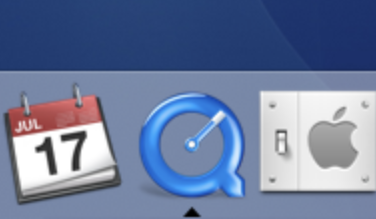
    The visible shape and appearance of an app icon is unrelated to its clickable — or, perhaps soon, tappable — area. Rendering a visible squircle doesn’t change the shape of the clickable/tappable target area around an icon. In the bygone days when MacOS permitted delicious app icons — and Apple crafted delicious icons for its own apps — you could click in the middle of, say, the QuickTime Player icon and it just worked. It would have been pretty nutty if it didn’t.

    Screenshot of the old QuickTime Player’s “Q” icon, with a transparent hole.

     ★ 
  • Daring Fireball daringfireball.net apple blog daring-fireball john-gruber tech technology 2026-07-09 19:50

    ↗

    Some historical follow-up regarding just-click-it launching and apps as tiled buttons with a uniform square shape. Back in the System 7 era in the 1990s, Apple sold (sold!) a product called At Ease (via Nathan Lineback’s venerable GUI Galley): I don’t recall ever using At...

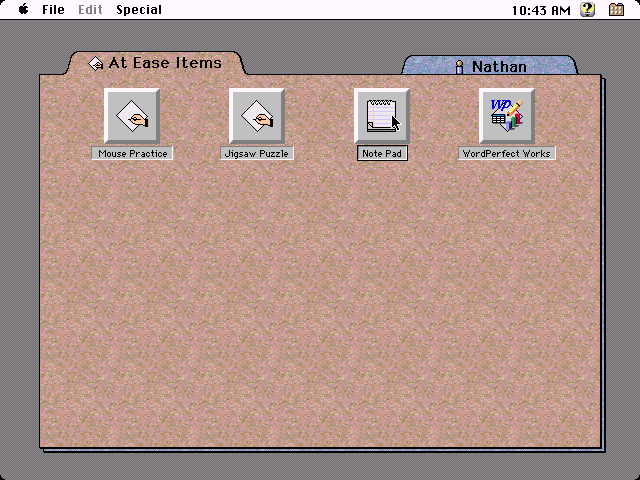
    Some historical follow-up regarding just-click-it launching and apps as tiled buttons with a uniform square shape. Back in the System 7 era in the 1990s, Apple sold (sold!) a product called At Ease (via Nathan Lineback’s venerable GUI Galley):

    Screenshot of At Ease on System 7.5.

    I don’t recall ever using At Ease, nor seeing anyone who did.

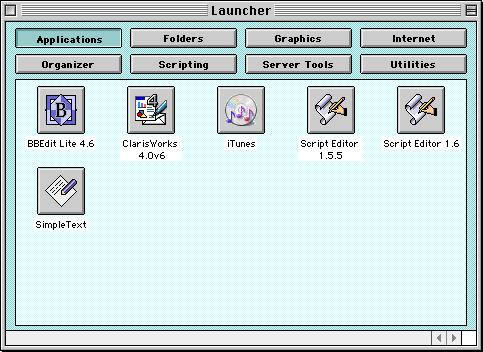
    A few years later, Apple built a feature called Launcher into Mac OS 8 (via LinkedResources):

    Screenshot of Launcher on Mac OS 8.

    Launcher, I never used personally, but I do remember it being something of a thing. At Ease was an early effort to create a primitive “can’t mess it up” baby computer mode for the Mac. Launcher was more of a stilted attempt to sherlock great utilities like DragThing (R.I.P.). It wasn’t a baby computer mode, but an attempt to provide a bit of a power-user mode. I mean, when you first tried it, one of the default apps it included was Script Editor. Even the name “Launcher” evokes power-user utilities of today like Alfred, Raycast, and my favorite, LaunchBar.

    Update 1: A whole slew of readers who are a decade or so younger than me have written to say that At Ease was a pervasive — and much despised — part of the Macs in their grade school computer labs. (Those computers were all Apple II models for me in the 1980s.) And, it turns out, DragThing creator James Thomson worked on At Ease while he was at Apple.

    Update 2: The Mac OS 9 Finder had a “View as Buttons” mode I’d completely forgotten about.

     ★ 
  • Daring Fireball daringfireball.net apple blog daring-fireball john-gruber tech technology 2026-07-09 19:17

    ↗

    What gave Tim Cook’s privacy letter heft in 2014 wasn’t just the clarity of its plain language, but the fact that you didn’t have to take his word for it that the ads Apple showed you respected your privacy, because Apple didn’t show you ads in 2014.

    In September 2014, in the wake of a series of hacks that stole private photos from the iCloud accounts of multiple celebrities, Tim Cook wrote an open letter to customers that was published at apple.com/privacy. Apple seemingly no longer hosts a copy of the letter. (That tends to happen to memorable open letters from Apple CEOs.) The Wall Street Journal’s fast-loading website still hosts a copy of the letter, as does the Internet Archive’s essential but slow-loading site.

    Cook’s letter is cogent and clear, and well worth reading in full today. But when you do, you can see why Apple no longer hosts a copy:

    A few years ago, users of Internet services began to realize that when an online service is free, you’re not the customer. You’re the product. But at Apple, we believe a great customer experience shouldn’t come at the expense of your privacy.

    Our business model is very straightforward: We sell great products. We don’t build a profile based on your email content or web browsing habits to sell to advertisers. We don’t “monetize” the information you store on your iPhone or in iCloud. And we don’t read your email or your messages to get information to market to you. Our software and services are designed to make our devices better. Plain and simple.

    One very small part of our business does serve advertisers, and that’s iAd. We built an advertising network because some app developers depend on that business model, and we want to support them as well as a free iTunes Radio service. iAd sticks to the same privacy policy that applies to every other Apple product. It doesn’t get data from Health and HomeKit, Maps, Siri, iMessage, your call history, or any iCloud service like Contacts or Mail, and you can always just opt out altogether.

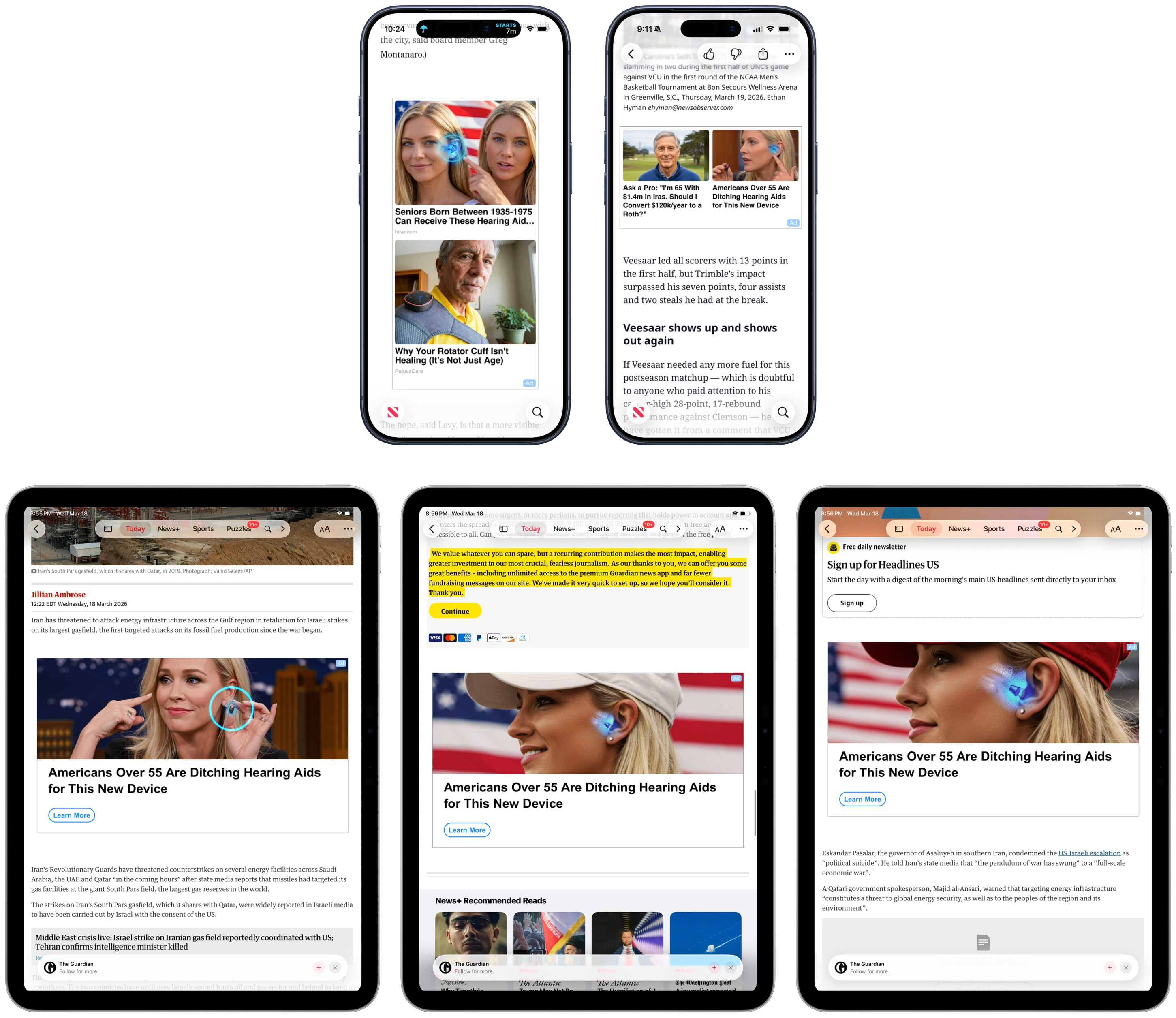
    Some of this remains true, but has lost some truthiness — and truthiness matters. But some of it is no longer true, period. It’s no longer just “one small part” of Apple’s business that serves advertisers. Here in 2026, search results in the App Store not only show paid ads — frequently for casinos — but the search results are visually dominated by paid ads now that Apple has added a second ad to results. Apple News+ is a paid subscription that offers a genuinely great value for the number of paywalled publishers whose content it includes, but articles on the News app tend to include the weirdest AI-generated ads on the Internet. (How many young blond women am I supposed to believe need hearing aids?) And — at this writing, still “coming soon” — Apple is launching ads on Apple Maps. Apple Maps remains free of charge to use, so according to Tim Cook, we’re not the customer. We’re the product. Or, if you prefer, our frustration is the product.

    I thought to revisit Cook’s 2014 “you’re not the customer, you’re the product” letter today in light of Meta’s new policy of defaulting Instagram users into having their personal content serve as grist for AI-generated content created by other users. The New York Times described Meta’s on-by-default policy as “surprising”; I say it’s not surprising at all. Meta has never shown any respect for its users’ privacy, and when they’ve claimed to, everyone knew it was a sham. They no longer show any respect for their own engineers’ privacy for chrissake.

    But Apple? Apple meant it. And I think they still do. But I think they’re lost in the weeds on two fronts:

    1. Squeezing out every extra cent of Services revenue they can.
    2. Satisfied in their own deep knowledge of how their systems are designed to safeguard users’ privacy and personal data.

    Issue #1 is self-explanatory. The ratio of ads to organic results in App Store search — especially when measured in screen area — is clearly not aligned with Cook’s 2014 statement that “Our software and services are designed to make our devices better. Plain and simple.” Obviously not. App Store search today is designed primarily to generate more revenue for Apple. That’s not criminal, but it’s a change.

    Issue #2 is more subtle. Apple really does have a religious fervor for privacy. Consider ads for Maps. It hasn’t shipped yet but Apple states, “Run ads in a privacy-first environment that respects your customers, who already trust Maps. No tracking — just helpful discovery.” I’m quite sure that’s all completely true. I just wrote last week about how Apple has never had to deal with “geofence warrants” for its location services because Apple has never kept personally-identifiable usage data for location. They not only don’t give advertisers — or law enforcement — your location data, but can’t, because they don’t collect it and never did.

    So let’s just concede that the upcoming ads in Apple Maps are completely private. How many users are going to believe that? Or assume it? I think very few. People see ads and they think “I’m being tracked.” When Apple starts showing ads in Maps, many — perhaps most — users are going to think they’re being tracked by Apple and their location “is being sold” to advertisers.

    It’s not true. Apple knows it’s not true, because they built and control all of the systems involved. Apple is very proud that this is true, and they should be. It’s a good thing and it really is an important institutional value at the company. It’s a religious fervor. On this particular issue Apple really is set apart from its peer-sized companies in technology.

    But that’s not what the general population believes. The general population thinks of “Big Tech” as a single, almost unified, hegemony. A lot of “Apple users” only use one Apple platform, the iPhone, and if they own another Apple product or two they’re iPhone peripherals like AirPods and Apple Watch. If they believe Apple is ethically better with regard to privacy (or anything else) than other companies, it’s only a little better. Most people have no idea whatsoever how anything Apple sells actually works. It’s all magic. That’s why a majority of adults believe that apps on their devices surreptitiously listen to and record real-world conversations in order to show them eerily-accurate targeted ads. Apple has actually done a lot of hard engineering and design work to guarantee that software on your devices can’t surreptitiously listen to you. But most people don’t know that and wouldn’t understand it if it were explained to them. All they know is that they were talking about Frisbees the other day, after not having uttered the word “Frisbee” in years, and now they’re seeing ads for flying discs in Instagram — and the only explanation that makes any sense to them is that their phone “listens” and betrays their privacy.

    What gave Tim Cook’s privacy letter heft in 2014 wasn’t just the clarity of its plain language, but the fact that you didn’t have to take his word for it that the ads Apple showed you respected your privacy, because Apple didn’t show you ads in 2014.1 Apple today can’t say that. Apple can prove to itself, and to technically sophisticated outsiders who are willing to listen, that it can serve ads — even in Maps — in privacy-protecting ways. But the only way they can prove to most people that they’re not betraying the privacy of their location data or app usage is not to sell such ads in the first place. Seeing is believing, and when people see ads in their maps app, they believe they’re being tracked.

    John Ternus should return Apple’s privacy policy to its 2014 clarity. The trust Apple would earn from such a move would far out-value whatever revenue these ads pad to their already hefty and ever-increasing quarterly Services numbers. “The companies that offer you services free-of-charge to show you ads are betraying your privacy and disrespecting your attention” is a powerful marketing message that only one major tech company used to be able to credibly make. That’s always been a resonant message, but never more so than today, in the age of AI. Ternus should make the slight course correction needed so that Apple can hammer that message once again.


    1. The genius — cynical genius, perhaps, but genius — part of Apple’s privacy stance regarding advertising is that they’ve made veritable mountains of profit through the traffic acquisition cost partnership with Google for web search traffic originating from Safari. That deal made Apple one of the most profitable companies in the highly lucrative Internet advertising industry without themselves needing to sell or display a single ad. Apple’s hands are clean from that deal except for whatever germs they pick up counting the $20+ billion in cash that Google trucks over from Mountain View to Cupertino every year. The ads Apple shows in the App Store and (soon) in Maps will dirty their reputation while generating far, far less money than they continue to rake from the Google/Safari deal, which deal leaves Apple’s reputation unsullied. ↩︎

  • Daring Fireball daringfireball.net apple blog daring-fireball john-gruber tech technology 2026-07-09 01:45

    ↗

    App icons in MacOS are not mere buttons. You can drag them, move them, and drop things on them. You click them to select, and double-click to launch. They are richer objects that deserve a richer visual vocabulary.

    Tobias Steinke, replying on Mastodon to my “Apple Should Eliminate the App Icon ‘Squircle Jail’” piece:

    But iOS app icons (and iPadOS) were always in squircle shape. Why is and was this okay for you, but it’s not for macOS?

    This is a good and fair question. But I not only have an answer, I have an answer that clarifies why this entire debate is important. That “design is how it works” applies even to something as seemingly superficial as icons.

    There are all sorts of limitations and simplifications in iOS that would be bad ideas to bring to MacOS, which would range in effect from disappointing to frustrating to maddening to ruinous. Where squircle jail falls on that scale is subjective. It’s certainly not ruinous, but I’d say it’s maddening. (iOS baby-computer-isms that would be ruinous to bring to MacOS would include killing AppKit, removing the Unix terminal layer, or requiring all apps to come from the App Store.)

    MacOS has suffered many such frustrating decisions before. E.g., it arguably makes sense for iOS to omit always-visible scroll bars because screen real estate is so limited. It makes no such sense on the Mac.

    As for mandatory squircle shapes for app icons in particular:

    (a) I don’t think this is a good mandate for iOS either;

    (b) it was always so for iOS, though, so it’s not like Apple has ever taken away rich creative icon shapes on the platform;

    (c) MacOS is a far richer and more precise environment than iOS.

    App icons on the iOS home screen are effectively simple buttons. I think it’s rather obvious that’s why they have had that squircle/roundsquare shape ever since the iPhone was announced in January 2007 (source). They’re one-tap launchers. App icons in MacOS are not mere buttons. You can drag them, move them, and drop things on them. You click them to select, and double-click to launch. They are richer objects that deserve a richer visual vocabulary. iOS is a world meant for fat-tipped Magic Markers and blunt safety scissors. MacOS is a world meant to support fine-tipped drafting pens and precision razor-sharp X-ACTO knives.

    Plus, Macintosh icons have four decades of glorious history. Style and fashion change over time. But limitations should not be imposed where freedom once reigned.

    And shape as a differentiating factor is not mere decoration. We have long known this. We all knew this. And not only did Apple know it, the rest of us knew it because we learned it from Apple. Via the Internet Archive, here’s Apple’s Macintosh Human Interface Guidelines from 2018,1 which was not that long ago:

    Consider giving your app icon a realistic, unique shape. In macOS, app icons can have the shape of the objects they depict. A unique outline focuses attention on the object and makes it easy to recognize the icon at a glance. If necessary, you can use a circular shape to encapsulate a set of images. Avoid using the rounded rectangle shape that people associate with iOS app icons.

    “A unique outline focuses attention on the object and makes it easy to recognize the icon at a glance.” Eight short years ago. That is not the description of a fad or fashion. It is a description of human perception. Our unchanging nature.

    So much collective hard-earned wisdom has been ignored of late. But it’s not lost or forgotten. Chapter 11 of the 2002 Aqua Human Interface Guidelines is a good place to start remembering. There was tremendous thought, rigor, and logic behind those guidelines — all of it in the name of creating a visual language for icons that most people simply thought looked cool as fuck.


    1. It caught my attention that as recently as 2018, Apple still published platform-specific Human Interface Guidelines. At some point after that they did a Dye job on the whole thing and now there’s just one Apple Human Interface Guidelines. Instead of platform-specific HIGs, there’s one HIG, with platform-specific call-outs as sidebars within the text. This is no little thing. It’s emblematic of Apple shipping user interfaces that are ignorant of the principles Apple itself forged over the previous decades. It’s like trying to make movies without ever having watched and studied the best movies made in the past, or writing a novel without having read a fucking book. It’s not just the Mac that should have its own HIG. Each of Apple’s platforms should. (iPadOS can share iOS’s.) There could be a “foundations” HIG that serves as a primer on fundamentals, but platform-specific HIGs could — and in the past, did — explain in detail why they are discrete platforms with different idioms, capabilities, and requirements. ↩︎

  • Daring Fireball daringfireball.net apple blog daring-fireball john-gruber tech technology 2026-07-06 22:23

    ↗

    Shape was often the most iconic thing about an icon. Now it’s no part at all.

    Paul Kafasis, in a post at Rogue Amoeba’s blog titled “Free the Icons”:

    Apple’s prohibition on shapes is a step backward for both usability and creativity in app icons. Icons are now harder to distinguish because they’re no longer allowed to be distinctive. But there’s no technical reason for it. Apple could, and should, once again allow icons to take on a wide variety of shapes.

    It’s clear that some people within Apple recognize that the transition to Liquid Glass introduced mistakes. They also appear to have the authority to fix those mistakes. Refinements to Apple’s own icons in Golden Gate are a welcome course correction, as is the much-celebrated Liquid Glass opacity slider. It’s time to correct the mistake of banning icon shapes as well.

    Apple should stop forcing every icon into the same squircle.

    The squircles, I will point out, are not in and of themselves the problem. The problem would be the same with any mandated shape, like, e.g., VisionOS’s circles.

    John Siracusa:

    Squircle Jail is the worst design-related thing Apple has ever done to Mac developers, and probably the worst icon-related thing it has ever done, period. Incredibly developer-hostile.

    If squircled icons are actually better, then let that design win in the market. That’s how we transitioned from the classic Mac OS icon style to the more photorealistic Mac OS X icon style. Developers adopted it because they wanted to, and because users desired it.

    John Siracusa has a long memory, cares deeply about Mac design, and is not prone to hyperbole (putting it mildly). I’m not sure I agree with him that this is “the worst design-related thing Apple has ever done to Mac developers”, but it’s certainly on the short list for consideration. And, like Siracusa, I can’t think of any other design crime Apple has ever foisted on Mac developers that I’d argue (with Siracusa) was worse.

    It’s one thing for Apple to force all of its own app icons into the same identical shape. That would be bad enough, because Apple’s own Mac apps are numerous and popular, and as the platform owner Apple necessarily sets the direction that many third-party apps follow. But it’s just downright spiteful to enforce it platform-wide. Apple decided they’re no longer going to create nice icons with unique, interesting, and most importantly, distinctive shapes — but they no longer allow third-party apps to either. It’s like Apple decided every single one of its own apps must wear a stupid-looking hat, and they put those stupid-looking hats on third-party apps too, whether the developers of those apps want them or not. Scratch that. Not hats but helmets. The mandatory squircle makes identifying apps at a glance harder in the same way that it’s difficult to identify individual people if they’re all wearing same-shaped helmets. Real helmets at least serve an important safety purpose. The squircles are like stupid unnecessary helmets.

    To that point, Jim Nielsen draws an even better analogy — traffic signs:

    Consistency for traffic signs! Let’s start by redesigning them all to be the same shape.

    Four diamond-shaped road signs: a yellow right-turn warning sign, a red stop sign, a white speed limit 80 sign, and an Interstate 15 highway marker.

    Which was a sarcasm-dripping reply to his own previous post:

    Shape isn’t everything, but it’s one tool to help provide differentiation and uniqueness in icons. But not anymore.

    Four Apple app icons in black on a light gray background: the Keynote lectern logo and its squircle app icon, and the Numbers bar chart logo and its squircle app icon.

    Just the mere silhouette of the old Keynote icon is more recognizable, and thus more iconic, than any icon on any platform from Apple today.

    No civil engineer would ever suggest changing yield and stop signs from their iconic triangles and octagons to identical squircles. The human visual system evolved to be remarkably good and quick at identifying shapes. The primary element of an app icon is the semantic meaning of its illustration. Color and shape are secondary. With the squircle mandate, Apple has removed shape from the equation.1 The purpose of icons is right there in their name: to be iconic. Shape was often the most iconic thing about an icon. Now it’s no part at all.

    It makes no more sense than removing color. But Apple did that too! One of the purported reasons for the new icon guidelines across MacOS and iOS are the tinted and clear appearance options introduced last year with Liquid Glass and the OS 26 releases. These are both terrible ideas that remove color as a distinguishing factor, reducing ostensibly distinguishable icons into indistinguishable buttons. Adam Engst skewered the Clear and Tinted icon appearance options in a recent column at TidBITS, and ran a poll to see if anyone actually used them. Spoiler: nope.

    App icons used to be exuberantly fun and so beautiful that they were the subject of two splendid coffee table books. This squircle shit is no fun at all, and ugly as sin.

    Let’s go back.


    1. With the new Creator Studio suite, Apple has largely (and for some apps, entirely) removed semantically meaningful illustrations from its own app icons. The only thing left to distinguish them is the color of the crude squiggle inside the squircle. ↩︎

  • Daring Fireball daringfireball.net apple blog daring-fireball john-gruber tech technology 2026-07-04 19:28

    ↗

    Yours truly, back in 2018: I don’t share the depth of their pessimism regarding native apps, but Electron is without question a scourge. I think the Mac will prove more resilient than Windows, because the Mac is the platform that attracts people who care. But I worry. In some...

    Yours truly, back in 2018:

    I don’t share the depth of their pessimism regarding native apps, but Electron is without question a scourge. I think the Mac will prove more resilient than Windows, because the Mac is the platform that attracts people who care. But I worry.

    In some ways, the worst thing that ever happened to the Mac is that it got so much more popular a decade ago. In theory, that should have been nothing but good news for the platform — more users means more attention from developers. The more Mac users there are, the more Mac apps we should see. The problem is, the users who really care about good native apps — users who know HIG violations when they see them, who care about performance, who care about Mac apps being right — were mostly already on the Mac. A lot of newer Mac users either don’t know or don’t care about what makes for a good Mac app.

    This eight-year-old piece holds up well. My concern was justified, but so too was my lack of defeatist pessimism. Truly native, idiomatically correct Mac-assed Mac apps are resurgent. Electron and its brethren non-native frameworks have not receded, but they haven’t gained further ground. For every Claude (Electron) there’s a ChatGPT (AppKit). I’m seeing more new good Mac apps released today than I was in 2018, and longstanding Mac stalwarts continue to thrive. High tide seems to have passed without washing the native platform away.

    Apple itself is a good example. The Mac version of Journal, first introduced in MacOS 26 Tahoe, is a profound disappointment — not just because of serious bugs but because it’s un-Mac-like in sad ways. You can’t open an entry into its own window, for example. But the brand-new Siri app in the developer betas of MacOS 27 Golden Gate is pretty Mac-like. You can double-click chats in list view to open them in their own windows, for example. (You can’t double-click chats in grid view to open them into windows, though — presumably a bug.) Siri is not a great Mac app but it does feel like a Mac app, and it’s only a 1.0 in its second developer beta. It doesn’t feel like an iOS app running in a Mac window, like Journal does.

    The ironic frustration with Anthropic’s Claude app being an Electron turd is that Claude and especially Claude Code are so capable of helping to create good native Mac apps. It’s one thing for a big company or organization with cross-platform aspirations but no institutional Mac expertise, like Notion or Slack or Discord, to choose Electron to create their Mac client. It’s another when it’s a company like Anthropic, whose only product’s single most impressive ability is generating programming code, including high-quality AppKit and SwiftUI code for the Mac. To return to my hammering-screws-into-the-walls metaphor from yesterday, it’s as though the building into which Anthropic decided to hammer all the screws is a renowned screwdriver factory.

     ★ 
  • Daring Fireball daringfireball.net apple blog daring-fireball john-gruber tech technology 2026-07-03 21:24

    ↗

    Felix Rieseberg, quite obviously, is the answer to the question why Claude is an Electron app. It’s like wondering why all the screws in a building were hammered into the walls, and then finding out that the guy who oversaw construction founded and co-owns the world’s biggest...

    Anthropic released the first version of the Claude “desktop” app for MacOS in October 2024 — an Electron clunker that did not impress UI designers. When it came out, I wrote:

    ChatGPT’s native Mac app, on the other hand, is a truly native Mac app. It looks like a Mac app and feels like a Mac app because it really is a Mac app. I’ve liked it ever since it launched back in May, and it keeps getting better. And I keep using it more and more as my go-to resource for answering questions.

    I asked Claude, “What is the best way to engineer a native Mac app? What frameworks and developer tools should one use if the goal is a great Mac experience?” Claude’s answer started by positing it as a decision between SwiftUI and AppKit. Perhaps Anthropic’s Mac engineers should have asked Claude this same question before they built this turd of an Electron app.

    In March of this year, linking to Anthropic’s announcement that Claude Code and Claude Cowork can take control of your Mac to accomplish agentic tasks, I returned to the same question:

    The Claude Mac client itself remains a lazy Electron clunker. If Claude Code is so good I don’t get why they don’t prove it by using it to make an even halfway decent native Mac app.

    I’m not the only one who has pondered this. Drew Breunig wrote “Why is Claude an Electron App?” in February this year:

    On the surface, this ability should render Electron’s benefits obsolete! Rather than write one web app and ship it to each platform, we should write one spec and test suite and use coding agents to ship native code to each platform. If this ability is real and adopted, users get snappy, performant, native apps from small, focused teams serving a broad market.

    But we’re still leaning on Electron. Even Anthropic, one of the leaders in AI coding tools, who keeps publishing flashy agentic coding achievements, still uses Electron in the Claude desktop app. And it’s a slow, buggy, and bloated app.

    So why are we still using Electron and not embracing the agent-powered, spec driven development future?

    For one thing, coding agents are really good at the first 90% of dev. But that last bit — nailing down all the edge cases and continuing support once it meets the real world — remains hard, tedious, and requires plenty of agent hand-holding. [...]

    For now, Electron still makes sense. Coding agents are amazing. But the last mile of dev and the support surface area remains a real concern.

    I’m with Breunig up until the point where he accepts coding agents struggling with the final 10 percent as a justification for choosing Electron to create a Mac app. Plenty of people — individuals and teams alike — are using Claude Code to create terrific new native Mac apps. Just among my friends, Glenn Fleishman, Lex Friedman, and Jason Snellman, have all in recent months used not just AI coding assistants in general, but Claude Code specifically, to create genuinely native Mac apps that meet their own personal high standards for Mac-assedness, forged through decades of literally professional Mac snobbery. A comprehensive catalog of Mac-assed apps made with the assistance of Claude Code, would, I suspect, be remarkably long.

    The struggle with the last 10 percent is unrelated to AI coding. It’s the nature of all software engineering. There’s a well-known adage that Wikipedia names the “Ninety-Ninety Rule”, attributed to Tom Cargill of Bell Labs:

    The first 90 percent of the code accounts for the first 90 percent of the development time. The remaining 10 percent of the code accounts for the other 90 percent of the development time.

    Cargill’s mathematically humorous formulation resonates because it not only explains why the final 10 percent consumes half the time, but also why software projects tend to take twice as long as expected. This universal truth holds whether the code is human-written, AI-generated, or a mix of both.

    Breunig gets closer to the truth in a postscript, linking to the Hacker News thread discussing his post. The top-rated comment in the HN thread is from Boris Cherny, who works at Anthropic on the Claude Code team. Cherny wrote:

    Boris from the Claude Code team here.

    Some of the engineers working on the app worked on Electron back in the day, so preferred building non-natively. It’s also a nice way to share code so we’re guaranteed that features across web and desktop have the same look and feel. Finally, Claude is great at it.

    That said, engineering is all about tradeoffs and this may change in the future!

    I would rephrase the guarantee that “features across web and desktop have the same look and feel” as guaranteeing that the Mac app is restrained by the limits of the web and cut off from the breadth of idiomatically native functionality provided by the Mac’s native frameworks. Electron guarantees that an app feels just as wrong on all platforms. But the more relevant tidbit is this sentence: “Some of the engineers working on the app worked on Electron back in the day, so preferred building non-natively.” So it’s not that Claude somehow prefers Electron, but that “some of the engineers” at Anthropic do.

    Some is doing some heavy lifting there, given that “some of the engineers” includes Felix Rieseberg, currently Anthropic’s engineering lead for Claude Cowork and Claude Code Desktop, and previously engineering lead for the Claude apps for MacOS and Windows. Rieseberg didn’t merely “work on Electron back in the day”. He is one of the principal people responsible for creating Electron, and remains today one of three members of the Electron project’s Administrative Working Group that “oversees the entire governance and project”. He literally wrote the book on Electron.

    Felix Rieseberg, quite obviously, is the answer to the question why Claude is an Electron app. It’s like wondering why all the screws in a building were hammered into the walls, and then finding out that the guy who oversaw construction founded and co-owns the world’s biggest hammer manufacturer. Windows uses Philips head screws, Linux uses hex screws, and MacOS requires Torx (of course) — but a hammer works the same way with all screws. That’s Electron. That’s Rieseberg’s baby.

    Rieseberg, it turns out, hasn’t only had a hand in Claude being an Electron app. Per both his personal home page and LinkedIn profile, before joining Anthropic he spent over two years as the engineering manager for the desktop team at Notion, whose client for Mac is a massive 518 MB Electron app and a notoriously non-native experience.1 Before Notion, Rieseberg spent 2016–2021 “as a Senior Staff Engineer and Engineering Manager at Slack, where I got to support a team of amazing C++ engineers building the cross-platform desktop framework Electron — as well as Slack’s desktop apps for macOS, Windows, and Linux.”2

    Finding out that one guy — who is a senior Electron maintainer — has led the teams for the desktop clients for Slack, Notion, and now Claude is like discovering that it was one guy — whose family business was a distillery — who helmed the Titanic, piloted the Hindenburg, and then served as air traffic controller for Amelia Earhart.


    1. Notion, it’s worth pointing out, has perhaps seen the error of their ways. Apple prominently featured Notion during the Platforms State of the Union technical keynote at WWDC last month, saying, “And apps that previously used cross-platform or web technologies like Notion are migrating their user interface to SwiftUI because they want a level of performance and UI consistency that other technologies can’t deliver.” This, just one year after Rieseberg left for Anthropic. Perhaps Claude will similarly seek to wash the Electron stink off the Claude app eventually. I suspect an Electron codebase is like sap, though — sticky, dirty, and harder to wash off the longer you wait. ↩︎

    2. Before getting promoted to engineering manager in charge of all of Slack’s “desktop” apps, Rieseberg started at Slack as engineering team lead for Windows, which offers an inkling as to his platform taste. ↩︎︎

  • Daring Fireball daringfireball.net apple blog daring-fireball john-gruber tech technology 2026-07-02 20:32

    ↗

    Back in March 2022, Nicole Nguyen of The Wall Street Journal compared the battery life effects of 5G vs. LTE by streaming videos on several iPhone and iPad models. She found that using LTE saved significant battery life. (It would be nice if someone re-ran similar tests on...

    Back in March 2022, Nicole Nguyen of The Wall Street Journal compared the battery life effects of 5G vs. LTE by streaming videos on several iPhone and iPad models. She found that using LTE saved significant battery life. (It would be nice if someone re-ran similar tests on more recent devices — just because it was true with the iPhone 13 Pro doesn’t mean it’s true with current models. But I’ll bet it is.)

    Anyway, linking to her report, I wrote:

    With both regular 5G and LTE, I typically get between 50–100 Mbps down — and I see a regular 5G connection far far more often than I do 5G ultra wideband. I don’t see any practical advantage to regular 5G compared to LTE. Those crazy-fast ultra-wideband download speeds are like owning a car that can go 200 MPH. So I’m just going to set my iPhone to use LTE all the time and save battery life. I’ll turn 5G Auto back on if I ever run into a situation where my LTE signal seems weak or slow.

    Which rings several bells with my “A Tale of Two Modems” post yesterday, regarding an AppleInsider report that data stolen from Apple supplier Tata Electronics shows that Apple is going to use Qualcomm’s mmWave-supporting cellular modems only in models of the iPhone 18 Pro sold in the U.S.

    But so what happened to my LTE setting? If I switched to LTE in 2022 because the battery life savings were noticeable and 5G’s faster download speeds were not, how’d I wind up back on 5G in 2026 and switching to LTE again only earlier this month?

    I don’t remember exactly, to be honest. I do know that I never switched back to 5G because I found LTE slow. As best I can remember, I switched back at some point when testing a new iPhone and ... just stopped thinking about it and never switched back to full-time LTE. But I’m on LTE again now, and I’m not switching back unless (a) I do find LTE slow, or (b) someone publishes results from a testing showing that 5G no longer consumes more battery power than LTE on current iPhone models.

    Oh, and to that point — a few readers emailed to say that one reason to prefer 5G, especially if you’re within range of a mmWave tower, is if you’re sharing your cellular connection to a Mac (or multiple Macs) via hotspot tethering. Yes, for sure. Another point that’s been raised is that 5G is supposedly better than LTE in crowded/congested situations like a stadium or arena full of people. Maybe? But in both cases, you know those situations when you encounter them, and you can use LTE all day most days and just turn on 5G when you’re using your iPhone as a hotspot, or when you find yourself in a crowded stadium. I’m saying try turning 5G off day-to-day, not telling you to sign up for a cellular plan without 5G (which I’m not even sure you can buy anymore).

     ★ 
  • Daring Fireball daringfireball.net apple blog daring-fireball john-gruber tech technology 2026-07-02 19:38

    ↗

    After I linked to Commerce Secretary Howard Lutnick posting on Twitter/X about the Trump administration allowing Anthropic to once again release Claude Fable 5, I was reminded once again that no one else in the Trump administration uses Truth Social other than Trump himself....

    After I linked to Commerce Secretary Howard Lutnick posting on Twitter/X about the Trump administration allowing Anthropic to once again release Claude Fable 5, I was reminded once again that no one else in the Trump administration uses Truth Social other than Trump himself. Not even Lutnick, a lickspittle among lickspittles.* The rest of them all use X. Which in turn reminds me of my observation from a year ago:

    I’ve been thinking about this for a few weeks, and in that time, Trump’s own posts on Truth Social have made the news on a near-daily basis. I’ve never once, ever, seen a post from anyone else on Truth Social make the news. Trump is not just the one and only person of consequence using it, his is the one and only account on Truth Social that you ever, ever hear about.

    If Truth Social were actually meant to compete with X, Threads, Bluesky, and Mastodon, this almost certainly would have been a source of conflict between Trump and Musk. Because, if it were meant to be an actual competitive social network, it would occur to Trump to require all his flunkeys and toadies not only to post to Truth Social, but to stop posting to X. But he hasn’t done that, because Truth Social is functioning as intended: it’s just an outlet for Trump to spew his demented mad-king musings (today he’s retweeting calls for him to be added to Mount Rushmore) and, most importantly, get some of his all-caps-laden bangers read aloud on the TV news.

    * Every single time I type Lutnick’s name I’m tempted to spell it “Nutlick”, but that’s too immature for the hallowed pages of this website.

     ★ 
  • Daring Fireball daringfireball.net apple blog daring-fireball john-gruber tech technology 2026-07-01 23:26

    ↗

    Cellular download speed and reception is nearly a solved problem for my needs. Battery life is not.

    Cellular download speed and reception is nearly a solved problem for my needs. Battery life is not.
  • Daring Fireball daringfireball.net apple blog daring-fireball john-gruber tech technology 2026-07-01 19:55

    ↗

    Following up on my earlier post on Valve’s righteous objection to selling game console hardware at a loss, I should have noted that PlayStation Plus starts at $11/month (and goes up to $20/month) and Xbox Game Pass starts at $10/month (and goes up to $23/month). One draw of...

    Following up on my earlier post on Valve’s righteous objection to selling game console hardware at a loss, I should have noted that PlayStation Plus starts at $11/month (and goes up to $20/month) and Xbox Game Pass starts at $10/month (and goes up to $23/month). One draw of these subscriptions is access to a library of game titles — but another one is that you need one of these subscriptions to play online multiplayer games. Not every game demands online access but many (most?) do. There are very few serious PlayStation and Xbox gamers who don’t pay for a subscription, and within a few years those subscriptions cost more than the (subsidized) hardware. It’s not just about licensing fees for game titles players purchase anymore.

    Valve didn’t make any hay over this point, but should have. Because Steam Deck and Steam Machine are fundamentally more like PCs, all you need to play online multiplayer games is a free Steam account.

     ★ 
  • Daring Fireball daringfireball.net apple blog daring-fireball john-gruber tech technology 2026-07-01 15:48

    ↗

    The great John Moltz returns to the show. Topics include Apple’s hardware price hikes in response to the global RAM/SSD shortage, and some spitballing on what we like about the UI changes in the MacOS 27 Golden Gate beta. Sponsored by: Coax: Defeat the tyranny of choice....

    The great John Moltz returns to the show. Topics include Apple’s hardware price hikes in response to the global RAM/SSD shortage, and some spitballing on what we like about the UI changes in the MacOS 27 Golden Gate beta.

    Sponsored by:

    • Coax: Defeat the tyranny of choice. Channel surf your Plex server. Relax with Coax.
    • Even Realities: Even G2, the everyday display smart glasses. Use promo code talkshow to save 10% off the R1 Ring and/or Even Clip.
    • Squarespace: Save 10% off your first purchase of a website or domain using code TALKSHOW.
     ★ 
  • Daring Fireball daringfireball.net apple blog daring-fireball john-gruber tech technology 2026-06-30 18:52

    ↗

    Google no longer collects this information in a way that is susceptible to geofence warrants, and, more importantly, Apple never did.

    Amy Howe, writing at the ever-excellent SCOTUSblog:

    The Supreme Court on Monday ruled that when law enforcement officials used a “geofence warrant” — a warrant that instructed Google to provide location data for cellphone users who were near a particular place during a specific time period — to obtain evidence used to convict a Virginia man of a 2019 bank robbery, they conducted a “search” for purposes of the Fourth Amendment. By a vote of 6-3, the justices sent Okello Chatrie’s case back to the lower court for it to consider whether, as the Fourth Amendment requires, the search was “reasonable.”

    Writing for the majority, Justice Elena Kagan emphasized that “[a]n individual has a reasonable expectation of privacy in records about his cell phone’s location, and police intrude on that constitutionally protected interest when they demand the information — even though for only a limited time, and from a third-party tech company.” [...]

    The issue at the center of Chatrie v. United States arose after a man armed with a gun entered a federal credit union outside Richmond, Virginia, and gave the teller a note demanding money. He made off with nearly $200,000, but law enforcement officials did not have any leads until they served Google with a geofence warrant, which directed the tech company to provide location data for cellphone users who were near the bank at the time of the robbery.

    I agree, wholeheartedly, with the decision. Howe’s coverage, being at SCOTUSblog, is unsurprisingly concerned with the legal aspects. But I’m also fascinated by the technical aspects. It’s remarkable — and regrettable — that Google had this geofence information in the first place. The data was part of a grossly invasive and ill-conceived feature Google called “Location History”, and was used to power a feature called “Timeline” in Google Maps. The data was stored unencrypted by Google in the cloud, tied to your Google account, thus making it available to these geofence warrants.

    Back in December 2023 Google announced that it was changing the way it stored this data, defaulting instead to on-device storage and using end-to-end encryption (that Google itself cannot decrypt) for location data it holds online. This change had long been advocated by the EFF, which celebrated Google’s policy change. (Notably, Chatrie robbed that credit union in 2019.)

    Most people have an unshakeable belief in the widely-held misconception that “everything” we do — everywhere we go, even everything we say — in the presence of our phones is tracked and recorded, and traceable back to us individually. It’s not at all ridiculous that this belief is so common, given that it is technically feasible. Our phones are precise GPS devices, they do have good microphones, and they are (almost) always connected to cellular and/or Wi-Fi networks. And the surveillance advertising industrial complex — primarily Meta and Google — is so uncannily good at serving ads based on our recent personal interests that the most obvious explanation for how they do it is “they listen to us and track us and record everything we do”. That’s not how they do it. But “they listen to us and track us and record everything we do” is an explanation that everyone can easily understand. If that were how Meta and Google served targeted ads to us, everyone could understand how the ads are so often so uncannily and creepily accurate. The way it actually works is complex and complicated, and thus in the realm of Arthur C. Clarke’s maxim that “any sufficiently advanced technology is indistinguishable from magic”. Incorrect explanations that people understand resonate and take hold and become entrenched beliefs; correct explanations that people don’t understand are dismissed and are not believed. (Exhibit A: evolution.) This is why it is such a precious gift to be able to explain complex technical and scientific subject matter in ways that many people can understand.1

    And lo, now here’s a Supreme Court case showing that when the police asked for a list of people whose phones were near a particular bank at a particular time on a particular day, Google had that information and handed it over. Chatrie v. United States is not a particularly celebrated case, but this will only contribute to the entrenching of superstitious incorrect conspiracy theories about the data that “they” — big tech companies — collect about us.

    But Google no longer collects this information in a way that is susceptible to geofence warrants, and, more importantly, Apple never did. From my own December 2023 post on Google’s decision to change how it collects this data to ensure privacy:

    The reason these overly broad geofence warrants “almost always” were specific to Google is that Apple never collected location data that could be collected in the aggregate like this. From Apple’s most recent government transparency report (PDF), covering the first half of 2022:

    Apple may also receive requests from government agencies seeking customer data related to specific latitude and longitudes coordinates (geofence) for a specified time period. Apple does not have any data to provide in response to geofence requests.

    I checked with a source at Apple, and they believe they have never collected or stored geolocation data in a manner that can be linked to groups of individuals in a certain area or areas.

    So the whole question of geofence-warrant fishing expeditions may have been obviated two years ago by Google for Android users, and was never an issue for iPhone users. Unless, perhaps, they used the Google Maps app on their iPhones and granted it the “always on” location access that it asks for. I suspect, but do not know, that iPhone users who granted “always on” location access to Google Maps (or any other Google iOS app that asked for it? — all of their iOS apps seem to ask for location permissions, but I don’t know how many other than Google Maps ask for always-on access) were just as susceptible to these geofence warrants as Android users.

    This decision should still serve as good precedent for location data held by other companies, and I hope the decision serves as good precedent for any searchable Personally Identifiable Information susceptible to fishing-expedition warrants in general.

    But the bottom line is: Apple has never held data tracking your location, and while Google did, they no longer do.


    1. It’s good for the expert, too, to prove that they can explain complex subject matter at the level of a freshman lecture — which is the only way to prove that they truly understand it themselves. ↩︎

  • Daring Fireball daringfireball.net apple blog daring-fireball john-gruber tech technology 2026-06-27 23:35

    ↗

    Sanders’s tweet is better punctuated and capitalized, but it’s the same argument as Trump’s. Zero economic sense, 100 percent ideological wishful thinking.

    Bernie Sanders, posting on Twitter/X Thursday (don’t complain to me that he doesn’t use his Bluesky account):

    Corporate greed is Tim Cook, the billionaire Apple CEO, claiming that hiking prices on Apple products by over $200 is “unavoidable” after it made $112 billion in profits last year & spent $310 billion on stock buybacks.

    These price hikes aren’t unavoidable. They’re unacceptable.

    It boggles the mind how anyone could post this and not question the common sense napkin math of a company spending 3× its annual profit on stock buybacks. That’s theoretically possible, I suppose, but obviously unsustainable. A company would have to burn through a cash hoard or incur massive amounts of debt to spend 3× its profit on anything. It makes no sense. Someone who doesn’t consider the common sense of those numbers probably shouldn’t be spouting off on anything related to economics. And of course Apple files an annual report with the SEC, easily searchable via the web, which plainly shows that the company spent $89 billion on stock repurchases last year, and paid shareholders $15 billion in dividends. Those numbers make sense for a company that earned $112 billion in profit.

    I suspect Sanders is so ignorant of basic economics that he sees the ampersand in his tweet as additive — that Apple made $112 billion in profit and spent $310 billion in buybacks and thus had something like $420 billion of money “in the black” with which they could eat the cost of rising RAM and SSD components. But they’re not additive. Stock repurchases are purchases. If Apple actually had spent $310 billion on stock buybacks last year — which, to repeat, they most certainly did not — even Karl Marx might excuse them for raising prices on their products this year, because they’d be in a $200 billion hole they needed to dig out of.

    But such concerns, obvious to anyone who’s taken an Econ 101 course in college, seldom stop ideologues.

    Putting aside Sanders’s factually incorrect and nonsensical $310 billion figure, let’s just consider this general scenario: A company makes a product that consists of essential components they must purchase from suppliers. Something happens — outside the company’s control — that causes those essential components to rise in price significantly. Therefore the cost of goods for the company’s product increases significantly. What should the company do? Raise prices and pass those increased costs on to their customers, maintaining the same level of profit for themselves? Or hold prices steady and eat those costs, accepting lower profits or even negative margins, so that customers remain unaffected?

    One can hold logically consistent views at both extremes. At one end, the belief that business is business and higher costs naturally result in higher prices passed along to customers. At the other end, the belief that companies should put the welfare of their customers ahead of their own profit seeking. Perhaps you think the answer is somewhere in-between: somewhat higher prices and somewhat lower profit margins. What you cannot do is hold a philosophically consistent logically coherent view where your answer to how a company should respond in such a scenario is contingent on what the “something happens” is that caused component prices to rise.

    When the “something happens” is a global RAM and SSD shortage resulting from the AI datacenter capex spending spree, Sanders’s tweet makes clear that he’s of the opinion that Apple should eat these costs.

    But when the “something happens” was Trump’s tariffs, Sanders argued that (emphasis added) “Trump’s across-the-board tariffs are not the way to do it. We do not need a blanket and arbitrary sales tax on imported goods which will raise prices on products that the American people desperately need.” And again: “Trump’s blanket tariffs will just raise prices for American consumers and hurt our relationships with allies, undermining our global position.” Not “might” raise prices. “Will” raise prices.

    Sanders arguing today that Apple should eat the entire cost of rising RAM and SSD components makes no more sense than this tweet from Donald Trump a year ago:

    Walmart should STOP trying to blame Tariffs as the reason for raising prices throughout the chain. Walmart made BILLIONS OF DOLLARS last year, far more than expected. Between Walmart and China they should, as is said, “EAT THE TARIFFS,” and not charge valued customers ANYTHING. I’ll be watching, and so will your customers!!!

    Sanders’s tweet is better punctuated and capitalized, but it’s the same illogic. Zero economic sense, 100 percent ideological wishful thinking. Yelling angrily doesn’t make your argument any more compelling or coherent.

  • Hacker News - Front Page daringfireball.net community hacker-news links tech technology y-combinator 2026-06-26 23:33

    ↗

    Comments

    Comments
  • Daring Fireball daringfireball.net apple blog daring-fireball john-gruber tech technology 2026-06-26 23:22

    ↗

    This is going to sound cornier than a bucket of Jiffy-Pop, but it is a profound irony that a man with such a big and beautiful figurative heart could have such a lousy literal one.

    John Gruber and Om Malik, sitting in the audience, smiling, at the WWDC 2025 keynote.

    Om died two days ago, after a long battle against a bum heart.

    Om and I often sat next to each other at Apple keynotes. This was not at all surprising or odd, insofar as we’d been friends for 20 years. Folks at Apple PR knew that we were close, and would often pair us together in post-keynote media briefings. I always enjoyed being paired with him. He asked keen questions. He saw through bullshit. He found holes in arguments. He took everything in. When I felt overwhelmed, he seemed serene. Om always seemed serene, period. His own photography reflects his presence.

    Also, he was funny and fun. Profoundly generous. A good person to be around. A great person to know and be known by. He knew everyone and everyone knew Om. A lot of the people I know in this racket, I know through Om. Every time he’d introduce me to someone, he’d embarrass me with praise for my work. He greeted everyone with a compliment and whatever he said, he meant it. He had kind words to offer everyone because he had a gift for recognizing good things about everyone. He didn’t have an insincere bone in his body, which made him intensely lovable as a friend, and fiercely acerbic and accurate as a critic of technology. “He did not mince words” and “Everyone loved him” do not usually apply to the same person. They did with Om.

    He was, of course, a Yankees fan.

    So, no, it was not odd that he and I gravitated toward each other at Apple events. But the fact that Om continued to be invited to these events, with a media badge, was in fact unusual. He had stepped away from day-to-day journalism and became an investor back in 2014. A decade later, he was still on the short list of top invitees to events at Apple. His reputation warranted that respect. His ongoing writing and analysis — right up until the very end — continued to earn it. So of course Om continued to be invited to, and attend, these events. He was Om Fucking Malik. His presence improved any room, and lifted everyone’s mood. He made grumps smile. You couldn’t help it.

    Om Malik, John Gruber, and John Siracusa, eating lunch at Apple Park after the 2024 WWDC keynote.

    When he stepped aside from his namesake website GigaOm in 2014, Om wrote:

    “Now it is time for the next chapter,” wrote Derek Jeter, the New York Yankees shortstop and my 2nd favorite Yankee (behind Bernie Williams), sharing his intention to retire at the end of 2014. “I have new dreams and aspirations and new challenges. And I want the ability to move at my own pace, see the world and finally have a summer vacation.”

    I relate to Jeter’s desire to find life outside of work. Living a 24-hour news life has come at a personal cost. I still wake in middle of the night to check the stream to see if something is breaking, worrying whether I missed some news.

    It is a unique type of addiction that only a few can understand, and it is time for me to opt out of this non-stop news life. After five years as a “venture partner,” I am joining True Ventures as a partner, and thus bringing an end to my life as a professional journalist.

    Om, somehow, went straight from new-media wunderkind to éminence grise of tech journalism. Back when he was blogging, he blogged hard — multiple breaking-news posts per day, every day, while he was working as an acclaimed reporter for Business 2.0, Forbes, and Red Herring. That’s not what he did for the latter half of his career at all. He began changing his pace and perspective after suffering a heart attack in 2008, at the age of 42. He knew what he wanted to change, he told us he was going to change it, and then he did it. Thinking about his career transformation brings to mind the great Donald Knuth’s remarks regarding email:

    Email is a wonderful thing for people whose role in life is to be on top of things. But not for me; my role is to be on the bottom of things. What I do takes long hours of studying and uninterruptible concentration. I try to learn certain areas of computer science exhaustively; then I try to digest that knowledge into a form that is accessible to people who don’t have time for such study.

    What email is to Knuth, the 24-hour news cycle was to Om. He’d had enough, and recognized it. He no longer wanted to be on top of things. He wanted to be on the bottom of things. He transformed himself from the bloggiest of quick-trigger bloggers into the most thoughtful of essayists. He went from documenting what was happening, as it happened, to explaining why. He was very, very good at that — he saw things through a singular perspective and expressed his thoughts with a singular voice.

    Om was never impressed by who someone was, what they’d previously accomplished, what grand wealth they’d garnered, or stature they’d achieved. It’s human nature to be overwhelmed by awe in the presence of great people. Om was not. To impress Om, you needed to deliver impressive new work. He was impervious to riptides of hype. Those are superpowers in this racket.

    Om Malik, standing in a ray of sunshine in the hands-on area at Steve Jobs Theater in September 2024.

    I texted him on June 1 to coordinate meeting up at WWDC the next week. That’s when he filled me in that he’d been hospitalized in the ICU at Stanford since mid-April, and the situation was dire. He needed a heart transplant or he wouldn’t live. I knew he’d been dealing with health issues in recent years, but I had no idea it had become so acute. We’d been chatting regularly for weeks — largely because he’d been so prolific of late, on topics exactly aligned with my own recent attention. He’d been doing some of the best writing and analysis of his career this year — but for the last few weeks, unbeknownst to me, and most of the world, that writing was from a bed in the ICU.1 This is going to sound cornier than a bucket of Jiffy-Pop, but it is a profound irony that a man with such a big and beautiful figurative heart could have such a lousy literal one.

    I apologized for calling out his website in my “What Is a Dickover?” interactive essay, which I hadn’t warned him about, and had posted just three days before he told me of his medical plight. He told me not to worry, I was right, it was annoying, and he’d fix it. I didn’t think he’d get to that. But I checked today, and it’s gone.

    Om didn’t keep his health crisis secret, per se. He kept it private. That was very Om. He was generous and effusive, often ebullient, always intense. But he was, in many ways, inscrutable. Private. Contemplative. Comfortable with himself, and by himself. I’ve never met anyone like Om Malik. They broke that mold after minting one.

    I seldom ask anyone for professional advice, but when I did, I often asked Om. We did not do exactly the same thing, he and I, but we did close to the same thing. He understood what I do — or at least, what I try to do here — in a way that few others could. Among those of us who came of age in the first decade of blogging, who aspired to make it a career, the common route was to go from independent blogging to a salaried byline at an established big-name publication with roots in print as a magazine or newspaper. Om went the other way — from acclaimed reporter in top-shelf print magazines to turning GigaOm into a phenomenon. I never saw Daring Fireball as a stepping stone to greater things. I wanted only to make Daring Fireball a great thing. Om recognized that. In one of my earliest memories of meeting him — I think when I was working at Joyent, circa 2006 — we discussed publishing and new media and my own ambitions. He told me I should just keep doing what I was doing. Establishment media was a bloated slow-moving mess, he said. The future, he was absolutely certain, would be controlled by creators building their own brands and reputations, not subserving a legacy media publication. I told him I had no such plan. He said, “Good. You don’t need them. They need you.”

    Om Malik, Matt Mullenweg, and John Gruber at Yankee Stadium for the AL wild card game between the Astros and Yankees, 6 October 2015. Only one of us was happy with the game's outcome.

    Om loved good coffee, nice watches, exotic pens, Apple products, the media industry, photography (both the art and the gadgetry), and the New York Yankees. So, yeah — he and I always had more to talk about than time to talk when we were together. Always. But it was the Yankees we talked about most. He loved about the Yankees what I love about the Yankees — that they embody the pursuit of excellence. Not just winning, but winning the right way. The Yankees play in Yankee Stadium, not Shitco Cellular Service & Financial Bank Park. He got angry about the Yankees by what gets me angry about them. Not when they merely lose. That’s baseball. But when they get cheap, or stupid, or both. (You did not want to get Om started on Hal Steinbrenner, who is definitely cheap and possibly stupid.)

    We attended a handful of games together at the Stadium. One time, he told me the most amazing story. When he first immigrated to New York in 1993, and was hustling to make a career in journalism in the U.S., he supported himself with a job selling luggage across the street from (old) Yankee Stadium in the Bronx. If you’ve ever been to New York, you know those stores. He worked at one. He didn’t know anyone in New York, let alone anyone in the U.S. business or technology news media. And he didn’t know a damn thing about baseball. So, on many days, he’d work all day and into the early evening, and then go across the street and buy a cheap seat in the upper deck and watch the Yankees. You’re never alone in a stadium. He learned baseball, and he fell in love with the Yankees on the cusp of the remarkable Jeter-Rivera-Pettitte-Posada dynasty. Om’s favorite player of that era was the serene Bernie Williams, of course. (Mine was Paul O’Neill, the hothead. Of course.)

    I said, “I’ve always wondered about those stores. There’s so many of them. Does anyone actually buy luggage at those places?”

    “John, you would be surprised. But they do not sell themselves. You have to sell them. It is hard work. The people who buy suitcases in those stores buy them there because they want to argue about prices. It is a fight every day.”

    In Om’s telling, the threads were all infused. His lonesome isolation as a young immigrant, 7,000 miles from his birthplace. Falling in love with baseball (in general) and the Yankees (in particular) at just the right time — a crash course in American culture and an antidote to loneliness, rolled into one pinstriped package. His burning ambition to break into major U.S. journalism. And the daily humbling grind of selling suitcases on the hot summer sidewalks of the Bronx.

    Om, from behind, taking a photo at Steve Jobs Theater, in September 2024.

    Om didn’t sell suitcases for long. But I’ll bet while he did, he was pretty fucking good at it. He didn’t wait for his future to arrive. He made it happen. Careers — hell, our entire lives — are like those suitcases. They don’t sell themselves.

    He not busy being born is busy dying, wrote Dylan. Om Malik wasn’t busy dying even when he was dying.


    1. I will forever be thankful that, somehow, I had the inkling to tell Om how good his recent writing was, before he told me his health was in such dire straits. Don’t hold back on telling people they made something you love or admire. Om himself was remarkably generous in that regard. ↩︎

  • Daring Fireball daringfireball.net apple blog daring-fireball john-gruber tech technology 2026-06-25 22:49

    ↗

    On the eve of WWDC, in a post arguing that “SwiftUI Only Makes It Easy to Develop Bad Apps”, I wrote about an atrocious bug in Apple’s Journal app: If you’re running MacOS 26 Tahoe, open Journal and make a new dummy entry. Type something like “The quick brown fox.” Then...

    On the eve of WWDC, in a post arguing that “SwiftUI Only Makes It Easy to Develop Bad Apps”, I wrote about an atrocious bug in Apple’s Journal app:

    If you’re running MacOS 26 Tahoe, open Journal and make a new dummy entry. Type something like “The quick brown fox.” Then double-click on the word “brown” and delete it. Now invoke Undo.

    What you expect is for the word “brown” to reappear. What happens is ... the whole sentence disappears. Gone. Invoke Redo and you only get back to “The quick fox.” The word “brown” is just gone forever. It’s nowhere in the Undo stack. That’s just profoundly fucked up. I’ve never seen anything like this with an AppKit app, ever. (I’ve never seen it with a UIKit app either — and the same thing happens on iOS with Journal. It’s just that you notice it less often because we don’t invoke Undo and Redo nearly as often there.)

    Marcin Wichary, linking to my post from his remarkably good, remarkably prolific blog Unsung, wrote:

    Software engineering typically has some categories of bugs and failures that result in immediate action — a night shift, a war room, “sevs,” and so on. Those are, in my experience, things like:

    • the app crashes,
    • the site doesn’t load,
    • there is data loss.

    Depending on what you work on, this list will also likely include security problems, regulatory considerations, privacy-leaking bugs, and so on. In a more mature organization, these are all well documented, but even in early startups there is some shared understanding that some bugs are bigger than life and they take immense priority over pretty much anything else.

    At any company, a version of this list needs to exist for front-end and user-experience problems, and undo should be on top of that list. If you break undo, you drop what you’re doing to fix it.

    This seems to be what exactly happened. I don’t understand how Journal’s data-destroying Undo bug persisted as long as it did, but after I wrote about it two weeks ago, I heard from Apple PR that:

    • The text editing component in Journal is in fact UIKit, not SwiftUI, so I was wrong to blame SwiftUI just because Journal is largely SwiftUI-based.
    • The bug had been identified and fixed for a future update.

    Well, the future is already here, because the buggy Undo behavior in Journal is fixed in developer beta 2 on both MacOS and iOS 27. Nice. I hope it gets fixed for the 26.6 releases too, but at the moment it’s still broken in the current developer beta of 26.6 (and, of course, still broken in all the v26.5 OSes). So be careful while writing in Journal.

     ★ 
  • Daring Fireball daringfireball.net apple blog daring-fireball john-gruber tech technology 2026-06-25 22:36

    ↗

    Some quick thoughts on the hardware prices Apple increased — and didn’t increase — today.

    Some quick thoughts on the hardware prices Apple increased — and didn’t increase — today. Here’s a table with most of the base models whose prices increased:

    OriginalNewChange
    Vision Pro$3500$37006%
    HomePod$300$35017%
    HomePod Mini$100$13030%
    Apple TV 64 GB$130$20054%
    Apple TV 128 GB$150$25067%
     
    iPad$350$45029%
    iPad Mini$500$60020%
    iPad Air$600$75025%
    iPad Pro$1000$120020%
     
    MacBook Neo$600$70017%
    MacBook Air$1100$130018%
    MacBook Pro$1700$200018%
    iMac$1300$150015%
     
    Mac Mini$600$80033%
    Mac Studio M4 Max$2000$250025%
    Mac Studio M3 Ultra$4000$530033%

    Apple TV 4K was hit particularly hard on a percentage basis, with the 64 GB base model going up 54% and the 128 GB model (which also includes a Thread radio and Ethernet) rising 67%. These increases especially hurt for a product that was already perceived — fairly or unfairly — as being too expensive compared to its competition. A Roku Ultra costs $100 and Roku Streaming Sticks start at $30, as do Amazon’s Fire TV Sticks. A replacement Siri Remote for Apple TV alone costs $60. It’s clearly the SSD storage in the Apple TV 4K that prompted this, but because people use them to “stream”, consumers don’t even think of Apple TV as having “storage”.

    Poor Vision Pro’s meager 6% price increase feels more like a pep talk than a meaningful change. A signifier that Apple has not forgotten it exists. “Don’t worry, buddy, you’re getting a price increase too, just like everyone else. We’ll bump you up ... I don’t know ... how about $200? There you go. Here’s a pat on the head too. Keep your chin up, kid.”

    iPad prices mostly went up 20–25%, but the hardest hit was the no-adjective base model, which rose almost 30%, from $350 to $450. That’s a big increase for a product meant to appeal to buyers for whom price is obviously their biggest concern.

    MacBook and iMac prices went up 15–20%, but Mac Minis and Mac Studios went up almost twice as much on a percentage basis.

    Apple did not raise prices on three of its most popular product lines: iPhone, Apple Watch, and AirPods. With iPhone and Apple Watch, I guess they think they can hold the line until September, when new models will be announced. But the rumor mill strongly suggests that the only new iPhones coming in September are the iPhone 18 Pro and the new foldable “Ultra”.1 I can’t help but wonder whether, alongside the introduction of new iPhones, the existing ones slated to be updated in early 2027 (iPhone Air, iPhone 17, iPhone 17e) will go up in price. In normal years, those of us in the know generally discourage friends and family from buying new iPhones or Apple Watches in the summer, encouraging them to wait until September. This year, it might make sense to encourage people to buy now, if they’re price conscious. Based on these other products, surely iPhones and Apple Watches will soon rise in price 15–25 percent. Whether “soon” means “next week” or “September”, I don’t know. But at this moment, iPhones and Apple Watches are selling for bargain prices relative to iPads and Macs, and the iPhone 18 Pro is going to cost a lot more than the 17 Pros. Plus, orange?

    Perhaps it’s unsurprising that AirPods did not go up in price. They don’t use SSD storage and they don’t use RAM like other products do.

    Because these price increases were driven entirely by RAM and SSD component pricing, the hardest-hit products are the professional tier models, with the most RAM and largest SSDs. Here’s a table I put together in Apple Notes, which (forgive me) I’m going to paste as a screenshot.

    M5 Pro / Max 14″ MacBook Pro Configurations

    Table of price increases for M5 Pro and M5 Max MacBook Pro configurations.

    Notes:

    • The nano-texture display upgrade remains +$150, for both 14-inch and 16-inch models.
    • 16-inch models remains +$300 vs. same-spec 14-inch models.
    • The binned M5 Pro chip with 15-core CPU/16-core GPU remains exclusively available in 14-inch models, at -$200 compared to the 18/20-core chip. I didn’t bother to include it in the table, nor the plain M5 chip MacBook Pro, which is also only available in 14-inch models.

    The base model prices for these M5 Pro and M5 Max MacBook Pros only went up 13–15%. But RAM and SSD upgrades increased, in most configurations, by a whopping 50–67%. The 64 and 128 GB RAM upgrades for the M5 Max doubled in price.

    Example configurations:

    • 14-inch M5 Pro 18/20 cores, 64 GB RAM, 4 TB SSD:
      • Was: $4,000
      • Now: $5,200 (+30%)
    • 14-inch M5 Max, 18/40 cores, 128 GB RAM, 8 TB SSD, nano-texture display:
      • Was: $7,050
      • Now: $9,850 (+40%)

    Add $300 to those prices if you prefer 16-inch — which brings the maxed-out configuration to $10,150, and still hits an even $10K if you omit the nano-texture option.

    That second one is the configuration I personally would want to buy to replace my beloved but aging M1 Max MacBook Pro (64 GB RAM, 4 TB SSD) from 2021. I knew prices would go up if I waited another year, but I hadn’t really considered that they’d go up by 40%. For that $2,800 price increase, one used to be able to purchase 16 spare wheels for the late great Mac Pro.


    1. I’m still holding out hope they call it “iPhone Duo”. ↩︎

  • Daring Fireball daringfireball.net apple blog daring-fireball john-gruber tech technology 2026-06-23 16:23

    ↗

    Jason Snell returns to the show for a look back at WWDC 2026, and a look ahead to Designed in California, his and Myke Hurley’s upcoming 50-episode Apple history podcast. Sponsored by: Factor: Healthy eating, made easy. Get 50% off your first box, plus free daily greens, with...

    Jason Snell returns to the show for a look back at WWDC 2026, and a look ahead to Designed in California, his and Myke Hurley’s upcoming 50-episode Apple history podcast.

    Sponsored by:

    • Factor: Healthy eating, made easy. Get 50% off your first box, plus free daily greens, with code talkshow50off.
    • Squarespace: Save 10% off your first purchase of a website or domain using code TALKSHOW.
    • Finalist — A daily planner for iPhone, iPad and Mac, built on proven paper-based planning methods. DF readers get six months free; see details at the link.
     ★ 
  • Hacker News - Front Page daringfireball.net community hacker-news links tech technology y-combinator 2026-06-23 10:54

    ↗

    Comments

    Comments
  • Daring Fireball daringfireball.net apple blog daring-fireball john-gruber tech technology 2026-06-23 01:21

    ↗

    Some follow-up thoughts on my earlier piece, regarding the second-gen iPhone Air’s additional camera lens being a 0.5× ultra-wide, not a 3× or 4× telephoto: Ultimately, it’s the fact that I use my 0.5× lens not so much for photography but for scanning documents and notes, and...

    Some follow-up thoughts on my earlier piece, regarding the second-gen iPhone Air’s additional camera lens being a 0.5× ultra-wide, not a 3× or 4× telephoto:

    Ultimately, it’s the fact that I use my 0.5× lens not so much for photography but for scanning documents and notes, and taking “What is this?” images of things in my hand, that explains its utility compared to a telephoto. I think of photography as meaning, roughly, “I’m trying to capture an aesthetically pleasing image that I intend to keep in perpetuity, to enjoy and remember for years to come.”

    A telephoto is only good for photography, in that sense. The ultra-wide lens is a tool with additional utility beyond capturing photos you want to keep in any artistic or emotional sense. You can always grit your teeth and use digital zoom if you don’t have a telephoto, but you can’t fake going wider or, importantly, closer. The minimum focal distance of the iPhone 17 Pro 1× lens is 20 cm. The minimum focal distance of the iPhone Air 1× lens is 15 cm. Those extra 5 cm make a difference, but the iPhone Pro’s 0.5× lens has a minimum focal distance of just 2 cm. It can focus on pretty much anything you put in front of it. The iPhone Air’s 1× lens can’t do that. With Apple Intelligence and Siri AI, taking macro photos of objects and text, simply to ask Siri or another chatbot about them, is increasingly important.

    One reader, who previously owned iPhone Pro models, but bought an Air last year, emailed to say: “It would be nice to have the telephoto; it’s annoying not having the ultra wide. When I was buying it I thought I’d miss the telephoto but actually it’s the other way around. If they add ultra wide it will be an instant upgrade for me.”

    I think that sentiment sums it up.

     ★ 
  • Daring Fireball daringfireball.net apple blog daring-fireball john-gruber tech technology 2026-06-17 00:50

    ↗

    Yours truly, in September 2024, expressing skepticism that “European iPhones are more fun now”: Meanwhile no one in the EU will get Apple Intelligence or iPhone Mirroring, both of which features are very useful, and, dare I say, quite fun. Should we judge how much fun each...

    Yours truly, in September 2024, expressing skepticism that “European iPhones are more fun now”:

    Meanwhile no one in the EU will get Apple Intelligence or iPhone Mirroring, both of which features are very useful, and, dare I say, quite fun. Should we judge how much fun each side of the continental divide is having by how much fun they theoretically could be having, or by how much fun they are having?

    As it stands, the fun side is not the EU. But hope springs eternal.

    Here we are two years later and I think the answer is more clear than ever which side of the continental divide is more fun. It’s not the EU. EU users still don’t have iPhone Mirroring and until and unless the European Commission changes its interpretation of the DMA, they likely never will. It’s a great feature.

    Apple Intelligence, as we knew it until last week, eventually came to the EU, about six months after it shipped for the rest of us. One can reasonably argue that EU iPhone and iPad users didn’t miss much during those six months. And that there hasn’t been that much to enjoy since Apple Intelligence debuted in the EU in iOS 18.4. That changed last week with the introduction of the first beta release of iOS 27. Siri AI is really good, truly useful, and genuinely fun. And it is not on pace to come to the EU six months after iOS 27 ships this fall. It is currently on pace to come to the EU never.

     ★ 
  • Daring Fireball daringfireball.net apple blog daring-fireball john-gruber tech technology 2026-06-12 23:36

    ↗

    Recorded in front of a live audience at The California Theatre in San Jose on Tuesday 9 June 2026, special guests Joanna Stern and Nilay Patel join John Gruber to discuss Apple’s announcements at WWDC 2026.

    Recorded in front of a live audience at The California Theatre in San Jose on Tuesday 9 June 2026, special guests Joanna Stern and Nilay Patel join John Gruber to discuss Apple’s announcements at WWDC 2026.

    Immersive 3D video with spatial audio: Available exclusively in Sandwich Vision’s Theater on Vision Pro, available on the App Store. The bandwidth-constrained immersive livestream Tuesday night looked cool; the on-demand version coming in a few days will look amazing.

    Audio-only version: In the usual place, and wherever you get your podcasts.

    Sponsored by:

    • DetailsPro — Design with SwiftUI anytime, anywhere: on iPhone, iPad, Mac, or Apple Vision Pro. Get one year of DetailsPro Premium for $26 (normally $59.99) with this link.

    • Flighty — The world’s best flight tracker and travel app. Now hiring one Senior Product Designer and one Senior Full-Stack iOS Engineer.

    • Finalist — A daily planner for iPhone, iPad and Mac, built on proven paper-based planning methods. Use this link to get six months free.

    Watch on a big screen if you can (real, or virtual). All credit and thanks for the video production go to my friends at Sandwich, who, as ever, are nothing short of a joy to work with.

  • Daring Fireball daringfireball.net apple blog daring-fireball john-gruber tech technology 2026-06-11 00:09

    ↗

    This is my favorite news from all of WWDC this week. I mean that. In a small way I mean it because I so loathe this aspect of MacOS Tahoe. But in a large way I mean it because it’s proof that the rot has been rooted out of Apple’s software design team.

    Perhaps the worst UI crime in MacOS 26 Tahoe was the inexplicable decision to add inscrutable, distracting icons next to every item in the menu bar. You will recall Jim Nielsen writing about it, rightly describing it as exactly the sort of thing that Mac users look down upon in platforms like Google Docs and Windows. You will also recall Nikita “Tonsky” Prokopov writing about it, illustrating that the bad idea wasn’t even implemented well, with different Apple apps using entirely different icons for the same menu items. You will also recall my linking to Nielsen (“I can tolerate being angry about UI changes Apple makes to the Mac. But I can’t tolerate being heartbroken.”) and to Prokopov (“The fact that Tahoe’s menu item icons are glaringly inconsistent and often utterly inscrutable is the fudge icing on a shit cake, but the real embarrassment is that the idea ever got past the proposal stage. No real UI or icon designers think this is a good idea. None.”)

    Top third-party developers rightly rejected the design, adopting open source code from Brent Simmons to disable the default “icons in all standard menu items” behavior.

    Wonderful news in MacOS 27 Golden Gate: the icons are gone. It’s like Tahoe’s menu item icons never happened. Prokopov noted it on Mastodon with before and after screenshots, and mentions that Apple has updated the Human Interface Guidelines accordingly:

    Use menu item icons sparingly and with purpose. Icons allow people to find menu items more quickly, and help clarify what selecting an item does. Use an icon to highlight the most common actions and key features of your app, file system locations, connected devices, visual concepts like rotating or flipping an image, and user-generated content like folders and documents. Don’t display an icon if you can’t find one that clearly represents the menu item.

    This updated advice in the HIG is perfect. Screenshot:

    Screenshot from the updated HIG, with illustrations of menus with and without unnecessary icons.

    MacOS 26 Tahoe — across every Apple app on the system — is a living example of the updated HIG’s “what not to do” example illustrations (including the second section about groups within a menu). If you’re stuck using Tahoe until Golden Gate arrives, recall this tip to alleviate the problem to some extent.

    This is my favorite news from all of WWDC this week. I mean that. In a small way I mean it because I so loathe this aspect of MacOS Tahoe. But in a large way I mean it because it’s proof that the rot has been rooted out of Apple’s software design team. I don’t know if all the untalented hacks are gone, but the untalented magazine-designer hacks with clout and influence all left with Alan Dye. I’ve chatted with a few people from Apple’s design team this week and they’re all loving the work they’re doing and the direction they’re taking Apple’s platforms. Backtracking on these idiotic menu item icons was a necessary first step.

  • Daring Fireball daringfireball.net apple blog daring-fireball john-gruber tech technology 2026-06-08 01:30

    ↗

    Apple’s developer message used to be that it was not just easy to develop apps for their platforms, but that it was easy to develop good idiomatically native apps. That’s still true for AppKit and UIKit, but it’s never been true for SwiftUI, and SwiftUI is now seven years old.

    Paulo Andrade, last month, “Using SwiftUI to Build a Mac-Assed App in 2026”:

    I recently launched the macOS version of Shopie, an app I first released on the iOS App Store late last year. Shopie helps you keep track of products you’re interested in by letting you create wishlists and notifying you whenever a product’s price, availability, and other details change.

    Unlike my other apps, where I typically blend AppKit (or UIKit) with SwiftUI, Shopie is built entirely in SwiftUI. I wanted to keep it that way to maximize code reuse across iOS, iPadOS, and now macOS. This post explores how far SwiftUI can take you on the Mac in 2026, especially if your goal is to build an app that feels truly native to the platform. It’s not meant to be an exhaustive review of SwiftUI on macOS. It’s simply a collection of recipes and issues I ran into while porting Shopie, a fairly small app, and keeping it 100% SwiftUI.

    Andrade’s examples are copious. His conclusion is damning:

    Apple dropped the ball here. AppKit was ahead of its time and UIKit was a more polished version of AppKit. A serious cross-platform framework that unified the two should have happened long before SwiftUI. Instead, Apple left AppKit to fossilize and then tried to leapfrog the problem.

    You can see the result everywhere. SwiftUI is productive, modern, and often delightful, right up until you try to make a really good Mac app. Then suddenly you’re fighting the framework for things the Mac solved 20 years ago.

    There’s something really wrong with SwiftUI. Amongst the apps I use, the best example is Apple Journal. Basic stuff that’s worked reliably for decades — some things that heretofore had worked forever — are dangerously broken. If you’re running MacOS 26 Tahoe, open Journal and make a new dummy entry. Type something like “The quick brown fox.” Then double-click on the word “brown” and delete it. Now invoke Undo.

    What you expect is for the word “brown” to reappear. What happens is ... the whole sentence disappears. Gone. Invoke Redo and you only get back to “The quick fox.” The word “brown” is just gone forever. It’s nowhere in the Undo stack. That’s just profoundly fucked up. I’ve never seen anything like this with an AppKit app, ever. (I’ve never seen it with a UIKit app either — and the same thing happens on iOS with Journal. It’s just that you notice it less often because we don’t invoke Undo and Redo nearly as often there.)

    I actually use the Journal app and I’ve lost entire sentences of text to this incompetent implementation of Undo. Editing text in Journal is dangerous because SwiftUI is so bad at something as fundamental as text editing. AppKit has had this solved since 1989 or so, a decade before Apple reunified with NeXT. And my example here is just one of many. Andrade documents a whole bunch more in his post. [Shopie is a good modern Mac app — you can practically see from reading his post that Andrade’s hands are scarred from dozens of paper cuts.

    So while the world is largely focused on Apple’s AI-related announcements at WWDC tomorrow, I’ve got SwiftUI (on all platforms) and Mac-assed Mac development high on my list. Apple’s developer message used to be that it was not just easy to develop apps for their platforms, but that it was easy to develop good idiomatically native apps. You got the correct complex behavior — for things like Undo/Redo — out of the box. That’s still true for AppKit and UIKit, but it’s never been true for SwiftUI, and SwiftUI is now seven years old. That’s too long for any excuses to hold water.

  • Daring Fireball daringfireball.net apple blog daring-fireball john-gruber tech technology 2026-05-29 20:58

    ↗

    dickover — a modal panel, popover, or curtain presented by a website or app, deliberately obscuring its own content to frustrate the user with an unwanted, unnecessary, mandatory interaction; e.g. asking the user to accept “cookies”, subscribe to a newsletter, install the...

    Please enjoy this article on its own webpage. Trust me.

  • Daring Fireball daringfireball.net apple blog daring-fireball john-gruber tech technology 2026-05-22 20:30

    ↗

    The Supreme Court’s typographic style has been stunningly consistent for — no pun intended — well over a century.

    The 13 circuits of the U.S. federal courts of appeals operate with a fair amount of independence, including their typographic choices. I was reminded of this today while reading the aforelinked decision from the Ninth Circuit in Epic v. Apple, because the Ninth Circuit sets their decisions in Times New Roman — a font that came up back in December in the context of the Trump State Department.

    Long argument short, Times New Roman isn’t bad, but it isn’t good. It is the median choice. But most of the circuit courts use it: the Third, Fourth, Sixth, Eighth, Ninth, Tenth, and Eleventh. It could be worse: the First circuit not only uses Courier New (the worst version of Courier, so of course it’s the one Microsoft shipped with Windows), but fully justifies their text — contrary to the nature of a monospaced font. (The Fourth circuit only recently switched from Courier New to Times New Roman — an upgrade, to be sure, but a disappointingly mediocre one.) It could be better: the Second and Seventh use Palatino. (Note how much better that Seventh Circuit decision looks than the Second’s, with its wider margins creating a narrower column of text.)

    But it can be much better. The Fifth Circuit was long typographically superior to its peers, using Century Schoolbook — a highly legible font with great tradition and the right vibe. But in 2020, the Fifth Circuit upgraded, switching to Equity, Matthew Butterick’s excellent type family (which, of course, is used throughout Butterick’s own web book, Typography for Lawyers). Here’s a before and after tweet noting the change. The results are typographically sublime (including improved margins).

    The gold standard is the U.S. Supreme Court, which uses Century Schoolbook. Yes, I just praised the Fifth Circuit’s change from Century Schoolbook to Equity as an upgrade, but tradition and consistency have their place. The Supreme Court’s typographic style has been stunningly consistent for — no pun intended — well over a century. (If only that were true of their recent decisions. Rimshot.) Here is last month’s Louisiana v. Callais decision — the gerrymandering / redistricting case. Here is 1954’s Brown v. Board of Education. I’d give the nod to the older one, which made better use of proper small caps, but the overall consistency is obvious.

    Here is the 2026 edition of the Rules of the Supreme Court. Not only does the Court use Century Schoolbook for its own decisions, it requires submissions to the Court to use the same (p. 44):

    The text of every booklet-format document, including any appendix thereto, shall be typeset in a Century family (e. g., Century Expanded, New Century Schoolbook, or Century Schoolbook) 12-point type with 2-point or more leading between lines. Quotations in excess of 50 words shall be indented. The typeface of footnotes shall be 10-point type with 2-point or more leading between lines. The text of the document must appear on both sides of the page.

    Every booklet-format document shall be produced on paper that is opaque, unglazed, and not less than 60 pounds in weight, and shall have margins of at least three-fourths of an inch on all sides. The text field, including footnotes, may not exceed 4⅛ by 7⅛ inches.

    Why the extra one-eighths of an inch instead of just 4 × 7? I don’t know. But 4⅛ × 7⅛ is exactly the size of the text field in the court’s own decisions.

    Now compare the current 2026 rulebook to this edition printed in 1910 (with rules adopted in 1884). The consistency is striking — but, once again, the older version makes better use of small caps and just has a bit more vim and vigor to it. Just look at page 44, for example. It’s perfect. The current Court’s document formatters should aspire only to more closely ape the confidence and sturdiness of this older one. A century from now, U.S. Supreme Court decisions should look as similar to today’s as today’s do to those from a century ago.


    The various circuit courts using lesser typefaces, looser margins, and lazier formatting should follow the Fifth’s lead and get their shit together. Tuck your shirt in, comb your hair, straighten your tie, and pop a mint in your mouth. If you’re a United States federal court, your typographic style should reflect that.

    Back in 2020, Butterick took a well-deserved victory lap when the Fifth Circuit adopted Equity.1 He quoted Fifth Circuit Judge Don Willett, a typography fan who spearheaded the restyling project, on its rationale. Willett wrote:

    [Why] did the circuit devote finite judicial energy to swapping typefaces and widening margins? Simple answer: Our job is not just to present clear opinions, but to present our opinions clearly. Getting the law right is, of course, our tip-top priority. Nothing matters more. ... But good enough is never good enough. Our work is consequential, impacting the lives and livelihoods of real people walloped by real problems in the real world. The stakes are high, and we must present our best opinion, not merely a passable one. And that presentation begins before the first word is ever read.


    1. In the very same post, Butterick sings the praises of the Apple Extended Keyboard II, and notes that he has several spares in reserve. I do keenly intend to take Butterick up on his standing offer to dine when next I’m in Los Angeles, but I worry that if we meet, we’ll trigger some sort of calamitous singularity of aligned taste. ↩︎

  • Daring Fireball daringfireball.net apple blog daring-fireball john-gruber tech technology 2026-05-16 20:32

    ↗

    It’s not even a feature. It’s just technology.

    Steven Levy, writing for Wired last month after Apple’s CEO transition was announced, under the provocative headline “Apple’s Next CEO Needs to Launch a Killer AI Product” (News+ link to get around Wired’s miserly paywall):

    Much more recently, I quizzed Ternus and global marketing head Greg Joswiak about Apple’s future, specifically its plans to get ahead of the AI transformation. Ternus acknowledged that AI is “an immense kind of inflection point,” but couched it as one of many leaps that Apple has navigated. Each hit product — the Apple II, the Mac, iTunes, the iPod, the iPhone, iPad — piggybacked on a previous product. “We never think about shipping a technology,” he said. “We want to ship amazing products, features, and experiences, and we don’t want our customers to think about what [underlying] technology makes it possible. That’s the way we think about AI.”

    That’s fine, but I look back to the mid-2000s when everybody was waiting for Apple to come out with a phone. When Jobs finally delivered in January 2007, the product defined the mobile era. It’s a big ask for Ternus to do something similar for the AI age — but it’s an opportunity that must be seized. AI threatens to disrupt the entire iPhone ecosystem. By the end of this decade, it’s unlikely that people will swipe on their phones to tap on Uber or Lyft. They will just tell their always-on AI agent to get them home. Or that agent will have already figured out where they need to go, and the car will be waiting without the friction of a request. “There’s an app for that,” may be replaced by “Let the agent do that.”

    I’m a huge longtime Steven Levy fan, but this is nonsense. It’s hard to read this and not worry that he too has lost his mind to the AI snake-oil hypesters. What Ternus told him is exactly right. The Apple way is never to ship a technology. The iPod wasn’t about MP3 files. It wasn’t about 1.8-inch hard drives. It was about music. The iPhone did define the mobile era (which we’re still very much in), but Apple doesn’t need to capitalize on every single market the mobile era opened up. Social media is a defining component of the mobile era. It comprises the entirety of Meta’s value and a sizable slice of Google’s (via YouTube). Apple doesn’t have a social network business. It’s fine — because the way people consume and create social media is using their phones.

    Does AI “threaten to disrupt the entire iPhone ecosystem”? It’s possible, but it doesn’t seem nearly as likely to me as Levy asserts. Changing the iPhone ecosystem? Sure — that’s already true. Obviating the iPhone ecosystem? I don’t see it. Levy’s argument reminds me of the hype around “the cloud” when that first became a term. It’s so meaningless when used broadly (e.g. “Everything will soon be in the cloud”) that it could mean anything. It’s step #2 in the gnomes-stealing-underpants master plan.

    The idea that AI agents “will have already figured out where [we] need to go, and the car will be waiting without the friction of a request” strikes me as pure fever dream high-on-the-hype fantasy. I’m just going to step outside a restaurant when I’m done eating a meal and a ride-share is going to be there, waiting for me, without my having hailed it? Every time? And I’m going to find this pleasing, not creepy? And ride-share drivers are going to respond to all these requests, because the requests will never be wrong? And this is going to happen, somehow, without my carrying a phone with me? And this is going to happen in the next four years? I don’t think I’d want this even if it were plausible, but it doesn’t sound plausible.

    Actual products have to be real. Actual experiences have to rely on actual products. How exactly in Levy’s end-of-this-decade scenario will we tell our “always-on AI agent” to get us home? What microphone is listening to the command? What speaker is telling us the request was understood and acted upon? What screen do we look at to see how far away the hailed car is? I’d bet a pretty large sum of money that in 2030, when someone hails a ride-share vehicle to take them home, the most common product they’ll use to do that will be their phone. Whether they’re doing it via a verbal command issued to an “always-on AI agent” or good old tapping and swiping, it’ll be a phone.

    If you think that people will buy smaller devices to replace their phones, and use those to talk to “always-on AI agents” instead, you have to answer some questions. What company is the best in the world at making smaller-than-phone personal computing devices? What device will people use as their camera? What device will people use as their screen, for watching videos, playing games, texting, and (one hopes) reading? My answers to those three questions: Apple, phone, phone. Why would smaller devices — you know, like watches, earbuds, and, say, glasses — work independently rather than pair with the phone that you’re almost certainly still going to be carrying with you?

    Only a fool would argue that Apple can stand on the sidelines and ignore AI. It’s very different from, say, social media that way. Social media doesn’t pervade everything in technology. You can ignore social media as a user. (And you’re probably more productive, and happier, if you do.) A company can eschew social media as a business. AI, on the other hand, is pervasive. It can’t be ignored. But it’s just technology.

    Wireless networking is pervasive too. But Apple doesn’t have “a killer wireless networking product”.1 Wireless networking simply pervades everything Apple makes. I’m hard pressed to think of a single product Apple makes that doesn’t use some combination of Wi-Fi, cellular, Bluetooth, and proprietary wireless protocols. There was a time, not too long ago, when Apple didn’t make a single product with wireless connectivity. Now it’s pervasive in all their devices. That’s more what AI is going to be like. There’s not going to be one “killer AI device”. Everything is going to be an AI device, to some extent, just like how everything today is a wireless connectivity device, to some extent.

    Postscript: “Existing Stakeholders Have a Say in the Future”.


    1. AirPort qualified, arguably. But Apple walked away from it, alas. ↩︎

  • Daring Fireball daringfireball.net apple blog daring-fireball john-gruber tech technology 2026-06-27 17:18

    ↗

    No full content extracted yet.

    Extracting…
  • End of feed
Maibook — your private personalized AI community
  • rcanand.com
  • mlaillc.com
  • @rcanand (X)
  • LinkedIn
  • Feedback
  • Credits