Tier list of 50 common data visualization techniques. Ratings are based upon how useful each plot is for data analysis. As a tier list, the rankings here are subjective based on my opinions and experience. Also note that this is not an exhaustive list of data visualization...
Tier list of 50 common data visualization techniques. Ratings are based upon how useful each plot is for data analysis.
As a tier list, the rankings here are subjective based on my opinions and experience. Also note that this is not an exhaustive list of data visualization techniques: I chose 50 of the more common data visualizations that I see and use, but I may not have included some of your favorites!
Thanks to all the subscribers for contributing to the channel's success in reaching 20,000 subs!
Note: This tier list was made via custom HTML and is therefore not reproducible or sharable as a template.
This plot shows the finishing times of Olympic medalists (Men and Women) in the 100 Meter dash over time. World records lines are included as a reference point. Note that wind-aided finishing times faster than the world record may occur. * The name for the 2020 Men's gold...
This plot shows the finishing times of Olympic medalists (Men and Women) in the 100 Meter dash over time. World records lines are included as a reference point. Note that wind-aided finishing times faster than the world record may occur.
* The name for the 2020 Men's gold winner should be Lamont JACOBS (I used his middle name Marcell by mistake while trying to get the video out as soon as possible after results came in).
Data Sources:
Wikipedia
Manual data collection for Tokyo 2020
Plotting:
flourish
Music:
Green Hill Zone (Sonic the Hedgehog) - GaMetal Remix:
https://www.youtube.com/watch?v=jbjkvsIrjVQ&ab_channel=GaMetal
Naruto power levels from Naruto 1 through Shippuden 500. Every episode is displayed for approximately 1 second. Note that the video only shows power levels relevant to the current timeline (does not include flashbacks) and it skips long spans of filler episodes. Also note...
Naruto power levels from Naruto 1 through Shippuden 500. Every episode is displayed for approximately 1 second. Note that the video only shows power levels relevant to the current timeline (does not include flashbacks) and it skips long spans of filler episodes. Also note that the video shows a character’s current power level. This means a character that is strong but exhausted, injured or suppressing his power might appear lower than expected.
The concept of “power levels” are not a part of Naruto canon like they are in Dragonball, but I thought it would be fun to make a power level plot video similar to my Dragonball video, showing the flow of the story of Naruto over time as expressed through rough character power levels. Many viewers have expressed interest in such a video.
It is not possible to make a direct translation from Dragonball power levels to Naruto, since the concept of strength in the two shows is different. In Dragonball, power is fairly easy to quantify: the stronger a character is, the more speed, durability and more destructive power they have. In Naruto, power is more nuanced. Fights are more strategic and often based upon techniques like ninjutsu and genjutsu instead of brute force, DBZ style taijutsu and energy projection. The power levels here are meant to roughly fit into the DBZ conception of power level, but Naruto characters will generally have lower durability and raw destructive power than DBZ characters at similar power levels, while having more techniques and abilities.
Also note that one character having a higher power level than another does not necessarily mean they would win a fight. Certain characters counter others with abilities and some characters are able to fight well above their power level due to strategy and preparation. Some characters are capable of drastically raising their power levels for short bursts (chidori, rasengan, opening gates, etc.) which allows them to take down opponents with higher base power levels.
General guide to Naruto power level tiers in this video:
Power Level 0: Unconscious/Dead
Power Level 1-10: Normal Person
Power Level 10-100: Genin Level
Power Level 100-200: Chunin Level
Power Level 200-400: Jounin Level
Power Level 400-800: Jounin+ Level (Strong Jounin)
Power Level 800-1500: Kage Level
Power Level 1500-4000: Kage+ Level (Strong Kage)
Power Level 4000-10000: Demigod Level
Power Level 10000+: God Level
About the video:
Data: Custom hand-made data set
Plotting: flourish
Music:
1. Naruto - Strong And Strike (https://www.youtube.com/watch?v=57stJGfNN-I)
*Update* This song has been replaced with an audio library track due to a Content ID claim that blocked the video.
2. Kana Boon – Silhouette (https://www.youtube.com/watch?v=FswTx00PeOU&ab_channel=TreckMusicRandomTreckMusicRandom)
3. Track: Naruto Main Theme Remix (No Copyrights) Naruto Shippuden Anime Music, OST & Soundtrack [NCFS UPDATE]
Music provided by No Copyrights Free Sounds
Watch: https://youtu.be/EPhuRrHLPKI
Free Download / Stream: https://tii.ai/nN43
This video shows the basics of using the yield keyword to create generator functions in Python. Code used in this video is available in the description below. Video on the basics of generators and generator expressions: https://www.youtube.com/watch?v=RvQkEaBMTJc&ab_channel=DataDaft
This video shows the basics of using the yield keyword to create generator functions in Python. Code used in this video is available in the description below.
Video on the basics of generators and generator expressions: https://www.youtube.com/watch?v=RvQkEaBMTJc&ab_channel=DataDaft
This video goes over the basics of generators and generator expressions in Python. Generators are a useful way for creating sequences of values without storing the values in memory. Video on using yield to make generator functions:...
This video goes over the basics of generators and generator expressions in Python. Generators are a useful way for creating sequences of values without storing the values in memory.
Video on using yield to make generator functions: https://www.youtube.com/watch?v=XBRlAxdUWDc&ab_channel=DataDaft
Code used in this video is available in the pinned comment below.
This video goes over the basics of using the **kwargs construction in Python to allow a function to take any number of named arguments. Code used in this video is available in the comments below!
This video goes over the basics of using the **kwargs construction in Python to allow a function to take any number of named arguments.
Code used in this video is available in the comments below!
This video goes over the basics of using the *args construction in Python to allow a function to take any number of unnamed arguments. Code used in this video is available in the comments below!
This video goes over the basics of using the *args construction in Python to allow a function to take any number of unnamed arguments.
Code used in this video is available in the comments below!
This video shows the basics of making and calling functions in Python and supplying functions with default arguments. Code available in the pinned comment below!
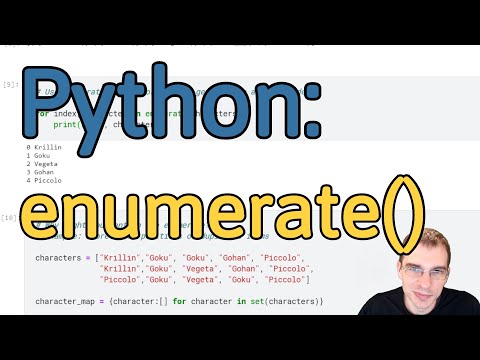
Code available in comment below! This video shows the basics of how to use enumerate() in Python. enumerate() is useful for looping through data structures like lists while having access to each index and the corresponding value for each iteration of the loop. characters =...
Code available in comment below! This video shows the basics of how to use enumerate() in Python. enumerate() is useful for looping through data structures like lists while having access to each index and the corresponding value for each iteration of the loop.
characters = ["Krillin","Goku", "Vegeta", "Gohan", "Piccolo"]
# enumerate() returns a sequence of (index, item) tuples
list(enumerate(characters))
# Use enumerate() in a for loop to get an item and its index
for index, character in enumerate(characters):
print(index, character)
# Why might you want to use enumerate?
# Example: store index positions of duplicate items
characters = ["Krillin","Goku", "Goku", "Gohan", "Piccolo",
"Krillin","Goku", "Vegeta", "Gohan", "Piccolo",
"Piccolo","Goku", "Vegeta", "Goku", "Piccolo"]
character_map = {character:[] for character in set(characters)}
print(character_map)
# Use enumerate to store the index for each occurence
for index, character in enumerate(characters):
character_map[character].append(index)
character_map
This episode of Python Programming Practice shows two approaches to LeetCode #5 -- Longest Palindromic Substring https://leetcode.com/problems/longest-palindromic-substring/ This is a medium difficulty problem. Note that the intent of this series to help viewers think through...
This episode of Python Programming Practice shows two approaches to LeetCode #5 -- Longest Palindromic Substring
https://leetcode.com/problems/longest-palindromic-substring/
This is a medium difficulty problem.
Note that the intent of this series to help viewers think through approaches to problems, not to provide copy/paste access to code that will pass LeetCode tests.
Data visualization showing the balance of power in Game of Thrones over time . "Balance of Power" in this video essentially means how far a given character is from sitting on the iron throne at any point in time. Note that for all characters other than those actually sitting...
Data visualization showing the balance of power in Game of Thrones over time . "Balance of Power" in this video essentially means how far a given character is from sitting on the iron throne at any point in time. Note that for all characters other than those actually sitting on the throne, the ranking is subjective. I gave strong precedence to characters with a valid claim to the throne based on lineage, followed by characters with close relations to the current ruler (hand of the king, trusted advisor, etc.) and powerful contenders seeking to claim the throne for themselves.
Data: Custom data set
Track: Game of Thrones Theme | DJD3 & BRANDS Remix
Music provided by "ByeByeCopyright".
Watch: https://youtu.be/7RkICW700GY
Free Download / Stream: http://bit.ly/GameOfThrones_Remix
This episode of Python Programming Practice shows two approaches to LeetCode #6 -- ZigZag Conversion https://leetcode.com/problems/zigzag-conversion/ This is a medium difficulty problem. Note that the intent of this series to help viewers think through approaches to problems,...
This episode of Python Programming Practice shows two approaches to LeetCode #6 -- ZigZag Conversion
https://leetcode.com/problems/zigzag-conversion/
This is a medium difficulty problem.
Note that the intent of this series to help viewers think through approaches to problems, not to provide copy/paste access to code that will pass LeetCode tests.