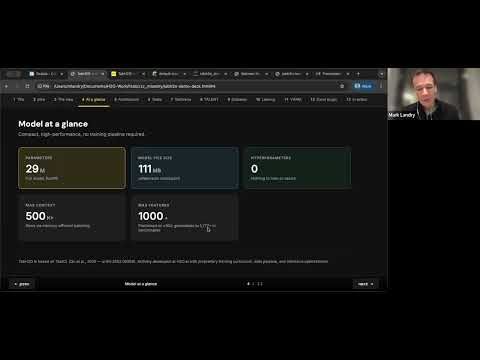
What if asking a predictive question was as easy as writing a prompt? In this hands-on webinar, Andreea Turcu (Head of Global Training at H2O.ai) introduces tabular foundation models and demonstrates TabH2O live - going from a raw spreadsheet to predictions in seconds, with...
What if asking a predictive question was as easy as writing a prompt? In this
hands-on webinar, Andreea Turcu (Head of Global Training at H2O.ai) introduces
tabular foundation models and demonstrates TabH2O live - going from a raw
spreadsheet to predictions in seconds, with no model training, no code, and no
infrastructure.
You'll see the full workflow inside Excel: install the add-in, load a dataset,
and predict missing values at the click of a button. Plus a candid look at when
TabH2O is the right tool — and when traditional machine learning still wins.
━━━━━━━━━━━━━━━━━━━━━━━━━━━━━━
🔗 LINKS
→ Try TabH2O (free): https://tabh2o.h2oai.com
→ Docs & manifest.xml download: https://tabh2o.h2oai.com/docs
→ Sample dataset (opportunity value): https://github.com/h2oai/h2o-university-resources/blob/main/demo-datasets/sample_customer_churn.csv
→ Excel Online: https://excel.cloud.microsoft/
→ Free courses & certifications: https://h2o.ai/university
→ Enterprise limits & use cases: https://h2oai.com/demo
━━━━━━━━━━━━━━━━━━━━━━━━━━━━━━
⏱️ CHAPTERS
0:00 Welcome & the prediction question
2:13 Who we are — a decade of predictive AI
4:22 Today's roadmap
5:20 The shift — why business data stayed hard
6:43 Tabular data: the language of business
8:23 Why traditional ML feels heavy
10:01 The prediction gap
11:56 What is a tabular foundation model?
14:48 Meet TabH2O
17:01 How it works — labeled rows in, predictions out
17:32 Your data stays yours (privacy)
18:52 Live demo — setup
34:50 The predict moment
36:15 What just happened — before vs after
39:09 One workflow, many business questions
40:43 When traditional ML is still the better choice
43:28 Beyond the spreadsheet — agentic & actions
46:03 The future — from creator to forecaster
47:42 Q&A
━━━━━━━━━━━━━━━━━━━━━━━━━━━━━━
ABOUT TABH2O
TabH2O is a tabular foundation model from H2O.ai.
Just as large language models learn patterns across language, tabular foundation models learn patterns across
tables — so you can bring a spreadsheet, provide a few labeled examples, and
generate predictions without building or training a model. It handles
classification and regression, runs inside Excel via an add-in, and works even
on small datasets. Your data is processed in memory — not stored, not cached,
not used to retrain the model.
━━━━━━━━━━━━━━━━━━━━━━━━━━━━━━
ABOUT H2O.AI
H2O.ai has spent more than a decade helping organizations generate value from
predictive AI — with open-source H2O, AutoML, and Driverless AI used by data
scientists worldwide.
#TabH2O #H2Oai #TabularFoundationModels #PredictiveAI #MachineLearning #ExcelAI #NoCodeML
How H2O.ai aligns ML model development with business outcomes using custom scorers, ROI documentation, and enterprise tool integration. AI projects only succeed when they deliver measurable business value. H2O.ai organizes technical work around strategic goals using...
How H2O.ai aligns ML model development with business outcomes using custom scorers, ROI documentation, and enterprise tool integration.
AI projects only succeed when they deliver measurable business value. H2O.ai organizes technical work around strategic goals using structured workspaces and business metadata tagging. Custom scoring functions in Driverless AI allow teams to optimize models directly for profit functions—such as customer retention probability or intervention costs—rather than generic statistical metrics. The H2O Super Agent can autonomously draft ROI analyses, while API integrations with tools like Jira and ServiceNow synchronize the model lifecycle with existing enterprise workflows.
Technical Capabilities & Resources
➤ Goal-Oriented Workspaces: Organize AI projects around business strategy and expected outcomes using collaborative workspace descriptions.
🔗 https://docs.h2o.ai/haic-documentation/guide/general/create-manage-workspaces
➤ Custom Business Value Scoring: Optimize Driverless AI models directly for revenue or cost-based profit functions using custom scorers.
🔗 https://github.com/h2oai/driverlessai-recipes/blob/master/scorers/classification/binary/profit.py
➤ Automated Business Documentation: Use AutoDoc and the H2O Super Agent to generate business cases and ROI analyses from model performance data.
🔗 https://docs.h2o.ai/driverless-ai/latest-stable/docs/userguide/autodoc.html
➤ Enterprise Tool Integration: Synchronize model lifecycle events with Jira, ServiceNow, or Azure DevOps via the Python API.
🔗 https://docs.h2o.ai/driverless-ai/latest-stable/docs/userguide/python_client.html
How H2O.ai delivers audit-ready AI with centralized logging, automated model documentation, and traceable agent execution. When regulators ask questions, teams need a complete, reproducible paper trail. H2O.ai builds auditability directly into the DSML lifecycle—centralized...
How H2O.ai delivers audit-ready AI with centralized logging, automated model documentation, and traceable agent execution.
When regulators ask questions, teams need a complete, reproducible paper trail. H2O.ai builds auditability directly into the DSML lifecycle—centralized audit logs capture every user action, deployment event, and configuration change with precise timestamps and actor context. AutoDoc eliminates manual reporting by generating comprehensive model documentation automatically. For generative AI, every agent execution step is fully traceable, exposing tool calls, data access, and reasoning steps to explain exactly how a recommendation was reached.
Technical Capabilities & Resources
➤ Centralized Audit Logging: Complete history of user actions, administrative changes, and operational events with timestamps and actor context.
🔗 https://docs.h2o.ai/haic-documentation/security-guarantees-model#audit-logging
➤ Automated Model Documentation (AutoDoc): Generate reproducible reports covering model configurations, feature importance, and performance metrics automatically.
🔗 https://docs.h2o.ai/driverless-ai/latest-lts/docs/userguide/autodoc-using.html
➤ Traceable Agent Execution: Step-by-step breakdown of agent tool calls, data access, and reasoning for full decision transparency.
🔗 https://docs.h2oai.com/enterprise-h2ogpte/guide/agents#how-to-review-agent-behavior
➤ ML Interpretability & Retention: Support long-term compliance with interpretability tooling and configurable data retention policies.
🔗 https://docs.h2o.ai/driverless-ai/latest-lts/docs/userguide/mli.html
TabH2O removes the export, cleanup, and model building. Open your spreadsheet, click Predict, and get answers in seconds. Try it free → tabh2o.h2oai.com
TabH2O removes the export, cleanup, and model building.
Open your spreadsheet, click Predict, and get answers in seconds.
Try it free → tabh2o.h2oai.com
How H2O.ai enforces RBAC, model constraints, audit logging, and GenAI guardrails across the enterprise AI lifecycle. As AI scales across organizations, governance must be embedded into the platform architecture—not added as an afterthought. H2O.ai manages role-based access...
How H2O.ai enforces RBAC, model constraints, audit logging, and GenAI guardrails across the enterprise AI lifecycle.
As AI scales across organizations, governance must be embedded into the platform architecture—not added as an afterthought. H2O.ai manages role-based access controls across workspaces so business users and ML engineers see only what they need to. Monotonicity constraints embed regulatory logic directly into model training behavior. VPC and air-gapped deployment options enforce data residency requirements, while comprehensive audit logging and automated GenAI guardrails maintain full operational transparency.
Technical Capabilities & Resources
➤ Role-Based Access Control (RBAC) & Workspaces: Manage workspace-level permissions for secure collaboration across MLOps and GenAI workflows.
🔗 https://docs.h2o.ai/enterprise-h2ogpte/guide/system-dashboard/roles-and-permissions
➤ Model Constraints & Metadata Tagging: Embed monotonicity constraints into models and tag assets by risk level and sensitivity.
🔗 https://docs.h2oai.com/driverless-ai/latest-stable/docs/userguide/monotonicity-constraints.html
➤ Audit Logging & Compliance: Capture all governance events, approvals, and permission changes to support regulatory examinations.
🔗 https://docs.h2o.ai/haic-documentation/security-guarantees-model#audit-logging
➤ Model Monitoring & Alerts: Customizable alerts for performance degradation to maintain ongoing compliance.
🔗 https://docs.h2o.ai/mlops/model-monitoring
How H2O.ai bridges visual no-code ML pipelines and code-first Python execution for diverse data science working styles. AI teams contain visual thinkers, coders, and everyone in between. Driverless AI supports intuitive wizards and visual pipeline diagrams for feature...
How H2O.ai bridges visual no-code ML pipelines and code-first Python execution for diverse data science working styles.
AI teams contain visual thinkers, coders, and everyone in between. Driverless AI supports intuitive wizards and visual pipeline diagrams for feature engineering and model tuning. MLOps allows switching between UI-based row scoring and command-line batch execution. h2oGPTe agents generate sandbox-tested Python code that can be exported, modified, and used in automated testing—enabling teams to fluidly transition from a visual interface to a fully scriptable environment without losing any work.
Technical Capabilities & Resources
➤ Visual Pipeline Composition: Visualize feature engineering, model selection, and ensembling steps as interactive diagrams in Driverless AI.
🔗 https://docs.h2oai.com/driverless-ai/latest-stable/docs/userguide/scoring_pipeline_visualize.html
➤ No-Code to Code Conversion: Export UI workflows from Driverless AI into reproducible, executable Python scripts.
🔗 https://docs.h2o.ai/driverless-ai/latest-stable/docs/userguide/examples/autoviz_client_example/autoviz_client_example.html
➤ Custom Code Integration: Incorporate custom functions and recipes directly into Driverless AI workflows for granular control.
🔗 https://docs.h2o.ai/driverless-ai/latest-stable/docs/userguide/custom_recipes.html
How the H2O Super Agent acts as a natural language IDE to automate, execute, and orchestrate enterprise AI workflows conversationally. The H2O Super Agent goes beyond question-answering—it translates natural language intent directly into execution by calling APIs, writing and...
How the H2O Super Agent acts as a natural language IDE to automate, execute, and orchestrate enterprise AI workflows conversationally.
The H2O Super Agent goes beyond question-answering—it translates natural language intent directly into execution by calling APIs, writing and running code, and modifying configurations autonomously. Users select from specialized agent types optimized for different use cases. The agent provides full transparency into its reasoning, code generation, and tool outputs for developer debugging. Role-based access controls ensure business users see only finalized outputs, while maintaining human-in-the-loop oversight throughout.
Technical Capabilities & Resources
➤ Natural Language IDE & Workflow Automation: Build and execute complex AI workflows through conversational prompts with transparent step-by-step reasoning.
🔗 https://docs.h2o.ai/enterprise-h2ogpte/get-started/h2ogpte-flow
➤ Tool Calling & Execution: Agents autonomously call external APIs, write code, and orchestrate integrated tools beyond text generation.
🔗 https://docs.h2o.ai/enterprise-h2ogpte/guide/agents/tool-calling
➤ Agent Builder Overview: Understand the broader agent architecture enabling autonomous workflow orchestration.
🔗 https://docs.h2o.ai/enterprise-h2ogpte/guide/agents/agent-builder/overview
How h2oGPTe enables no-code Super Agent customization and auto-generated multi-agent Python code using CrewAI and LangGraph. Enterprises often need agents tailored to specific workflows beyond built-in defaults. h2oGPTe supports two approaches: the Super Agent can be rapidly...
How h2oGPTe enables no-code Super Agent customization and auto-generated multi-agent Python code using CrewAI and LangGraph.
Enterprises often need agents tailored to specific workflows beyond built-in defaults. h2oGPTe supports two approaches: the Super Agent can be rapidly customized using system prompts, collections, and tool configurations without any code. For advanced requirements, the Agent Builder generates fully executable Python source code by accepting a natural language workflow description, selecting the right framework (CrewAI or LangGraph), and running an internal build-test-refine loop. Agents also generate standardized A2A protocol files for cross-framework interoperability.
Technical Capabilities & Resources
➤ Super Agent Customization: Configure task-specific agents using custom system prompts, collections, and tool orchestration—no code required.
🔗 https://docs.h2o.ai/enterprise-h2ogpte/guide/agents#how-it-works
➤ Agent Builder & Code Generation: Generate production-ready Python code for custom agents using CrewAI, LangGraph, or the OpenAI SDK.
🔗 https://docs.h2o.ai/enterprise-h2ogpte/guide/agents
➤ Multi-Agent Ecosystems (A2A Protocol): Automatically generate A2A communication files for agent interoperability across different frameworks.
🔗 https://docs.h2o.ai/enterprise-h2ogpte/guide/agents/agent-builder/a2a-protocol
Catch the recording to explore TabH2O, H2O.ai’s foundation model for tabular machine learning. In this session, you’ll learn how tabular foundation models work and see live how TabH2O delivers predictions in seconds.
Catch the recording to explore TabH2O, H2O.ai’s foundation model for tabular machine learning.
In this session, you’ll learn how tabular foundation models work and see live how TabH2O delivers predictions in seconds.
How H2O.ai's Data Science Agent automates EDA, model training, and SHAP explainability across the ML lifecycle. The H2O Data Science Agent connects directly to enterprise data sources like S3 to autonomously perform data profiling and generate visual analytics—distribution...
How H2O.ai's Data Science Agent automates EDA, model training, and SHAP explainability across the ML lifecycle.
The H2O Data Science Agent connects directly to enterprise data sources like S3 to autonomously perform data profiling and generate visual analytics—distribution plots, correlation heatmaps—then synthesizes findings into a business narrative tailored to the audience. Beyond exploration, the agent integrates with Driverless AI to configure and monitor AutoML experiments, and extracts SHAP values for transparent feature importance analysis. This tight coupling between generative AI and predictive modeling accelerates the full data science workflow.
Technical Capabilities & Resources
➤ Automated Exploratory Data Analysis: Autonomous data profiling, visual analytics generation, and business-context narrative synthesis.
🔗 https://docs.h2o.ai/enterprise-h2ogpte/guide/chats/chat-settings#agent-type
➤ Driverless AI Integration via Agent: Configure, trigger, and monitor AutoML experiments directly through agent tool integration.
🔗 https://docs.h2o.ai/enterprise-h2ogpte/guide/chats/chat-settings#agent-type
➤ Integrated SHAP Explainability: Agent extracts SHAP values from trained models to provide transparent feature importance insights.
🔗 https://docs.h2o.ai/enterprise-h2ogpte/guide/chats/chat-settings#agent-type
How H2O.ai's Python SDKs, REST APIs, and MCP tools enable full programmatic control over the enterprise AI platform. No-code interfaces are valuable, but serious AI developers need deep programmatic flexibility. H2O.ai exposes Python SDKs, REST APIs, and hosted Jupyter Labs...
How H2O.ai's Python SDKs, REST APIs, and MCP tools enable full programmatic control over the enterprise AI platform.
No-code interfaces are valuable, but serious AI developers need deep programmatic flexibility. H2O.ai exposes Python SDKs, REST APIs, and hosted Jupyter Labs for scripting and automating every platform component—from triggering Driverless AI experiments to managing MLOps deployments within CI/CD pipelines. OpenAPI Swagger UIs allow developers to explore endpoints and generate client code in Python, JavaScript, or Go. The Model Context Protocol (MCP) server enables h2oGPTe agents to connect directly to external systems like Salesforce, MongoDB, and GitHub.
Technical Capabilities & Resources
➤ Comprehensive SDKs & Libraries: Automate Driverless AI, MLOps, h2oGPTe, and Eval Studio via Python, JavaScript, and Go clients.
🔗 https://docs.h2o.ai/mlops/py-client/overview
➤ OpenAPI Specifications: Interactive Swagger UIs for exploring endpoints, testing calls, and generating client code.
🔗 https://h2ogpte.cloud-dev.h2o.dev/swagger-ui/
➤ Agent Extensibility via MCP: Connect generative AI agents to external tools and proprietary data systems using the h2oGPTe MCP server.
🔗 https://pypi.org/project/h2ogpte-mcp-server/
How H2O.ai orchestrates enterprise AI workloads on Kubernetes with managed resource profiles and cost guardrails. As AI programs scale, managing compute resources across teams and use cases becomes operationally critical. H2O.ai runs all workloads—Driverless AI experiments,...
How H2O.ai orchestrates enterprise AI workloads on Kubernetes with managed resource profiles and cost guardrails.
As AI programs scale, managing compute resources across teams and use cases becomes operationally critical. H2O.ai runs all workloads—Driverless AI experiments, Feature Store operations, MLOps deployments, and h2oGPTe agent executions—as managed Kubernetes workloads. Administrators define specialized resource profiles allocating the right CPU, GPU, and memory per task. Cost guardrails enforce idle timeouts, maximum run durations, and dynamic cluster autoscaling, keeping infrastructure spend under control without requiring Kubernetes expertise from data scientists.
Technical Capabilities & Resources
➤ Workload Orchestration & Resource Profiles: Schedule ML workloads using admin-managed profiles that allocate CPU, GPU, and memory automatically.
🔗 https://docs.h2o.ai/ai-engine-manager/user-guide/dai-engine/create-dai-engine/#step-4-configure-resources
➤ Cost Optimization & Infrastructure Guardrails: Control compute costs with resource constraints, idle timeouts, and dynamic cluster autoscaling.
🔗 https://docs.h2o.ai/mlops/model-deployments/create-a-deployment#advanced-settings
➤ H2O Engine Management: View and manage engine configuration and last-used resource profile information.
🔗 https://docs.h2o.ai/ai-engine-manager/user-guide/h2o-engine/manage-h2o-engine/
How h2oGPTe grounds LLMs in enterprise data using multimodal RAG, hybrid search, and autonomous agent workflows. LLMs don't inherently know your internal products, policies, or customer history. h2oGPTe bridges this gap by ingesting 50+ file formats—including documents,...
How h2oGPTe grounds LLMs in enterprise data using multimodal RAG, hybrid search, and autonomous agent workflows.
LLMs don't inherently know your internal products, policies, or customer history. h2oGPTe bridges this gap by ingesting 50+ file formats—including documents, audio, and video—using multi-engine OCR and native enterprise connectors for SharePoint, S3, and Azure. Hybrid retrieval combines semantic similarity and BM25 with Reciprocal Rank Fusion and cross-encoder reranking for precise, citation-backed answers. Agentic workflows extend RAG further by enabling autonomous retrieval, reasoning, and tool execution.
Technical Capabilities & Resources
➤ Document Ingestion & Transformation: 50+ format support with multi-engine OCR, table preservation, and enterprise connectors.
🔗 https://docs.h2o.ai/enterprise-h2ogpte/guide/collections/supported-file-types
➤ Built-in & External Vector Storage: Includes Vex embedded vector database plus integrations with external vector providers.
🔗 https://docs.h2o.ai/enterprise-h2ogpte/architecture/vector-database
➤ Advanced Hybrid Search: Combines semantic similarity, BM25, Reciprocal Rank Fusion, and cross-encoder reranking.
🔗 https://docs.h2o.ai/enterprise-h2ogpte/guide/chats/chat-settings#generation-approach
➤ Agentic Workflows: Autonomous agents that iteratively retrieve, reason, and trigger tool execution for complex queries.
🔗 https://docs.h2o.ai/enterprise-h2ogpte/guide/agents
How Enterprise h2oGPTe protects LLM applications from toxic content, PII leaks, and adversarial jailbreak attempts. Even high-performing generative AI models require safeguards. h2oGPTe enforces multi-stage guardrails at the collection level—monitoring content during...
How Enterprise h2oGPTe protects LLM applications from toxic content, PII leaks, and adversarial jailbreak attempts.
Even high-performing generative AI models require safeguards. h2oGPTe enforces multi-stage guardrails at the collection level—monitoring content during ingestion, at prompt submission, and before final response generation. Built-in toxic topic classifications and configurable custom guardrails keep AI strictly on-topic. PII detection uses a defense-in-depth approach combining regex, Presidio, and a fine-tuned ModernBERT model, while PromptGuard actively blocks adversarial jailbreak patterns and logs every violation.
Technical Capabilities & Resources
➤ Toxic Content & Custom Topic Filtering: Block harmful content and restrict AI to approved business topics using configurable guardrails.
🔗 https://docs.h2o.ai/enterprise-h2ogpte/guide/collections/create-a-collection#guardrails-and-pii-detection
➤ PII Detection & Redaction: Identify and redact sensitive data across prompts and responses using Regex, Presidio, and ModernBERT.
🔗 https://docs.h2o.ai/enterprise-h2ogpte/guide/collections/pii-sanitization#pii-detection-methods
➤ Adversarial Jailbreak Protection: PromptGuard detects and neutralizes adversarial prompt patterns before they reach the model.
🔗 https://docs.h2o.ai/enterprise-h2ogpte/changelog/tags/v-1-5#guardrails
How to fine-tune domain-specific LLMs for tasks like text-to-SQL and multimodal QA using H2O Enterprise LLM Studio. When prompt engineering alone is insufficient, fine-tuning a domain-specific model can reduce costs while improving accuracy. H2O Enterprise LLM Studio walks...
How to fine-tune domain-specific LLMs for tasks like text-to-SQL and multimodal QA using H2O Enterprise LLM Studio.
When prompt engineering alone is insufficient, fine-tuning a domain-specific model can reduce costs while improving accuracy. H2O Enterprise LLM Studio walks through the full instruction tuning process—leveraging LoRA adapters, built-in AutoML for hyperparameter optimization, and real-time training metrics like loss curves and validation perplexity. Models are evaluated for safety and quality, then exported directly to Hugging Face for distribution across the organization.
Technical Capabilities & Resources
➤ Multimodal Generative AI Tuning: Train models for domain-specific tasks including multi-modal causal language modeling and image/text classification.
🔗 https://docs.h2o.ai/h2o-enterprise-llm-studio/get-started/what-is-h2o-enterprise-llm-studio#use-cases
➤ Instruction Tuning & DPO Alignment: Fine-tune base models using labeled data, automated hyperparameter search, and preference optimization.
🔗 https://docs.h2o.ai/h2o-llmstudio/guide/experiments/supported-problem-types#dpo-modeling
➤ Augmentation for Fine-Tuning Datasets: Use LLM DataStudio to augment and prepare training data for downstream instruction tuning.
🔗 https://docs.h2o.ai/h2o-llm-data-studio/guide/augment/augmentation-datasets