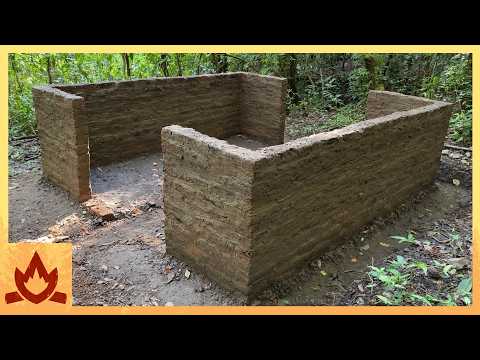
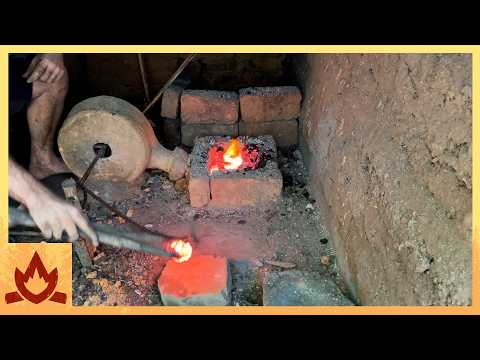
I built a permanent wall structure using homemade fired bricks and a refined mud mortar mix. Watch the entire ancient engineering process from raw earth to finished masonry. The finished mortar gives the wall a clean, sturdy bond. #PrimitiveTechnology #building #mortar...
I built a permanent wall structure using homemade fired bricks and a refined mud mortar mix. Watch the entire ancient engineering process from raw earth to finished masonry. The finished mortar gives the wall a clean, sturdy bond.
#PrimitiveTechnology #building #mortar #firedbricks #engineering
The ultimate challenge is seeing how far human ingenuity can go. Subscribe here:
https://www.youtube.com/channel/UCAL3JXZSzSm8AlZyD3nQdBA?sub_confirmation=1
About Primitive Technology:
Building things in the wild completely from scratch no modern tools, no modern materials.
The challenge is simple but strict: If I need a fire, I make a fire stick. If I need an axe, I shape a stone. Every hut is built solely from trees, mud, and rocks. I don't live in the wild, but I love discovering just how far we can go using only natural materials and human effort.
Browse by Category: Visit the Playlists tab to find focused videos on Shelter, Pyrotechnology, Tools & Machines, Weapons, Food & Agriculture, and Weaving & Fiber.
Follow Primitive Technology here:
Website: https://primitivetechnology.wordpress.com/
Patreon: patreon.com/user?u=2945881
Chapters:
00:00 Brick Foundation Layout
01:22 Mud Mortaring bricks
03:47 Plumb Bob
6:06 Fire by friction
8:50 Gable Layers
11:41 Tiles Onto Walls To Protect Against Rain
Primitive Technology | Building Walls with Fired Bricks and Mud Mortar
https://youtu.be/LTu6xpoPvzg
Mud mortar experiment and firing roof tiles. Subscribe: http://bit.ly/subPT | Never miss a video! Enable ‘ALL’ Notifications! Watch my newest content: https://youtube.com/playlist?list=PLGnWLXjIDnpBR4xqf3FO-xFFwE-ucq4Fj&playnext=1&index=2 Follow Primitive Technology:...
Mud mortar experiment and firing roof tiles.
Subscribe: http://bit.ly/subPT | Never miss a video! Enable ‘ALL’ Notifications!
Watch my newest content: https://youtube.com/playlist?list=PLGnWLXjIDnpBR4xqf3FO-xFFwE-ucq4Fj&playnext=1&index=2
Follow Primitive Technology:
Wordpress: https://primitivetechnology.wordpress.com/
Patreon: https://patreon.com/user?u=2945881
Watch More Primitive Technology:
Newest Uploads: https://youtube.com/playlist?list=PLGnWLXjIDnpBR4xqf3FO-xFFwE-ucq4Fj&playnext=1&index=2
Pyrotechnology: https://youtube.com/playlist?list=PLGnWLXjIDnpBVRqu5lz5JGaQxjPs7q3CJ&playnext=1&index=2
Shelter: https://youtube.com/playlist?list=PLGnWLXjIDnpBBsdKZb-vy30o88SIxItp2&playnext=1&index=2
Weapons: https://youtube.com/playlist?list=PLGnWLXjIDnpA-XGDrrmVgBnSXx15i2Awp&playnext=1&index=2
Popular Videos: https://youtube.com/playlist?list=PLGnWLXjIDnpAb29Lrdki5BPjTpMon8zla&playnext=1&index=2
About This Video:
I tried building wall from fired bricks mortared together with mud rather than ash cement due to the mud being easier to produce, especially in the wet season when fire is difficult to produce. The wall initially survived heavy rain as it was being built but eventually collapsed near completion, likely to being built too fasts before the layers could dry. If I try again in future, I'll wait a day between layers and only build in dry weather, though this experiment showed that this method will survive heavy rain up to over a meter in wall height.
Next I continued on from the last video and successfully fired the roof tiles in the new kiln. The ash was pelletised to make ash cement for future use. Then I made a new batch of tiles and some bricks as well for the next firring. Hopefully the weather dries up soon so I can build a permanent workshop for the next wet season, I need another tiled hut (in addition to the current 2 walled tiled hut) that won't rot in the wet weather like thatch does.
0:00 Mud mortar experiment
11:21 Drying roof tile/ making kiln
13:03 Firing roof tiles
19:13 Making next batch of tiles and bricks
About Primitive Technology:
Primitive technology is a hobby where you build things in the wild completely from scratch using no modern tools or materials. These are the strict rules: If you want a fire, use a fire stick - An axe, pick up a stone and shape it - A hut, build one from trees, mud, rocks etc. The challenge is seeing how far you can go without utilizing modern technology. I do not live in the wild, but enjoy building shelter, tools, and more, only utilizing natural materials. To find specific videos, visit my playlist tab for building videos focused on pyrotechnology, shelter, weapons, food & agriculture, tools & machines, and weaving & fiber.
#PrimitiveTechnology #survival #pyrotechnics
Roof tiles dried by underfloor heating Subscribe: http://bit.ly/subPT | Never miss a video! Enable ‘ALL’ Notifications! Watch my newest content: https://youtube.com/playlist?list=PLGnWLXjIDnpBR4xqf3FO-xFFwE-ucq4Fj&playnext=1&index=2 Follow Primitive Technology: Wordpress:...
Roof tiles dried by underfloor heating
Subscribe: http://bit.ly/subPT | Never miss a video! Enable ‘ALL’ Notifications!
Watch my newest content: https://youtube.com/playlist?list=PLGnWLXjIDnpBR4xqf3FO-xFFwE-ucq4Fj&playnext=1&index=2
Follow Primitive Technology:
Wordpress: https://primitivetechnology.wordpress.com/
Patreon: https://patreon.com/user?u=2945881
Watch More Primitive Technology:
Newest Uploads: https://youtube.com/playlist?list=PLGnWLXjIDnpBR4xqf3FO-xFFwE-ucq4Fj&playnext=1&index=2
Pyrotechnology: https://youtube.com/playlist?list=PLGnWLXjIDnpBVRqu5lz5JGaQxjPs7q3CJ&playnext=1&index=2
Shelter: https://youtube.com/playlist?list=PLGnWLXjIDnpBBsdKZb-vy30o88SIxItp2&playnext=1&index=2
Weapons: https://youtube.com/playlist?list=PLGnWLXjIDnpA-XGDrrmVgBnSXx15i2Awp&playnext=1&index=2
Popular Videos: https://youtube.com/playlist?list=PLGnWLXjIDnpAb29Lrdki5BPjTpMon8zla&playnext=1&index=2
About This Video:
I made a batch of tiles to test the underfloor heating in the new hut. A new chimney was made from bricks and the floor of the hut was given a new layer of mud. A roof tile mold and form were carved and a batch of 40 roof tiles were made using them. Despite wet weather, the new hut was able to keep the tiles out of the rain and actively dry them with the heat from the floor.
0:00 Fire wood shelf
0:50 Underfloor heating mud chimney
2:00 Replacing mud chimney with bricks
3:05 Fire by friction
4:01 Drying/plastering floor
5:02 Cane tile frame
6:33 Curved wooden tile form
8:55 Making roof tiles
11:36 Drying roof tiles with underfloor heating
About Primitive Technology:
Primitive technology is a hobby where you build things in the wild completely from scratch using no modern tools or materials. These are the strict rules: If you want a fire, use a fire stick - An axe, pick up a stone and shape it - A hut, build one from trees, mud, rocks etc. The challenge is seeing how far you can go without utilizing modern technology. I do not live in the wild, but enjoy building shelter, tools, and more, only utilizing natural materials. To find specific videos, visit my playlist tab for building videos focused on pyrotechnology, shelter, weapons, food & agriculture, tools & machines, and weaving & fiber.
#PrimitiveTechnology #hut #shelter
Hut with Underfloor Heating (Ondol/Hypocaust) Subscribe: http://bit.ly/subPT | Never miss a video! Enable ‘ALL’ Notifications! Watch my newest content: https://youtube.com/playlist?list=PLGnWLXjIDnpBR4xqf3FO-xFFwE-ucq4Fj&playnext=1&index=2 Follow Primitive Technology:...
Hut with Underfloor Heating (Ondol/Hypocaust)
Subscribe: http://bit.ly/subPT | Never miss a video! Enable ‘ALL’ Notifications!
Watch my newest content: https://youtube.com/playlist?list=PLGnWLXjIDnpBR4xqf3FO-xFFwE-ucq4Fj&playnext=1&index=2
Follow Primitive Technology:
Wordpress: https://primitivetechnology.wordpress.com/
Patreon: https://patreon.com/user?u=2945881
Watch More Primitive Technology:
Newest Uploads: https://youtube.com/playlist?list=PLGnWLXjIDnpBR4xqf3FO-xFFwE-ucq4Fj&playnext=1&index=2
Pyrotechnology: https://youtube.com/playlist?list=PLGnWLXjIDnpBVRqu5lz5JGaQxjPs7q3CJ&playnext=1&index=2
Shelter: https://youtube.com/playlist?list=PLGnWLXjIDnpBBsdKZb-vy30o88SIxItp2&playnext=1&index=2
Weapons: https://youtube.com/playlist?list=PLGnWLXjIDnpA-XGDrrmVgBnSXx15i2Awp&playnext=1&index=2
Popular Videos: https://youtube.com/playlist?list=PLGnWLXjIDnpAb29Lrdki5BPjTpMon8zla&playnext=1&index=2
About This Video:
I built a thatched hut with an underfloor heating system for the purpose of drying bricks, tiles and pottery faster. I built my standard small 2 x 2 m hut design first to keep the rain off the work site. Then I dug 8 meters of trench, 25 cm wide and deep, zig-zagging through the floor of the hut, while building up the sides with mud made from the excavated soil. When the tunnels were finished, flat stones were laid over the trenches and covered with mud as well to form a flat floor. A fire was lit in the lower entrance of the tunnels and the system drew the smoke through weakly. This was enhanced by building a short chimney at the back. The floor will take time to dry out slowly without cracking. When it is dry, it will be used for drying tiles, bricks and pottery made from a nearby source of clay. This underfloor heating is similar to the Korean "Ondol" or Roman "Hypocaust", both systems involving fire beneath a floor to provide warmth although it is more like the typical ondol with multiple tunnels whereas the hypocaust consists of tiles held up with pillars.
About Primitive Technology:
Primitive technology is a hobby where you build things in the wild completely from scratch using no modern tools or materials. These are the strict rules: If you want a fire, use a fire stick - An axe, pick up a stone and shape it - A hut, build one from trees, mud, rocks etc. The challenge is seeing how far you can go without utilizing modern technology. I do not live in the wild, but enjoy building shelter, tools, and more, only utilizing natural materials. To find specific videos, visit my playlist tab for building videos focused on pyrotechnology, shelter, weapons, food & agriculture, tools & machines, and weaving & fiber.
#PrimitiveTechnology #hut #underground
Primitive Technology: Portable pulley blower
Subscribe: http://bit.ly/subPT | Never miss a video! Enable ‘ALL’ Notifications!
Watch my newest content: https://youtube.com/playlist?list=PLGnWLXjIDnpBR4xqf3FO-xFFwE-ucq4Fj&playnext=1&index=2
Follow Primitive Technology:
Wordpress: https://primitivetechnology.wordpress.com/
Patreon: https://patreon.com/user?u=2945881
Watch More Primitive Technology:
Newest Uploads: https://youtube.com/playlist?list=PLGnWLXjIDnpBR4xqf3FO-xFFwE-ucq4Fj&playnext=1&index=2
Pyrotechnology: https://youtube.com/playlist?list=PLGnWLXjIDnpBVRqu5lz5JGaQxjPs7q3CJ&playnext=1&index=2
Shelter: https://youtube.com/playlist?list=PLGnWLXjIDnpBBsdKZb-vy30o88SIxItp2&playnext=1&index=2
Weapons: https://youtube.com/playlist?list=PLGnWLXjIDnpA-XGDrrmVgBnSXx15i2Awp&playnext=1&index=2
Popular Videos: https://youtube.com/playlist?list=PLGnWLXjIDnpAb29Lrdki5BPjTpMon8zla&playnext=1&index=2
About This Video:
The previous pulley blower was fixed in place and couldn't be moved due to stakes hammered into the ground that supported the rotor for the blower. This meant that the blower took up room in an already cluttered hut. To make it portable, I tried to lash the stakes to the housing but it would not do so in such a way that the rotor would be centred. So the solution I came up with was to the piece of the ground the stakes were hammered into portable- I simply cast the stakes into an adobe block and it it dry hard. The result was a portable blower that could be shifted out of the way and stored in a corner until needed. I then did an iron smelt with it and it got a similar yield to the original set up.
About Primitive Technology:
Primitive technology is a hobby where you build things in the wild completely from scratch using no modern tools or materials. These are the strict rules: If you want a fire, use a fire stick - An axe, pick up a stone and shape it - A hut, build one from trees, mud, rocks etc. The challenge is seeing how far you can go without utilizing modern technology. I do not live in the wild, but enjoy building shelter, tools, and more, only utilizing natural materials. To find specific videos, visit my playlist tab for building videos focused on pyrotechnology, shelter, weapons, food & agriculture, tools & machines, and weaving & fiber.
#PrimitiveTechnology #portable #fire
Primitive Technology: Convection turbine experiments (hot air windmill) Subscribe: http://bit.ly/subPT | Never miss a video! Enable ‘ALL’ Notifications! Watch my newest content: https://youtube.com/playlist?list=PLGnWLXjIDnpBR4xqf3FO-xFFwE-ucq4Fj&playnext=1&index=2 Follow...
Primitive Technology: Convection turbine experiments (hot air windmill)
Subscribe: http://bit.ly/subPT | Never miss a video! Enable ‘ALL’ Notifications!
Watch my newest content: https://youtube.com/playlist?list=PLGnWLXjIDnpBR4xqf3FO-xFFwE-ucq4Fj&playnext=1&index=2
Follow Primitive Technology:
Wordpress: https://primitivetechnology.wordpress.com/
Patreon: https://patreon.com/user?u=2945881
Watch More Primitive Technology:
Newest Uploads: https://youtube.com/playlist?list=PLGnWLXjIDnpBR4xqf3FO-xFFwE-ucq4Fj&playnext=1&index=2
Pyrotechnology: https://youtube.com/playlist?list=PLGnWLXjIDnpBVRqu5lz5JGaQxjPs7q3CJ&playnext=1&index=2
Shelter: https://youtube.com/playlist?list=PLGnWLXjIDnpBBsdKZb-vy30o88SIxItp2&playnext=1&index=2
Weapons: https://youtube.com/playlist?list=PLGnWLXjIDnpA-XGDrrmVgBnSXx15i2Awp&playnext=1&index=2
Popular Videos: https://youtube.com/playlist?list=PLGnWLXjIDnpAb29Lrdki5BPjTpMon8zla&playnext=1&index=2
About This Video:
I built a turbine powered by convection to see if it would be a viable source of motive force in a primitive setting. In the past, I've used water power to power a hammer and a forge blower but I envisioned a method of producing power that would be independent of a water source. The concept of a "convection mill" that could be set up anywhere and powered by fire was what I wanted to test. So I modified an existing radial fan from my blower, giving it an axial form by twisting the blades. The design worked as a windmill when sat on tree forks so that the axle could spin freely. Next I tied it to a string and hung it above a fire whereby it spun about its vertical axis. I next tested it in a wooden frame above a fire where it spun well too. I then built a pyramidal hood to funnel the hot air up to the blades causing the fan to spin more efficiently. Finally, I used the turbine to power a forge blower. It did so very weakly and then the whole contraption burnt down. The concept has potential but needs work.
About Primitive Technology:
Primitive technology is a hobby where you build things in the wild completely from scratch using no modern tools or materials. These are the strict rules: If you want a fire, use a fire stick - An axe, pick up a stone and shape it - A hut, build one from trees, mud, rocks etc. The challenge is seeing how far you can go without utilizing modern technology. I do not live in the wild, but enjoy building shelter, tools, and more, only utilizing natural materials. To find specific videos, visit my playlist tab for building videos focused on pyrotechnology, shelter, weapons, food & agriculture, tools & machines, and weaving & fiber.
#PrimitiveTechnology #wildlife #experiment
Grate furnace, wood fuel smelting experiment
Subscribe: http://bit.ly/subPT | Never miss a video! Enable ‘ALL’ Notifications!
Watch my newest content: https://youtube.com/playlist?list=PLGnWLXjIDnpBR4xqf3FO-xFFwE-ucq4Fj&playnext=1&index=2
Follow Primitive Technology:
Wordpress: https://primitivetechnology.wordpress.com/
Patreon: https://patreon.com/user?u=2945881
Watch More Primitive Technology:
Newest Uploads: https://youtube.com/playlist?list=PLGnWLXjIDnpBR4xqf3FO-xFFwE-ucq4Fj&playnext=1&index=2
Pyrotechnology: https://youtube.com/playlist?list=PLGnWLXjIDnpBVRqu5lz5JGaQxjPs7q3CJ&playnext=1&index=2
Shelter: https://youtube.com/playlist?list=PLGnWLXjIDnpBBsdKZb-vy30o88SIxItp2&playnext=1&index=2
Weapons: https://youtube.com/playlist?list=PLGnWLXjIDnpA-XGDrrmVgBnSXx15i2Awp&playnext=1&index=2
Popular Videos: https://youtube.com/playlist?list=PLGnWLXjIDnpAb29Lrdki5BPjTpMon8zla&playnext=1&index=2
About This Video:
I built a furnace from bricks with a grate to admit air that ran by natural draft and used wood fuel instead of charcoal to smelt a cylinder of iron ore and charcoal powder placed on the grate. The grate had a hexagonal cross-section and the furnace was made from bricks. The furnace was 1.5 cm tall when finished and about 50 cm wide internally. The ore brick was placed on a small pot filled with twigs in the centre of the grate so that it would melt into the pot. A crucible was not used because there is no clay refractory enough to withstand the heat here. The furnace was filled with wood. A fire was lit from the bottom up and the whole thing burned for about 2 hours. The ore brick had indeed melted but fell over during the smelt so the slag and iron didn't flow properly. The pot it was meant to melt into melted apart and cause the ore brick to topple. But the ore brick still did melt and some iron prills were visible but were to small to bother collecting. The ash from the firing was made into ash pellets for mortar production that will be used on another project I'm working on. The furnace has potential, no labour is used during operation (no bellows or blower), no charcoal is needed though the wood must be cut to small pieces and a high temperature can be attained so that ore is melted.
About Primitive Technology:
Primitive technology is a hobby where you build things in the wild completely from scratch using no modern tools or materials. These are the strict rules: If you want a fire, use a fire stick - An axe, pick up a stone and shape it - A hut, build one from trees, mud, rocks etc. The challenge is seeing how far you can go without utilizing modern technology. I do not live in the wild, but enjoy building shelter, tools, and more, only utilizing natural materials. To find specific videos, visit my playlist tab for building videos focused on pyrotechnology, shelter, weapons, food & agriculture, tools & machines, and weaving & fiber.
#PrimitiveTechnology #wood #fire
Wood ash & crushed terracotta mortar
Subscribe: http://bit.ly/subPT | Never miss a video! Enable ‘ALL’ Notifications!
Watch my newest content: https://youtube.com/playlist?list=PLGnWLXjIDnpBR4xqf3FO-xFFwE-ucq4Fj&playnext=1&index=2
Follow Primitive Technology:
Wordpress: https://primitivetechnology.wordpress.com/
Patreon: https://patreon.com/user?u=2945881
Watch More Primitive Technology:
Newest Uploads: https://youtube.com/playlist?list=PLGnWLXjIDnpBR4xqf3FO-xFFwE-ucq4Fj&playnext=1&index=2
Pyrotechnology: https://youtube.com/playlist?list=PLGnWLXjIDnpBVRqu5lz5JGaQxjPs7q3CJ&playnext=1&index=2
Shelter: https://youtube.com/playlist?list=PLGnWLXjIDnpBBsdKZb-vy30o88SIxItp2&playnext=1&index=2
Weapons: https://youtube.com/playlist?list=PLGnWLXjIDnpA-XGDrrmVgBnSXx15i2Awp&playnext=1&index=2
Popular Videos: https://youtube.com/playlist?list=PLGnWLXjIDnpAb29Lrdki5BPjTpMon8zla&playnext=1&index=2
About This Video:
I made mortar from wood ash and crushed terracotta and then used it to mortar bricks together. The ash from previous brick firings was formed into pellets and re-fired in the kiln to calcine it. There is calcium in wood ash which behaves the same as limestone when burned so it will set after being wetted and allowed to dry. The aggregate was crushed terracotta from old broken bricks. These contributed alumina and silica which along with the sodium and silica from the ash form aluminosilicate chains, forming a geopolymer. It forms a noticeably stronger mortar than the previous on I made from wood ash and sand. Also the terracotta is easier to source than sand in this location. Mixing 1 part ash to 3 parts terracotta yielded a useable mortar. A sample was tested after 9 days of drying and did not dissolve in water. I'll likely investigate easier ways to produce this material in future so I can build more structures with brick.
About Primitive Technology:
Primitive technology is a hobby where you build things in the wild completely from scratch using no modern tools or materials. These are the strict rules: If you want a fire, use a fire stick - An axe, pick up a stone and shape it - A hut, build one from trees, mud, rocks etc. The challenge is seeing how far you can go without utilizing modern technology. I do not live in the wild, but enjoy building shelter, tools, and more, only utilizing natural materials. To find specific videos, visit my playlist tab for building videos focused on pyrotechnology, shelter, weapons, food & agriculture, tools & machines, and weaving & fiber.
#PrimitiveTechnology #terracotta #wood
Double water bellows Subscribe: http://bit.ly/subPT | Never miss a video! Enable ‘ALL’ Notifications! Watch my newest content: https://youtube.com/playlist?list=PLGnWLXjIDnpBR4xqf3FO-xFFwE-ucq4Fj&playnext=1&index=2 Follow Primitive Technology: Wordpress:...
Double water bellows
Subscribe: http://bit.ly/subPT | Never miss a video! Enable ‘ALL’ Notifications!
Watch my newest content: https://youtube.com/playlist?list=PLGnWLXjIDnpBR4xqf3FO-xFFwE-ucq4Fj&playnext=1&index=2
Follow Primitive Technology:
Wordpress: https://primitivetechnology.wordpress.com/
Patreon: https://patreon.com/user?u=2945881
Watch More Primitive Technology:
Newest Uploads: https://youtube.com/playlist?list=PLGnWLXjIDnpBR4xqf3FO-xFFwE-ucq4Fj&playnext=1&index=2
Pyrotechnology: https://youtube.com/playlist?list=PLGnWLXjIDnpBVRqu5lz5JGaQxjPs7q3CJ&playnext=1&index=2
Shelter: https://youtube.com/playlist?list=PLGnWLXjIDnpBBsdKZb-vy30o88SIxItp2&playnext=1&index=2
Weapons: https://youtube.com/playlist?list=PLGnWLXjIDnpA-XGDrrmVgBnSXx15i2Awp&playnext=1&index=2
Popular Videos: https://youtube.com/playlist?list=PLGnWLXjIDnpAb29Lrdki5BPjTpMon8zla&playnext=1&index=2
About This Video:
I built two water bellows to use in tandem for smelting. Previously I made and tested one water bellow. It was small and was fired in a pit. For this project I made two that had a deeper stroke than the last one. I also fired it in a kiln so it would be stronger. I made a wide based tuyere for the two spouts of the bellows to fit into during use. When one bellow was lifted the other dropped so that a constant but intermittent stream of air entered the fire. The bellows worked well initially but then the handle came off one. So I attached wooden handles to both and they were easier to operate. I got about 2 hours of use and then the spout broke off one. This was probably due to a low firing temperature in the kiln, I could fix that problem the next time I do a firing by adding fewer layers of bricks in the bottom of the kiln. Also, the design could be modified to make the spout stronger.
00:00- 03:13 Make new water bellows
03:13- 06:45 Making bricks
06:45-10:13 Firing bellows and bricks
10:13- 12:11 Bellows valves
12:11- 13:06 Bricks and ash pellets
13:06- 14:47 Setting up bellows
14:47- 19:44 Testing Bellows
About Primitive Technology:
Primitive technology is a hobby where you build things in the wild completely from scratch using no modern tools or materials. These are the strict rules: If you want a fire, use a fire stick - An axe, pick up a stone and shape it - A hut, build one from trees, mud, rocks etc. The challenge is seeing how far you can go without utilizing modern technology. I do not live in the wild, but enjoy building shelter, tools, and more, only utilizing natural materials. To find specific videos, visit my playlist tab for building videos focused on pyrotechnology, shelter, weapons, food & agriculture, tools & machines, and weaving & fiber.
#PrimitiveTechnology #fire #survival
2.5 m Natural draft furnace experiment Subscribe: http://bit.ly/subPT | Never miss a video! Enable ‘ALL’ Notifications! Watch my newest content: https://youtube.com/playlist?list=PLGnWLXjIDnpBR4xqf3FO-xFFwE-ucq4Fj&playnext=1&index=2 Follow Primitive Technology: Wordpress:...
2.5 m Natural draft furnace experiment
Subscribe: http://bit.ly/subPT | Never miss a video! Enable ‘ALL’ Notifications!
Watch my newest content: https://youtube.com/playlist?list=PLGnWLXjIDnpBR4xqf3FO-xFFwE-ucq4Fj&playnext=1&index=2
Follow Primitive Technology:
Wordpress: https://primitivetechnology.wordpress.com/
Patreon: https://patreon.com/user?u=2945881
Watch More Primitive Technology:
Newest Uploads: https://youtube.com/playlist?list=PLGnWLXjIDnpBR4xqf3FO-xFFwE-ucq4Fj&playnext=1&index=2
Pyrotechnology: https://youtube.com/playlist?list=PLGnWLXjIDnpBVRqu5lz5JGaQxjPs7q3CJ&playnext=1&index=2
Shelter: https://youtube.com/playlist?list=PLGnWLXjIDnpBBsdKZb-vy30o88SIxItp2&playnext=1&index=2
Weapons: https://youtube.com/playlist?list=PLGnWLXjIDnpA-XGDrrmVgBnSXx15i2Awp&playnext=1&index=2
Popular Videos: https://youtube.com/playlist?list=PLGnWLXjIDnpAb29Lrdki5BPjTpMon8zla&playnext=1&index=2
About This Video:
I built a 2.5 m tall furnace to see if it could get hot enough to smelt iron by natural draft alone. Such furnaces work by the stack effect where the tall furnace causes negative pressure inducing an air flow from the base of the furnace and out the top. I'd previously built 2 natural draft furnaces 1.5 m tall with one producing a small amount of iron (4 grams) from ore.
The new furnace was built 25 cm in diameter and 50 cm tall with a chimney on top extending another 1.5 m. A charging door allowed charcoal and ore to be charged through the side without blocking the chimney. The furnace was hot enough to produce slag but no iron was recovered from the smelt. This was probably due to an oxidising atmosphere in the furnace, due to the short fuel bed and large charcoal lump size.
An interesting side effect of the test was a strange pulsing combustion when the door was left open. Flames and smoke would blow out and be sucked back in the charging door rhythmically so it sounded like a locomotive. This phenomenon has been observed in wood stoves, I don't think it's exactly like combustion in a pulse jet as it relies on natural draft to get started but is similar. Air is sucked in, the gases combust blowing air out the door and chimney, the gases in the furnace become over expanded causing a vacuum and air is sucked back in with the cycle repeating.
In future it may be necessary to mix carbon with the ore to form pellets to get it to convert to iron. I'd made a furnace like this bottle shaped design back in 2012 but with a grate rather than using tuyeres and it successfully made some nuggets of iron from an ore brick of ore and crushed charcoal set directly on the grate.
About Primitive Technology:
Primitive technology is a hobby where you build things in the wild completely from scratch using no modern tools or materials. These are the strict rules: If you want a fire, use a fire stick - An axe, pick up a stone and shape it - A hut, build one from trees, mud, rocks etc. The challenge is seeing how far you can go without utilizing modern technology. I do not live in the wild, but enjoy building shelter, tools, and more, only utilizing natural materials. To find specific videos, visit my playlist tab for building videos focused on pyrotechnology, shelter, weapons, food & agriculture, tools & machines, and weaving & fiber.
#PrimitiveTechnology #1 #2
Primitive Technology: Grass mat loom Subscribe: http://bit.ly/subPT | Never miss a video! Enable ‘ALL’ Notifications! Watch my newest content: https://youtube.com/playlist?list=PLGnWLXjIDnpBR4xqf3FO-xFFwE-ucq4Fj&playnext=1&index=2 Follow Primitive Technology: Wordpress:...
Primitive Technology: Grass mat loom
Subscribe: http://bit.ly/subPT | Never miss a video! Enable ‘ALL’ Notifications!
Watch my newest content: https://youtube.com/playlist?list=PLGnWLXjIDnpBR4xqf3FO-xFFwE-ucq4Fj&playnext=1&index=2
Follow Primitive Technology:
Wordpress: https://primitivetechnology.wordpress.com/
Patreon: https://patreon.com/user?u=2945881
Watch More Primitive Technology:
Newest Uploads: https://youtube.com/playlist?list=PLGnWLXjIDnpBR4xqf3FO-xFFwE-ucq4Fj&playnext=1&index=2
Pyrotechnology: https://youtube.com/playlist?list=PLGnWLXjIDnpBVRqu5lz5JGaQxjPs7q3CJ&playnext=1&index=2
Shelter: https://youtube.com/playlist?list=PLGnWLXjIDnpBBsdKZb-vy30o88SIxItp2&playnext=1&index=2
Weapons: https://youtube.com/playlist?list=PLGnWLXjIDnpA-XGDrrmVgBnSXx15i2Awp&playnext=1&index=2
Popular Videos: https://youtube.com/playlist?list=PLGnWLXjIDnpAb29Lrdki5BPjTpMon8zla&playnext=1&index=2
About This Video:
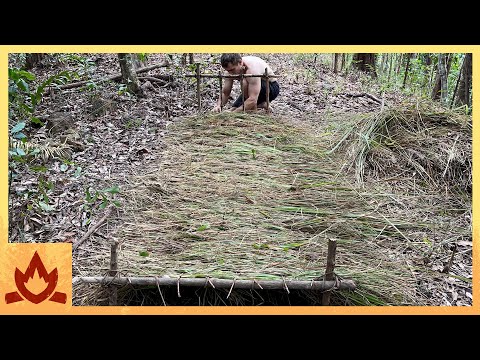
I made a loom for weaving grass mats on for the purpose of testing grass mats as roofing material for shelters. This is also known as a camp loom. Regular thatch is good for a stationary hut but is not portable. But a mat can be easily placed on a shelter roof to provide cover and then can be rolled up and taken to a new site like a tent. I cut grass about 1 m long and carried it to the site. There I set up a loom 3m long and 75 cm wide by hammering in 2 stakes into the ground and used vine as the string. Grass was then passed between the warp and weft strings as a crossbar was lifted and dropped. Th mat was then tied off at the ends when finished and could be rolled up and carried away. Two 2.5 m mats were made this way. A quick shed was made and the mats were used to cover the roof. The mats were placed on so water would run from one to the other. There were gaps in the grass which presented a problem. So I simply doubled the mats up by folding them in half. When laid on 2 layers thick the mats did shed water. The method does produce water proof mats quickly ( about 30 minutes per mat) but they need to be laid on two layers thick to be waterproof.
About Primitive Technology:
Primitive technology is a hobby where you build things in the wild completely from scratch using no modern tools or materials. These are the strict rules: If you want a fire, use a fire stick - An axe, pick up a stone and shape it - A hut, build one from trees, mud, rocks etc. The challenge is seeing how far you can go without utilizing modern technology. I do not live in the wild, but enjoy building shelter, tools, and more, only utilizing natural materials. To find specific videos, visit my playlist tab for building videos focused on pyrotechnology, shelter, weapons, food & agriculture, tools & machines, and weaving & fiber.
#PrimitiveTechnology #grass #outdoors
Floating Pulley Blower Smelt
Subscribe: http://bit.ly/subPT | Never miss a video! Enable ‘ALL’ Notifications!
Watch my newest content: https://youtube.com/playlist?list=PLGnWLXjIDnpBR4xqf3FO-xFFwE-ucq4Fj&playnext=1&index=2
Follow Primitive Technology:
Wordpress: https://primitivetechnology.wordpress.com/
Patreon: https://patreon.com/user?u=2945881
Watch More Primitive Technology:
Newest Uploads: https://youtube.com/playlist?list=PLGnWLXjIDnpBR4xqf3FO-xFFwE-ucq4Fj&playnext=1&index=2
Pyrotechnology: https://youtube.com/playlist?list=PLGnWLXjIDnpBVRqu5lz5JGaQxjPs7q3CJ&playnext=1&index=2
Shelter: https://youtube.com/playlist?list=PLGnWLXjIDnpBBsdKZb-vy30o88SIxItp2&playnext=1&index=2
Weapons: https://youtube.com/playlist?list=PLGnWLXjIDnpA-XGDrrmVgBnSXx15i2Awp&playnext=1&index=2
Popular Videos: https://youtube.com/playlist?list=PLGnWLXjIDnpAb29Lrdki5BPjTpMon8zla&playnext=1&index=2
About This Video:
I tested the floating pulley blower I made last time in an iron smelt. I started by re-building the blower housing from the last project which had broken after getting wet. Then I set up the blower and tested a fixed pulley wheel that was held in place with a different configuration to the pulley wheels from the last project, where the pulley was outside of 2 stakes as opposed to between to stakes, in order to allow a crank handle to be attached directly to the wheel instead of to the rotor. But it had issues with durability so I decided to test the "floating" pulley wheel method I developed last time where the pulley has 2 handles and is held in the hands only with no support frame, spokes or hub of the fixed wheel design. The great reduction in parts makes it simpler and less likely to fail. It worked satisfactorily pushing about the same air as the "one way spinning rope stick blower" method and the "2 way spinning blower method" but with more even air flow. It gave a slightly above average yield of 21 g of cast iron prills from 1200g of ore as opposed to the normal 15 g from 1200g. This is despite the wood preheat phase of the furnace only being 25 minutes as opposed to 1 hour, preheating the furnace may be important to get the furnace to temperature before adding the charcoal and in future I'll do it for longer. Using the floating wheel isn't as tiring as I thought it might be and is comparable to the rope stick method and is much easier than the 2 way spinning method where a rope has to pulled outwards with two hands repeatedly. It is currently a good competitor to the rope stick method. However, if I want to scale up the wheel size and consequently rpm of the fan, I'll need to revisit the fixed wheel design as the floating wheel won't scale up. Overall, I see this method as a stepping stone to a better blower and better smelts in future.
00:00-05:18 New blower housing
05:18-06:51 Set up blower and furnace
06:51-08:50 Banana fibre belt & splicing
08:50-10:14 Little clay pulleys
10:14-11:33 Testing a fixed pulley design
11:33- 12:29 Making and testing floating pulley design
12:29-14:09 Replace clay pulleys with fibre wrapped rotor/test
14:09- 14:37 Smelt preparations
14:37- 17:39 Smelt
17:39- 19:09 Process bloom
19:09- 19:48 Result
About Primitive Technology:
Primitive technology is a hobby where you build things in the wild completely from scratch using no modern tools or materials. These are the strict rules: If you want a fire, use a fire stick - An axe, pick up a stone and shape it - A hut, build one from trees, mud, rocks etc. The challenge is seeing how far you can go without utilizing modern technology. I do not live in the wild, but enjoy building shelter, tools, and more, only utilizing natural materials. To find specific videos, visit my playlist tab for building videos focused on pyrotechnology, shelter, weapons, food & agriculture, tools & machines, and weaving & fiber.
#PrimitiveTechnology #1 #2
Belt and pulley blower Subscribe: http://bit.ly/subPT | Never miss a video! Enable ‘ALL’ Notifications! Watch my newest content: https://youtube.com/playlist?list=PLGnWLXjIDnpBR4xqf3FO-xFFwE-ucq4Fj&playnext=1&index=2 Follow Primitive Technology: Wordpress:...
Belt and pulley blower
Subscribe: http://bit.ly/subPT | Never miss a video! Enable ‘ALL’ Notifications!
Watch my newest content: https://youtube.com/playlist?list=PLGnWLXjIDnpBR4xqf3FO-xFFwE-ucq4Fj&playnext=1&index=2
Follow Primitive Technology:
Wordpress: https://primitivetechnology.wordpress.com/
Patreon: https://patreon.com/user?u=2945881
Watch More Primitive Technology:
Newest Uploads: https://youtube.com/playlist?list=PLGnWLXjIDnpBR4xqf3FO-xFFwE-ucq4Fj&playnext=1&index=2
Pyrotechnology: https://youtube.com/playlist?list=PLGnWLXjIDnpBVRqu5lz5JGaQxjPs7q3CJ&playnext=1&index=2
Shelter: https://youtube.com/playlist?list=PLGnWLXjIDnpBBsdKZb-vy30o88SIxItp2&playnext=1&index=2
Weapons: https://youtube.com/playlist?list=PLGnWLXjIDnpA-XGDrrmVgBnSXx15i2Awp&playnext=1&index=2
Popular Videos: https://youtube.com/playlist?list=PLGnWLXjIDnpAb29Lrdki5BPjTpMon8zla&playnext=1&index=2
About This Video:
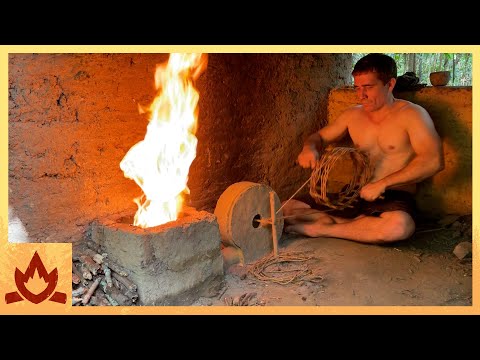
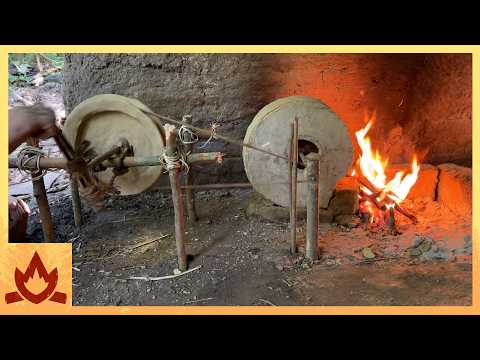
I made a belt and pulley drive to power a blower. Up until now I had been using a rope and stick to spin the fan rotor of the blower. Though this was useable and produced continuous one way rotation, it was unable to reach higher revolutions per minute due to limitations of the drive mechanism. As a result, only low pressure air flow was attainable. This is enough to smelt iron ore to produce a bloom. But it is not solid, with the result being slag with high carbon steel or cast iron droplets instead of a large solid bloom of low carbon iron. A pulley and belt produces continuous rotation and can be geared up with different pulley sizes to produce greater rpm.
I first made a large clay wheel to be cranked by hand and a small one to drive the fan. It worked but had issues due to weight wasn't durable. The small clay wheel worked ok though. The next test was of a cane wheel made by weaving a basket without a base so if formed a cylinder for the belt to wrap around. This worked better and was faster. It sometimes has issues with the frame it's set in though. The final test was with a "floating" version of the cane wheel meaning that it wasn't set in a frame but had 2 handles and was spun while holding with 2 hands. This worked with fewer issues but would not be scalable.
All of the wheels in the video where 25 cm in diameter and gave a ratio of about 1:10 (one hand turn = 10 fan turns). The previous rope stick blower gives about 960 rpm whereas the the pulley and belt might give 1200 if cranked twice per second, though this may be exceeding its limits of durability. A larger diameter wheel of say 50 cm will give 1:20 ratios. Future experiments will need to be done to see if they make a difference to smelting results.
00:00-14:05 Making the parts
14:05-17:34 Clay pulley wheel
17:34-24:54 Cane pulley wheel
24:54-27:48 "Floating" pulley wheel (not fixed to a frame)
About Primitive Technology:
Primitive technology is a hobby where you build things in the wild completely from scratch using no modern tools or materials. These are the strict rules: If you want a fire, use a fire stick - An axe, pick up a stone and shape it - A hut, build one from trees, mud, rocks etc. The challenge is seeing how far you can go without utilizing modern technology. I do not live in the wild, but enjoy building shelter, tools, and more, only utilizing natural materials. To find specific videos, visit my playlist tab for building videos focused on pyrotechnology, shelter, weapons, food & agriculture, tools & machines, and weaving & fiber.
#PrimitiveTechnology #blowers #fire
Charcoal retort experiment
Subscribe: http://bit.ly/subPT | Never miss a video! Enable ‘ALL’ Notifications!
Watch my newest content: https://youtube.com/playlist?list=PLGnWLXjIDnpBR4xqf3FO-xFFwE-ucq4Fj&playnext=1&index=2
Follow Primitive Technology:
Wordpress: https://primitivetechnology.wordpress.com/
Patreon: https://patreon.com/user?u=2945881
Watch More Primitive Technology:
Newest Uploads: https://youtube.com/playlist?list=PLGnWLXjIDnpBR4xqf3FO-xFFwE-ucq4Fj&playnext=1&index=2
Pyrotechnology: https://youtube.com/playlist?list=PLGnWLXjIDnpBVRqu5lz5JGaQxjPs7q3CJ&playnext=1&index=2
Shelter: https://youtube.com/playlist?list=PLGnWLXjIDnpBBsdKZb-vy30o88SIxItp2&playnext=1&index=2
Weapons: https://youtube.com/playlist?list=PLGnWLXjIDnpA-XGDrrmVgBnSXx15i2Awp&playnext=1&index=2
Popular Videos: https://youtube.com/playlist?list=PLGnWLXjIDnpAb29Lrdki5BPjTpMon8zla&playnext=1&index=2
About This Video:
I tested a charcoal retort based on the Hookway retort method using only primitive materials. A normal retort is one in which the sealed chamber of wood is inside a furnace and the heat drives off the volatiles converting it to charcoal. The Hookway retort, invented by James Hookway (see original video: https://www.youtube.com/watch?v=fBYaP5K0AkE ) has furnace, a metal pipe, inside the sealed chamber of wood, so the heat conducts out into the wood converting it to charcoal. In addition to this, escaping volatiles from the wood enter the pipe where they are burnt, adding further heat. After a while, no more wood is added to the furnace as it runs entirely of wood gas.
In my version I made a clay pipe and tested it. It did produce some charcoal but most of the wood remained unburnt. This was due to the poor heat conductivity of the clay pipe relative to the metal pipe of the original. The charcoal it did produce from wood touching the clay pipe directly, was of excellent quality. Another benefit of the design was it did not need sealing of the air entries like a typical charcoal mount. The retort did not become self sustaining on woodgas and needed to be fed with wood for the duration of the burn.
In future I'd try making charcoal in a large clay pot retort inside a furnace. I've done it in a previous video with a 25 cm diameter x 25 cm tall pot and it worked well producing shiny intact charcoal with the only unburnt wood at the bottom of the pot. For a new version I'd make the pot taller but not wider for greater yields. Or I'd simply make charcoal in a pit doused with water which gives poorer quality charcoal but with less time and effort. I've tested doused charcoal before in iron smelting and it seems to give the same yield of iron.
00:00-04:36 Regular charcoal mound
04:36-16:33 Hookway charcoal retort
16:33-19:14 Doused charcoal method
About Primitive Technology:
Primitive technology is a hobby where you build things in the wild completely from scratch using no modern tools or materials. These are the strict rules: If you want a fire, use a fire stick - An axe, pick up a stone and shape it - A hut, build one from trees, mud, rocks etc. The challenge is seeing how far you can go without utilizing modern technology. I do not live in the wild, but enjoy building shelter, tools, and more, only utilizing natural materials. To find specific videos, visit my playlist tab for building videos focused on pyrotechnology, shelter, weapons, food & agriculture, tools & machines, and weaving & fiber.
#PrimitiveTechnology #experiment #survival
Primitive Technology: Re-smelting previously made iron Subscribe: http://bit.ly/subPT | Never miss a video! Enable ‘ALL’ Notifications! Watch my newest content: https://youtube.com/playlist?list=PLGnWLXjIDnpBR4xqf3FO-xFFwE-ucq4Fj&playnext=1&index=2 Follow Primitive...
Primitive Technology: Re-smelting previously made iron
Subscribe: http://bit.ly/subPT | Never miss a video! Enable ‘ALL’ Notifications!
Watch my newest content: https://youtube.com/playlist?list=PLGnWLXjIDnpBR4xqf3FO-xFFwE-ucq4Fj&playnext=1&index=2
Follow Primitive Technology:
Wordpress: https://primitivetechnology.wordpress.com/
Patreon: https://patreon.com/user?u=2945881
Watch More Primitive Technology:
Newest Uploads: https://youtube.com/playlist?list=PLGnWLXjIDnpBR4xqf3FO-xFFwE-ucq4Fj&playnext=1&index=2
Pyrotechnology: https://youtube.com/playlist?list=PLGnWLXjIDnpBVRqu5lz5JGaQxjPs7q3CJ&playnext=1&index=2
Shelter: https://youtube.com/playlist?list=PLGnWLXjIDnpBBsdKZb-vy30o88SIxItp2&playnext=1&index=2
Weapons: https://youtube.com/playlist?list=PLGnWLXjIDnpA-XGDrrmVgBnSXx15i2Awp&playnext=1&index=2
Popular Videos: https://youtube.com/playlist?list=PLGnWLXjIDnpAb29Lrdki5BPjTpMon8zla&playnext=1&index=2
About This Video:
I took the iron I already smelted and re- smelted it. The iron was old and rusty from forging experiments. Iron oxidises faster when in the forge due to the hot and oxidising conditions. So I tried smelting it again to turn the rust back into iron.
The first attempt involved charging the iron into a furnace in a single charge. The results were mixed, the iron was in separated pieces though the iron was softer and could be slightly cold forged.
Next the iron was included in an iron smelt with fresh, roasted ore. 3 charges of ore were charged, then the scrap iron and then another 3 charges of ore. The result was cleaner but the iron was still in separate pieces.
Next, an attempt was made to consolidate the iron in a forge. Bricks were taken off the furnace to reduce its height, to form a forge. The iron was charged into the forge and heated in front of the blast to consolidate it. The iron came together a bit but was still in separate bits. The iron was softer and more malleable though.
Finally, the iron was put in a crucible with iron ore to decarburise it further. The iron was heated and it became absorbed into the slag. Nearly all of the iron was lost as oxide.
I learnt some things from this project. One of the difficulties was not having the iron in one piece as the small pieces of iron tends to get lost in the coals. Next time, I'll likely try a crucible (without iron oxide in it) just to consolidate the freshly made cast iron prills. Once the iron is in one piece, I'll attempt to decarburise it and forge it with light hammer blows.
About Primitive Technology:
Primitive technology is a hobby where you build things in the wild completely from scratch using no modern tools or materials. These are the strict rules: If you want a fire, use a fire stick - An axe, pick up a stone and shape it - A hut, build one from trees, mud, rocks etc. The challenge is seeing how far you can go without utilizing modern technology. I do not live in the wild, but enjoy building shelter, tools, and more, only utilizing natural materials. To find specific videos, visit my playlist tab for building videos focused on pyrotechnology, shelter, weapons, food & agriculture, tools & machines, and weaving & fiber.
#PrimitiveTechnology #iron #smelter