
No full content extracted yet.
Extracting…Digital Signal Processing
active · last success 2026-08-04 10:03
-
-
No full content extracted yet.
Extracting… -

Here, the standard FIR Python filter class is extended by a method which changes the coefficients (= the learning rule). Then 50Hz is removed from an ECG. See the adaptive filter playlist: https://www.youtube.com/watch?v=C0qUQNwP6SY&list=PLxWwb-b9LnpAtV3arjkyl3ltE2sMyTzEl
Here, the standard FIR Python filter class is extended by a method which changes the coefficients (= the learning rule). Then 50Hz is removed from an ECG. See the adaptive filter playlist: https://www.youtube.com/watch?v=C0qUQNwP6SY&list=PLxWwb-b9LnpAtV3arjkyl3ltE2sMyTzEl -

With the help of the gradient descent we derive the learning rule how the coefficients are changed so that the average error is minimised.
With the help of the gradient descent we derive the learning rule how the coefficients are changed so that the average error is minimised. -

Adaptive FIR filters are filters where the coefficients are changing while the filter is operating. It's aim is to minimise the average error between a desired signal and its output.
Adaptive FIR filters are filters where the coefficients are changing while the filter is operating. It's aim is to minimise the average error between a desired signal and its output. -

In practical applications the number of samples is finite so you'll have a limited number of samples at hand. This leads to certain limitations which are discussed.
In practical applications the number of samples is finite so you'll have a limited number of samples at hand. This leads to certain limitations which are discussed. -

I've compared a few microphones / techniques when recording lectures. Microphones: BPHS1 (pro headset), AKG451 (pro radio moderator mic), PC310 (gaming headset), Clip on mic (as used in lecture theatres) and the dreaded mic in a laptop. The single most important rule is to...
I've compared a few microphones / techniques when recording lectures. Microphones: BPHS1 (pro headset), AKG451 (pro radio moderator mic), PC310 (gaming headset), Clip on mic (as used in lecture theatres) and the dreaded mic in a laptop. The single most important rule is to keep the distance between microphone and speaker below 20cm. Ideally less. Anything else are myths! Happy recording. -
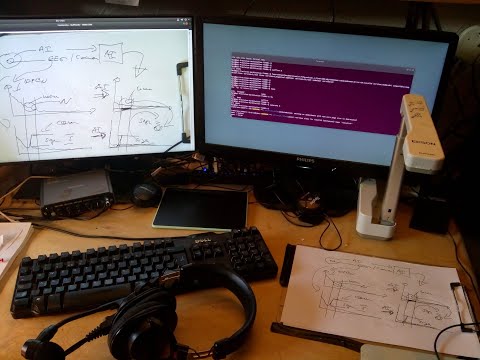
In this clip I describe how I've made the online lectures of this DSP class. I've been using an EPSON ELPDC06 visualiser for this purpose. More info here: http://berndporr.blogspot.com/2018/04/blended-learning.html Bernd Porr
In this clip I describe how I've made the online lectures of this DSP class. I've been using an EPSON ELPDC06 visualiser for this purpose. More info here: http://berndporr.blogspot.com/2018/04/blended-learning.html Bernd Porr -

This howto shows you how to record with zoom by doing a zoom meeting with yourself, enabling screen sharing and then off you go! Bernd Porr.
This howto shows you how to record with zoom by doing a zoom meeting with yourself, enabling screen sharing and then off you go! Bernd Porr. -

https://github.com/berndporr/iir_fixed_point The C++ demo simulates a realtime process in reading integer ECG data from a file and then processing it sample by sample by our two biquad filters.
https://github.com/berndporr/iir_fixed_point The C++ demo simulates a realtime process in reading integer ECG data from a file and then processing it sample by sample by our two biquad filters. -

The coefficients are calculated with the help of Python high level commands. They all directly generate 2nd order pole/zero pairs so that these can be copy/pasted into the filter C++ class.
The coefficients are calculated with the help of Python high level commands. They all directly generate 2nd order pole/zero pairs so that these can be copy/pasted into the filter C++ class. -

https://github.com/berndporr/iir_fixed_point The C++ implementation of the Direct Form Type I filter is completely kept in a header file so that no library is generated and the C++ compiler can in the best case inline the filter function to speed up calculations.
https://github.com/berndporr/iir_fixed_point The C++ implementation of the Direct Form Type I filter is completely kept in a header file so that no library is generated and the C++ compiler can in the best case inline the filter function to speed up calculations. -
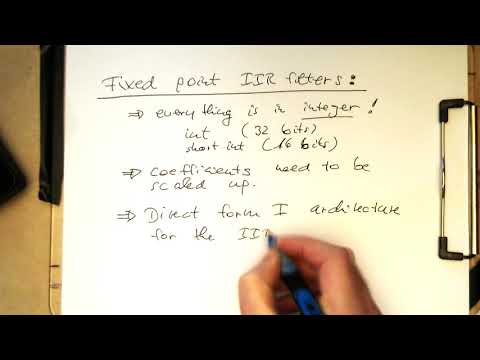
Fixed point IIR filters just use integers for all operations. The coefficients are scaled up so that they use the full dynamic range of the integer coefficients but won't create overflows in the accumulator.
Fixed point IIR filters just use integers for all operations. The coefficients are scaled up so that they use the full dynamic range of the integer coefficients but won't create overflows in the accumulator. -

Fixed point IIR filters can be implemented by creating a chain of 2nd order filters which are implemented as Direct Form I filters.
Fixed point IIR filters can be implemented by creating a chain of 2nd order filters which are implemented as Direct Form I filters. -
Scipy has a large selection of high level filter commands.
- End of feed

