• maiweb v0.1.0
  • ★
  • Feedback

Akash Murthy

active · last success 2026-06-18 23:29

Visit site ↗ · Feed ↗

  • Akash Murthy youtube.com audio-and-video channel video youtube 2023-12-26 09:00
    ↗

    In this video, we'll take a look at how a linear phase filter preserves the shape of a waveform in the time domain. We'll look at the phase response plot in detail and see the difference between an IIR filter and a linear phase FIR filter in action. Find the full playlist...

    ▶ Watch on YouTube Opens in a new tab
    In this video, we'll take a look at how a linear phase filter preserves the shape of a waveform in the time domain. We'll look at the phase response plot in detail and see the difference between an IIR filter and a linear phase FIR filter in action. Find the full playlist here: https://www.youtube.com/watch?v=Qmd685msY-Y&list=PLbqhA-NKGP6Afr_KbPUuy_yIBpPR4jzWo Repository: https://github.com/Thrifleganger/filter-basics References: David Dorran - Why linear phase filters are used - https://www.youtube.com/watch?v=xPTe7ZWLVhQ Digital Filters: A Practical guide, David Dorran http://dx.doi.org/10.13140/RG.2.2.26017.48486 In this series on Digital Filter Basics, we'll take a slow and cemented dive into the fascinating world of digital filter theory. Many resources present this topic with dense and exhausting mathematics. Although a fair understanding of complex mathematics is required to fully comprehend the science of filter design, understanding the basics of filters and how they fundamentally work is better left to analysis and visualizations, which I try to do in this series. We'll learn about feedforward and feedback filter topologies, impulse and impulse responses and and wide variety of other topics. If you've got any questions, suggestions or recommendations, type them out here, or send me a message on any of my social channels mentioned below. A lot of time was spent on creating this series, and I plan to do more. So please consider subscribing if you wish to be notified about more releases in the future. And if you feel generous: https://www.patreon.com/akashmurthy Check out my music here: https://farfetchd-official.bandcamp.com/ Check out the audio track in the intro and outro here: https://soundcloud.com/thrifleganger/tinderbox Give me a shout here: Website - https://www.akashmurthy.com/ Facebook - https://www.facebook.com/akash.murthy.319 Instagram - https://www.instagram.com/thrifleganger/
  • Akash Murthy youtube.com audio-and-video channel video youtube 2023-12-25 18:15
    ↗

    ▶ Watch on YouTube Opens in a new tab

    No full content extracted yet.

    Extracting…
  • Akash Murthy youtube.com audio-and-video channel video youtube 2023-12-11 08:00
    ↗

    In this video, we'll subject an impulse signal through a first order feedback filter to get an impulse response, and we'll see why this response is called an infinite impulse response and what makes a filter unstable. We'll then briefly talk about the zeros and poles of a...

    ▶ Watch on YouTube Opens in a new tab
    In this video, we'll subject an impulse signal through a first order feedback filter to get an impulse response, and we'll see why this response is called an infinite impulse response and what makes a filter unstable. We'll then briefly talk about the zeros and poles of a filter, and make a simple modification to create a p-z filter. We'll end the discussion with the advantages and disadvantages on an IIR filter. Find the full playlist here: https://www.youtube.com/watch?v=Qmd685msY-Y&list=PLbqhA-NKGP6Afr_KbPUuy_yIBpPR4jzWo Content: 0:00 Impulse response 4:42 Poles and zeroes 8:41 p-z filter 9:27 Direct form 1 and 2 10:23 Bi-quads / Advantages 13:02 Disadvantages Repository: https://github.com/Thrifleganger/filter-basics References: Designing Audio Effect Plugins in C++, Will C. Pirkle - https://www.willpirkle.com/about/books/ Digital Filters: A Practical guide, David Dorran http://dx.doi.org/10.13140/RG.2.2.26017.48486 In this series on Digital Filter Basics, we'll take a slow and cemented dive into the fascinating world of digital filter theory. Many resources present this topic with dense and exhausting mathematics. Although a fair understanding of complex mathematics is required to fully comprehend the science of filter design, understanding the basics of filters and how they fundamentally work is better left to analysis and visualizations, which I try to do in this series. We'll learn about feedforward and feedback filter topologies, impulse and impulse responses and and wide variety of other topics. If you've got any questions, suggestions or recommendations, type them out here, or send me a message on any of my social channels mentioned below. A lot of time was spent on creating this series, and I plan to do more. So please consider subscribing if you wish to be notified about more releases in the future. And if you feel generous: https://www.patreon.com/akashmurthy Check out my music here: https://farfetchd-official.bandcamp.com/ Check out the audio track in the intro and outro here: https://soundcloud.com/thrifleganger/tinderbox Give me a shout here: Website - https://www.akashmurthy.com/ Facebook - https://www.facebook.com/akash.murthy.319 Instagram - https://www.instagram.com/thrifleganger/
  • Akash Murthy youtube.com audio-and-video channel video youtube 2023-12-05 08:00
    ↗

    In this video, we'll talk about the feedback topology and discover how choosing different coefficients can result in wildly different frequency responses and the idea that a filter can now be unstable for certain values and what that means in reality. Find the full playlist...

    ▶ Watch on YouTube Opens in a new tab
    In this video, we'll talk about the feedback topology and discover how choosing different coefficients can result in wildly different frequency responses and the idea that a filter can now be unstable for certain values and what that means in reality. Find the full playlist here: https://www.youtube.com/watch?v=Qmd685msY-Y&list=PLbqhA-NKGP6Afr_KbPUuy_yIBpPR4jzWo Content: 0:00 Feedback topology 1:52 Difference equation 4:17 Feedback filter plugin demo 6:21 Time domain response of filter to different frequencies 7:16 Negative b1 coefficient 9:26 Filter instability 11:39 Positive b1 coefficient Repository: https://github.com/Thrifleganger/filter-basics References: Designing Audio Effect Plugins in C++, Will C. Pirkle - https://www.willpirkle.com/about/books/ Introduction to Digital Filters, Julius O. Smith - https://ccrma.stanford.edu/~jos/filters/ In this series on Digital Filter Basics, we'll take a slow and cemented dive into the fascinating world of digital filter theory. Many resources present this topic with dense and exhausting mathematics. Although a fair understanding of complex mathematics is required to fully comprehend the science of filter design, understanding the basics of filters and how they fundamentally work is better left to analysis and visualizations, which I try to do in this series. We'll learn about feedforward and feedback filter topologies, impulse and impulse responses and and wide variety of other topics. If you've got any questions, suggestions or recommendations, type them out here, or send me a message on any of my social channels mentioned below. A lot of time was spent on creating this series, and I plan to do more. So please consider subscribing if you wish to be notified about more releases in the future. And if you feel generous: https://www.patreon.com/akashmurthy Check out my music here: https://farfetchd-official.bandcamp.com/ Check out the audio track in the intro and outro here: https://soundcloud.com/thrifleganger/tinderbox Give me a shout here: Website - https://www.akashmurthy.com/ Facebook - https://www.facebook.com/akash.murthy.319 Instagram - https://www.instagram.com/thrifleganger/
  • Akash Murthy youtube.com audio-and-video channel video youtube 2023-08-28 07:00
    ↗

    In this video, we'll implement text scrolling / text marquee on a JUCE Label. Quite often we find that dynamic text used in fixed sized labels are too big to be entirely visible within the label. JUCE automatically uses ellipses to indicate that more text is preset, but...

    ▶ Watch on YouTube Opens in a new tab
    In this video, we'll implement text scrolling / text marquee on a JUCE Label. Quite often we find that dynamic text used in fixed sized labels are too big to be entirely visible within the label. JUCE automatically uses ellipses to indicate that more text is preset, but there's no way of reveal the rest of the text. The ScollableLabel class that we develop during the video will reveal the rest of text on mouse hover. 0:00 Introduction 4:25 ScrollableLabel implementation 19:19 Ease in - ease out 24:32 Control animation speed To follow along with this coding tutorial, you'll need a C++ compiler installed, an IDE of your choice (Visual Studio, Xcode) and JUCE framework installed, along with Projucer. Find the source code here: https://github.com/Thrifleganger/juce-snippets/tree/master/TextScrolling If you've got any questions, suggestions or recommendations, type them out here, or send me a message on any of my social channels mentioned below. A lot of time was spent on creating this series, and I plan to do more. So please consider subscribing if you wish to be notified about more releases in the future. And if you feel generous: https://www.patreon.com/akashmurthy Check out my music here: https://farfetchd-official.bandcamp.com/ Give me a shout here: Website - https://akashmurthy.com Facebook - https://www.facebook.com/akash.murthy.319 Instagram - https://www.instagram.com/thrifleganger/
  • Akash Murthy youtube.com audio-and-video channel video youtube 2022-12-26 09:30
    ↗

    In this video, we'll finish off the analysis of the feedforward topology by passing an impulse signal through and we'll see why a purely feedforward filter is a finite impulse response filter on an FIR filter. Find the full playlist here:...

    ▶ Watch on YouTube Opens in a new tab
    In this video, we'll finish off the analysis of the feedforward topology by passing an impulse signal through and we'll see why a purely feedforward filter is a finite impulse response filter on an FIR filter. Find the full playlist here: https://www.youtube.com/watch?v=Qmd685msY-Y&list=PLbqhA-NKGP6Afr_KbPUuy_yIBpPR4jzWo Content: 0:00 Impulse signal analysis 2:29 Finite impulse response 3:51 Python code 9:50 FIR filter plugin 11:36 Conclusion Repository: https://github.com/Thrifleganger/filter-basics References: Designing Audio Effect Plugins in C++, Will C. Pirkle - https://www.willpirkle.com/about/books/ Introduction to Digital Filters, Julius O. Smith - https://ccrma.stanford.edu/~jos/filters/ In this series on Digital Filter Basics, we'll take a slow and cemented dive into the fascinating world of digital filter theory. Many resources present this topic with dense and exhausting mathematics. Although a fair understanding of complex mathematics is required to fully comprehend the science of filter design, understanding the basics of filters and how they fundamentally work is better left to analysis and visualizations, which I try to do in this series. We'll learn about feedforward and feedback filter topologies, impulse and impulse responses and and wide variety of other topics. If you've got any questions, suggestions or recommendations, type them out here, or send me a message on any of my social channels mentioned below. A lot of time was spent on creating this series, and I plan to do more. So please consider subscribing if you wish to be notified about more releases in the future. And if you feel generous: https://www.patreon.com/akashmurthy Check out my music here: https://farfetchd-official.bandcamp.com/ Check out the audio track in the intro and outro here: https://soundcloud.com/thrifleganger/tinderbox Give me a shout here: Website - https://www.akashmurthy.com/ Facebook - https://www.facebook.com/akash.murthy.319 Instagram - https://www.instagram.com/thrifleganger/
  • Akash Murthy youtube.com audio-and-video channel video youtube 2022-12-16 09:53
    ↗

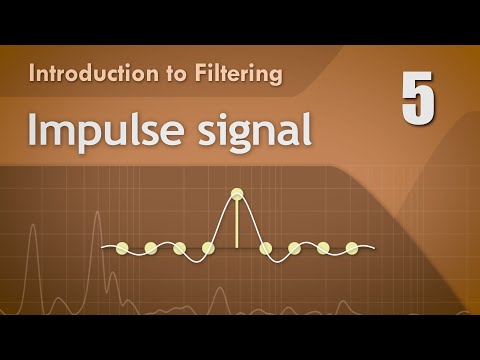
    In this video, we'll take a step back and look at the impulse signal and all the intricacies behind it. We'll learn that an impulse signal contains sinusoids of all possible frequencies and build our intuition towards this fact with the help of some python code. We'll look at...

    ▶ Watch on YouTube Opens in a new tab
    In this video, we'll take a step back and look at the impulse signal and all the intricacies behind it. We'll learn that an impulse signal contains sinusoids of all possible frequencies and build our intuition towards this fact with the help of some python code. We'll look at another mathematical function called the sinc function and see how the sinc function in continuous time is equivalent to the impulse signal in discrete time. Find the full playlist here: https://www.youtube.com/watch?v=Qmd685msY-Y&list=PLbqhA-NKGP6Afr_KbPUuy_yIBpPR4jzWo Content: 0:00 Introduction 1:14 Generating impulse 3:41 Intuition 7:02 Sinc function 9:43 Conclusion Repository: https://github.com/Thrifleganger/filter-basics/blob/master/Python/Impulse%20signal.ipynb References: Designing Audio Effect Plugins in C++, Will C. Pirkle - https://www.willpirkle.com/about/books/ Introduction to Digital Filters, Julius O. Smith - https://ccrma.stanford.edu/~jos/filters/ David Dorran - Intro to the impulse signal - https://www.youtube.com/watch?v=GuL7gllicX4 In this series on Digital Filter Basics, we'll take a slow and cemented dive into the fascinating world of digital filter theory. Many resources present this topic with dense and exhausting mathematics. Although a fair understanding of complex mathematics is required to fully comprehend the science of filter design, understanding the basics of filters and how they fundamentally work is better left to analysis and visualizations, which I try to do in this series. We'll learn about feedforward and feedback filter topologies, impulse and impulse responses and and wide variety of other topics. If you've got any questions, suggestions or recommendations, type them out here, or send me a message on any of my social channels mentioned below. A lot of time was spent on creating this series, and I plan to do more. So please consider subscribing if you wish to be notified about more releases in the future. And if you feel generous: https://www.patreon.com/akashmurthy Check out my music here: https://farfetchd-official.bandcamp.com/ Check out the audio track in the intro and outro here: https://soundcloud.com/thrifleganger/tinderbox Give me a shout here: Website - https://www.akashmurthy.com/ Facebook - https://www.facebook.com/akash.murthy.319 Instagram - https://www.instagram.com/thrifleganger/
  • Akash Murthy youtube.com audio-and-video channel video youtube 2022-12-09 09:00
    ↗

    In this video, we'll take a look at feedforward filters, a simple filter topology that let's us get into the concept of finite impulse response. We'll subject a simple 1st order feedforward filter to a few control signal and analytically look at the response of the filter and...

    ▶ Watch on YouTube Opens in a new tab
    In this video, we'll take a look at feedforward filters, a simple filter topology that let's us get into the concept of finite impulse response. We'll subject a simple 1st order feedforward filter to a few control signal and analytically look at the response of the filter and plot its response. Find the full playlist here: https://www.youtube.com/watch?v=Qmd685msY-Y&list=PLbqhA-NKGP6Afr_KbPUuy_yIBpPR4jzWo Content: 0:00 Feedforward topology 2:58 DC signal analysis 5:36 Nyquist signal analysis 7:31 1/2 Nyquist signal analysis 11:10 1/4 Nyquist signal analysis 12:32 Frequency response 14:10 Phase response References: Designing Audio Effect Plugins in C++, Will C. Pirkle - https://www.willpirkle.com/about/books/ Introduction to Digital Filters, Julius O. Smith - https://ccrma.stanford.edu/~jos/filters/ In this series on Digital Filter Basics, we'll take a slow and cemented dive into the fascinating world of digital filter theory. Many resources present this topic with dense and exhausting mathematics. Although a fair understanding of complex mathematics is required to fully comprehend the science of filter design, understanding the basics of filters and how they fundamentally work is better left to analysis and visualizations, which I try to do in this series. We'll learn about feedforward and feedback filter topologies, impulse and impulse responses and and wide variety of other topics. If you've got any questions, suggestions or recommendations, type them out here, or send me a message on any of my social channels mentioned below. A lot of time was spent on creating this series, and I plan to do more. So please consider subscribing if you wish to be notified about more releases in the future. And if you feel generous: https://www.patreon.com/akashmurthy Check out my music here: https://farfetchd-official.bandcamp.com/ Check out the audio track in the intro and outro here: https://soundcloud.com/thrifleganger/tinderbox Give me a shout here: Website - https://www.akashmurthy.com/ Facebook - https://www.facebook.com/akash.murthy.319 Instagram - https://www.instagram.com/thrifleganger/
  • Akash Murthy youtube.com audio-and-video channel video youtube 2022-12-02 09:00
    ↗

    In this video, we'll look at the different test signals we'd want to subject our theoretical filter with, including a DC signal, Nyquist signal, Impulse signal and a couple others in between. Later in the video, we'll look at the notations that we'd be using to describe...

    ▶ Watch on YouTube Opens in a new tab
    In this video, we'll look at the different test signals we'd want to subject our theoretical filter with, including a DC signal, Nyquist signal, Impulse signal and a couple others in between. Later in the video, we'll look at the notations that we'd be using to describe signals, and the algorithmic building blocks used to construct any filter - a delay element, a scalar multiplier and an adder. Find the full playlist here: https://www.youtube.com/watch?v=Qmd685msY-Y&list=PLbqhA-NKGP6Afr_KbPUuy_yIBpPR4jzWo Content: 0:00 Introduction 1:23 DC/0Hz signal 2:13 Nyquist signal 3:47 1/2 Nyquist signal 4:02 1/4 Nyquist signal 4:30 Impulse signal 5:57 Notations 7:30 Algorithmic blocks References: Designing Audio Effect Plugins in C++, Will C. Pirkle - https://www.willpirkle.com/about/books/ Introduction to Digital Filters, Julius O. Smith - https://ccrma.stanford.edu/~jos/filters/ In this series on Digital Filter Basics, we'll take a slow and cemented dive into the fascinating world of digital filter theory. Many resources present this topic with dense and exhausting mathematics. Although a fair understanding of complex mathematics is required to fully comprehend the science of filter design, understanding the basics of filters and how they fundamentally work is better left to analysis and visualizations, which I try to do in this series. We'll learn about feedforward and feedback filter topologies, impulse and impulse responses and and wide variety of other topics. If you've got any questions, suggestions or recommendations, type them out here, or send me a message on any of my social channels mentioned below. A lot of time was spent on creating this series, and I plan to do more. So please consider subscribing if you wish to be notified about more releases in the future. And if you feel generous: https://www.patreon.com/akashmurthy Check out my music here: https://farfetchd-official.bandcamp.com/ Check out the audio track in the intro and outro here: https://soundcloud.com/thrifleganger/tinderbox Give me a shout here: Website - https://www.akashmurthy.com/ Facebook - https://www.facebook.com/akash.murthy.319 Instagram - https://www.instagram.com/thrifleganger/
  • Akash Murthy youtube.com audio-and-video channel video youtube 2022-11-25 09:00
    ↗

    We'll look at what a filter is, and narrow our focus on digital filters. We'll look at ways of analyzing the behavior of a filter by studying the characteristics of the filter, it's frequency and phase response. Find the full playlist here:...

    ▶ Watch on YouTube Opens in a new tab
    We'll look at what a filter is, and narrow our focus on digital filters. We'll look at ways of analyzing the behavior of a filter by studying the characteristics of the filter, it's frequency and phase response. Find the full playlist here: https://www.youtube.com/watch?v=Qmd685msY-Y&list=PLbqhA-NKGP6Afr_KbPUuy_yIBpPR4jzWo Content: 0:00 What is a filter? 1:56 Frequency response 6:08 Phase response References: Designing Audio Effect Plugins in C++, Will C. Pirkle - https://www.willpirkle.com/about/books/ Introduction to Digital Filters, Julius O. Smith - https://ccrma.stanford.edu/~jos/filters/ Video references Vowels: https://www.youtube.com/watch?v=J3TwTb-T044 Mic Pickup patterns: https://www.youtube.com/watch?v=keBa2ocQInI Graphic EQ: https://www.youtube.com/watch?v=JQaMxxjVp2U Room acoustics: https://www.youtube.com/watch?v=pqRw1K8qxX4 In this series on Digital Filter Basics, we'll take a slow and cemented dive into the fascinating world of digital filter theory. Many resources present this topic with dense and exhausting mathematics. Although a fair understanding of complex mathematics is required to fully comprehend the science of filter design, understanding the basics of filters and how they fundamentally work is better left to analysis and visualizations, which I try to do in this series. We'll learn about feedforward and feedback filter topologies, impulse and impulse responses and and wide variety of other topics. If you've got any questions, suggestions or recommendations, type them out here, or send me a message on any of my social channels mentioned below. A lot of time was spent on creating this series, and I plan to do more. So please consider subscribing if you wish to be notified about more releases in the future. And if you feel generous: https://www.patreon.com/akashmurthy Check out my music here: https://farfetchd-official.bandcamp.com/ Check out the audio track in the intro and outro here: https://soundcloud.com/thrifleganger/tinderbox Give me a shout here: Website - https://www.akashmurthy.com/ Facebook - https://www.facebook.com/akash.murthy.319 Instagram - https://www.instagram.com/thrifleganger/
  • Akash Murthy youtube.com audio-and-video channel video youtube 2022-11-24 09:37
    ↗

    In this series on Digital Filter Basics, we'll take a slow and cemented dive into the fascinating world of digital filter theory. Many resources present this topic with dense and exhausting mathematics. Although a fair understanding of complex mathematics is required to fully...

    ▶ Watch on YouTube Opens in a new tab
    In this series on Digital Filter Basics, we'll take a slow and cemented dive into the fascinating world of digital filter theory. Many resources present this topic with dense and exhausting mathematics. Although a fair understanding of complex mathematics is required to fully comprehend the science of filter design, understanding the basics of filters and how they fundamentally work is better left to analysis and visualizations, which I try to do in this series. Find the full playlist here: https://www.youtube.com/watch?v=Qmd685msY-Y&list=PLbqhA-NKGP6Afr_KbPUuy_yIBpPR4jzWo References: Designing Audio Effect Plugins in C++, Will C. Pirkle - https://www.willpirkle.com/about/books/ Introduction to Digital Filters, Julius O. Smith - https://ccrma.stanford.edu/~jos/filters/ If you've got any questions, suggestions or recommendations, type them out here, or send me a message on any of my social channels mentioned below. A lot of time was spent on creating this series, and I plan to do more. So please consider subscribing if you wish to be notified about more releases in the future. And if you feel generous: https://www.patreon.com/akashmurthy Check out my music here: https://farfetchd-official.bandcamp.com/ Check out the audio track in the intro and outro here: https://soundcloud.com/thrifleganger/tinderbox Give me a shout here: Website - https://www.akashmurthy.com/ Facebook - https://www.facebook.com/akash.murthy.319 Instagram - https://www.instagram.com/thrifleganger/
  • Akash Murthy youtube.com audio-and-video channel video youtube 2022-07-25 08:00
    ↗

    In this video, we'll learn how to rescale and resize already existing plugins which have raster images and assets and have components with absolute positioning. It's an easy way to convert a project of any size or complexity to a resizable app, while maintaining aspect ratio...

    ▶ Watch on YouTube Opens in a new tab
    In this video, we'll learn how to rescale and resize already existing plugins which have raster images and assets and have components with absolute positioning. It's an easy way to convert a project of any size or complexity to a resizable app, while maintaining aspect ratio and imposing size limits. 0:00 Introduction 2:56 A look at the project 4:14 An overview of the solution 5:43 Coding the solution 14:35 Saving state of scaleFactor To follow along with this coding tutorial, you'll need a C++ compiler installer, an IDE of your choice (Visual Studio, Xcode) and JUCE framework installed, along with Projucer. I'll have a starter series on how to get started with JUCE soon, but you can find plenty of tutorials on their website and on YouTube. An introduction to JUCE and plugin development: (TBD) Find the source code here: https://github.com/Thrifleganger/resizable-plugin-window-demo Background image of plugin: https://www.pexels.com/photo/timelapse-photography-of-stars-at-night-169789/ If you've got any questions, suggestions or recommendations, type them out here, or send me a message on any of my social channels mentioned below. A lot of time was spent on creating this series, and I plan to do more. So please consider subscribing if you wish to be notified about more releases in the future. And if you feel generous: https://www.patreon.com/akashmurthy Check out my music here: https://farfetchd-official.bandcamp.com/ Give me a shout here: Website - https://akashmurthy.com Facebook - https://www.facebook.com/akash.murthy.319 Instagram - https://www.instagram.com/thrifleganger/
  • Akash Murthy youtube.com audio-and-video channel video youtube 2022-07-14 08:00
    ↗

    In this video, we'll discuss the widely used metric of RMS (Root Mean Square) calculations and fully understand the origins of the value, why it's needed in the first place in the domains of analog signals and what it means in the context of audio signals. Find the full...

    ▶ Watch on YouTube Opens in a new tab
    In this video, we'll discuss the widely used metric of RMS (Root Mean Square) calculations and fully understand the origins of the value, why it's needed in the first place in the domains of analog signals and what it means in the context of audio signals. Find the full playlist here: https://www.youtube.com/playlist?list=PLbqhA-NKGP6DAkB4eYDsnNMQh9a9nvQh9 Content: 00:00 Introduction 02:12 Electrical theory 06:16 RMS equation and value of sinusoid 08:23 RMS value of a triangle wave 08:49 RMS value of a square wave 09:30 RMS in the context of audio Desmos calculator for Sinusoids: https://www.desmos.com/calculator/2bi14lav80 Triangle wave: https://www.desmos.com/calculator/gkplzivdrc Square wave: https://www.desmos.com/calculator/ldbyng8rcm References: Audio Metering; Measurements, Standards, and Practice; Third edition Media used: Compressed metal: Higher Octane - Vans in Japan (Royalty Free from YouTube Music catalog) Uncompressed drums: Paweł Mąciwoda - One Of The First (Unmixed) In this module on Loudness and Level we'll delve into how our sense of loudness is different for different frequencies and all the nuances associated with hearing. We'll look at level, and the technical ways of measuring and calculating the amplitude of signals. And finally we’ll look at a new way of measuring loudness that’s all the rage at the moment, the Loudness unit. It has redefined the standard used in streaming and broadcast, and promises to bring an end to the age of super compressed audio and the so-called loudness war. If you've got any questions, suggestions or recommendations, type them out here, or send me a message on any of my social channels mentioned below. A lot of time was spent on creating this series, and I plan to do more. So please consider subscribing if you wish to be notified about more releases in the future. And if you feel generous: https://www.patreon.com/akashmurthy Check out the audio track in the intro and outro here: https://soundcloud.com/thrifleganger/tinderbox Check out my music here: https://farfetchd-official.bandcamp.com/ Give me a shout here: My website - https://www.akashmurthy.com/ Facebook - https://www.facebook.com/akash.murthy.319 Instagram - https://www.instagram.com/thrifleganger/
  • Akash Murthy youtube.com audio-and-video channel video youtube 2022-07-04 10:10
    ↗

    We'll delve into the electronic representation of sound, i.e audio signals. We'll look at how audio signals are represented electronically, and ask the question, how large an audio signal is. We'll discuss some of the characteristics and properties of signals, including the...

    ▶ Watch on YouTube Opens in a new tab
    We'll delve into the electronic representation of sound, i.e audio signals. We'll look at how audio signals are represented electronically, and ask the question, how large an audio signal is. We'll discuss some of the characteristics and properties of signals, including the peak value, peak-to-peak value and average value. Find the full playlist here: https://www.youtube.com/playlist?list=PLbqhA-NKGP6DAkB4eYDsnNMQh9a9nvQh9 Content: 00:00 Sound vs audio 02:27 Peak value 03:00 Peak-to-peak value 03:49 Average value 05:24 Average visualized Desmos calculator: https://www.desmos.com/calculator/pvb4yy3rpk References: Audio Metering; Measurements, Standards, and Practice; Third edition https://www.electricaltechnology.org/2019/05/rms-value-average-value-peak-value-instantiations-value-form-factor-peak-factor.html In this module on Loudness and Level we'll delve into how our sense of loudness is different for different frequencies and all the nuances associated with hearing. We'll look at level, and the technical ways of measuring and calculating the amplitude of signals. And finally we’ll look at a new way of measuring loudness that’s all the rage at the moment, the Loudness unit. It has redefined the standard used in streaming and broadcast, and promises to bring an end to the age of super compressed audio and the so-called loudness war. If you've got any questions, suggestions or recommendations, type them out here, or send me a message on any of my social channels mentioned below. A lot of time was spent on creating this series, and I plan to do more. So please consider subscribing if you wish to be notified about more releases in the future. And if you feel generous: https://www.patreon.com/akashmurthy Check out the audio track in the intro and outro here: https://soundcloud.com/thrifleganger/tinderbox Check out my music here: https://farfetchd-official.bandcamp.com/ Give me a shout here: My website - https://www.akashmurthy.com/ Facebook - https://www.facebook.com/akash.murthy.319 Instagram - https://www.instagram.com/thrifleganger/
  • Akash Murthy youtube.com audio-and-video channel video youtube 2022-01-04 14:30
    ↗

    In this video, we learn about the elusive, and often confusing topic of subnormal or denormal numbers in the floating point range. We'll learn that the floating point format is a real oddity, it’s full of interesting nuances. A large portion of the numbers, normalized numbers...

    ▶ Watch on YouTube Opens in a new tab
    In this video, we learn about the elusive, and often confusing topic of subnormal or denormal numbers in the floating point range. We'll learn that the floating point format is a real oddity, it’s full of interesting nuances. A large portion of the numbers, normalized numbers are logarithmically spaced out, with floating point representation and precision, and then a small subset of numbers, denormalized numbers are linearly spaced out, with fixed point representation. Watch the full playlist here: https://www.youtube.com/playlist?list=PLbqhA-NKGP6Deb72dGjrwxM0_9lHkKqD_ Content: 0:00 Logarithmic scale 2:33 The island of zero 3:50 Coding 1 7:06 Subnormal representation 9:42 Coding 2 13:18 Conclusion References: https://en.wikipedia.org/wiki/Subnormal_number Floating Point Calculator - https://www.h-schmidt.net/FloatConverter/IEEE754.html The story behind the IEEE 754 format, it's a great read! - https://bit.ly/3sLGSLf Intel SSE Flush to Zero flag - https://intel.ly/32KkbMJ This series describes the 2 fundamental formats for expressing numbers and audio data in the digital domain - fixed point format and floating point format. They both have their advantages, their areas of usage where they absolutely shine, and they both fall short or completely fail in other aspects. There is no one over the other. As audio and DSP enthusiasts, you'd need to know what where a particular format is preferred and under what circumstances they fall short. Why do digital playback hardware prefer fixed point number format. Why do DAW softwares prefer to work with floating point numbers? What even is a double precision number? And what number format do you use when implementing a DSP algorithm. The series will address these questions and a lot more. If you've got any questions, suggestions or recommendations, type them out here, or send me a message on any of my social channels mentioned below. A lot of time was spent on creating this series, and I plan to do more. So please consider subscribing if you wish to be notified about more releases in the future. And if you feel generous: https://www.patreon.com/akashmurthy Check out my music here: https://farfetchd-official.bandcamp.com/ Check out the audio track in the intro and outro here: https://soundcloud.com/thrifleganger/tinderbox Give me a shout here: Website - https://akashmurthy.com Facebook - https://www.facebook.com/akash.murthy.319 Instagram - https://www.instagram.com/thrifleganger/
  • End of feed
Maibook — your private personalized AI community
  • rcanand.com
  • mlaillc.com
  • @rcanand (X)
  • LinkedIn
  • Feedback
  • Credits