
A talk from AI Engineer Melbourne https://webdirections.org/ai-engineer/ .
Jeremy Howard
active · last success 2026-08-04 14:00
-
-
No full content extracted yet.
Extracting… -

Watch Jeremy Howard close-read a chapter of Eric Ries's latest book in a way that was impossible until a few months ago. Using an LLM, Jeremy sets up necessary context and shows how to create handoff notes to maintain continuity across chapters. He follows rabbit holes that...
Watch Jeremy Howard close-read a chapter of Eric Ries's latest book in a way that was impossible until a few months ago. Using an LLM, Jeremy sets up necessary context and shows how to create handoff notes to maintain continuity across chapters. He follows rabbit holes that interest him, seeks counterexamples when skeptical, and asks how the principles from the book can apply to his own startup. Jeremy shares his process with Eric and they both reflect on the experience. 00:00 - Context engineering 02:30 - Hierarchical context 07:00 - Curiosity-driven exploration 12:00 - Personalized application 17:30 - Following the thread 25:00 - Skeptical verification 33:30 - Good-faith skepticism 35:00 - Session continuity 39:30 - Concept exploration 42:30 - Meta-reflection This was part of a lesson in the How to Solve It With Code fast.ai course. Find out more here: https://solve.it.com/ Eric Ries's upcoming book, Incorruptible: https://www.simonandschuster.com/books/Incorruptible/Eric-Ries/9798893311860 -

Using Yann LeCun's LeJEPA paper as an example, Jonno Whittaker walks through his process for how to read an academic paper with an LLM. He sets up the needed context, loads the paper, and then asks for summaries and explanations. Tools allow him to explore the source code...
Using Yann LeCun's LeJEPA paper as an example, Jonno Whittaker walks through his process for how to read an academic paper with an LLM. He sets up the needed context, loads the paper, and then asks for summaries and explanations. Tools allow him to explore the source code repo from within the LLM environment. He concludes by building a simple interactive demo in order to develop intuition for the ideas in the paper. 00:00 - Set up context 00:44 - Background on the paper 09:56 - Ask for summaries and targeted explanations 11:19 - Try the code from the paper 13:44 - Use file tools to explore the source repo 15:06 - Build a minimal interactive demo to develop intuition 17:00 - Iterate This was part of a lesson in the How to Solve It With Code fast.ai course. Find out more here: https://solve.it.com/ -

Chris Lattner (creator of LLVM, Swift, and Mojo) and I (Jeremy Howard) discuss why rushing to AI-generated code might be destroying the craftsmanship needed to build software that lasts. When CEOs brag about 10,000 lines of AI code per day, are we racing toward a future where...
Chris Lattner (creator of LLVM, Swift, and Mojo) and I (Jeremy Howard) discuss why rushing to AI-generated code might be destroying the craftsmanship needed to build software that lasts. When CEOs brag about 10,000 lines of AI code per day, are we racing toward a future where no one understands how anything works? In this conversation, Chris shares hard-won insights from 25 years of building foundational systems that still power most of today's programming languages. We explore the difference between "vibe-coding" (hoping AI will solve your problems) and using AI as a tool to enhance your mastery. Chris reveals specific examples of AI coding gone wrong at his company, why unit tests generated by AI can become technical debt, and how he actually uses AI to get productivity gains without sacrificing understanding. We also discuss Chris's journey from LLVM to Mojo, the parallels between today's AGI hype and the 2017 self-driving car predictions, and how developers can build skills that differentiate them in an AI-saturated market. Whether you're a junior engineer worried about your career or a senior developer trying to navigate the AI tooling landscape, this conversation offers a pragmatic path forward: how to embrace AI while still building software, and a career, that lasts. -
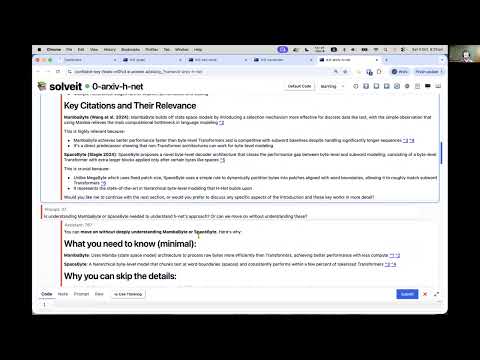
NB: There is also a written version of these docs: https://www.fast.ai/posts/2025-11-07-solveit-features.html Large language models make it remarkably easy to generate code. Ask ChatGPT or Claude to build an application, and you’ll receive hundreds of lines of working code in...
NB: There is also a written version of these docs: https://www.fast.ai/posts/2025-11-07-solveit-features.html Large language models make it remarkably easy to generate code. Ask ChatGPT or Claude to build an application, and you’ll receive hundreds of lines of working code in seconds. But this creates a problem: you get code you don’t understand, and when you need to modify it, fix a bug, or add a feature, you’re stuck. Solveit ( https://solve.it.com ) takes a different approach. Rather than generating large blocks of code, it works with you interactively to build solutions piece by piece. You write one or two lines at a time, understand what they do, then move to the next step. The AI sees your full working context and suggests what comes next based on what you’re actually building. This method may sometimes be slower initially, but produces something more valuable: working code that you understand. Code you can modify, extend, and maintain. Code that becomes part of your expanding skill set rather than a black box you’re afraid to touch. This video covers the features of the Solveit platform, built specifically to support this interactive, incremental approach to development. -

To get access to our next course, which includes access to the Solveit platform, go to: https://solve.it.com/
To get access to our next course, which includes access to the Solveit platform, go to: https://solve.it.com/ -

Sarah has also written a blog post here: https://www.answer.ai/posts/2025-03-17-gpu-programming-scratch.html
Sarah has also written a blog post here: https://www.answer.ai/posts/2025-03-17-gpu-programming-scratch.html -
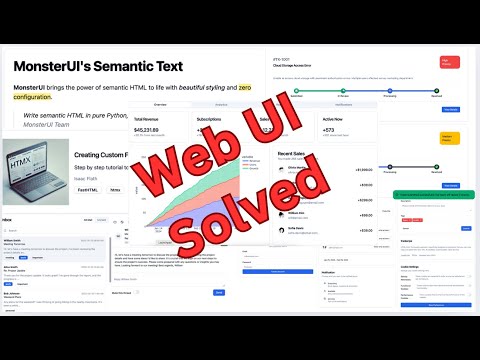
MonsterUI ( https://monsterui.answer.ai/ ) is a Python/fasthtml library that simplifies web development by combining the best of modern UI frameworks like FrankenUI, Tailwind, DaisyUI, and HighlightJS. Through live coding examples, we'll show you how to create...
MonsterUI ( https://monsterui.answer.ai/ ) is a Python/fasthtml library that simplifies web development by combining the best of modern UI frameworks like FrankenUI, Tailwind, DaisyUI, and HighlightJS. Through live coding examples, we'll show you how to create professional-looking web applications with minimal code and zero configuration. We take you through several complete UIs in minimal lines of code, featuring responsive layouts, dynamic updates, and polished UI components, and explain how MonsterUI provides smart defaults and semantic HTML elements while maintaining full access to underlying frameworks when needed. You'll learn how to: - Build production-ready UIs without CSS expertise - Live code examples with real-time updates - Integrate with popular services like DiceBear for avatars - Use the built-in dark/light mode support - Take advantage of HTML components with modern styling You can install it from pip; for comprehensive docs and live interactive examples see https://monsterui.answer.ai/ . 0:00 - Introduction 0:25 - MonsterUI Overview 1:25 - Cards Example Deep Dive 3:05 - What MonsterUI does 8:28 - Semantic Typography 11:05 - Iterating on UI 13:05 - AI context usage 14:45 - Style discoverability 15:35 - The vision 17:00 - Isaac’s experience 18:33 - How to get started 21:22 - Stay in touch -

Discover how Fast.ai evolved into Answer.ai and is revolutionizing how we code with AI. Join Hamel Husain and Jeremy Howard as they reveal a groundbreaking "Dialogue Engineering" approach. https://solveit.fast.ai/
Discover how Fast.ai evolved into Answer.ai and is revolutionizing how we code with AI. Join Hamel Husain and Jeremy Howard as they reveal a groundbreaking "Dialogue Engineering" approach. https://solveit.fast.ai/ -
Note: the course discussed here filled up in under 2 days! Keep an eye on https://www.fast.ai for information about new cohorts in 2025. We’ve discovered a completely new and unexpected way to combine AI with coding (it’s not what you think) and we want to share it with you....
Note: the course discussed here filled up in under 2 days! Keep an eye on https://www.fast.ai for information about new cohorts in 2025. We’ve discovered a completely new and unexpected way to combine AI with coding (it’s not what you think) and we want to share it with you. Join us to learn and explore this new approach to solving problems with code, including preview access to a brand new tool we've built. https://solveit.fast.ai/ -
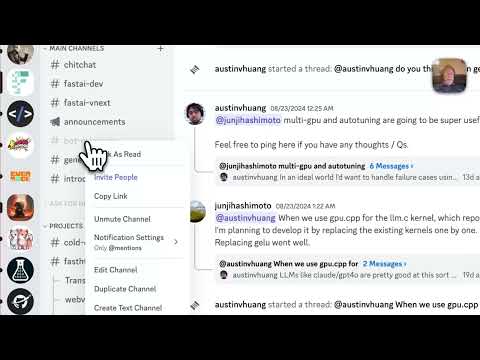
This is a brief demo of how to quickly catch up on messages in Discord, so you can be sure you don't miss anything. This is a little experiment in starting to record some short-form videos. I hope it's useful to some of you!
This is a brief demo of how to quickly catch up on messages in Discord, so you can be sure you don't miss anything. This is a little experiment in starting to record some short-form videos. I hope it's useful to some of you! -

FastHTML (https://fastht.ml ), which reinvents how web apps are built, is heavily based on the work of Carson Gross. So I interviewed him. It was one of the most fascinating interviews I've ever done. I believe Carson is a genius, and that his HTMX (https://htmx.org/ )...
FastHTML (https://fastht.ml ), which reinvents how web apps are built, is heavily based on the work of Carson Gross. So I interviewed him. It was one of the most fascinating interviews I've ever done. I believe Carson is a genius, and that his HTMX (https://htmx.org/ ) project is a work of genius. I put it to him that HTMX was "discovered, not invented"---i.e that he has unearthed in it something deeper within the hypermedia system itself; Carson agreed with that view. HTMX is an emerging technology that promises to simplify web development. It is a library that extends HTML to provide powerful capabilities without the complexity of traditional JavaScript frameworks. 00:00 Introduction to Carson Gross & HTMX 01:35 Understanding HTMX 04:00 The First Part of the Book: HTML & HTTP 06:13 Exploring the Web 07:19 The Core Network Format: HTTP 09:16 The Evolution of the Web & the Role of Forms 11:03 The Limitations of Forms & the Rise of Web Applications 14:04 The Constraints of the Web & the Need for HTMX 17:16 The Power of HTMX & its Potential to Revolutionize the Web 19:05 Understanding the Constraints of Traditional Web Apps 22:01 Understanding HX Attributes in FastHTML 28:28 Understanding HX Target & its Use Cases 29:37 Refactoring the Button & Understanding HX Swap 31:00 The Surface Area of HX & its Limitations 37:28 Embracing Existing Ideas & Technology 41:06 Learning & Understanding HTMX 49:02 HTMX Events & Custom Events 51:10 HTMX & JavaScript Integration 53:16 HTMX & FastHTML 57:06 HTMX & Drag-and-Drop Functionality 01:01:03 The Evolution of Web Development 01:05:39 The Discovery of HTMX 01:12:02 The Importance of Looking Back & Learning from the Past 01:14:33 The Power of Humor & Meme Culture 01:20:01 The Importance of Positivity & Authenticity 01:22:07 The Future of Browsers & Web Development 01:22:49 HTMX & its Potential Impact on the Web 01:24:12 The Future of HTMX 01:25:34 Exploring Other Projects 01:28:09 Introducing Hyperscript 01:33:03 The Importance of View Source 01:35:09 HTMX & Hyperscript 01:37:01 FastHTML & Community Reaction 01:40:02 Cache & Policies 01:41:11 Community & Inspiration 01:43:29 Efficiency & Code Quality 01:45:44 Tinkering & Creativity (chapter titles thanks to @ElectricEric2030) -

FastHTML (https://fastht.ml ) is a new framework for creating pure Python modern interactive web applications. Introduction to Fast HTML - 00:00:00 Demo of Fast HTML Capabilities - 00:00:10 Benefits and Use Cases of Fast HTML - 00:01:08 Comparisons with Other Web Frameworks -...
FastHTML (https://fastht.ml ) is a new framework for creating pure Python modern interactive web applications. Introduction to Fast HTML - 00:00:00 Demo of Fast HTML Capabilities - 00:00:10 Benefits and Use Cases of Fast HTML - 00:01:08 Comparisons with Other Web Frameworks - 00:01:37 Creating a To-Do Web Application - 00:03:14 Defining Routes and Components - 00:03:46 Using Templates and Python Functions - 00:04:12 Adding Interactivity with HTMX - 00:04:40 Adding Persistency with SQLite - 00:05:15 Enhancing UI and Functionality - 00:05:51 Expanding Features and Components - 00:06:22 Authentication and Deployment - 00:06:53 Documentation and Examples - 00:07:24 -

And end-to-end walkthru of creating and deploying a complete web application in Python using FastHTML (https://fastht.ml/ ). To learn more, read the background information at https://about.fastht.ml/ , or dive into the code at https://docs.fastht.ml/ .
And end-to-end walkthru of creating and deploying a complete web application in Python using FastHTML (https://fastht.ml/ ). To learn more, read the background information at https://about.fastht.ml/ , or dive into the code at https://docs.fastht.ml/ . - End of feed
