AI agents that can use tools, have memory, control a wallet with digital money and autonomously act on the internet are going to have a dramatic effect on our digital world. This video introduces why AI agents are so different from the chatbots we're all used to and how they...
AI agents that can use tools, have memory, control a wallet with digital money and autonomously act on the internet are going to have a dramatic effect on our digital world. This video introduces why AI agents are so different from the chatbots we're all used to and how they represent the beginning of a completely new creative medium.
AI is an imagination amplifier, and so the incentives for building these agents matter a lot. This is a challenge to all creatives out there: what agent do you want to see in the world?
Eden.art Creative Agent builder: https://app.eden.art/
Full tutorial on how to make your first creative agent: https://youtu.be/RHNr2KPyk_c?si=c_qGytDsvEpALoJc
This is a full ComfyUI walkthrough of TextureFlow. Make sure to checkout part I first: https://youtu.be/NSQLVNAe5Hc Hosted version available on Eden: https://beta.eden.art/ ComfyUI Workflow link:...
This is a full ComfyUI walkthrough of TextureFlow.
Make sure to checkout part I first: https://youtu.be/NSQLVNAe5Hc
Hosted version available on Eden: https://beta.eden.art/
ComfyUI Workflow link:
https://github.com/edenartlab/workflows/blob/main/workspaces/mono_workspace/workflows/texture_flow/TextureFlow.json
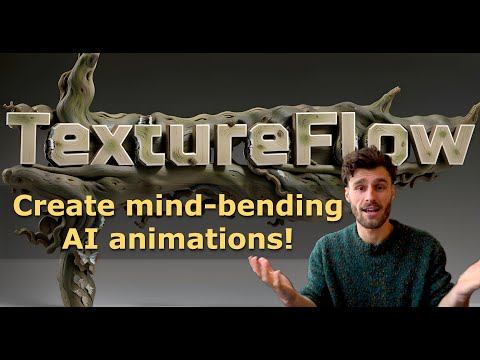
TextureFlow is a powerful AI animation tool built on top of AnimateDiff, controlnet and IP-adapter. It allows seamless combination of textures and shapes to produce stunning morphing animations.
#animatediff #comfyui #comfyuistablediffusion #stablediffusion #ai #aiart #vj #vjloops #visualart #visual #projectionmapping #blender #touchdesigner #generativeai #animationart
Introducing the TextureFlow AI Animation tool. Try TextureFlow on Eden: https://beta.eden.art/ TextureFlow collection to browse for settings: https://beta.eden.art/collections/673f60aed53d7ce30d0eb5c7 TextureFlow ComfyUI WorkFlow:...
Introducing the TextureFlow AI Animation tool.
Try TextureFlow on Eden: https://beta.eden.art/
TextureFlow collection to browse for settings: https://beta.eden.art/collections/673f60aed53d7ce30d0eb5c7
TextureFlow ComfyUI WorkFlow: https://github.com/edenartlab/workflows/tree/main/workspaces/slow/workflows/texture_flow
ComfyUI Walkthrough Part II video: https://youtu.be/k3aUf5SpFvA?si=lHRkYiea3kTRwmpf
Outro music by Tristan Rio: https://linktr.ee/tristanrio
This powerful AI animation tool allows combining arbitrary textures with arbitrary shapes to produce stunning, morphing animations. This AI tool is fully open source and can be run on your own gpu at home! Create mind-bending AI animations using your own images with AnimateDiff, controlnet, Stable Diffusion and IP-adapter. This AI animation tool is perfect for abstract VJ loops and projection mapping, logo animation, QR code animation, and all kinds of abstract morphing animation.
0:00 Intro
0:52 Eden.art
2:37 TextureFlow
5:54 Shape Control
9:55 Advanced Options
13:25 VJ Expert AI agent
14:23 Outro
#animatediff #comfyui #comfyuistablediffusion #stablediffusion #ai #aiart #vj #vjloops #visualart #visual #projectionmapping #blender #touchdesigner #generativeai #animationart
If you want to support this channel, here is my patreon link: https://patreon.com/ArxivInsights --- You are amazing!! ;) If you have questions you would like to discuss with me personally, you can book a 1-on-1 video call through Pensight:...
If you want to support this channel, here is my patreon link:
https://patreon.com/ArxivInsights --- You are amazing!! ;)
If you have questions you would like to discuss with me personally, you can book a 1-on-1 video call through Pensight: https://pensight.com/x/xander-steenbrugge
--------------------------------
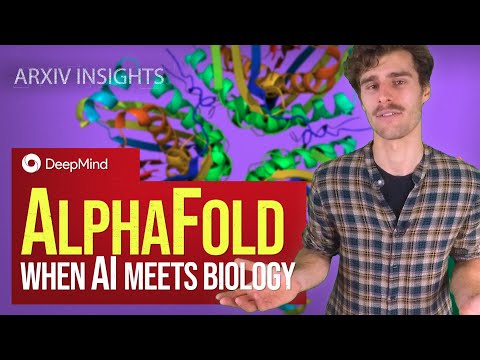
AlphaFold is DeepMinds latest breakthrough addressing the protein folding problem. Using an advanced Deep Learning architecture that achieves end-to-end learning of protein structures, this work is arguably one of the most influential papers of this decade and is likely to spark enormous advanced in computational biology and protein design. This video covers the entire architecture of the model as well as training principles that led to the incredible results of AlphaFold2!
AlphaFold Nature paper: https://www.nature.com/articles/s41586-021-03828-1
AlphaFold Codebase: https://github.com/deepmind/alphafold
Work from the Baker lab: https://www.bakerlab.org/
Fabian Fuchs' amazing blog on equivariance: https://fabianfuchsml.github.io/alphafold2/
Ongoing Open Source effort to reproduce AlphaFold: https://github.com/lucidrains/alphafold2
::Chapters::
00:00 Intro
02:28 The Protein Folding Problem
05:29 AlphaFold1 revisited
06:10 Multiple Sequence Alignments (MSA)
08:10 Distograms
12:29 AlphaFold2
14:52 The Evoformer
19:07 The Structure Module
28:13 Zooming out: looking at the future
If you want to support this channel, here is my patreon link: https://patreon.com/ArxivInsights --- You are amazing!! ;) If you have questions you would like to discuss with me personally, you can book a 1-on-1 video call through Pensight:...
If you want to support this channel, here is my patreon link:
https://patreon.com/ArxivInsights --- You are amazing!! ;)
If you have questions you would like to discuss with me personally, you can book a 1-on-1 video call through Pensight: https://pensight.com/x/xander-steenbrugge
--------------------------------
Life is a molecular marvel of astounding complexity. In this video we take a dive into the world of molecular engines, proteins and the physical processes that power life on earth. This video serves as an introduction to molecular biology and a primer for the future videos that will cover Machine Learning applications in computational biology and protein design.
::Chapters::
00:00 Intro
02:37 What are Proteins, and why should I care?
04:10 Getting a sense of scale
07:39 From DNA to Proteins
12:17 From Structure to Function
17:23 The Coronavirus
19:39 Application Potential of AI assisted computational Biology
22:11 Pensight and Patreon Links
Link to Notebooks: https://drive.google.com/open?id=1LBWcmnUPoHDeaYlRiHokGyjywIdyhAQb Link to the StyleGAN paper: https://arxiv.org/abs/1812.04948 Link to GAN blogpost: http://hunterheidenreich.com/blog/gan-objective-functions/ If you want to support this channel, here is my...
Link to Notebooks:
https://drive.google.com/open?id=1LBWcmnUPoHDeaYlRiHokGyjywIdyhAQb
Link to the StyleGAN paper: https://arxiv.org/abs/1812.04948
Link to GAN blogpost: http://hunterheidenreich.com/blog/gan-objective-functions/
If you want to support this channel, here is my patreon link:
https://patreon.com/ArxivInsights --- You are amazing!! ;)
If you have questions you would like to discuss with me personally, you can book a 1-on-1 video call through Pensight: https://pensight.com/x/xander-steenbrugge
--------------------------------
This episode covers one of the greatest ideas in Deep Learning of the past couple of years: Generative Adversarial Networks.
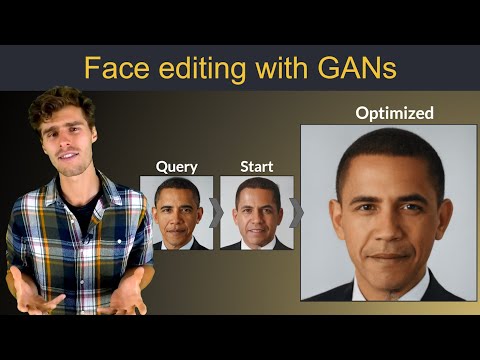
I first explain how a generative adversarial network (GAN) really works. After this general overview, we go into the specific objective function that is optimized during training. We then dive into Nvidia's StyleGAN model and learn how we can manipulate it's latent space to morph arbitrary images of faces.
This video comes with a complete Google Colab notebook to reproduce & play with all the examples shown in the video!
::Chapters::
00:00 Intro
02:55 Video overview
03:35 Introduction to GANs
05:40 5 min Deepdive on the Training Objective for GANs
10:07 State-of-the-art GAN techniques: StyleGAN
14:40 Manipulating the latent space of GANs
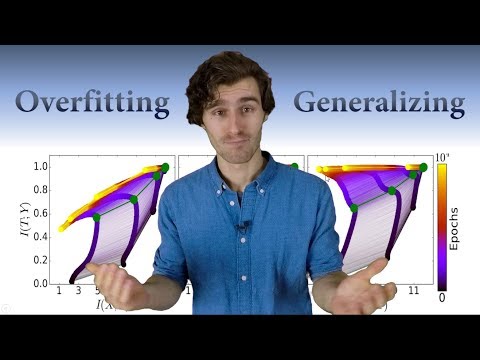
In this third episode on "How neural nets learn" I dive into a bunch of academical research that tries to explain why neural networks generalize as wel as they do. We first look at the remarkable capability of DNNs to simply memorize huge amounts of (random) data. We then see...
In this third episode on "How neural nets learn" I dive into a bunch of academical research that tries to explain why neural networks generalize as wel as they do. We first look at the remarkable capability of DNNs to simply memorize huge amounts of (random) data. We then see how this picture is more subtle when training on real data and finally dive into some beautiful analysis from the viewpoint on information theory.
Main papers discussed in this video:
First paper on Memorization in DNNs: https://arxiv.org/abs/1611.03530
A closer look at memorization in Deep Networks: https://arxiv.org/abs/1706.05394
Opening the Black Box of Deep Neural Networks via Information: https://arxiv.org/abs/1703.00810
Other links:
Quanta Magazine blogpost on Tishby's work: https://www.quantamagazine.org/new-theory-cracks-open-the-black-box-of-deep-learning-20170921/
Tishby's lecture at Stanford: https://youtu.be/XL07WEc2TRI
Amazing lecture by Ilya Sutkever at MIT: https://youtu.be/9EN_HoEk3KY
If you want to support this channel, here is my patreon link:
https://patreon.com/ArxivInsights --- You are amazing!! ;)
If you have questions you would like to discuss with me personally, you can book a 1-on-1 video call through Pensight: https://pensight.com/x/xander-steenbrugge
In this episode I introduce Policy Gradient methods for Deep Reinforcement Learning. After a general overview, I dive into Proximal Policy Optimization: an algorithm designed at OpenAI that tries to find a balance between sample efficiency and code complexity. PPO is the...
In this episode I introduce Policy Gradient methods for Deep Reinforcement Learning.
After a general overview, I dive into Proximal Policy Optimization: an algorithm designed at OpenAI that tries to find a balance between sample efficiency and code complexity. PPO is the algorithm used to train the OpenAI Five system and is also used in a wide range of other challenges like Atari and robotic control tasks.
If you want to support this channel, here is my patreon link:
https://patreon.com/ArxivInsights --- You are amazing!! ;)
If you have questions you would like to discuss with me personally, you can book a 1-on-1 video call through Pensight: https://pensight.com/x/xander-steenbrugge
Links mentioned in the video:
⦁ PPO paper: https://arxiv.org/abs/1707.06347
⦁ TRPO paper: https://arxiv.org/abs/1502.05477
⦁ OpenAI PPO blogpost: https://blog.openai.com/openai-baselines-ppo/
⦁ Aurelien Geron: KL divergence and entropy in ML: https://youtu.be/ErfnhcEV1O8
⦁ Deep RL Bootcamp - Lecture 5: https://youtu.be/xvRrgxcpaHY
⦁ RL-adventure PyTorch implementation: https://github.com/higgsfield/RL-Adventure-2
⦁ OpenAI Baselines TensorFlow implementation: https://github.com/openai/baselines
In this episode I discuss OpenAI Five, a Machine Learning system that was able to defeat professional gamers in the popular video game Dota 2: - How was the system built? - What does this mean for AI progress? - What real world applications can be built on this succes? You...
In this episode I discuss OpenAI Five, a Machine Learning system that was able to defeat professional gamers in the popular video game Dota 2:
- How was the system built?
- What does this mean for AI progress?
- What real world applications can be built on this succes?
You can find all the OpenAI blogposts here: https://blog.openai.com/
If you enjoy my videos, all support is super welcome!
https://www.patreon.com/ArxivInsights
If you have questions you would like to discuss with me personally, you can book a 1-on-1 video call through Pensight: https://pensight.com/x/xander-steenbrugge
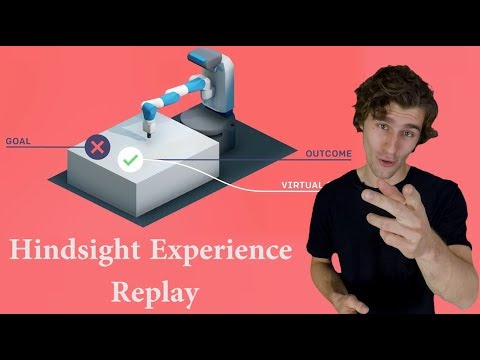
In this video I dive into three advanced papers that addres the problem of the sparse reward setting in Deep Reinforcement Learning and pose interesting research directions for mastering unsupervised learning in autonomous agents. Papers discussed: Reinforcement Learning with...
In this video I dive into three advanced papers that addres the problem of the sparse reward setting in Deep Reinforcement Learning and pose interesting research directions for mastering unsupervised learning in autonomous agents.
Papers discussed:
Reinforcement Learning with Unsupervised Auxiliary Tasks - DeepMind:
https://arxiv.org/abs/1611.05397
Curiosity Driven Exploration - UC Berkeley:
https://arxiv.org/abs/1705.05363
Hindsight Experience Replay - OpenAI:
https://arxiv.org/abs/1707.01495
If you want to support this channel, here is my patreon link:
https://patreon.com/ArxivInsights --- You are amazing!! ;)
If you have questions you would like to discuss with me personally, you can book a 1-on-1 video call through Pensight: https://pensight.com/x/xander-steenbrugge
This episode gives a general introduction into the field of Reinforcement Learning: - High level description of the field - Policy gradients - Biggest challenges (sparse rewards, reward shaping, ...) This video forms the basis for a series on RL where I will dive much deeper...
This episode gives a general introduction into the field of Reinforcement Learning:
- High level description of the field
- Policy gradients
- Biggest challenges (sparse rewards, reward shaping, ...)
This video forms the basis for a series on RL where I will dive much deeper into technical details of state-of-the-art methods for RL.
Links:
- "Pong from Pixels - Karpathy": http://karpathy.github.io/2016/05/31/rl/
- Concept networks for grasp & stack (Paper with heavy reward shaping): https://arxiv.org/abs/1709.06977
If you enjoy my videos, all support is super welcome!
https://www.patreon.com/ArxivInsights
If you have questions you would like to discuss with me personally, you can book a 1-on-1 video call through Pensight: https://pensight.com/x/xander-steenbrugge
::Chapters::
00:00 Intro
01:03 So what is Reinforcement Learning?
03:39 Learning without explicit examples
07:25 Main challenges when doing RL
15:04 Are the robots taking over now?
In this episode, we dive into Variational Autoencoders, a class of neural networks that can learn to compress data completely unsupervised! VAE's are a very hot topic right now in unsupervised modelling of latent variables and provide a unique solution to the curse of...
In this episode, we dive into Variational Autoencoders, a class of neural networks that can learn to compress data completely unsupervised!
VAE's are a very hot topic right now in unsupervised modelling of latent variables and provide a unique solution to the curse of dimensionality.
This video starts with a quick intro into normal autoencoders and then goes into VAE's and disentangled beta-VAE's.
I aslo touch upon related topics like learning causal, latent representations, image segmentation and the reparameterization trick!
Get ready for a pretty technical episode!
Paper references:
- Disentangled VAE's (DeepMind 2016): https://arxiv.org/abs/1606.05579
- Applying disentangled VAE's to RL: DARLA (DeepMind 2017): https://arxiv.org/abs/1707.08475
- Original VAE paper (2013): https://arxiv.org/abs/1312.6114
If you want to support this channel, here is my patreon link:
https://patreon.com/ArxivInsights --- You are amazing!! ;)
If you have questions you would like to discuss with me personally, you can book a 1-on-1 video call through Pensight: https://pensight.com/x/xander-steenbrugge
In this episode we dive into the world of adversarial examples: images specifically engineered to fool neural networks into making completely wrong decisions! Link to the first part of this series: https://youtu.be/McgxRxi2Jqo If you want to support this channel, here is my...
In this episode we dive into the world of adversarial examples: images specifically engineered to fool neural networks into making completely wrong decisions!
Link to the first part of this series: https://youtu.be/McgxRxi2Jqo
If you want to support this channel, here is my patreon link:
https://patreon.com/ArxivInsights --- You are amazing!! ;)
If you have questions you would like to discuss with me personally, you can book a 1-on-1 video call through Pensight: https://pensight.com/x/xander-steenbrugge
Interpreting what neural networks are doing is a tricky problem. In this video I dive into the approach of feature visualisation. From simple neuron excitation to the Deep Visualisation Toolbox and the Google DeepDream project, let's open up the black box! Links: Distill.pub...
Interpreting what neural networks are doing is a tricky problem.
In this video I dive into the approach of feature visualisation.
From simple neuron excitation to the Deep Visualisation Toolbox and the Google DeepDream project, let's open up the black box!
Links:
Distill.pub post on Feature Visualisation: https://distill.pub/2017/feature-visualization/
Sander Dieleman post on music recommendation: http://benanne.github.io/2014/08/05/spotify-cnns.html
Blogpost on Deep Feature visualisation: http://yosinski.com/deepvis
Github link to DeepVis Toolbox: https://github.com/yosinski/deep-visualization-toolbox
Paper by Zeiler & Fergus: https://arxiv.org/abs/1311.2901
If you want to support this channel, here is my patreon link:
https://patreon.com/ArxivInsights --- You are amazing!! ;)
If you have questions you would like to discuss with me personally, you can book a 1-on-1 video call through Pensight: https://pensight.com/x/xander-steenbrugge
- Link to edited game versions: https://rach0012.github.io/humanRL_website/ - Link to the Paper: https://openreview.net/pdf?id=Hk91SGWR- "Why are humans such incredibly fast learners?" This is the core question of this paper. By leveraging powerful prior knowledge about how...
- Link to edited game versions: https://rach0012.github.io/humanRL_website/
- Link to the Paper:
https://openreview.net/pdf?id=Hk91SGWR-
"Why are humans such incredibly fast learners?"
This is the core question of this paper.
By leveraging powerful prior knowledge about how the world works, humans are able to quickly figure out efficient strategies in new and unseen environments.
Current state-of-the-art Reinforcement Learning algorithms however, usually don't have strong priors and this is one of the fundamental challenges in current research on Transfer Learning.
If you want to support this channel, here is my patreon link:
https://patreon.com/ArxivInsights --- You are amazing!! ;)
If you have questions you would like to discuss with me personally, you can book a 1-on-1 video call through Pensight: https://pensight.com/x/xander-steenbrugge