Before Trump paused Jay Clayton’s nomination, Democrats thought they were on a “glide path” to renewing FISA. Now the president wants to tie domestic surveillance to voter suppression. The post Senate Democrats Aren’t Happy About Trump’s Spy Law Ultimatum appeared first on The Intercept.
Before President Donald Trump threw his latest hand grenade into congressional negotiations over a key domestic spying law, two factions of Senate Democrats seemed to believe they were on the verge of a breakthrough.
Privacy advocates thought they had their best chance in years of passing reforms, including a warrant requirement for searching American communications collected abroad.
Centrists allied with U.S. intelligence agencies, meanwhile, thought they were close to renewing Section 702 of the Foreign Intelligence Surveillance Act with only minor tweaks.
Then Trump, who had once already thrown the renewal process into chaos, announced on Wednesday that he wouldn’t sign it unless Congress passed an unrelated voter suppression bill.
Claiming that Democrats were poised to walk away from a spy law compromise, Trump said that “to add a slight bit of intrigue but, for the Good of the Nation, and the People of our Country, I will not approve FISA without THE SAVE AMERICA ACT going along with it.”
Trump’s surprise outburst on Truth Social on Wednesday scrapped the confirmation hearing set later in the day for Jay Clayton, a federal prosecutor in New York, to serve as the permanent director of national intelligence. Senate Majority Leader John Thune, R-S.D., had said that he hoped to quickly confirm Clayton.
Clayton’s impending confirmation had appeared to solve a problem — at least for some Democrats — that Trump created by tapping lapdog housing chief, Bill Pulte, as the Cabinet-level intelligence chief. It might also have opened a route for Congress to renew Section 702, the surveillance law that allows federal agents to conduct “backdoor,” warrantless searches of Americans’ communications collected abroad.
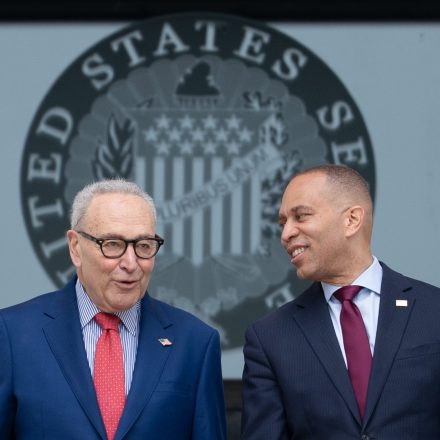
In a joint press conference on Wednesday, top Senate Democrats revealed the cracks in their coalition over next steps on FISA.
A key reformer, Sen. Ron Wyden, D-Ore., said he still hopes to pursue adding a warrant requirement to Section 702, while a centrist aligned with the intelligence agencies, Sen. Mark Warner, D-Va., expressed disappointment that the easiest route to renewal without major changes had been foreclosed.
“We had a path forward, as of yesterday, and today we don’t, and that’s because of this president.”
“This has become a complete debacle, and now it’s up to the White House to figure out a path forward here,” said Sen. Mark Kelly, D-Ariz., a member of the intelligence committee. “We had a path forward, as of yesterday, and today we don’t, and that’s because of this president and his advisers.”
Senate Minority Leader Chuck Schumer, D-N.Y., remained cagey about what version of the law he would like to see ultimately passed. But in comments at the joint press conference, he sought to portray Democrats as the more responsible party when it came to Section 702.
“It’s on our Republican colleagues to work with us to find A) a capable director, not someone who is a menace, and second, then to work with us on renewing FISA. It is up to them,” Schumer said at the press conference. He said he was deeply concerned about Trump’s appointment of Pulte, who appears likely to step into the office on Friday.
Republicans “have got to have the courage to buck the president, who clearly doesn’t want a DNI director and doesn’t want FISA renewed,” Schumer said. “All he wants is Pulte.”
Warner, the top Democrat on the Senate Intelligence Committee, claimed Sunday that Section 702 renewal was on a “glide path” before Pulte’s nomination. He also praised Clayton’s selection, while reserving the right to ask about Clayton’s views on election integrity.
Reformers said Thursday, however, that Section 702’s renewal was never as assured as Warner and Senate Intelligence Committee Chair Tom Cotton, R-Ark., have suggested in public comments.
Majorities of both Republicans and Democrats voted in recent weeks against advancing the law’s renewal in versions of the bill that do not include a warrant requirement.
“They don’t want to have to deal with people who want things like warrants.”
“They want that to be the narrative, because they don’t want to have to deal with people who want things like warrants,” said Kia Hamadanchy, a senior policy counsel at the American Civil Liberties Union. “At no point have they actually demonstrated that they have a deal that one, has 60 votes in the Senate, and two, has any chance of going anywhere in the House.”
Wyden expressed alarm about Trump’s actions at the joint Senate Democrat press conference. Wyden said that he always wanted to reform the law — not allow it to expire.

“It is now even clearer than before that the only path to 60 votes in the United States Senate on intelligence is real reform, actual black-letter law, that addresses these issues,” Wyden said.
Privacy advocates argue that the way out of the congressional logjam is to allow members of Congress to vote on whether to add a warrant requirement, something that Thune and House Speaker Mike Johnson have not been willing to allow so far. Even then, however, Trump could veto whatever version of the law emerges from that process.
The post Senate Democrats Aren’t Happy About Trump’s Spy Law Ultimatum appeared first on The Intercept.